Animal
Domestic pig
Pigs are farm animals with a flat, round nose called a snout. They are very clever, they love to dig, and they roll in mud to keep cool.
Domestic pigs live with people on every continent except Antarctica. Their ancestor is the wild boar, which people began taming about 9,000 years ago. Pigs are among the smartest farm animals, with a super-sensitive snout for digging up food.
The domestic pig (Sus domesticus, or Sus scrofa domesticus) is an omnivorous, monogastric livestock species domesticated from the wild boar, independently in western Asia and in China, about 9,000 years ago. Bred into more than 300 varieties, it is one of the world's most important sources of meat and a key animal in medical research.
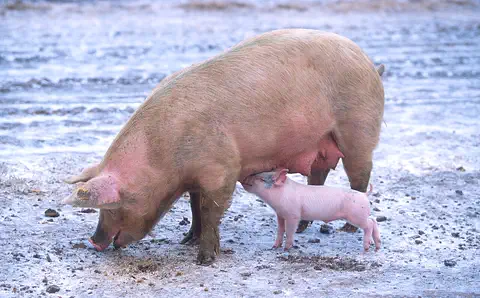
Photo: Scott Bauer, USDA, public domain, via Wikimedia Commons
Meet the pig
A pig has a round body and short legs.
Its nose ends in a flat, round snout. A baby pig is called a piglet. A mother pig is called a sow.
Pigs are stout, barrel-shaped mammals with short legs, thick skin and a coat of stiff hairs called bristles. Their ears may stand up or flop down, depending on the kind of pig. A grown pig usually weighs 140 to 300 kilograms, about as much as two to four grown-ups.
Pigs have lots of names. All pigs are swine. In the United States, a pig heavier than about 50 kilograms is called a hog. A female that has not had piglets yet is a gilt, a mother is a sow and a male is a boar.
Domestic pigs belong to the family Suidae, with wild boars, warthogs, babirusas and other wild pigs. Some taxonomists treat them as a distinct species, Sus domesticus, and others as a domestic form of the wild boar, Sus scrofa. Adults generally weigh 140 to 300 kilograms, though some breeds are much heavier and miniature research breeds stay under about 90 kilograms.
The pig has a large head on a short neck, a muzzle ending in a cartilaginous disk, and cloven hooves with two smaller, non-functional digits behind them. The thick skin bears sparse bristles, and pigskin breathes unusually well as leather because the bristle follicles pass all the way through the hide.
Quick facts
- Group
- Mammal
- Weight
- 140 to 300 kg
- Lifespan in the wild
- up to 20 years
From wild boar to farmyard
Long ago, all pigs were wild.
People tamed wild boars, and over many years they became farm pigs. Now pigs live with people almost everywhere in the world.
Every farm pig has a wild ancestor: the wild boar, which still lives in forests across Europe, Asia and North Africa. About 9,000 years ago, people in what is now Turkey began keeping wild boars, and people in China tamed their own wild boars separately.
Today domestic pigs live on every continent except Antarctica. China has by far the most pigs, and the European Union and the United States come next. Pigs that escape from farms and live in the wild are called feral pigs.
Domestic pigs descend from the wild boar. Britannica dates domestication to about 9,000 years ago, probably in present-day Turkey, with Chinese and European wild boars domesticated separately. Genetic research reported in Nature shows that early domestic pigs routinely interbred with wild boars, and that herders repeatedly selected useful traits that counteracted the wild genes.
Domestic pigs are now kept on every continent except Antarctica; China has the largest population, followed by the European Union and the United States. Pigs were not native to the Americas: Columbus brought them to the West Indies in 1493. Because the species is domestic, the map shows the continents where it is kept, not a wild range.
Continents
Did you know?
Pigs roll in mud to stay cool.
Pigs cannot cool down well by sweating, so they wallow in mud or water on hot days.
Because their sweat glands do little to lower body temperature, pigs regulate heat by wallowing, which is behind their reputation for dirtiness.
Where can you find this animal?
- Kept by people · Countries and seas named by a scientific source
- Sightings recorded · Records of wild sightings (GBIF)
Kept by people · Countries and seas named by a scientific source
Domestic pigs are kept by people on every continent except Antarctica. They are farm animals, so this map shows where they are raised, not a wild range. Their wild ancestor, the wild boar, is native to Europe, Asia and North Africa.
Places: Africa, Asia, Europe, North America, South America and Australia and Oceania.
Source: Britannica Kids · checked October 2026
Sightings recorded · Records of wild sightings (GBIF)
Counts of GBIF records of wild observations (human and machine) and preserved specimens. Records include introduced populations, vagrants, escaped or released animals and misidentifications, so a country with records is not necessarily part of the native range.
Wild sightings have been recorded in Denmark, France, Spain, Germany, Netherlands, Sweden, United States, UK and 25 more places.
Source: gbif · checked October 2026
Range maps show where scientists say an animal lives, often country by country. An animal may live in only part of a country shown, and sightings records can include animals that wandered far from home.
A nose for food
Pigs eat plants and other foods too.
They use their snout to dig in the ground for roots. On farms, they eat grain, vegetables, fruit and hay.
Pigs are omnivores, which means they eat both plants and animals. Wild pigs eat leaves, roots, fruit and small animals. They push their flat snouts into the soil to sniff out and dig up food, which is called rooting.
On farms, pigs eat feed made from corn, soybeans, barley or wheat, plus carrots, potatoes, fruit and hay. Unlike cows, pigs have a simple stomach with one chamber, a bit like ours, so they cannot live on grass alone.
Pigs are omnivores. Wild pigs eat leaves, roots, fruit, reptiles, rodents and carrion, locating much of it by smell and rooting it out with the snout disk. Pigs are monogastric: with a single-chambered stomach, they cannot use large amounts of forage as ruminants do, and they need concentrated feed.
Their nutritional needs, for water, vitamins, minerals, protein, carbohydrates and fats, are similar to those of humans. Farm diets are usually based on corn, soybeans, barley or wheat, often with added vitamins and protein, supplemented with root crops, fruit and hay. Since ancient times, some pigs have been kept in pens and others left to range freely and scavenge, and both methods are still used.

Snouts, bristles and mud
A pig's snout can smell food under the ground.
Pigs cannot sweat much. So on hot days they roll in mud or water to cool down. They are not dirty; they are keeping cool!
A pig's snout is a tough, flat disk that works like a shovel and a nose at once. Pigs have an excellent sense of smell and good hearing.
Pigs are famous for rolling in mud, but they are not dirty animals. Their sweat glands do not cool them well, so on hot days they wallow in mud or shallow water to lower their body temperature. Given a clean place with shade from the sun, pigs are perfectly happy. Each foot has a split hoof with two smaller toes behind it.
The snout ends in a flat, rounded disk of cartilage, supported by strong neck muscles, which pigs use to root for food; smell and hearing are well developed. Pigs have tusks, elongated teeth that grow throughout life and are honed as upper and lower tusks rub together. They are long in wild pigs, and farmers often trim them in domestic pigs.
Because pigs' sweat glands are relatively ineffective at lowering body temperature, they cool themselves by wallowing in mud or water, behavior behind their undeserved reputation for dirtiness. Clean, shaded housing meets the same need. Skin color varies by breed: white, pink, gray, black or brown.
A litter of piglets
A mother pig has many babies at once.
The babies are called piglets. They can walk and play right away. They snuggle together to stay warm.
A mother pig is pregnant for about four months, about 114 to 120 days. Then she gives birth to a litter of piglets, often 7 to 10 at once, and some breeds have even more.
Piglets are born with a good sense of smell and hearing and can find their mother right away. They walk and play almost immediately, and within a week or two they practice rooting and play-fighting. They snuggle up together to keep warm. A mother pig can have about two litters a year.
Gestation lasts about 114 to 120 days, and domestic sows can breed year-round and produce about two litters a year, typically of 7 to 10 piglets; some breeds have been bred for larger litters. Breeding for ever-larger litters can increase stillbirths and may shorten the sow's life.
Piglets are precocial: they identify their mother at once by smell and sound, walk and play immediately and begin rooting and mock fighting within one to two weeks. On farms, sows usually stay with their litters for four to eight weeks. Pigs can live about 20 years when well cared for, though most farm pigs are raised for food and do not reach old age.
Clever and chatty
Pigs are very clever.
They can learn many things. They grunt, squeal and squeak to talk to each other. Pigs like to be with other pigs.
Pigs are among the smartest of all farm animals. In tests, they have done even better than dogs. They can learn quickly and remember where to find food.
Pigs are social. Wild pigs live in small groups of females and their young, while adult males usually live alone. Pigs talk a lot, using about 20 different sounds, such as grunts, squeals and squeaks, to greet each other, warn of danger and find mates.
In intelligence tests pigs have proved to be among the most capable domestic animals, in some measures outperforming dogs. Their social structure, inherited from wild boars, is based on small groups of females and their young, with adult males largely solitary except when mating.
Vocal communication is rich: Britannica describes some 20 distinct sounds used in specific situations such as greeting, alarm and courtship. When threatened, pigs usually flee but can defend themselves with their tusks. These abilities are worth remembering when people decide how pigs should be kept.
Did you know?
Piglets know their mom right away.
Piglets are born with good smell and hearing and can recognize their mother straight away.
Precocial piglets identify their mother by smell and sound immediately after birth.
Pigs and people
Farmers around the world raise pigs.
Pigs give people food. Some people keep small pigs as pets. Pigs even help doctors learn how to help people.
For thousands of years, people have raised pigs for food. Pork, ham and bacon come from pigs, and their skin makes strong leather. Their stiff bristles have been used to make brushes.
Pigs also help medicine. Because pigs' bodies are a lot like ours in some ways, special small pigs are used in medical research, and materials from pigs are used to treat burns and to replace damaged heart valves. Some people keep potbellied pigs as pets.
Britannica ranks the pig as the world's second largest provider of meat; FAO figures show poultry, at almost 40 percent of global meat production in 2020, is now the largest. Breeders have developed more than 300 breeds, from lard types like the Berkshire to lean bacon types like the Yorkshire, perhaps the most widespread breed. Pigs provide leather and bristles, and the meat-type hog of today was shaped by intensive selection from the 1950s.
Pigs are important in medicine. Miniature breeds such as the Göttingen and Yucatan are used in research on organ transplantation, surgery and drugs, and pig tissues are used to treat burns and replace diseased heart valves. Some cultures and religions avoid pork; how pigs are viewed and used differs widely around the world.
Did you know?
Pigs talk with lots of sounds.
Pigs use about 20 different sounds, such as grunts and squeals, for greeting, warning and more.
Britannica describes some 20 distinct pig vocalizations, each used in particular situations.
Wild relatives and feral pigs
There are lots of farm pigs in the world.
Pigs have wild cousins, like the warthog and the tiny pygmy hog. Some wild cousins need help to stay safe.
Domestic pigs are not endangered: there are hundreds of millions of them. But some of their wild relatives are. The pygmy hog of India, the smallest wild pig, is endangered, and people are breeding pygmy hogs and returning them to the wild.
Feral pigs, which escaped or were released from farms, now live wild in many places where pigs are not native, such as parts of the Americas.
As a domestic animal the pig is not assessed by the IUCN, but several wild suids are. The pygmy hog of northeastern India is Endangered, threatened by loss of grassland to farming, development, logging and burning, and a captive breeding and reintroduction program began early this century. Babirusas and the bearded pig are listed as Vulnerable or Endangered.
Feral domestic pigs, and introduced wild boars, have spread far beyond the native range of Sus scrofa, including the Americas, where pigs were first introduced in 1493.
Did you know?
Pigs are very smart.
In intelligence tests, pigs have done even better than dogs.
Pigs rank among the most intelligent domestic animals, in some tests outperforming dogs.
Amazing facts
-
Pigs roll in mud to stay cool.
Pigs cannot cool down well by sweating, so they wallow in mud or water on hot days.
Because their sweat glands do little to lower body temperature, pigs regulate heat by wallowing, which is behind their reputation for dirtiness.
-
Pigs are very smart.
In intelligence tests, pigs have done even better than dogs.
Pigs rank among the most intelligent domestic animals, in some tests outperforming dogs.
-
Piglets know their mom right away.
Piglets are born with good smell and hearing and can recognize their mother straight away.
Precocial piglets identify their mother by smell and sound immediately after birth.
-
Pigs talk with lots of sounds.
Pigs use about 20 different sounds, such as grunts and squeals, for greeting, warning and more.
Britannica describes some 20 distinct pig vocalizations, each used in particular situations.
Words to know
- snout
- a pig's nose, which ends in a flat, round disk
- rooting
- digging in the ground with the snout to find food
- omnivore
- an animal that eats both plants and animals
- litter
- a group of babies born to one mother at the same time
- domesticated
- tamed and raised by people over many generations
- wallow
- to roll in mud or water
Discovery challenge
-
Why do pigs roll in mud?
Why do pigs wallow in mud?
What explains the pig's habit of wallowing?
- To keep cool
- To fly
- Because they are sleepy
Show the answer
To keep cool
Mud helps pigs cool down on hot days.
Pigs cannot sweat well, so mud and water help them cool off.
Their sweat glands do little to cool them, so wallowing replaces sweating as a way to shed heat.
-
What wild animal did farm pigs come from?
Which wild animal is the ancestor of domestic pigs?
Where were pigs first domesticated?
- The wild boar
- The zebra
- The camel
Show the answer
The wild boar
Farm pigs came from wild boars.
People tamed wild boars about 9,000 years ago.
Independently in western Asia, probably present-day Turkey, and in China, about 9,000 years ago.
-
What does a pig use its snout for?
What is rooting?
What is the pig's snout disk used for?
- Digging and smelling food
- Swimming
- Climbing trees
Show the answer
Digging and smelling food
The snout digs and smells for food.
Rooting is pushing the snout into the soil to sniff out and dig up food.
Rooting: locating food by smell and digging it from the soil.
-
What is a baby pig called?
What is a group of piglets born together called?
How long is a pig's gestation?
- A piglet; born in a litter
- A calf; born alone
- A chick; hatched from an egg
Show the answer
A piglet; born in a litter
A baby pig is a piglet, and many are born at once.
They are a litter, often 7 to 10 piglets.
About 114 to 120 days, roughly four months.
Explore next
-
 Watch
3D
Animal
Wild boar
Wild boars are bristly wild pigs that live in forests and fields across Europe, Asia and North Africa. They sniff out food with their powerful snouts, live in family groups called sounders, and are the wild ancestors of farm pigs.
-
 Watch
Animal
Common warthog
Common warthogs are tough wild pigs of the African savanna. They kneel down to eat short grass, sleep in old aardvark burrows and run with their tails held straight up like little flags. The bumps on their faces are thick pads of skin.
-
 Watch
3D
Animal
Cattle
Cattle are large farm animals that people tamed from wild oxen long ago. They eat grass and digest it with a stomach that has four parts. Farmers around the world keep cattle for milk, meat and leather, and in some places oxen still pull plows and carts.
-
 Watch
3D
Animal
Domestic sheep
Domestic sheep are farm animals that people tamed in western Asia thousands of years ago. They graze on grass, digest it with a four-part stomach and stick together in flocks. People keep sheep for wool, meat, milk and leather.
-
 Watch
3D
Animal
Horse
Horses are grazing animals built for running, with long legs that end in a single hard hoof. People tamed wild horses about 6,000 years ago on the grasslands of Europe and Asia, and horses changed history: they pulled plows, carried riders and connected faraway places.
-
 Watch
3D
Animal
Chicken
The chicken is a domesticated bird: people raise it on farms and in backyards all over the world for eggs and meat. Its wild ancestor is the red junglefowl of the forests of southern and Southeast Asia, and scientists think chickens were first domesticated about 3,500 years ago near rice fields in Southeast Asia.
-
 Watch
Animal
Aardvark
The aardvark is a shy night digger of African savannas. It sniffs out ant and termite nests, rips them open with its spade-like claws and laps up the insects with a sticky tongue about 30 centimeters long. Its name means 'earth pig' in Afrikaans.
-
 Watch
Animal
African buffalo
The African buffalo is a huge, cow-like grazer with heavy, curving horns. It lives in herds that can number in the thousands, and a herd will rush to protect a calf in danger. It lives across much of Africa south of the Sahara, from open savannas to rainforests.
For parents & teachers
What children will learn
- Explain what domestication is, using the domestic pig and the wild boar.
- Describe the pig's snout, skin and cooling behavior.
- Describe the pig life cycle and pig intelligence and communication.
- Understand the many ways people use pigs, and that views of pigs differ between cultures.
Recommended ages: 3 to 17 · About 15 minutes
Talk about it
- Why do you think people long believed pigs were dirty? What is the real reason they roll in mud?
- Pigs are very clever. How should that affect how they are cared for?
- How is a farm pig different from a wild boar, and how is it the same?
Try at home or in class
- Wet one hand and leave the other dry, then wave both: feel how a wet surface cools, as mud cools a pig.
- Hide a strong-smelling food such as an orange peel in a box of sand or rice and try to find it by smell alone, like a rooting pig.
Key vocabulary: snout, rooting, omnivore, litter, domesticated, wallow
Where these facts come from
- GBIF Backbone Taxonomy and GBIF Occurrence Search , Global Biodiversity Information Facility (CC0 1.0 (backbone); occurrence counts are facts derived from records under CC0, CC BY and CC BY-NC)
- Pig (Britannica Kids, Students edition) , Encyclopaedia Britannica
- Pig (Britannica Kids) , Encyclopaedia Britannica
- Pig , Encyclopaedia Britannica
- 6 domestic animals and their wild ancestors , Encyclopaedia Britannica
- Pig-farming history traced , Nature
- Poultry production , Food and Agriculture Organization of the United Nations
- Wikidata , Wikimedia Foundation (CC0 1.0)
- Wikimedia Commons , Wikimedia Foundation (Per file: Public domain, CC0, CC BY or CC BY-SA only (credited on each page))
Checked, not yet human-reviewed. Last updated October 24, 2026. Spotted a mistake? Tell us.