
What If? Lab
What if we could understand animal sounds?
Animals send each other messages. Bees dance, whales sing and dogs move their tails. What if we could understand them? Let's find out with Olly!
Animals pass messages with sounds, smells, movements and touch. Scientists have already worked out what a honey bee's dance means, and they are listening hard to whales. Imagine understanding three animals, a bee, a whale and a dog, and find out how much we really know.
Animal signals travel by sound, sight, touch and chemistry. One code, the honey bee's waggle dance, has been read in detail; humpback song and sperm whale clicks are still being studied, and a 2024 analysis found far more structure in sperm whale codas than expected. This thought experiment asks what understanding them might change.
The big question
A dog wags its tail. A bee wiggles on the honeycomb. A whale sings in the sea.
They are all sending messages. What if we could understand every one?
Walk through a park and messages are flying all around you. A bird calls, a dog sniffs a lamppost, a squirrel flicks its tail. Most of us think of animal talk as sounds, but Texas Parks and Wildlife points out that animals send messages in four ways: sound, sight, touch, and smell and taste.
So what if we could understand those messages? In this thought experiment you can follow three animals: a honey bee that dances, a humpback whale that sings and a dog that talks with its body.
Communication happens across the animal kingdom, and it uses more than one channel. Texas Parks and Wildlife lists four: auditory (sound), visual (sight), tactile (touch) and chemical (smell and taste), and calls chemical signals the most widely used method.
This thought experiment imagines that we could understand animal messages. It tests the idea against three real cases at different stages of decoding: the honey bee's dance, which researchers have described in detail; humpback whale song, whose purpose is still debated; and dog body language, which people can learn to read, though not perfectly.
Explore the idea
Make a prediction
A bee finds flowers far away. How does she tell the other bees?
A honey bee finds flowers far from her hive. How does she tell the other bees where they are?
How does a honey bee forager communicate the location of a distant food source to her nestmates?
- She dances on the honeycomb
- She draws a map in the wax
- She sings a long song
-
Established fact
Animals send messages with sounds, looks, touches and smells.
Animals communicate by sound, sight, touch, and smell and taste, not just by sound.
Animal communication uses auditory, visual, tactile and chemical channels (Texas Parks and Wildlife).
-
Established fact
Scientists know what a bee's dance means.
Karl von Frisch and his students worked out what the honey bee's waggle dance means, and he shared the 1973 Nobel Prize for discoveries about animal behavior.
The waggle dance encodes bearing relative to the sun and distance by run duration; von Frisch shared the 1973 Nobel Prize in Physiology or Medicine with Lorenz and Tinbergen.
-
An idea scientists discuss
Understanding every animal is pretend. We imagine what might happen.
Understanding every animal message is imagined. What might change is an idea, built from what scientists have decoded so far.
Full understanding is hypothetical; many signals may trigger responses rather than carry word-like meanings, so 'understanding' might look very different from translation.
-
Established fact
Animals send messages with sounds, looks, touches and smells.
Animals communicate in four ways: sound, sight, touch, and smell and taste.
Texas Parks and Wildlife lists four channels of animal communication: auditory, visual, tactile and chemical, and describes chemical signals (pheromones) as the most widely used.
-
An idea scientists discuss
If we understood animals, we might get along with them even better.
If we could understand animal messages, we might take better care of animals and share our world with them more kindly.
Decoding animal signals might change how people care for animals, though how much it would change behavior is an open question.
-
Established fact
Bees do a different dance for near flowers and far flowers.
Bee experts at NC State say that for flowers less than 50 meters away, a bee does a round dance. For flowers more than 150 meters away, she does a waggle dance, which shows both distance and direction.
NC State Extension: round dance under 50 m (distance only), sickle dance from 50 to 150 m, waggle dance beyond 150 m (distance and direction). The 1973 Nobel press release gives a simpler rule, a waggle dance beyond about 50 m, so the switch-over distances differ between accounts.
-
Established fact
Straight up on the honeycomb means fly toward the sun.
If the bee wags straight up the honeycomb, the food is in the direction of the sun. If she wags 60 degrees to the left of straight up, the food is 60 degrees to the left of the sun.
The dancer transposes the solar angle into a gravitational angle: vertical stands for the sun's direction, so a run 60° left of vertical indicates food 60° left of the sun.
-
Established fact
New bees also follow the smell of the flowers.
Most scientists now think the new bees fly to the area the dance shows, then find the exact flowers by smell.
The accepted view is that recruits travel to the area depicted, then home in on odor cues; a robotic dancing bee recruited foragers properly only when it carried an odor.
-
An idea scientists discuss
If we understood bees, we might know which flowers they like best.
If everyone could read bee dances, beekeepers and gardeners might learn which flowers nearby the bees are using right now.
Routine dance reading might show which forage patches a colony is using at a given time; how useful that would be in practice is an idea.
-
Established fact
Male humpback whales sing.
Scientists believe only male humpbacks sing. In one breeding area, the males all sing the same current version of the song, sometimes several at once in a chorus.
NOAA's Olympic Coast sanctuary notes that scientists believe only males sing; within a breeding area all males sing the same current rendition, sometimes in choruses, in sessions from five minutes to over 24 hours.
-
Established fact
Scientists are still not sure why whales sing.
Scientists still debate why male humpbacks sing. Many think it is a way of showing off to other males, rather than calling to females.
NOAA's Hawaiian Islands sanctuary says the function of song remains debated, but it is generally believed to be a display of competitive fitness, with behavioral evidence that it is directed at other males rather than at females.
-
Established fact
Whales also make sounds by slapping the water with their tails.
Humpbacks also slap their tails and flippers on the water. Those sounds carry for hundreds of meters and seem to be another way whales communicate over distance.
NPS Glacier Bay notes that non-vocal tail and flipper slaps carry for hundreds of meters and seem to provide another channel for communication at a distance; even a wheeze blow can be heard.
-
Established fact
Sperm whales talk with clicks.
Sperm whales trade short patterns of clicks called codas. A 2024 study found these patterns are much more varied than scientists had thought, but what most of them mean is still unknown.
Sharma, Gero and colleagues (Nature Communications, 2024) found codas combine rhythm, tempo, rubato and ornamentation; they write that the communicative function of many codas remains an open question.
-
An idea scientists discuss
If we understood whales, we might know when boats bother them.
If we understood whale sounds, we might be able to tell when boat noise disturbs them, and find ways to keep the ocean quieter for them.
NPS notes that the effects of boat noise on whales are unknown; understanding their signals might reveal those effects, which is an idea, not a result.
-
Established fact
A dog that looks away and tucks its tail wants some space.
The RSPCA says a dog that keeps its head low, tucks its tail, puts its ears back, yawns or licks its lips is telling you it is uncomfortable and does not want you to come close.
RSPCA guidance lists a low head and body, tucked tail, ears back, yawning, lip-licking, avoiding eye contact and a raised front paw as signs a dog is uncomfortable and does not want to be approached.
-
Established fact
A wagging tail does not always mean a happy dog.
Vets say we cannot always read dogs correctly. A wagging tail might mean one dog is happy to see you, while the same wag in another dog might mean it is nervous.
The AVMA cautions that dogs, like people, have individual personalities: the same tail wag may signal play in one dog and anxiety in another, so no single signal is a reliable word.
-
An idea scientists discuss
If we understood dogs, we would know when they want to play.
If everyone could understand dogs perfectly, there might be fewer misunderstandings between dogs and people.
Perfect reading of dog signals might reduce misunderstandings and bites; the AVMA's point that individual dogs differ suggests this might never be fully possible.
In our world
Animals talk in many ways. Some use sounds. Some use smells.
Some use dances or the way they hold their bodies. People are learning what some of these messages mean.
Animals use every sense to send messages. Chirps, howls and barks are sound messages. A twitching tail or bristling fur is a message you see. A lick or a nuzzle is a touch message. Coyotes, like pet dogs, leave scent marks that tell other canines whether the animal was male or female.
People already understand some of these messages. Karl von Frisch spent decades working out what the honey bee's dance means, and he shared the 1973 Nobel Prize in Physiology or Medicine with Konrad Lorenz and Nikolaas Tinbergen for discoveries about animal behavior.
Texas Parks and Wildlife describes auditory signals (calls that can travel while the caller stays hidden), visual signals (tail twitches, raised hair, wing flashes), tactile signals (a lick, nip or nuzzle) and chemical signals called pheromones. Coyotes and domestic dogs use urine marks that tell other canines whether the marker was male or female and whether it posed a threat.
Some codes are well understood. The 1973 Nobel Prize in Physiology or Medicine went jointly to Karl von Frisch, Konrad Lorenz and Nikolaas Tinbergen "for their discoveries concerning organization and elicitation of individual and social behaviour patterns"; the Nobel press release says von Frisch is known mainly for his research on the "language" of bees.
Imagine understanding them
Imagine you could understand a bee. She might tell you where the flowers are.
Imagine you could understand a dog. You would know when it wants to play, and when it wants to rest.
Imagine you could understand every animal message. A bee's dance might tell you exactly which flowers are worth visiting today. A whale's song might tell you what humpbacks are announcing across the sea. A dog's ears, tail and body might tell you clearly when it wants to play and when it wants to be left alone.
These are ideas. For bees we already know quite a lot. For whales we know much less, and for dogs, vets say we can't always read their body language correctly.
Suppose every animal signal could be decoded. The imagined gains differ by species. For honey bees, much of the dance is already readable, so the change might be small. For humpbacks, knowing what a song communicates might settle a long-running question about why males sing. For dogs, reliable reading might cut misunderstandings between people and pets.
There is a catch even in principle: many signals may not be messages in the human sense at all. A pheromone, as Texas Parks and Wildlife notes, usually triggers an immediate response, and the 1973 Nobel press release described the bee dance as genetically programmed rather than learned. Understanding a signal might mean knowing what it does, not hearing a sentence.
Why it is hard to understand animals
Animals do not use words like we do.
A bee says where food is by dancing. A dog says how it feels with its tail and ears. We have to watch carefully to learn.
Animal messages are hard to understand because they are not made of words. A honey bee shows the direction of food by the angle she dances at on the honeycomb, compared with straight up, which stands for the direction of the sun. The longer her waggle run lasts, the farther away the food is.
Scientists only cracked that code with years of careful experiments. Von Frisch and his students trained marked bees to visit food at known distances, then measured their dances. Even then, other scientists argued that smell mattered more. Today most agree that the new bees fly to the area shown in the dance and then find the flowers by smell.
Decoding needs a signal that can be measured and a context that can be checked. NC State Extension describes how von Frisch's team trained marked foragers to feeders at known distances in glass-walled hives and measured the angle and duration of their dances. The waggle run's angle from vertical matches the food's angle from the sun, and its duration grows roughly linearly with distance: a 2.5-second run points to food about 2,625 meters away.
The code was disputed. Adrian Wenner and others argued that floral odors on the forager's body were the main cue, and experiments confirmed odors matter. The accepted view sits between: recruits fly to the area the dance shows, then home in by scent. A robotic bee could recruit foragers only when it carried an odor cue. Whale song has no such feeder experiment, which is one reason its meaning is still debated.
Listening for real
Scientists listen to whales with special underwater microphones.
They are learning a little more every year. You can learn too, by watching animals quietly and kindly.
Scientists are listening hard. In Glacier Bay, Alaska, the National Park Service keeps an underwater microphone, called a hydrophone, that records humpback songs, feeding calls and even tail slaps. Off the Caribbean island of Dominica, researchers have recorded the clicking codes of sperm whales for many years, and a group called Project CETI says its aim is to use machine learning and robots to understand them.
In 2024, a study of 8,719 sperm whale click patterns found they were more varied and structured than anyone had thought. But the scientists wrote that what many of them communicate is still an open question.
Real decoding is under way, slowly. NPS hydrophones in Glacier Bay record humpback song, a stereotyped feeding call heard 15 to 20 seconds before a group surfaces together, and non-vocal sounds such as tail slaps. Project CETI, a nonprofit working off Dominica, describes its aim as applying machine learning and robotics to listen to and translate sperm whale communication.
A Nature Communications paper (Sharma, Gero and colleagues, May 2024) analyzed 8,719 codas from the Eastern Caribbean clan in the Dominica Sperm Whale Project's recordings, made by at least 60 whales. It found that codas combine rhythm and tempo with two context-sensitive features the authors named rubato and ornamentation, giving a far larger inventory than the 21 coda types described before. The authors stress that the communicative function of many codas remains open: structure is not yet meaning.
Amazing facts
-
A dancing bee buzzes while she wiggles.
While a honey bee does her waggle run, she also buzzes with her wings at a low hum of 250 to 300 vibrations a second.
During the waggle run the dancer emits pulses of buzzing at 250 to 300 Hz, each about 20 milliseconds long (NC State Extension).
-
A bee's dance for the same flowers changes during the day.
Bees dance by the sun, and the sun moves. So for flowers to the east, a bee dances almost straight up in the morning and almost straight down in the late afternoon.
Because the code is sun-relative, a dance for a fixed site rotates through the day: for food due east, roughly vertical-up in the morning and vertical-down in late afternoon.
-
Scientists built a robot bee that can dance.
Researchers built a robot honey bee that dances. It could send real bees to the right place only when it also carried the smell of the food.
A robotic dancer recruited foragers to specific locations only when an odor cue was on its surface, evidence that dance and scent work together.
-
One humpback song recorded in Alaska lasts 25 minutes.
Park scientists in Glacier Bay, Alaska, recorded a whole humpback whale song that lasts 25 minutes.
Glacier Bay's underwater sound library includes a complete 25-minute humpback song recorded in fall, when some males there stop feeding and begin to sing (NPS).
Words to know
- communication
- sending a message from one animal (or person) to another
- signal
- a sound, movement, smell or touch that carries a message
- waggle dance
- a honey bee's figure-eight dance that shows other bees the direction and distance to food
- pheromone
- a chemical an animal gives off that sends a message to others of its kind
- hydrophone
- a microphone made for listening under water
- coda
- a short pattern of clicks that sperm whales exchange
Discovery challenge
-
How do animals send messages?
How do animals send messages to each other?
Which channels do animals use to communicate?
- With sounds, looks, touches and smells
- Only with sounds
- Only with colors
Show the answer
With sounds, looks, touches and smells
Animals use sounds, movements, touches and smells.
Animals communicate by sound, sight, touch, and smell and taste.
Auditory, visual, tactile and chemical channels are all used; Texas Parks and Wildlife calls chemical signals the most widely used.
-
What does a bee's dance tell other bees?
What does a honey bee's waggle dance tell the other bees?
What information does a waggle dance encode about a food source?
- How far away the food is and which way to fly
- What time it is
- How old the dancing bee is
Show the answer
How far away the food is and which way to fly
The dance shows the way to the food and how far it is.
The angle of the waggle run shows the direction, and how long it lasts shows the distance.
Bearing relative to the sun (angle from vertical) and distance (run duration, roughly linear).
-
Which humpback whales sing?
Which humpback whales sing the long songs?
According to NOAA, which humpbacks do scientists believe sing?
- Males
- Only calves
- None of them
Show the answer
Males
The male humpbacks sing.
Scientists believe only males sing, most often in their breeding grounds, though they sing in feeding areas too.
Males: scientists believe only males sing, most often on breeding grounds, though recordings show song in feeding areas and on migration as well (NOAA).
-
A dog turns away and tucks its tail. What should you do?
A dog looks away, yawns and tucks its tail. What is the kind thing to do?
A dog shows a tucked tail, ears back and lip-licking. What do these signals call for?
- Give it space and leave it alone
- Hug it right away
- Run toward it
Show the answer
Give it space and leave it alone
It wants some space, so leave it alone.
These are signs the dog is uncomfortable, so give it space.
The RSPCA lists them as signs of discomfort; the AVMA advises letting an avoiding dog go on its way.
Experiments to try
- Watch Try it What If? Lab What if elephants talked with very low sounds? Elephants really do talk with very low rumbles, some too low for people to hear. Turn the pitch down in our sound model and see what changes about the wave, then find out how far real elephant calls can carry.
- Watch What If? Lab What if trees shared food underground? Almost every tree has a fungus partner living on its roots. The fungus brings water and minerals; the tree pays it in sugar. Some people say the fungi also link trees together so they can share food. Explore what scientists have measured, and why some of them say the 'sharing' story has gone further than the evidence.
Explore next
-
 Watch
3D
Animal
Western honey bee
The western honey bee lives in big families called colonies, with one queen and many workers. Workers collect nectar and pollen from flowers, turn nectar into honey, and tell each other where food is by dancing. As they travel, they pollinate many plants, including crops people eat.
-
 Watch
3D
Animal
Humpback whale
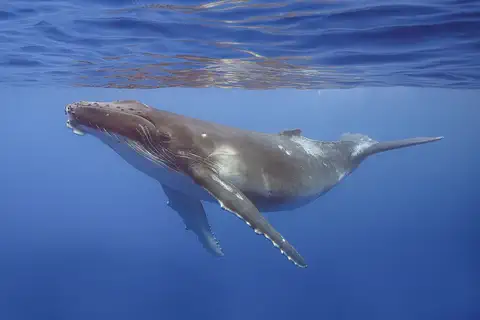
The humpback whale is a baleen whale famous for leaping out of the water, slapping its giant flippers and singing long, complex songs. It lives in every ocean and makes one of the longest journeys of any mammal, between cold feeding waters and warm waters where calves are born. Once hunted almost to extinction, it is now recovering.
-
 Watch
Animal
Sperm whale
The sperm whale is the biggest whale with teeth. Its huge, boxy head is about a third of its body, it dives deep into the dark ocean to hunt squid, and it makes the loudest sounds of any animal.
-
 Watch
3D
Animal
Domestic dog
The domestic dog has lived with people for more than 12,000 years. Dogs came from gray wolves, and today there are more than 400 breeds, from tiny Chihuahuas to giant Irish wolfhounds. They live with people all over the world as pets, helpers and friends.
- Watch Try it What If? Lab What if elephants talked with very low sounds? Elephants really do talk with very low rumbles, some too low for people to hear. Turn the pitch down in our sound model and see what changes about the wave, then find out how far real elephant calls can carry.
- Watch What If? Lab What if trees shared food underground? Almost every tree has a fungus partner living on its roots. The fungus brings water and minerals; the tree pays it in sugar. Some people say the fungi also link trees together so they can share food. Explore what scientists have measured, and why some of them say the 'sharing' story has gone further than the evidence.
- Watch Try it What If? Lab What if fish had no swim bladder? Most bony fish carry a gas-filled pouch called a swim bladder. It makes the fish almost exactly as heavy for its size as the water around it, so it can stay at one depth without sinking or floating up. Use a floating-and-sinking model to see what happens when the gas is taken away.
- Watch What If? Lab What if there were no decomposers? Bacteria, fungi, earthworms and millipedes break down dead leaves, wood and dead plants and animals, and give their nutrients back to the soil. National Geographic calls them Earth's cleanup crew. Imagine a world without them, and follow what might pile up, what might run short, and who does the work.
For parents & teachers
What children will learn
- Animals communicate through sound, sight, touch and smell, not just sounds.
- The honey bee's waggle dance shows direction (relative to the sun) and distance (by how long the run lasts).
- Humpback song and sperm whale codas are being studied; their structure is better understood than their meaning.
- Dog body language gives useful clues, but individual dogs differ, and children should ask before petting any dog.
Recommended ages: 5 to 17 · About 15 minutes
Talk about it
- Which of your senses do you use to tell how a friend or a pet is feeling?
- Why might it be easier to decode a bee's dance than a whale's song?
- If you could understand one animal, which would you choose, and what would you ask it?
- Is finding a pattern in animal sounds the same as knowing what they mean?
Try at home or in class
- Play the bee dance game: one person hides a toy in the room, then walks a short straight line, wiggling, pointing the way to the toy (with a window standing in for the sun). Can the others find it from the dance alone?
- Spend ten minutes quietly watching birds or a family pet. Write down every sound, movement and posture you notice, then talk about what each one might mean.
Key vocabulary: communication, signal, waggle dance, pheromone, hydrophone, coda
Where these facts come from
- Chemical Communication (Young Naturalist) , Texas Parks and Wildlife Department
- The Honey Bee Dance Language , NC State Extension
- The Nobel Prize in Physiology or Medicine 1973: Press release , NobelPrize.org
- The Nobel Prize in Physiology or Medicine 1973: Summary , NobelPrize.org
- Unraveling Mysteries of Humpback Whale Song , NOAA Office of National Marine Sanctuaries
- Whale Behavior , NOAA Hawaiian Islands Humpback Whale National Marine Sanctuary
- Sounds of Glacier Bay (underwater sound library) , National Park Service, Glacier Bay National Park & Preserve
- Humpback Whale Song November 2020 , National Park Service, Glacier Bay National Park & Preserve
- Contextual and combinatorial structure in sperm whale vocalisations (Sharma et al., 2024) , Nature Communications
- Project CETI , Project CETI
- Dog bite prevention , American Veterinary Medical Association
- Understanding a dog's body language , RSPCA
Checked, not yet human-reviewed. Last updated October 27, 2026. Spotted a mistake? Tell us.