Animal
Domestic dog
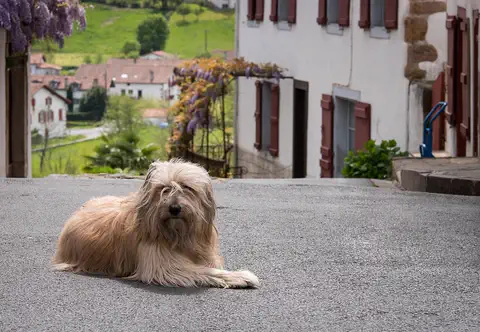
The dog is a friendly animal that lives with people. Dogs wag their tails, sniff everything and love to play. Long, long ago, dogs came from wolves.
The domestic dog has lived with people for more than 12,000 years. Dogs came from gray wolves, and today there are more than 400 breeds, from tiny Chihuahuas to giant Irish wolfhounds. They live with people all over the world as pets, helpers and friends.
The domestic dog descends from gray wolves (Canis lupus); many authorities treat it as a subspecies, Canis lupus familiaris. Genetic evidence places the first domestication in northern Eurasia between about 14,000 and 29,000 years ago, in a long process rather than a single event. Selective breeding has produced over 400 breeds, ranging from under 1 to about 70 kilograms.
Photo: Basotxerri, CC BY-SA 4.0, via Wikimedia Commons
Meet the dog
A dog is a furry animal that lives with people.
Dogs come in many sizes. Some are tiny and some are huge. Dogs wag their tails when they are happy.
Dogs belong to the dog family, the canids, together with wolves, foxes and jackals. They have lived with people for more than 12,000 years, as hunting partners, guards and friends.
Dogs come in a huge range of shapes and sizes. There are more than 400 dog breeds. A Chihuahua can be just 13 centimeters tall at the shoulder, while an Irish wolfhound can be 76 centimeters or more. Dogs can weigh anything from about 1 kilogram to 70.
Britannica treats the dog as a subspecies of the gray wolf, Canis lupus familiaris, while GBIF's backbone names it Canis familiaris; both describe the same animal. Dogs are carnivorans in the family Canidae, related to wolves, foxes and jackals.
Selective breeding has created more than 400 breeds and an extraordinary range of sizes, from Chihuahuas of 13 to 20 centimeters at the shoulder to Irish wolfhounds of 76 centimeters or more, and from about 1 to 70 kilograms. Despite this, dogs keep the teeth of their wolf ancestors: 28 baby teeth replaced by 42 adult teeth.
Quick facts
- Group
- Mammal
- Height
- 0.13 to 0.76 m
- Weight
- 1 to 70 kg
- Lifespan in the wild
- 12 years
Where dogs live
Dogs live with people all around the world.
They live in cities, in the countryside and on farms. Some dogs even pull sleds in the snow.
Dogs live with people worldwide, on every continent except Antarctica. You can find them in city apartments, farms, deserts, rainforest villages and the frozen Arctic, wherever people live.
Dogs came to the Americas with people, probably about 10,000 years ago. Some dogs live without owners. These are called feral dogs, and some of them live in family groups much like wolf packs.
The domestic dog has no wild range of its own: Animal Diversity Web describes it as found in association with humans worldwide, in a wide variety of habitats, on all continents except perhaps Antarctica. The map therefore shows the continents where dogs live with people.
Genetic evidence suggests dogs did not arrive in the Americas with the first people more than 15,000 years ago, but only some 10,000 years ago. Feral dog populations exist in many places; some have reverted to wolf-like family packs in which a dominant pair breeds and other members help raise the pups.
Continents
Did you know?
Dogs cool down by panting.
Dogs can't sweat like people, so on hot days they pant to let heat out.
Lacking extensive body sweating, dogs shed heat mainly by panting, which is why heat is a serious risk for them.
Where can you find this animal?
- Kept by people · Countries and seas named by a scientific source
- Sightings recorded · Records of wild sightings (GBIF)
Kept by people · Countries and seas named by a scientific source
Domestic dogs live with people worldwide, on every continent except Antarctica. This is not a wild range: dogs are here because people keep them. Feral dogs also live on their own in many places. Their wild ancestor is the gray wolf.
Places: Africa, Asia, Europe, North America, South America and Australia and Oceania.
Source: https://animaldiversity.org/accounts/Canis_lupus_familiaris/ · checked October 2026
Sightings recorded · Records of wild sightings (GBIF)
Counts of GBIF records of wild observations (human and machine) and preserved specimens. Records include introduced populations, vagrants, escaped or released animals and misidentifications, so a country with records is not necessarily part of the native range.
Wild sightings have been recorded in Australia, France, Chile, Colombia, United States, Belgium, Mexico, India and 149 more places.
Source: gbif · checked October 2026
Range maps show where scientists say an animal lives, often country by country. An animal may live in only part of a country shown, and sightings records can include animals that wandered far from home.
From wolf to dog
Long, long ago, all dogs were wolves.
Some wolves followed people and ate their leftovers. Slowly, these wolves became friendly dogs.
The dog's wild ancestor is the gray wolf. Scientists think that tens of thousands of years ago, some wolves began following groups of hunters across northern Europe and Asia, eating the scraps they left behind. Over many generations, the friendliest ones became the first dogs.
The first dogs were hunters with sharp eyes and noses. Later, people bred dogs for different jobs: guarding, herding sheep, pulling sleds, hunting and keeping people company. That is how so many breeds came about.
Genetic studies indicate that dogs descend from now-extinct wolf lineages that split from the ancestors of modern wolves between about 27,000 and 40,000 years ago, and that the first domestication events took place in northern Eurasia between about 14,000 and 29,000 years ago. Wolves probably took the first steps themselves by trailing nomadic hunters and scavenging their kills.
Britannica stresses that domestication was a process over thousands of years, with dogs and wolves continuing to interbreed and early dog populations replaced by later ones. Regional studies point to early dogs in China and India, and the timing and place remain debated. Early dog types included mastiffs, wolf-like dogs, sight hounds, pointers and herding dogs.
Did you know?
A dog's nose is super, super strong.
A dog's sense of smell is about a million times stronger than a person's, according to the Merck Veterinary Manual.
Olfaction is the dog's dominant sense, estimated by the Merck Veterinary Manual at about a million times more sensitive than ours.
What dogs eat
Dogs like to eat meat, but pet dogs eat dog food too.
Puppies need to eat several times a day. Grown-up dogs eat once or twice a day.
Dogs are carnivorans, members of the meat-eating group of mammals, and their teeth are like their wolf ancestors' teeth. Pet dogs eat food made for dogs, which gives them the right mix of protein and energy.
Puppies grow fast, so they need much more food for their size. A puppy needs about twice as much protein as an adult dog for each kilogram it weighs, and is fed four times a day until it is three months old, then three times a day until six months.
Dogs retain the carnivoran dentition of wolves, with 42 adult teeth, though domestic dogs are fed a varied diet by people. Animal Diversity Web notes that growth sharply increases needs: puppies require about twice the protein and 50 percent more calories per unit of body weight than adults.
Feeding schedules reflect this: about four meals a day until three months, three until six months, and two thereafter. An average-sized adult needs roughly 30 kilocalories per pound (about 66 per kilogram) of body weight a day, with real needs varying by breed, age and activity.
Did you know?
Puppies lose their baby teeth, just like you!
Puppies have 28 baby teeth that fall out and are replaced by 42 grown-up teeth.
Dogs replace 28 deciduous teeth with 42 permanent teeth, a dentition similar to their wolf ancestors'.
Super nose, super ears
A dog's nose is super good at smelling.
Dogs can hear sounds that people can't. When dogs are hot, they pant with their tongues out to cool down.
A dog's sense of smell is amazing. The Merck Veterinary Manual says it is about a million times stronger than ours. Dogs sniff each other to find out who is who. Their hearing is about four times better than ours, especially for high sounds.
Dogs see movement and dim light better than people, but they don't see fine details or colors as well. They can't sweat like we do, so they cool down by panting, taking quick breaths that release heat.
Smell is the dominant sense: the Merck Veterinary Manual describes it as about a million times more sensitive than a human's, and Britannica notes that dogs gather chemical information from each other's scent glands to identify individuals. Hearing is about four times more acute than ours, particularly for high frequencies.
Vision favors movement and low light over detail and color. Dogs keep warm better than they cool down: they cannot sweat over the body as humans do and rely mainly on panting, rapid shallow breathing that sheds heat from the airways, which is why hot weather is dangerous for them. Coats vary from thick, insulating undercoats in cold-climate breeds to oily, water-resistant coats in water dogs.
Growing up
Baby dogs are called puppies.
A mother dog has a few puppies at once. They drink her milk. Then they grow up and play.
A mother dog is pregnant for about nine weeks, 63 days. She usually has 3 to 9 puppies, though some have just one and some many more. Puppies drink their mother's milk until they are about 8 to 10 weeks old.
Puppies get 28 baby teeth, which are later replaced by 42 grown-up teeth. Most dogs are called puppies until they are about a year old, but many stay playful much longer. Well cared-for dogs can live 12 years or more, and small breeds usually live longer than big ones.
Gestation averages about 63 days. Litter size depends on breed and the mother's condition, averaging 3 to 9 pups. Pups are nursed until weaning at about 8 to 10 weeks, and sexual maturity comes at 6 to 12 months. In feral packs, other members help care for the dominant pair's pups, as in wolves.
Dogs grow 28 deciduous teeth, replaced by 42 permanent ones. Lifespan depends on care, breed and body size, with larger breeds generally shorter-lived; Animal Diversity Web says well-cared-for dogs can live 12 years or more. Britannica notes that the popular 'seven dog years per human year' rule is only a rough guide, since aging rates differ between breeds.

How dogs talk
Dogs talk with their tails, ears and faces.
A wagging tail and a relaxed face say, let's play! A tucked tail says, I feel scared.
Like wolves, dogs are pack animals, and they talk with their whole bodies. A friendly dog has a relaxed face, a slightly open mouth, ears loosely back and a wagging tail. A dog inviting you to play lowers its front end, keeps its rear up and may bark.
A dog that feels threatened may raise its fur, show its teeth and growl. A frightened dog pulls its ears back and tucks its tail under its body. Watching a dog's body helps you know how it feels.
Dogs share with wolves a complex repertoire for signaling social position and mood. Animal Diversity Web describes greeting (relaxed face, mouth slightly open, ears loosely back, tail wagging), offensive threat (raised hackles, bared teeth, wrinkled nose, growling, tail high) and defensive threat (growling but with ears flattened and tail low), as well as submission with averted eyes and a 'submissive grin'.
A wagging tail is therefore not always friendly: it can accompany an upright, threatening posture. Reading the whole body, ears, mouth, tail and stance together, is the reliable way to interpret a dog, and it is the basis of safe behavior around dogs for children and adults.
Did you know?
Some dogs are tiny and some are giant.
A Chihuahua can be 13 centimeters tall at the shoulder, and an Irish wolfhound 76 centimeters or more.
Shoulder height varies more than fivefold across breeds, from Chihuahuas to Irish wolfhounds.
Dogs and their wild relatives
Pet dogs are not in danger. There are dogs all over the world.
Dogs need people to keep them safe, cool and healthy.
Domestic dogs are not endangered: they live with people almost everywhere. Because they are domestic animals, they do not have a wild conservation status.
Dogs depend on people. They need shade, fresh water and a cool place on hot days, because they can't cool down well. Vets protect dogs with vaccines. Their wild ancestor, the gray wolf, has its own story, which you can explore on its own page.
As a domestic animal, the dog has no IUCN Red List assessment of its own. Its welfare depends directly on people: the Merck Veterinary Manual stresses that because dogs cool themselves poorly, shade, water and cool indoor space are essential in hot weather, and Britannica outlines routine vaccination schedules, including rabies vaccination from about three months.
Dogs also stay closely tied to their wild ancestor. Britannica notes that dogs and wolves kept interbreeding throughout domestication, and Animal Diversity Web records feral dog populations that have returned to wolf-like family packs, in which a dominant pair breeds and the others help raise the pups.
Amazing facts
-
A dog's nose is super, super strong.
A dog's sense of smell is about a million times stronger than a person's, according to the Merck Veterinary Manual.
Olfaction is the dog's dominant sense, estimated by the Merck Veterinary Manual at about a million times more sensitive than ours.
-
Dogs cool down by panting.
Dogs can't sweat like people, so on hot days they pant to let heat out.
Lacking extensive body sweating, dogs shed heat mainly by panting, which is why heat is a serious risk for them.
-
Puppies lose their baby teeth, just like you!
Puppies have 28 baby teeth that fall out and are replaced by 42 grown-up teeth.
Dogs replace 28 deciduous teeth with 42 permanent teeth, a dentition similar to their wolf ancestors'.
-
Some dogs are tiny and some are giant.
A Chihuahua can be 13 centimeters tall at the shoulder, and an Irish wolfhound 76 centimeters or more.
Shoulder height varies more than fivefold across breeds, from Chihuahuas to Irish wolfhounds.
Words to know
- domestic
- living with people, not wild
- breed
- a group of dogs with the same look and traits, made by people choosing parents
- ancestor
- a relative that lived long ago, from whom an animal is descended
- pant
- to breathe quickly with the mouth open, to cool down
- pack
- a family group of wolves or dogs that live together
- feral
- a domestic animal that lives on its own without owners
Discovery challenge
-
Which wild animal did dogs come from?
What is the dog's wild ancestor?
From which species did domestic dogs descend?
- The gray wolf
- The lion
- The bear
Show the answer
The gray wolf
Dogs came from wolves long, long ago.
Dogs descended from gray wolves over thousands of years.
Dogs descend from wolf lineages of Canis lupus, and many classifications treat them as a subspecies.
-
How does a hot dog cool down?
How do dogs cool off on a hot day?
What is a dog's main way of losing heat?
- By panting
- By sweating all over
- By barking
Show the answer
By panting
Dogs pant with their tongues out to cool down.
Dogs can't sweat like people, so they pant to release heat.
Panting, rapid breathing that sheds heat from the airways, is the main cooling mechanism.
-
What is a dog's best sense?
Which sense is a dog's strongest?
Which sense dominates in dogs?
- Smell
- Taste
- Seeing colors
Show the answer
Smell
Dogs are super smellers!
A dog's sense of smell is about a million times stronger than ours.
Olfaction; color vision and detail are actually weaker than ours.
-
What does a tucked tail mean?
A dog has its ears back and its tail tucked under. How does it feel?
Which posture signals fear or submission in a dog?
- Scared
- Excited to play
- Angry and ready to chase
Show the answer
Scared
A tucked tail means the dog feels scared.
Ears drawn back and a tail tucked tightly under the body show fear.
Flattened ears, a tucked tail and averted eyes indicate fear or submission.
Experiments to try
- Watch What If? Lab What if we could understand animal sounds? Animals pass messages with sounds, smells, movements and touch. Scientists have already worked out what a honey bee's dance means, and they are listening hard to whales. Imagine understanding three animals, a bee, a whale and a dog, and find out how much we really know.
- Watch What If? Lab What if you had no sense of smell? Your nose does more than you think. Much of what you call taste is really smell, and smell can warn you about smoke or food that has gone bad. Imagine a day with no sense of smell, then meet a dog, whose nose has up to 300 million smell receptors.
- Watch What If? Lab What if you could not sweat? Sweat is your body's built-in cooler. When it dries off your skin, it carries heat away with it. Dogs can hardly sweat, so they pant instead. Imagine a body with no sweat, and discover the clever ways people and animals keep cool.
Explore next
-
 Watch
3D
Animal
Gray wolf
The gray wolf is the largest member of the dog family and the wild ancestor of pet dogs. Wolves live in family packs that hunt big animals like elk and moose together, and their howls can carry about 10 kilometers. After being wiped out in many places, wolves are coming back in parts of North America and Europe.
-
 Watch
Animal
Dingo
The dingo is Australia's wild dog and the country's largest meat-eating mammal. People brought its ancestors to Australia about 4,000 years ago. It hunts rabbits, kangaroos and wallabies, howls rather than barks, and scientists still argue about whether it is its own species or a very old kind of dog.
-
 Watch
Animal
Red fox
The red fox is a small, clever member of the dog family with an orange coat, black legs and a bushy, white-tipped tail. It lives across North America, Europe, Asia and North Africa, more of the world than any other wild land carnivore, and has even moved into big cities.
-
 Watch
3D
Animal
Domestic cat
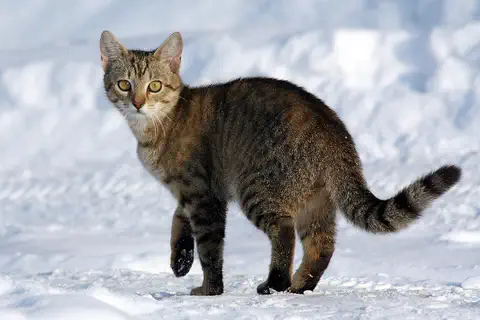
The domestic cat is one of the world's favorite pets. Cats live with people in homes, farms and towns in almost every country on Earth. Long ago they came from a small wildcat of the Middle East and Africa, and they still have the sharp senses and soft paws of a wild hunter.
- Watch What If? Lab What if we could understand animal sounds? Animals pass messages with sounds, smells, movements and touch. Scientists have already worked out what a honey bee's dance means, and they are listening hard to whales. Imagine understanding three animals, a bee, a whale and a dog, and find out how much we really know.
- Watch What If? Lab What if you had no sense of smell? Your nose does more than you think. Much of what you call taste is really smell, and smell can warn you about smoke or food that has gone bad. Imagine a day with no sense of smell, then meet a dog, whose nose has up to 300 million smell receptors.
- Watch What If? Lab What if you could not sweat? Sweat is your body's built-in cooler. When it dries off your skin, it carries heat away with it. Dogs can hardly sweat, so they pant instead. Imagine a body with no sweat, and discover the clever ways people and animals keep cool.
-
 Watch
3D
Animal
Coyote
The coyote is a clever, adaptable wild dog that lives from Alaska and Canada to Panama. It is smaller than a wolf and bigger than a fox. Coyotes eat mostly mice, voles and rabbits, howl and yip to keep in touch, and live everywhere from deserts and forests to city parks.
For parents & teachers
What children will learn
- Explain that dogs descend from gray wolves and how domestication happened over thousands of years.
- Describe dogs' senses and how they cool down.
- Read basic dog body language and understand how to behave safely around dogs.
- Understand that dogs live with people worldwide and depend on people for care.
Recommended ages: 3 to 17 · About 15 minutes
Talk about it
- Why might wolves and people have helped each other long ago?
- How can you tell how a dog is feeling before you go near it?
- What does a dog need from its family on a very hot day?
Try at home or in class
- Hide a treat-scented cloth under one of three cups and see whether a dog (with a grown-up's help) can find it by smell.
- Make a 'dog feelings' chart: draw a dog with happy, scared and warning body language and label the ears, tail and mouth.
Key vocabulary: domestic, breed, ancestor, pant, pack, feral
Where these facts come from
- GBIF Backbone Taxonomy and GBIF Occurrence Search , Global Biodiversity Information Facility (CC0 1.0 (backbone); occurrence counts are facts derived from records under CC0, CC BY and CC BY-NC)
- Wikidata , Wikimedia Foundation (CC0 1.0)
- Dog , Encyclopaedia Britannica
- Canis lupus familiaris (domestic dog) , Animal Diversity Web, University of Michigan Museum of Zoology
- Description and Physical Characteristics of Dogs , Merck Veterinary Manual
- Wikimedia Commons , Wikimedia Foundation (Per file: Public domain, CC0, CC BY or CC BY-SA only (credited on each page))
Checked, not yet human-reviewed. Last updated October 28, 2026. Spotted a mistake? Tell us.