
City Europe
Sarajevo
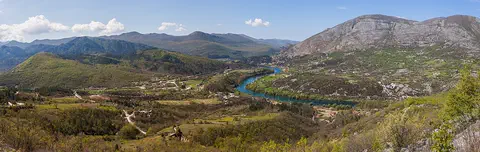
Sarajevo is the capital city of Bosnia and Herzegovina. It sits in a valley with mountains all around. A river runs through the town.
Sarajevo is the capital of Bosnia and Herzegovina, built in a valley ringed by mountains, along the Miljacka River. It grew from an Ottoman town founded in the 1400s around a market, the Baščaršija. An official estimate gives 270,608 people in the City of Sarajevo in mid-2026, and in 1984 the city hosted the Winter Olympics.
Sarajevo, capital of Bosnia and Herzegovina, lies on the Sarajevo Field, a basin about 500 m above sea level enclosed by Bjelašnica, Igman and Trebević. Its urban history begins with Isa-beg Isaković's endowments, recorded in a charter of 1462. Ottoman, Austro-Hungarian and Yugoslav periods shaped the city; the Federation's statistics institute estimated 270,608 people in its four municipalities on 30 June 2026.
Photo: Julian Nyča, CC BY-SA 4.0, via Wikimedia Commons
Discover Sarajevo
Sarajevo is the capital city of Bosnia and Herzegovina.
It is in a valley. Green mountains rise all around it. A river called the Miljacka flows through the city, under its bridges.
Sarajevo is the capital of Bosnia and Herzegovina, a country in southeastern Europe. The city's own website calls it the country's center for government, business, culture, universities and sport.
The City of Sarajevo is made up of four municipalities: Stari Grad (the Old Town), Centar, Novo Sarajevo and Novi Grad. The last census, in 2013, counted 275,524 people in them, and an official estimate for 30 June 2026 gives 270,608. The city lies in a valley along the Miljacka River, with mountains on every side.
Sarajevo is the capital of Bosnia and Herzegovina and, as the City of Sarajevo describes itself, its administrative, economic, cultural, academic and sporting center. The City is a unit of local self-government made up of four municipalities: Stari Grad, Centar, Novo Sarajevo and Novi Grad.
The 2013 census, the most recent, counted 275,524 people in the City. The Institute for Statistics of the Federation of Bosnia and Herzegovina estimated 270,608 on 30 June 2026 (Centar 51,598, Novi Grad 124,111, Novo Sarajevo 61,796 and Stari Grad 33,103). Its population has changed a great deal over time: the city's history pages record 111,087 people in the inner city area in 1948 and 527,049 in the wider city in April 1991, areas that are not the same as today's four municipalities.
- Country
- Bosnia and Herzegovina (capital)
- People in the City of Sarajevo (official estimate, 30 June 2026)
- 270,608
- Made up of
- four municipalities: Stari Grad, Centar, Novo Sarajevo and Novi Grad
- Founding charter of Isa-beg Isaković
- 1462
A market square, old bridges and City Hall
The oldest part of Sarajevo has a big market square called Baščaršija.
Nearby is the City Hall, more than 100 years old. An old stone bridge crosses the river.
The heart of old Sarajevo is the Baščaršija, the city's main market square. It was already there before 1462, and shops selling cloth, saddles and leather grew up around it. Close by stands the Gazi Husrev-beg Mosque, built in 1530–31.
Beside the river is City Hall, or Vijećnica, which opened in 1896. It is built in a style called pseudo-Moorish. Not far away, the Latin Bridge is a stone bridge built in the 1500s.
Baščaršija, the "main market," grew from a square that existed before 1462, around Isa-beg Isaković's han (an inn with shops), where textiles were the main trade; streets of saddlers and other crafts formed around it. Gazi Husrev-bey, governor of the Bosnian sanjak three times between 1521 and 1541, built the Gazi Husrev-beg Mosque in 1530–31, then a madrasah whose 1537 charter also founded a library that still exists.
City Hall (Vijećnica) opened on 20 April 1896 as the seat of the city government. It is in the pseudo-Moorish style, with architects Karel Pařík, Alexander Wittek and Ćiril Iveković involved in its design and building. The Latin Bridge across the Miljacka dates from the 16th century.
- Baščaršija
- the main market square, there before 1462
- Gazi Husrev-beg Mosque
- built 1530–31
- City Hall (Vijećnica)
- opened 1896, reopened after rebuilding in 2014
- Latin Bridge
- a stone bridge from the 1500s
From an Ottoman town to a modern capital
Sarajevo began more than 500 years ago, as a small town with a market.
About thirty years ago there was a war, and many buildings were damaged. People worked hard to fix them, like City Hall.
Sarajevo began in the middle of the 1400s, when Isa-beg Isaković built a mosque, a court called a saray, a bridge, an inn, a bath and shops. The city's name comes from that saray. By the 1500s it was the biggest town in Bosnia.
In 1878 Austria-Hungary took control, and new buildings, trams and a museum followed. On 28 June 1914 the heir to Austria-Hungary's throne, Archduke Franz Ferdinand, and his wife Sophie were killed at the Latin Bridge, an event that helped start the First World War. Later Sarajevo was part of Yugoslavia. From 1992 to the end of 1995, during the Bosnian War, the city was under siege for 44 months. A peace agreement ended the war, and damaged buildings such as City Hall have been rebuilt.
The city's urban history starts with Isa-beg Isaković: before 1462, the year of his endowment charter (vakufnama), he had built a mosque, later called the Emperor's Mosque, and an administrative court, the saray that gave Sarajevo its name, followed by a han, a bridge over the Miljacka, a bath, shops and mills. In the 16th century it became the largest and most important city in Bosnia.
Austria-Hungary occupied Bosnia in 1878. On 28 June 1914 Archduke Franz Ferdinand and his wife Sophie were assassinated at the Latin Bridge by Gavrilo Princip, an event widely regarded as one of the triggers of the First World War. From December 1918 Bosnia and Herzegovina was part of the Yugoslav state, and in 1945 Sarajevo became the capital of one of Yugoslavia's six federal units. The siege of Sarajevo in the Bosnian War began in April 1992 and lasted 44 months, until the peace agreement signed in Dayton, Ohio, at the end of 1995. Rebuilding has continued since: City Hall, burned in August 1992, reopened in 2014.
- Austria-Hungary takes over
- 1878
- Archduke Franz Ferdinand killed at the Latin Bridge
- 28 June 1914
- Siege of the city
- April 1992 to the end of 1995 (44 months)
Trams and a cable car up the mountain
Sarajevo has trams that run on rails through the streets.
A cable car carries people up a mountain called Trebević. Little cabins hang from a long cable.
Sarajevo has had trams for a long time. Horses pulled the first ones in 1885, and the first electric tram ran in 1895. In 2025 the city celebrated 140 years of public transport.
To get up Mount Trebević, people ride a cable car. It opened in 1959 and climbs from Bistrik, 583 meters above sea level, to 1,160 meters. After 26 years out of use, it reopened on 6 April 2018, the day Sarajevo celebrates as the city's birthday.
Public transport in Sarajevo began with a horse-drawn tram in 1885; the first electric tram followed in 1895, and the 140th anniversary was marked at City Hall in November 2025.
The Trebević cable car first carried passengers in 1959, linking Bistrik (583 m) with a viewpoint at 1,160 m; its cabins held four people and passed between about 5 and more than 50 meters above the ground. After 26 years out of service it reopened on 6 April 2018, which the City of Sarajevo describes as the city's birthday, helped by private donations of close to four million euros.
- First horse-drawn tram
- 1885
- First electric tram
- 1895
- Trebević cable car
- from 583 m at Bistrik to 1,160 m; opened 1959, reopened 2018
Snowy winters, warm summers
Winter in Sarajevo is cold, and snow falls.
Summer is warm. Rain comes in every month of the year.
Sarajevo has cold winters and warm summers. At the World Meteorological Organization's Sarajevo station, January days averaged about 4 °C and nights about −3 °C between 1991 and 2020. August had the warmest days, averaging about 28 °C.
Rain and snow come in every month, about 950 millimeters in an average year. On average, snow can fall from early November to late April. The city says its climate and nearby mountains, good for winter sports, were why Bosnia and Herzegovina asked to host the 1984 Winter Olympics, and it won.
WMO normals for Sarajevo (Federal Hydrometeorological Service of the Federation of Bosnia and Herzegovina, 1991–2020) give average highs and lows of 4.1 °C and −2.9 °C in January and 28.3 °C and 14.3 °C in August, the month with the highest averages; July is close behind at 27.8 °C and 14.2 °C.
Precipitation is spread through the year: the monthly averages add up to 949.5 mm, from 62.9 mm in August to 91.4 mm in October, with 7 to 11 days of precipitation a month. The City of Sarajevo describes a moderate continental climate shaped by central European influences from the north and Mediterranean ones from the south; on average the first snow falls on 4 November and the last on 23 April. The City's climate page says the favorable climate and nearby mountains suited to winter sports were why Bosnia and Herzegovina bid for, and won, the XIV Winter Olympic Games, held 8–20 February 1984.
- January, average daily high and low (WMO Sarajevo station, 1991–2020)
- about 4 °C and −3 °C
- August, average daily high and low (same station and period)
- about 28 °C and 14 °C
- Rain and snow in a year (sum of the monthly averages)
- about 950 mm
Museums, libraries and the 1984 Olympics
Sarajevo has a museum with a botanical garden.
It has a library that is almost 500 years old. In 1984, Sarajevo hosted the Winter Olympics.
The National Museum of Bosnia and Herzegovina was founded in Sarajevo in 1888. Its home, four pavilions and a botanical garden, opened in 1913. The Gazi Husrev-bey Library goes back to 1537. During the war of the 1990s, its books were moved from place to place several times, and the whole collection was saved.
In February 1984 Sarajevo hosted the Winter Olympic Games. In the old town, mosques, churches and a synagogue have stood a short walk apart since the 1500s.
The National Museum of Bosnia and Herzegovina, founded on 1 February 1888, is the country's oldest modern cultural and scientific institution; its purpose-built complex of four pavilions and a Botanical Garden was completed in 1913. The Gazi Husrev-bey Library traces its start to the 1537 madrasah charter; in 1992 its holdings were moved to several places in turn and were completely preserved, and since 2014 it has had a new building beside the Kuršumli madrasah. It holds about 200,000 items, including more than 10,500 manuscript volumes.
The City of Sarajevo notes that mosques, churches and a synagogue within about a hundred meters of one another have been in use since the 16th century. Jews began to settle in Sarajevo in the early 1500s, and the Jewish Cemetery has been on UNESCO's Tentative List since 2018, as has the city itself ("Sarajevo – continual open city") since 1997.
- National Museum of Bosnia and Herzegovina
- founded 1888; museum complex and Botanical Garden opened 1913
- Gazi Husrev-bey Library
- dates from 1537; new building opened 2014
- XIV Winter Olympic Games
- 8–20 February 1984
Sarajevo on the map
Find Sarajevo on the globe.
It is in Bosnia and Herzegovina, in southeastern Europe. Look for a valley with mountains all around it.
Sarajevo is in Bosnia and Herzegovina, in southeastern Europe. The city is built on the Sarajevo Field, a flat valley floor about 500 meters above sea level.
Mountains surround the valley: Bjelašnica and Igman to the southwest and Trebević to the southeast, with lower hills to the north. The Miljacka River flows through the city.
Sarajevo lies at about 43.9° N and 18.4° E. According to the City of Sarajevo, it occupies the Sarajevo Field (Sarajevsko polje), an intramontane depression averaging about 500 m above sea level, bounded by Bjelašnica and Igman to the southwest, Trebević to the southeast and medium-high mountains and ridges to the north and northwest.
The surrounding mountains are mostly limestone and dolomite with karst features, while the valley floor, geologically very young, is made of freshwater gravels and sands; thermal and mineral springs rise near Ilidža. The Miljacka River runs through the city.
- Latitude
- about 43.9° north
- Longitude
- about 18.4° east
- Sarajevo Field (the valley floor)
- about 500 m above sea level
Amazing facts
-
Long ago, horses pulled Sarajevo's trams.
Sarajevo's first trams, in 1885, were pulled by horses; electric trams took over in 1895.
Sarajevo marked 140 years of public transport in November 2025, counting from its horse-drawn tram of 1885; the first electric tram ran in 1895.
-
Sarajevo is named after an old government building called a saray.
Sarajevo is named after the saray, the court that Isa-beg Isaković built in the 1400s as a center of government.
The city takes its name from the saray, the administrative court Isa-beg Isaković built before his endowment charter of 1462.
-
Old books in a Sarajevo library were kept safe by moving them again and again.
During the war of the 1990s, the Gazi Husrev-bey Library's books were moved to different places several times, and the whole collection was saved.
From April 1992 the Gazi Husrev-bey Library's holdings, including manuscripts in Arabic, Turkish, Persian and Bosnian, were moved between locations several times and were completely preserved.
-
A cable car in Sarajevo goes high up a mountain.
The Trebević cable car climbs from 583 meters to 1,160 meters above sea level.
The Trebević cable car, opened in 1959 and reopened in 2018, rises from Bistrik at 583 m to 1,160 m; its first cabins carried four people each.
Words to know
- capital
- the city where a country's government meets
- bazaar
- a market street or square lined with shops and workshops
- cable car
- a cabin that hangs from a moving cable and carries people up a slope
- tram
- a passenger vehicle that runs on rails laid in city streets
- endowment
- money, land or buildings given to support something, like a school or library, for a long time
- siege
- when an army surrounds a place and cuts it off
- census
- an official count of all the people in a country
Discovery challenge
-
Sarajevo is the capital of which country?
Sarajevo is the capital city of which country?
Sarajevo is the capital of which country?
- Bosnia and Herzegovina
- Austria
- Portugal
Show the answer
Bosnia and Herzegovina
Bosnia and Herzegovina! Sarajevo is its capital.
Sarajevo is the capital of Bosnia and Herzegovina, in southeastern Europe.
Bosnia and Herzegovina; Austria ruled Sarajevo as part of Austria-Hungary from 1878, but the city is not in Austria.
-
Which river flows through Sarajevo?
Which river flows through Sarajevo?
Which river does the Latin Bridge cross?
- The Thames
- The Miljacka
- The Nile
Show the answer
The Miljacka
The Miljacka! Bridges cross it.
The Miljacka River runs through the city, crossed by bridges.
The Miljacka; the Latin Bridge across it dates from the 16th century.
-
Which sports came to Sarajevo in 1984?
Which big sports event did Sarajevo host in 1984?
Which games were held in Sarajevo from 8 to 20 February 1984?
- The Winter Olympics
- The Summer Olympics
- The football World Cup
Show the answer
The Winter Olympics
The Winter Olympics! Snow sports came to town.
The Winter Olympic Games, in February 1984.
The XIV Winter Olympic Games, 8–20 February 1984.
-
What carries people up Mount Trebević?
What carries people from Bistrik up Mount Trebević?
What links Bistrik (583 m) with a viewpoint at 1,160 m on Trebević?
- A boat
- A cable car
- A hot-air balloon
Show the answer
A cable car
A cable car! Its cabins hang from a cable.
The Trebević cable car, which opened in 1959 and reopened in 2018.
The Trebević cable car (1959; reopened 6 April 2018 after 26 years).
-
What is Sarajevo's old market square called?
What is the name of Sarajevo's old main market square?
Which square, already there before 1462, became the core of Sarajevo's market district?
- Baščaršija
- Times Square
- Red Square
Show the answer
Baščaršija
Baščaršija! It is in the oldest part of town.
Baščaršija, the city's main market square since the 1400s.
Baščaršija, the "main market," which grew around Isa-beg Isaković's han.
Nearby places
-
 Watch
Landmark
Mehmed Paša Sokolović Bridge
The Mehmed Paša Sokolović Bridge crosses the Drina River at Višegrad, in eastern Bosnia and Herzegovina. The architect Sinan built it between 1571 and 1577. It is about 180 meters long, with eleven stone arches, and it has been a UNESCO World Heritage Site since 2007.
-
 Watch
Landmark
Stari Most
Stari Most, the Old Bridge, crosses the Neretva River in Mostar, Bosnia and Herzegovina, with a single stone arch. It was built in the 16th century, when the town was an Ottoman frontier town, and the town is even named after it. The bridge was rebuilt in 2004, and since 2005 its old town has been a World Heritage Site.
-
 Watch
City
Dubrovnik
Dubrovnik is a walled town on the Dalmatian coast of Croatia, beside the Adriatic Sea. UNESCO calls it the 'Pearl of the Adriatic' and says it became an important sea power from the 13th century. Its Old City is a World Heritage site. Croatia's 2021 census counted 26,922 people in the town.
-
 Watch
City
Split
Split is a port on Croatia's Adriatic coast. Larousse says the city was born inside the huge walls of a palace that the Roman emperor Diocletian built around the year 300. Its historic center has been a World Heritage Site since 1979, and Croatia's 2021 census counted 149,830 people in Split.
-
 Watch
City
Podgorica
Podgorica is the capital of Montenegro, on a plain where the valleys of the Morača and Zeta rivers meet. From 1946 to 1992 it was called Titograd. Montenegro's 2023 census counted 179,505 people in the Capital City of Podgorica, the country's most populated municipality.
-
 Watch
City
Belgrade
Belgrade, the capital of Serbia, stands where the Sava River flows into the Danube. Its name, Beograd, means "white city", probably because of the white limestone walls of its old fortress above the rivers. At the 2022 census, about 1.2 million people lived in the city itself and about 1.7 million in the wider City of Belgrade.
-
 Watch
Natural wonder
Adriatic Sea
The Adriatic Sea is a long, narrow part of the Mediterranean Sea, about 800 km long and 200 km wide. Its northern part is shallow, but its south drops to about 1,200 meters. In winter, strong bora winds make the densest water in the whole Mediterranean, which flows south and refreshes the deep sea.
-
 Watch
City
Zagreb
Zagreb is the capital of Croatia, between the Sava River and Medvednica mountain. It grew from two old hilltop towns, Kaptol and Gradec, which joined in 1850. The 2021 census counted 767,131 people in the City of Zagreb, and its blue trams have run since 1891.
Explore next
-
 Watch
 Country
Bosnia and Herzegovina
Bosnia and Herzegovina is a mountainous country in southeastern Europe. It has forests, limestone hills and many rivers, and famous old stone bridges cross some of them. Its capital is Sarajevo. It touches the Adriatic Sea along only about 20 kilometers of coast.
-
Watch
City
Zagreb
Zagreb is the capital of Croatia, between the Sava River and Medvednica mountain. It grew from two old hilltop towns, Kaptol and Gradec, which joined in 1850. The 2021 census counted 767,131 people in the City of Zagreb, and its blue trams have run since 1891.
-
Watch
City
Belgrade
Belgrade, the capital of Serbia, stands where the Sava River flows into the Danube. Its name, Beograd, means "white city", probably because of the white limestone walls of its old fortress above the rivers. At the 2022 census, about 1.2 million people lived in the city itself and about 1.7 million in the wider City of Belgrade.
-
 Watch
City
Istanbul
Istanbul is the biggest city in Türkiye, built on both sides of the Bosporus, the narrow strait between Europe and Asia. Once called Byzantium and then Constantinople, it was the capital of two great empires. About 15.7 million people lived in Istanbul province in 2023.
-
 Watch
City
Vienna
Vienna is the capital of Austria, on the Danube River. For centuries it was the home of emperors, and composers such as Haydn, Mozart and Beethoven lived and worked there. About 2 million people lived in the city at the start of 2026.
- Watch Geography Capital cities A capital is the city where a country's government is based. Many capitals grew up over hundreds of years beside rivers and trade routes. A few, like Brasília and Canberra, were built from scratch, and some countries share out their capital's jobs among two or three cities.
- Watch Geography How mountains form Most mountains are built by moving tectonic plates. When continents collide, rock crumples and folds into ranges like the Himalayas. Where the crust stretches and cracks, blocks of rock tilt up along faults. Volcanoes build mountains from lava and ash. Then erosion slowly wears them all down.
-
Watch
City
Podgorica
Podgorica is the capital of Montenegro, on a plain where the valleys of the Morača and Zeta rivers meet. From 1946 to 1992 it was called Titograd. Montenegro's 2023 census counted 179,505 people in the Capital City of Podgorica, the country's most populated municipality.
For parents & teachers
What children will learn
- Locate Sarajevo in Bosnia and Herzegovina, in a valley ringed by mountains.
- Describe how Sarajevo grew from a 15th-century Ottoman foundation through Austro-Hungarian and Yugoslav times.
- Explain how a city's landscape and climate can shape events, using the 1984 Winter Olympics as an example.
- Talk about how cities rebuild and protect their heritage, using City Hall and the Gazi Husrev-bey Library.
Recommended ages: 3 to 17 · About 15 minutes
Talk about it
- In the 1990s a Sarajevo library's books were moved again and again so they would not be lost. What would you most want to keep safe in your town's library or museum, and why?
- City Hall was rebuilt to match its original plans. Why might a city choose to rebuild an old building exactly as it was instead of building something new?
- Sarajevo has trams, buses and a cable car. Which of these would suit a town surrounded by mountains best, and why?
Try at home or in class
- Make a model of Sarajevo's valley: shape clay or play dough into a ring of mountains around a flat floor, and draw the Miljacka River across the middle with a blue marker.
- Build a mini cable car: tie a string between two chairs at different heights, hang a paper cup from a paper clip, and slide it up and down the line.
- Measure the rain at home for a month with a straight-sided jar and a ruler, and compare it with Sarajevo's October average of about 91 mm.
Key vocabulary: capital, bazaar, cable car, tram, endowment, siege, census
Where these facts come from
- Wikidata , Wikimedia Foundation (CC0 1.0)
- Natural Earth vector data , Natural Earth (NACIS) (Public domain)
- Stanovništvo (Population) , City of Sarajevo (Grad Sarajevo)
- Sarajevo (home page: about Sarajevo) , City of Sarajevo (Grad Sarajevo)
- Geografski položaj (Geographical position) , City of Sarajevo (Grad Sarajevo)
- Klima (Climate) , City of Sarajevo (Grad Sarajevo)
- Sarajevo u osmanskom periodu (Sarajevo in the Ottoman period) , City of Sarajevo (Grad Sarajevo)
- Sarajevo u austrougarskom periodu (Sarajevo in the Austro-Hungarian period) , City of Sarajevo (Grad Sarajevo)
- Sarajevo u periodu 1918.–1945. godina (Sarajevo 1918–1945) , City of Sarajevo (Grad Sarajevo)
- Sarajevo u periodu 1945.–1991. godina (Sarajevo 1945–1991) , City of Sarajevo (Grad Sarajevo)
- Trebevićka žičara (Trebević cable car) , City of Sarajevo (Grad Sarajevo)
- History (Historijat) , Gazi Husrev-bey Library
- About the National Museum of Bosnia and Herzegovina , National Museum of Bosnia and Herzegovina
- Thirty-four years since Sarajevo City Hall fire destroyed its priceless library collection , N1 Bosnia and Herzegovina
- Sarajevo celebrates 140 years of public transport, announces new modernization projects , FENA (Federal News Agency)
- Latin Bridge in Sarajevo , Contested Histories (EuroClio)
- Sarajevo commemorates 20th anniversary of 44-month siege , tportal.hr
- Sarajevo - unique symbol of universal multiculture - continual open city (Tentative List) , UNESCO World Heritage Centre
- Jewish Cemetery in Sarajevo (Tentative List) , UNESCO World Heritage Centre
- Sarajevo: climatological information , World Meteorological Organization, World Weather Information Service
- Procjena ukupnog broja stanovnika Federacije BiH po kantonima i općinama, stanje sredina godine (Estimate of the total population, by cantons and municipalities, as on June 30, 2026), First Release 14.2.1 , Institute for Statistics of the Federation of Bosnia and Herzegovina (31 Aug 2026)
- Wikimedia Commons , Wikimedia Foundation (Per file (public domain, CC0, CC BY or CC BY-SA); see each media record)
Checked, not yet human-reviewed. Last updated November 1, 2026. Spotted a mistake? Tell us.