
City Europe
Minsk
Minsk is the capital city of Belarus. A small river winds through it. It has wide streets, big parks and a library shaped like a giant diamond.
Minsk, the capital of Belarus, lies on the Svislach River near the middle of the country. First written about in 1067, it was almost completely destroyed in World War II and rebuilt with wide avenues, parks and apartment blocks. About 2 million people lived there in 2026.
Minsk, first recorded in 1067, became capital of the Belorussian Soviet republic in 1919 and of independent Belarus in 1991. Nearly destroyed in World War II, it was rebuilt as a planned Soviet city and grew faster than any comparable Soviet city between 1959 and 1989; about one in five people in Belarus now lives there.
Photo: Zedlik, CC BY-SA 3.0, via Wikimedia Commons
Discover Minsk
Minsk is the capital city of Belarus.
A river called the Svislach flows through it. Minsk has wide streets, green parks and tall apartment buildings. About two million people live there.
Minsk is the capital and biggest city of Belarus, a country in eastern Europe. It lies on the Svislach River, on gently hilly land near the middle of the country. About one in every five people in Belarus lives in Minsk, roughly 2 million people in 2026.
Minsk is very old: it was first written about in 1067. But during World War II it was almost completely destroyed. Afterward it was rebuilt with wide avenues, many parks and big blocks of apartments, so most of its buildings date from after the war.
Minsk is the capital of Belarus and the administrative center of Minsk oblast. It spreads over gently hilly ground on the Svislach (Svisloch) River, in the center of the country; Britannica describes the Belarusian Ridge widening into the Minsk Upland just north of the city. About one-fifth of the country's people live in the city: Belstat's count for January 1, 2026, cited by Wikidata, was 1,995,091.
Though first recorded in 1067, the city is almost entirely of new construction, because it was nearly demolished in World War II. Rebuilt with abundant parks, wide boulevards and multistory apartment blocks, Minsk grew faster than any comparable Soviet city between 1959 and 1989, more than tripling from about 500,000 to nearly 1,600,000 people. Since 1991 it has also been the administrative center of the Commonwealth of Independent States.
- Country
- Belarus (capital)
- People in the city (January 1, 2026)
- about 2 million
- River
- Svislach (Svisloch)
- First written about
- 1067
Famous places
Minsk has a library shaped like a giant diamond!
It has a big theater for opera and ballet. In the middle of the city is a wide square with lawns, fountains and a red brick church.
In 2006 the National Library of Belarus moved into a new building shaped like a giant diamond, and it quickly became one of the city's best-known sights. The library itself is much older than its building.
Most big buildings in the center were built in the solid, heavy style of the early Soviet period, after the war. A few older buildings survived, such as the Mariinsky Cathedral and the church of the old Bernardine monastery. On Independence Square, shown in the photo, lawns, a round fountain and glass domes spread out near a red brick church.
Postwar Minsk was planned on a grand scale: Britannica describes most principal buildings in the center as being in the ponderous style of the early Soviet period, set along wide boulevards and among large parks. The Mariinsky Cathedral and the church of the Bernardine monastery survive as relics of the older city.
The National Library of Belarus expanded in 2006 into a striking diamond-shaped building that Britannica says quickly became one of Minsk's most prominent landmarks. Cultural institutions include the Belarus State Theatre of Opera and Ballet, a music conservatory, other theaters and a palace of winter sports. The hero photo shows a garden square on Independence Square in the center, with lawns, a round fountain, low glass domes and a red brick church beside a broad avenue.
- National Library of Belarus
- diamond-shaped building opened 2006
- Older buildings that survive
- Mariinsky Cathedral, Bernardine monastery church
- Theater
- Belarus State Theatre of Opera and Ballet
A city rebuilt
Minsk is almost 1,000 years old.
Many times, fires and wars damaged the city. Each time, people built it again. After a big war, they built a whole new city with wide streets and parks.
Minsk was first written about in 1067. Over the centuries it belonged to different states: to Lithuania from the 1300s, later to Poland, and from 1793 to the Russian Empire. Fires and wars damaged it many times.
In the 1870s, two railways were built through Minsk, and it grew into a center of factories. In 1919 it became the capital of the Belorussian Soviet republic. During World War II the city was almost completely destroyed. It was rebuilt, and when Belarus became an independent country in 1991, Minsk stayed its capital.
First mentioned in 1067, Minsk became the seat of a principality in 1101. It passed to Lithuania in the 14th century, later to Poland, and to Russia in the Second Partition of Poland in 1793. The city suffered repeated disasters: frequent fires, a sack by the Crimean Tatars in 1505, French occupation in 1812, German occupation in 1918 and Polish occupation in 1919–20. It grew as a provincial center after 1793 and as an industrial center after the Moscow–Warsaw and Liepāja–Romny railways crossed it in the 1870s.
In 1919 Minsk became capital of the Belorussian Soviet republic. Under German occupation in 1941–44, the city's large Jewish community was systematically murdered, and by the war's end Minsk was almost entirely demolished. Belarus marks its Independence Day on July 3, the date of the city's liberation by Soviet forces in 1944. Minsk remained the capital when Belarus became independent in 1991.
Getting around Minsk
Many people in Minsk ride the metro.
Its trains run in tunnels under the city. There are three lines. Long-distance trains stop in Minsk too.
Minsk has a metro, an underground railway, that opened on June 29, 1984. Today it has 3 lines and 36 stations.
Minsk has been a railway town for a long time. In the 1870s two main lines were built through it, one between Moscow and Warsaw, and the railway helped Minsk grow into a factory city.
Minsk's metro opened on June 29, 1984; according to its operator, Minsk Metropolitan, it now has 3 lines and 36 stations, with 3 depots and 86 trains.
Rail has shaped the city since the 1870s, when the Moscow–Warsaw and Liepāja–Romny railways were built through Minsk; Britannica credits them with turning the provincial center into an industrial one. Today Minsk is the major industrial center of Belarus, best known for its trucks and tractors.
- Metro opened
- June 29, 1984
- Metro today
- 3 lines and 36 stations
- Railways through the city
- since the 1870s
Weather and seasons
Winters in Minsk are cold.
Even in the daytime, it is usually below freezing in January. Summers are warm and green. Rain falls in every month of the year.
Minsk has cold winters and warm summers. At the World Meteorological Organization's Minsk station, January days averaged about −4 °C and nights about −10 °C between 1971 and 2000, so it usually stays below freezing all day.
In July, days averaged about 22 °C and nights about 13 °C. Rain or snow falls in every month: adding up the monthly averages gives about 680 millimeters a year, and the wettest months are in summer.
WMO normals for the Minsk station (1971–2000) show a continental pattern: average daily highs and lows of about −4 °C and −10 °C in January and about 22 °C and 13 °C in July. Only from April to October does the average daily low stay above freezing.
Precipitation is spread through the year; the monthly averages sum to about 680 mm, with the most in July (about 88 mm) and the least in February (about 34 mm). Britannica notes that environmental groups have raised concerns about air quality and pollution in Minsk and other large Belarusian cities.
- January, average daily high and low (WMO Minsk station, 1971–2000)
- about −4 °C and −10 °C
- July, average daily high and low (same station and period)
- about 22 °C and 13 °C
- Rain and snow in a year (sum of the monthly averages)
- about 680 mm
Living in Minsk
Many families in Minsk live in tall apartment buildings.
Some grown-ups work in factories that build big trucks and tractors. Children can visit theaters, a library and a palace for winter sports.
Minsk is the main factory city of Belarus. Its biggest factories build trucks and tractors, and others make refrigerators, electric motors, watches, cloth and food.
It is also a city of learning. Its university was founded in 1921, and the National Academy of Sciences of Belarus is here. Many families live in apartment blocks near large parks. For fun there are theaters, a music festival every spring and a palace of winter sports.
Britannica calls Minsk the major industrial center of Belarus. Its economy rests on machine building, especially trucks and tractors, along with electric motors, bearings, machine tools, radio and television equipment, refrigerators, watches, textiles and foodstuffs.
It is equally the country's educational, cultural and printing center, home to the National Academy of Sciences of Belarus, a university founded in 1921, many other institutions of higher education, a music conservatory and the Spring International Music Festival. Rebuilt with abundant parks, wide boulevards and many multistory apartment blocks, the city shapes daily life around them, and Belarus's Independence Day, July 3, marks Minsk's liberation in 1944.
- Share of Belarus's people
- about one-fifth
- Factories make
- trucks, tractors, refrigerators, watches
- Festival
- Spring International Music Festival
Minsk on the map
Find Minsk on the globe.
It is in Belarus, in eastern Europe. Minsk is near the middle of the country. The country has no seaside at all.
Minsk is near the center of Belarus, in eastern Europe. Belarus is a landlocked country: it has no coast. Its neighbors are Russia, Ukraine, Poland, Lithuania and Latvia.
Vilnius, the capital of Lithuania, is not far to the northwest, across low hills left behind by ancient glaciers.
Minsk lies at about 53.9° N and 27.6° E, centrally in landlocked Belarus. Britannica describes the Belarusian Ridge, a belt of glacial moraine, running northeast from the Polish border to north of Minsk, where it widens into the Minsk Upland; the Ashmyany Upland, also of glacial moraines, lies between Minsk and Vilnius in Lithuania.
Homyel lies far to the southeast, and the Belovezhskaya Forest straddles the western border with Poland.
- Latitude
- about 53.9° north
- Longitude
- about 27.6° east
- Position in Belarus
- near the center
Amazing facts
-
The National Library in Minsk is shaped like a giant diamond.
In 2006 the National Library of Belarus moved into a diamond-shaped building, now one of the best-known sights in Minsk.
The National Library of Belarus expanded into its diamond-shaped building in 2006; Britannica says it quickly became one of the city's most prominent landmarks.
-
Minsk grew very fast after it was rebuilt.
Between 1959 and 1989, the number of people in Minsk more than tripled, from about 500,000 to nearly 1.6 million.
From 1959 to 1989 Minsk grew faster than any comparable Soviet city, from about 500,000 to nearly 1,600,000 inhabitants.
-
Belarus has a national holiday on July 3.
Belarus celebrates Independence Day on July 3, the day Minsk was freed in 1944, near the end of World War II.
Belarus's Independence Day, July 3, marks the Soviet liberation of Minsk in 1944.
-
The Minsk metro has 36 stations.
The Minsk metro opened on June 29, 1984, and now has 3 lines and 36 stations.
According to Minsk Metropolitan, the system opened on June 29, 1984, and today has 3 lines, 36 stations, 3 depots and 86 trains.
Words to know
- capital
- the city where a country's government meets
- landlocked
- having no coast on a sea or ocean
- metro
- a railway that runs in tunnels under a city
- avenue
- a wide city street
- moraine
- a ridge of rocks and soil left behind by a glacier
- rebuild
- to build something again after it was damaged or destroyed
Discovery challenge
-
Which river flows through Minsk?
Which river flows through Minsk?
On which river does Minsk, the capital of Belarus, stand?
- The Thames
- The Svislach
- The Nile
Show the answer
The Svislach
The Svislach! It winds through the city.
The Svislach River flows through Minsk, near the center of Belarus.
Minsk lies on the Svislach (Svisloch) River, on gently hilly ground near the center of the country.
-
What shape is the big library in Minsk?
What shape is the National Library of Belarus building, opened in 2006?
Which shape describes the National Library of Belarus building that opened in Minsk in 2006?
- A diamond
- A pyramid
- A ball
Show the answer
A diamond
A diamond! It looks like a giant jewel.
The library's building is shaped like a diamond and is one of the city's best-known sights.
Britannica calls the 2006 building diamond-shaped and one of Minsk's most prominent landmarks; the library itself is older than the building.
-
When did the Minsk metro open?
In which year did the Minsk metro open?
In which year did the Minsk metro's first trains run?
- 1884
- 1984
- 2024
Show the answer
1984
1984! It now has 36 stations.
The metro opened on June 29, 1984. Today it has 3 lines and 36 stations.
It opened on June 29, 1984, and has grown to 3 lines and 36 stations.
-
Which month is colder in Minsk?
In which month is Minsk colder, on average?
In which month do days at the WMO Minsk station average about −4 °C?
- January
- July
Show the answer
January
January! Winter days are often below freezing.
January days average about −4 °C, and July days about 22 °C.
WMO normals (1971–2000) give about −4 °C for January days and about 22 °C for July days.
-
Why does most of Minsk look new?
Why do most buildings in Minsk date from after World War II?
Why is Minsk, first recorded in 1067, almost entirely of new construction?
- It was almost destroyed in World War II and rebuilt
- The old city was moved to another country
- Old buildings were too small for cars
Show the answer
It was almost destroyed in World War II and rebuilt
A big war broke the city, so people built it again.
Minsk was almost completely destroyed in World War II, then rebuilt with wide avenues, parks and apartment blocks.
Nearly demolished in World War II, Minsk was rebuilt on a grand plan; only a few older buildings, such as the Mariinsky Cathedral, survive.
Nearby places
-
 Watch
City
Vilnius
Vilnius, the capital of Lithuania, grew where the Vilnia River flows into the Neris, below a castle on a hill. It was first written about in 1323, when it was already the capital of a huge state, and its old town of Gothic, Renaissance and Baroque buildings is a UNESCO World Heritage Site. About 618,000 people lived there in 2026.
-
 Watch
City
Kyiv
Kyiv is the capital of Ukraine, on the high west bank of the Dnieper River. More than 1,000 years ago it was the center of Kyivan Rus, the first East Slavic state, and its 11th-century St. Sophia's Cathedral and Pechersk Lavra monastery are a UNESCO World Heritage Site. About 2.95 million people lived there in 2022.
-
 Watch
City
Warsaw
Warsaw is the capital of Poland, on the Vistula River. Much of the city was destroyed in World War II, and afterward its people rebuilt the Old Town so carefully that UNESCO made it a World Heritage Site. About 1.86 million people lived there in 2024.
-
 Watch
City
Tallinn
Tallinn, the capital of Estonia, lies on a bay of the Gulf of Finland. Its walled Old Town, with towers, church spires and a town hall finished in 1404, is, says UNESCO, an exceptionally complete and well-preserved medieval trading town, and today the city is also known for its technology companies.
-
 Watch
City
Moscow
Moscow, the capital of Russia, grew up on the Moscow River around a fortress called the Kremlin. About 13.3 million people lived there in 2025. Its rings of roads, snowy winters and palace-like subway stations make it like no other city.
-
Watch
Landmark
Moscow Kremlin
The Moscow Kremlin is the oldest part of Moscow. It began as a wooden fort on a hill by the Moskva River. Its present walls and towers were built from 1485 to 1516. Inside stand golden-domed cathedrals, palaces, a tall bell tower and museums.
-
 Watch
Landmark
St. Basil's Cathedral
St. Basil's Cathedral stands at the end of Red Square in Moscow. Tsar Ivan IV ordered it in 1555, and it was finished by 1561. It is really ten small churches in one building, each with its own colorful dome, and today it is a museum.
-
 Watch
Landmark
Hermitage Museum
The Hermitage in Saint Petersburg is one of the world's great art museums. Empress Catherine the Great started it in 1764 as her private collection, and it opened to the public in 1852. Today it fills five connected buildings, including the green and white Winter Palace, and holds nearly three million objects, from the Stone Age to today.
Explore next
-
 Watch
 Country
Belarus
Belarus is a landlocked country in eastern Europe. Ice sheets of the last ice age shaped its low hills and wide plains, it has more than 10,000 lakes and one of Europe's largest wetlands, and about 9.1 million people lived there in 2025.
-
Watch
City
Vilnius
Vilnius, the capital of Lithuania, grew where the Vilnia River flows into the Neris, below a castle on a hill. It was first written about in 1323, when it was already the capital of a huge state, and its old town of Gothic, Renaissance and Baroque buildings is a UNESCO World Heritage Site. About 618,000 people lived there in 2026.
-
Watch
City
Warsaw
Warsaw is the capital of Poland, on the Vistula River. Much of the city was destroyed in World War II, and afterward its people rebuilt the Old Town so carefully that UNESCO made it a World Heritage Site. About 1.86 million people lived there in 2024.
-
Watch
City
Moscow
Moscow, the capital of Russia, grew up on the Moscow River around a fortress called the Kremlin. About 13.3 million people lived there in 2025. Its rings of roads, snowy winters and palace-like subway stations make it like no other city.
- Watch Geography Capital cities A capital is the city where a country's government is based. Many capitals grew up over hundreds of years beside rivers and trade routes. A few, like Brasília and Canberra, were built from scratch, and some countries share out their capital's jobs among two or three cities.
- Watch Geography Glaciers A glacier is a huge mass of ice and snow that slowly flows over land. It forms where more snow falls than melts, year after year, until the snow is squeezed into ice. Pulled by its own weight, it creeps downhill, carving wide valleys and carrying rocks along.
-
 Watch
City
Amsterdam
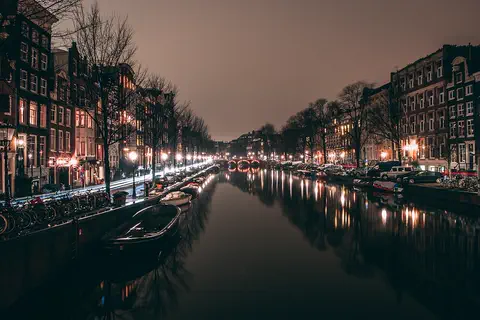
Amsterdam is the capital of the Netherlands. It began as a fishing village beside a dam on the Amstel River, which gave the city its name. Today about 942,000 people live among its rings of canals, hundreds of bridges, houseboats and bicycles.
-
 Watch
City
Athens
Athens is the capital of Greece and one of the oldest cities in the world. Above it rises the Acropolis, a rocky hill crowned by the marble Parthenon, built about 2,500 years ago. Ancient Athens was home to early democracy, great thinkers and theater.
For parents & teachers
What children will learn
- Locate Minsk near the center of landlocked Belarus.
- Explain how a city can be rebuilt after it is destroyed, and how that shapes its streets and buildings.
- Describe how railways and a metro helped Minsk grow.
- Read temperature averages to describe a climate with cold winters and warm summers.
Recommended ages: 3 to 17 · About 15 minutes
Talk about it
- Minsk was rebuilt with wide avenues and big parks. If you could plan a new city, what would you put in it?
- Railways helped Minsk grow into a factory city. What helped your town grow?
- Why might a library choose such an unusual shape for its building?
Try at home or in class
- Draw two street maps: one of an old town with narrow, twisting lanes and one of a planned city with wide, straight avenues and parks. Compare them.
- Make a simple timeline strip from 1067 to today and mark the dates from the Minsk story.
Key vocabulary: capital, landlocked, metro, avenue, moraine, rebuild
Where these facts come from
- Wikidata , Wikimedia Foundation (CC0 1.0)
- Natural Earth vector data , Natural Earth (NACIS) (Public domain)
- Minsk , Encyclopaedia Britannica
- Belarus (introduction and Land) , Encyclopaedia Britannica
- Belarus: Cultural life , Encyclopaedia Britannica
- Minsk Metropolitan (official site) , Minsk Metropolitan
- Minsk: climatological information , World Meteorological Organization, World Weather Information Service
- Wikimedia Commons , Wikimedia Foundation (Per file (public domain, CC0, CC BY or CC BY-SA); see each media record)
Checked, not yet human-reviewed. Last updated October 27, 2026. Spotted a mistake? Tell us.