
City Europe
Vilnius
Vilnius is the capital city of Lithuania. Two rivers meet there. Its old town has winding streets and many beautiful churches.
Vilnius, the capital of Lithuania, grew where the Vilnia River flows into the Neris, below a castle on a hill. It was first written about in 1323, when it was already the capital of a huge state, and its old town of Gothic, Renaissance and Baroque buildings is a UNESCO World Heritage Site. About 618,000 people lived there in 2026.
Vilnius, at the confluence of the Neris and Vilnia, was the capital of the Grand Duchy of Lithuania by 1323 and its political center into the late 18th century. A meeting place of Lithuanian, Polish, Jewish, Belarusian and Russian history, it became capital of independent Lithuania again in 1991; its historic center, with an intact medieval street plan, was inscribed by UNESCO in 1994.
Photo: Diliff, CC BY-SA 3.0, via Wikimedia Commons
Discover Vilnius
Vilnius is the capital city of Lithuania.
Two rivers meet there: the Neris and the Vilnia. On a hill above them stand the ruins of an old castle. The old town has twisty streets and many churches.
Vilnius is the capital and biggest city of Lithuania, a country in northern Europe beside the Baltic Sea. It stands where the small Vilnia River flows into the larger Neris, among wooded hills. About 618,000 people lived there in 2026.
Vilnius was first written about in 1323, when it was already the capital of the Grand Duchy of Lithuania, a very large state. Its old town, with narrow, winding streets and buildings from many centuries, is a UNESCO World Heritage Site.
Vilnius, capital and largest city of Lithuania, lies at the confluence of the Neris (Russian: Viliya) and the Vilnia, on glacial hills occupied on and off since the Neolithic. Statistics Lithuania estimated 617,984 residents in the Vilnius city municipality on January 1, 2026 (as compiled by City Population); Britannica gives 546,155 for 2021.
UNESCO notes that by 1323, the date of the first written reference, Vilnius was the capital of the Grand Duchy of Lithuania, which Britannica describes as geographically the largest state in Europe by the 15th century. The city remained the political center of the Grand Duchy until the end of the 18th century, and UNESCO credits it with a profound influence on the culture and architecture of much of eastern Europe.
- Country
- Lithuania (capital)
- People in the city municipality (January 1, 2026)
- about 618,000
- Rivers
- the Neris and the Vilnia
- First written about
- 1323
Famous places
On a hill in Vilnius stand the ruins of an old castle.
From its tower, people look out over the city. Below are old churches with towers and domes. One of them, St. Anne's, is more than 400 years old.
The ruins of the Castle of Gediminas stand on Castle Hill, high above the old town. Below them, narrow streets wind up and down the wooded slopes. The old town has buildings in many styles: Gothic, Renaissance, Baroque and Classical.
The Church of St. Anne, from the 1500s, is built in the Gothic style. About a dozen churches from the 1600s are Baroque, among them the Church of Saints Peter and Paul. The cathedral was first built in 1387; its present form dates from 1801.
Britannica describes the ruins of the Castle of Gediminas on Castle Hill as dominating the old town, whose narrow, winding streets climb the wooded slopes around the confluence. UNESCO notes that a wooden castle fortified the hill around 1000 and that the historic center keeps a typically medieval street pattern of small streets and irregular blocks, with large squares inserted later.
Surviving buildings span the Gothic, Renaissance, Baroque and Classical styles: the 16th-century Gothic Church of St. Anne, a dozen 17th-century Baroque churches, notably SS. Peter and Paul, and the cathedral, founded in 1387 but in its present form from 1801. UNESCO inscribed the Vilnius Historic Centre in 1994 for its impressive complex of buildings, its medieval layout and its natural setting, preserved despite invasions and partial destruction.
- Castle of Gediminas
- ruins on Castle Hill
- Church of St. Anne
- 16th-century Gothic
- Cathedral
- first built 1387; present form 1801
- UNESCO World Heritage Site
- Vilnius Historic Centre, 1994
Capital of a grand duchy
Long ago, a wooden castle stood on the hill in Vilnius.
The town grew below it. It became the capital of a very big land. Later, many different rulers came. Today Vilnius is Lithuania's capital again.
A wooden castle stood on the hill about 1,000 years ago, and a town grew up below it in the 1200s. By 1323 it was the capital of the Grand Duchy of Lithuania under Grand Duke Gediminas. In 1579 Vilnius University opened.
Over the centuries the city suffered wars, fires and plagues. In 1795 it passed to the Russian Empire. In the 1900s it changed hands many times, and from 1940 it was under Soviet rule. In 1991 Vilnius became the capital of independent Lithuania again.
A fortification existed in the 10th century, but the town developed only in the 13th; in 1323 it became the capital of Lithuania under Grand Duke Gediminas. After the personal union of Poland and Lithuania, Vilnius received its charter of self-government in 1387. Its population grew diverse, with Ruthenians, Jews, Poles, Germans and Tatars; about 1522 Francysk Skaryna set up a printing press, and in 1579 Vilnius University opened as a Jesuit academy founded by King Stephen Báthory.
Russian occupation (1655–60), Swedish capture (1702, 1706) and French occupation (1812) were followed by Russian rule after the Third Partition of Poland in 1795. Occupied by Germany in both world wars, the city was part of Poland from 1920 to 1939, was restored to Lithuania in 1939 and was annexed with Lithuania by the Soviet Union in June 1940; mass deportations followed in 1940–41 and 1946–50. Vilnius was for nearly 150 years a center of eastern European Jewish culture, and the YIVO Institute was founded here in 1925; the German occupation in World War II destroyed the community. Vilnius again became the capital of independent Lithuania in 1991.
Getting around Vilnius
The old streets of Vilnius are narrow and twisty.
They go up and down little hills. Newer parts of the city have straight streets and big buildings. Bridges cross the river.
In the old town, the streets are narrow and winding, as they were in the Middle Ages, and they climb up and down the wooded hills.
Around the old town, newer parts of the city were laid out with straight streets in a grid, big apartment blocks, offices and factories. Across the Neris River, tall modern buildings now rise on the far bank.
The historic center keeps its medieval layout: UNESCO describes small streets dividing it into irregular blocks, with large squares inserted in later periods, and Britannica notes how its narrow, winding streets climb the slopes around the confluence.
The contrast with the rest of the city is sharp. Around the old town, Britannica describes newer sectors with a rectangular street plan, large apartment blocks, administrative buildings and modern factories. The hero photo, taken from Gediminas' Tower, looks northwest across the Neris to a cluster of modern high-rise buildings, with bridges and riverside roads lit at dusk.
- Old town streets
- narrow and winding
- Newer districts
- rectangular street plan
- Medieval street pattern
- preserved in the historic center
Weather and seasons
Winters in Vilnius are cold.
Even in the daytime, it is usually below freezing in January. Summers are warm. July is the rainiest month.
Vilnius has cold winters and warm summers. At the World Meteorological Organization's Vilnius station, January days averaged about −2 °C and nights about −6 °C between 1981 and 2010, so it is usually freezing all day.
In July, days averaged about 23 °C and nights about 13 °C. Rain or snow falls all year, adding up to about 685 millimeters, and July is the wettest month.
WMO normals for the Vilnius station (1981–2010) give average daily highs and lows of about −2 °C and −6 °C in January and about 23 °C and 13 °C in July. Average daily highs stay below freezing in December, January and February.
Precipitation peaks in summer, with about 89 mm in July, and is lowest in February (about 37 mm); the monthly averages add up to about 685 mm. December averages about 19 days with precipitation.
- January, average daily high and low (WMO Vilnius station, 1981–2010)
- about −2 °C and −6 °C
- July, average daily high and low (same station and period)
- about 23 °C and 13 °C
- Rain and snow in a year (sum of the monthly averages)
- about 685 mm
Living in Vilnius
Vilnius has a very old university, more than 400 years old.
Students study there, and grown-ups work in offices and factories. The city has theaters and museums for everyone.
Vilnius is the cultural center of Lithuania. Vilnius University, which opened in 1579, is the country's largest university and leading research center. There are also schools of fine arts and engineering, theaters and museums.
Factories in Vilnius make machine tools, farm machines, electronics, clothes and food. For centuries, people of many backgrounds have lived here, and famous writers such as Adam Mickiewicz and Czesław Miłosz were connected with the city.
Britannica describes Vilnius as Lithuania's cultural center and an important industrial city producing machine tools, agricultural machinery, electrical and electronic apparatus, textiles, clothing and foodstuffs. Vilnius University, reorganized and closed several times over the centuries, is Lithuania's largest university and leading research institution; Vilnius Gediminas Technical University dates from 1969, and there are institutes of fine arts, teacher-training schools, theaters and museums.
The city's multiethnic past shapes its culture. Britannica notes its outsized role in Polish literature, through writers such as Adam Mickiewicz and Czesław Miłosz, and its long history as a center of Jewish learning and publishing in Hebrew and Yiddish.
- Vilnius University
- opened 1579; Lithuania's largest university
- Factories make
- machine tools, farm machinery, electronics, textiles, food
- Cultural center
- of Lithuania
Vilnius on the map
Find Vilnius on the globe.
It is in Lithuania, in northern Europe. Vilnius is in the east of the country, near the border with Belarus.
Vilnius is in the southeast of Lithuania, close to the border with Belarus. Minsk, the capital of Belarus, is to the southeast, and Riga, the capital of Latvia, is to the north.
The city sits among hills left behind by glaciers long ago, where the Vilnia River joins the Neris.
Vilnius lies at about 54.7° N and 25.3° E, in southeastern Lithuania near the Belarusian border, at the confluence of the Neris and the Vilnia. UNESCO describes the old town's site as glacial hills occupied intermittently since the Neolithic.
Britannica places the Ashmyany Upland, a ridge of glacial moraines, between Minsk and Vilnius.
- Latitude
- about 54.7° north
- Longitude
- about 25.3° east
- Rivers
- Vilnia flows into the Neris
Amazing facts
-
About 500 years ago, a printer in Vilnius made some of the very first books in his language.
About 1522, Francysk Skaryna set up a printing press in Vilnius and printed some of the first books in an East Slavic language.
Francysk Skaryna's press in Vilnius, set up about 1522, produced some of the first books published in an East Slavic language.
-
Vilnius's old castle hill had a wooden castle about 1,000 years ago.
UNESCO says a wooden castle was built around the year 1000 to guard the hill where the two rivers meet.
A wooden castle fortified Gediminas Hill around 1000, on glacial hills occupied intermittently since the Neolithic.
-
Vilnius University is more than 400 years old.
Vilnius University opened in 1579. Today it is the largest university in Lithuania.
Founded by King Stephen Báthory as a Jesuit academy, Vilnius University opened in 1579 and is now Lithuania's largest university and leading research institution.
-
Vilnius's cathedral was rebuilt to look the way it does now in 1801.
The cathedral of Vilnius was first built in 1387, but its present form dates from 1801.
The cathedral dates originally from 1387; its present form from 1801.
Words to know
- capital
- the city where a country's government meets
- confluence
- the place where two rivers meet
- grand duchy
- a land ruled by a grand duke
- Baroque
- a richly decorated style of building and art from about the 1600s and 1700s
- Gothic
- a style of building from the Middle Ages with pointed arches and tall windows
- charter
- an official document that gives a town or group certain rights
Discovery challenge
-
Vilnius is the capital of which country?
Vilnius is the capital city of which country?
Vilnius again became the capital of which independent country in 1991?
- Lithuania
- Latvia
- Estonia
Show the answer
Lithuania
Lithuania! Vilnius is its capital.
Lithuania. Riga is the capital of Latvia, and Tallinn of Estonia.
Lithuania, whose capital it had been since the Grand Duchy of the 14th century.
-
Which two rivers meet in Vilnius?
Vilnius stands where which two rivers meet?
At the confluence of which two rivers does Vilnius stand?
- The Neris and the Vilnia
- The Rhine and the Main
- The Sava and the Danube
Show the answer
The Neris and the Vilnia
The Neris and the Vilnia! They meet below the castle hill.
The small Vilnia River flows into the Neris at Vilnius.
The Neris (Russian: Viliya) and the Vilnia; UNESCO notes that the first written reference, in 1323, names it Vilnia.
-
When did Vilnius University open?
In which year did Vilnius University open?
In which year did Vilnius University, founded by Stephen Báthory as a Jesuit academy, open?
- 1579
- 1879
- 1979
Show the answer
1579
1579! That is more than 400 years ago.
It opened in 1579 and is now Lithuania's largest university.
1579; despite closures and reorganizations, it remains Lithuania's leading research institution.
-
Which month is colder in Vilnius?
In which month is Vilnius colder, on average?
In which month do nights at the WMO Vilnius station average about −6 °C?
- January
- July
Show the answer
January
January! It is freezing.
January days average about −2 °C, and July days about 23 °C.
WMO normals (1981–2010) give about −6 °C for January nights and about 13 °C for July nights.
-
What is on the hill above old Vilnius?
What stands on Castle Hill, above Vilnius's old town?
Whose castle's ruins dominate the old town from Castle Hill?
- The ruins of a castle
- A lighthouse
- A giant statue
Show the answer
The ruins of a castle
An old castle! Only part of it is left.
The ruins of the Castle of Gediminas, with a view over the whole city.
The ruins of the Castle of Gediminas, named for the grand duke under whom Vilnius became capital by 1323.
Nearby places
-
 Watch
City
Minsk
Minsk, the capital of Belarus, lies on the Svislach River near the middle of the country. First written about in 1067, it was almost completely destroyed in World War II and rebuilt with wide avenues, parks and apartment blocks. About 2 million people lived there in 2026.
-
 Watch
City
Warsaw
Warsaw is the capital of Poland, on the Vistula River. Much of the city was destroyed in World War II, and afterward its people rebuilt the Old Town so carefully that UNESCO made it a World Heritage Site. About 1.86 million people lived there in 2024.
-
 Watch
City
Tallinn
Tallinn, the capital of Estonia, lies on a bay of the Gulf of Finland. Its walled Old Town, with towers, church spires and a town hall finished in 1404, is, says UNESCO, an exceptionally complete and well-preserved medieval trading town, and today the city is also known for its technology companies.
-
 Watch
City
Kyiv
Kyiv is the capital of Ukraine, on the high west bank of the Dnieper River. More than 1,000 years ago it was the center of Kyivan Rus, the first East Slavic state, and its 11th-century St. Sophia's Cathedral and Pechersk Lavra monastery are a UNESCO World Heritage Site. About 2.95 million people lived there in 2022.
-
 Watch
City
Helsinki
Helsinki is the capital of Finland, on a peninsula in the Gulf of Finland. Founded in 1550 and made the capital in 1812, it has white stone buildings, a sea fortress on islands, and the world's most northern metro. About 694,000 people lived there at the end of 2025.
-
 Watch
Landmark
Hermitage Museum
The Hermitage in Saint Petersburg is one of the world's great art museums. Empress Catherine the Great started it in 1764 as her private collection, and it opened to the public in 1852. Today it fills five connected buildings, including the green and white Winter Palace, and holds nearly three million objects, from the Stone Age to today.
-
 Watch
City
Saint Petersburg
Saint Petersburg, in northwestern Russia, was founded by Tsar Peter the Great in 1703 on the islands of the Neva River delta. It was Russia's capital from 1712 to 1918 and is famous for the Winter Palace and Hermitage museum, its canals and bridges and its 'White Nights'. About 5.65 million people lived there in 2025.
-
 Watch
City
Stockholm
Stockholm, the capital of Sweden, is built on islands and the mainland where Lake Mälaren meets an arm of the Baltic Sea. First mentioned as a town in 1252, it has a medieval Old Town, a royal palace, a 17th-century warship you can visit and subway stations full of art. About 985,000 people lived there in 2022.
Explore next
-
Watch
 Country
Lithuania
Lithuania is the largest and southernmost of the three Baltic states. Its low land was shaped by glaciers and holds about 3,000 lakes, a long spit of sand dunes lines its coast, and about 2.89 million people lived there in 2025.
-
Watch
City
Tallinn
Tallinn, the capital of Estonia, lies on a bay of the Gulf of Finland. Its walled Old Town, with towers, church spires and a town hall finished in 1404, is, says UNESCO, an exceptionally complete and well-preserved medieval trading town, and today the city is also known for its technology companies.
-
Watch
City
Minsk
Minsk, the capital of Belarus, lies on the Svislach River near the middle of the country. First written about in 1067, it was almost completely destroyed in World War II and rebuilt with wide avenues, parks and apartment blocks. About 2 million people lived there in 2026.
-
 Watch
City
Prague
Prague, the capital of the Czech Republic, lies on the Vltava River in the heart of Europe. With Prague Castle on its hill, the 14th-century Charles Bridge and so many church towers that it is called the 'City of a Hundred Spires', its historic center is a UNESCO World Heritage Site. About 1.4 million people lived there in 2025.
- Watch Geography What is a World Heritage Site? World Heritage Sites are places so important that they belong, in a way, to everyone. Under a 1972 agreement, countries nominate their most outstanding places, experts check them, and a UNESCO committee decides. By 2026 the list held 1,273 sites: cultural places like the Taj Mahal, natural places like the Galápagos, and mixed ones like Machu Picchu.
- Watch Geography Capital cities A capital is the city where a country's government is based. Many capitals grew up over hundreds of years beside rivers and trade routes. A few, like Brasília and Canberra, were built from scratch, and some countries share out their capital's jobs among two or three cities.
-
 Watch
City
Amsterdam
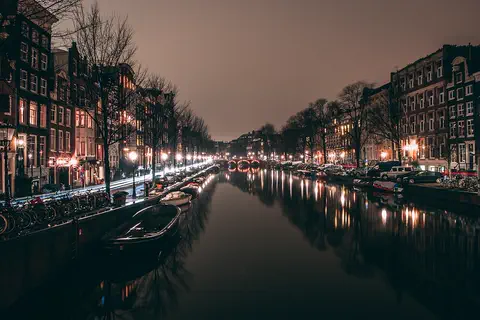
Amsterdam is the capital of the Netherlands. It began as a fishing village beside a dam on the Amstel River, which gave the city its name. Today about 942,000 people live among its rings of canals, hundreds of bridges, houseboats and bicycles.
-
 Watch
City
Athens
Athens is the capital of Greece and one of the oldest cities in the world. Above it rises the Acropolis, a rocky hill crowned by the marble Parthenon, built about 2,500 years ago. Ancient Athens was home to early democracy, great thinkers and theater.
For parents & teachers
What children will learn
- Locate Vilnius where the Vilnia meets the Neris in southeastern Lithuania.
- Describe how an old town keeps its medieval street plan and buildings from many periods.
- Explain that Vilnius was the capital of a large state and a meeting place of many cultures.
- Read temperature averages to describe a climate with cold winters and warm summers.
Recommended ages: 3 to 17 · About 15 minutes
Talk about it
- Vilnius's old streets are narrow and winding while newer districts are laid out in a grid. Why might cities change the way they plan streets?
- People of many languages and faiths have lived in Vilnius. How can a city remember all of its history?
- Why do you think a castle was built on a hill where two rivers meet?
Try at home or in class
- Draw two maps side by side: an old town with winding lanes around a castle hill, and a new district with streets in a grid.
- Find a picture of a Gothic church and a Baroque church and list three differences you can see.
Key vocabulary: capital, confluence, grand duchy, Baroque, Gothic, charter
Where these facts come from
- Wikidata , Wikimedia Foundation (CC0 1.0)
- Natural Earth vector data , Natural Earth (NACIS) (Public domain)
- UNESCO World Heritage List , UNESCO World Heritage Centre (Linked as a reference; site facts come from Wikidata)
- Vilnius , Encyclopaedia Britannica
- Belarus (introduction and Land) , Encyclopaedia Britannica
- Vilnius County: municipalities (Statistics Lithuania census 2021 and estimate for January 1, 2026) , City Population (Thomas Brinkhoff)
- Vilnius Historic Centre , UNESCO World Heritage Centre
- Vilnius: climatological information , World Meteorological Organization, World Weather Information Service
- Wikimedia Commons , Wikimedia Foundation (Per file (public domain, CC0, CC BY or CC BY-SA); see each media record)
Checked, not yet human-reviewed. Last updated October 27, 2026. Spotted a mistake? Tell us.