
Landmark Europe
St. Basil's Cathedral
St. Basil's Cathedral is a church in Moscow, Russia. It has lots of bright, swirly, onion-shaped domes. It is really ten churches joined together!
St. Basil's Cathedral stands at the end of Red Square in Moscow. Tsar Ivan IV ordered it in 1555, and it was finished by 1561. It is really ten small churches in one building, each with its own colorful dome, and today it is a museum.
Built for Ivan IV in the 1550s to mark the capture of Kazan, the Pokrovsky Cathedral is a cluster of red-brick chapels around a tall tented central church. Rebuilding after a fire in the 1580s gave it its onion domes, and repainting from the late 1600s to the mid-1800s its bright colors; it is now a branch of the State Historical Museum.
Photo: Diego Delso, public domain, via Wikimedia Commons
Discover St. Basil's
St. Basil's is in Moscow, a big city in Russia.
It stands at one end of a huge square called Red Square. Its walls are made of red brick. On top are many domes shaped like onions, painted in stripes and zigzags of blue, green, red and gold.
St. Basil's Cathedral stands at the south end of Red Square, the great open square beside the Kremlin in the middle of Moscow. Its official name is the Cathedral of the Intercession, or Pokrovsky Cathedral.
From outside it looks like one building, but it is really ten churches in one. Red-brick chapels stand in a ring around a tall central church, and each chapel wears a brightly painted dome. Most of these domes are onion domes: round and wide, with a pointed tip. Together with the Kremlin, the cathedral is part of a UNESCO World Heritage Site. Today it is a museum.
Red Square lies directly east of the Kremlin; at its southern end, opposite the State Historical Museum, stands the cathedral, officially the Cathedral of the Intercession on the Moat or Pokrovsky Cathedral. UNESCO, which listed the Kremlin and Red Square in 1990, calls it one of the most beautiful monuments of Old Russian church architecture and still a major work of Russian Orthodox art.
The building is a group of red-brick chapels in a mostly symmetrical layout around the largest, central church, which carries a steep tented roof; each chapel has its own colored dome. Britannica calls it nine-towered, and the State Historical Museum, which runs it as a branch, describes it as ten churches in one, with interiors dating from the 16th to the 20th centuries.
- Where
- Red Square, Moscow, Russia
- Built
- 1555 to 1561 (museum's dates)
- Churches inside
- 10
- World Heritage
- Kremlin and Red Square, listed 1990
Built for a tsar
Long ago, Russia was ruled by a tsar named Ivan.
He ordered a new church to celebrate winning a city called Kazan. Later, a small church was added for a man of Moscow named Basil. That is how the cathedral got its nickname.
In 1555, Tsar Ivan IV, known as Ivan the Terrible, ordered a new church on Red Square to celebrate his army's capture of Kazan, a city to the east. The museum says it was built from 1555 to 1561.
No one knows for sure who designed it. Two architects are usually named, Barma and Postnik Yakovlev, but some historians think these were two names for one person. In 1588, during the reign of Ivan's son Fyodor, a tenth church was added over the grave of Basil the Blessed, a Moscow man who lived in Ivan's time. People began calling the whole cathedral after him: St. Basil's.
Ivan IV ordered the church to commemorate his victory over the Kazan Khanate; Britannica adds his victory over Astrakhan. Dates differ slightly: Britannica gives 1554 to 1560, UNESCO 1555 to 1560 and the State Historical Museum 1555 to 1561.
The architects cannot be confirmed. Britannica names two Russian architects, Posnik and Barma, who may have been one person; CNN, interviewing the architectural historian William Brumfield, notes that Barma may have been Postnik Yakovlev's nickname and that fires, invasions and Moscow's burning in 1812 destroyed many records. The museum explains that Basil the Blessed, a Moscow inhabitant who lived at the same time as Ivan IV, was buried on the site, and in 1588 a church dedicated to him was built there; Britannica places his burial in the reign of Fyodor I (1584 to 1598), and his name became the cathedral's popular name. By CNN's account the building burned in 1583 and was rebuilt over the following decade.
Brick, tents and onion domes
The builders used red bricks to make the walls.
The middle church has a tall, pointy roof like a tent. The other churches stand around it in a ring. The bright colors were painted on much later.
The builders made the cathedral from red brick. According to the architectural historian William Brumfield, Russian builders had learned new ways of building tall brick towers from Italian architects, who had worked in Moscow earlier. That skill let them give the central church a steep, pointed tented roof. When it was finished, the cathedral was the tallest structure in the city.
The chapels stand in a mostly balanced pattern around the center. The onion domes were added after a fire in the 1580s, and the bright colors came even later, between the late 1600s and the mid-1800s, as fashions changed.
CNN, drawing on the historian William Brumfield, explains that between 1475 and 1510 Italian architects rebuilt the Kremlin and two major churches, bringing Renaissance brick technology that let Russian builders raise tall vertical forms, including the steep tented roof of St. Basil's central church. CNN describes the finished building as the tallest structure in Moscow at the time.
The present onion domes, flared cupolas later typical of Russian Orthodox architecture, are known to date from after the fire, though how the building looked before it is uncertain; Brumfield suggests St. Basil's may have been among the first in the region to adopt them. UNESCO credits the 17th century with the cathedral's present appearance, through the decorative finishing of the domes and painting inside and out, and CNN dates the vivid colors to the late 17th to mid-19th centuries. A bell tower was later added, and the interior gained floral decoration and figurative murals.
Ten churches in one
Every dome looks different! One has blue and white stripes. One has green and yellow diamonds. One has red and green zigzags.
Inside, the walls are painted with leaves, flowers and pictures.
Look closely and you will see that no two domes are alike. Some have stripes, some have diamond shapes, and some have zigzags, in blues, greens, reds and yellows. The tallest part, in the middle, is the tented roof of the central church, with a small golden dome on top.
Inside, the walls and domes are covered with paintings of plants and of saints, from many different centuries. The museum also shows old icons, which are religious paintings on wood, and precious gifts in the old sacristy, the room where church treasures were kept.
The ten churches, each of which, CNN notes, housed an altar dedicated to a saint associated with Ivan's power, are linked into one building around the tented central church. The State Historical Museum says the walls and domes are covered with frescoes and oil paintings of plant ornament and images of saints, and the interiors show work from the 16th to the 20th centuries.
The museum's temporary exhibition presents rare examples of the old Russian icon-painting school and masterpieces of applied art, and donations from royalty and parishioners are displayed in the former sacristy. In the photo, the striped, faceted and chevron-patterned onion domes show the variety that the late 17th- to mid-19th-century repainting produced.
- Churches
- 10
- Central church
- tall tented roof
- Basil's church
- added 1588
- Colors
- added from the late 1600s to the mid-1800s
St. Basil's today
Today, St. Basil's is a museum.
Visitors climb steep steps and walk through the little churches. In front stands a big statue of two men from long ago.
Today the cathedral is a branch of the State Historical Museum, which calls itself Russia's largest national museum and stands at the other end of Red Square. Visitors explore the ten churches, but the steps are high and the upper floor cannot be reached by wheelchair.
The cathedral has survived many dangers: big fires in the 1580s and in 1737, Napoleon's army in 1812, and the threat of being torn down in the 1930s. In front of it stands a bronze monument to Kuzma Minin and Prince Dmitry Pozharsky, two leaders from the year 1612. It was moved there in 1930.
The cathedral is a branch of the State Historical Museum, which describes itself as Russia's largest national museum; the museum notes that high steps and a stair-only second floor limit access for strollers and wheelchairs.
CNN lists the threats it has survived: a damaging fire in 1737, a near escape from being blown up by Napoleon's forces in 1812, and the threat of demolition under Stalin in the 1930s. Britannica records that in 1930 the monument to Kuzma Minin and Prince Dmitry Pozharsky, leaders of the army that forced the surrender of Polish forces in 1612, was moved from the center of Red Square to its present place in front of St. Basil's to make room for parades and demonstrations.
Amazing facts
-
St. Basil's is ten churches joined together.
St. Basil's looks like one building, but it holds ten separate churches.
The State Historical Museum describes the cathedral as ten churches in one.
-
The bright colors were added long after it was built.
The cathedral was not always so colorful. Its bright colors were added from the late 1600s to the mid-1800s.
The vivid color scheme accumulated between the late 17th and mid-19th centuries as fashions favored brighter colors.
-
Nobody is sure who designed it.
Historians are not sure who designed St. Basil's. Two names are given, Barma and Postnik, and they may even be the same person.
Britannica names Posnik and Barma as the architects but notes they may have been one person.
-
The statue in front used to stand in the middle of the square.
The statue of Minin and Pozharsky was moved in front of St. Basil's in 1930 to make room for parades.
In 1930 the Minin and Pozharsky monument was moved from the center of Red Square to the front of St. Basil's to make room for parades and demonstrations.
Words to know
- cathedral
- a large, important church
- onion dome
- a round roof that swells out and then narrows to a point, like an onion
- tsar
- the title of the rulers of Russia in the past
- chapel
- a small church, or a small room for worship inside a bigger church
- tented roof
- a steep, pointed roof shaped like a tall tent
- fresco
- a painting made on wet plaster on a wall or ceiling
Discovery challenge
-
Which city is St. Basil's in?
In which city does St. Basil's Cathedral stand?
On which city's Red Square does St. Basil's stand?
- Moscow
- Paris
- Cairo
Show the answer
Moscow
Moscow! It is a big city in Russia.
It stands at the south end of Red Square in Moscow, Russia.
Moscow; Red Square and the Kremlin were listed together by UNESCO in 1990.
-
How many churches are inside St. Basil's?
How many churches are joined together in St. Basil's?
How many churches does the State Historical Museum count in the cathedral?
- Two
- Ten
- Fifty
Show the answer
Ten
Ten churches in one building!
Ten churches: a ring of chapels around a tall central church.
Ten, the last of them the church built over Basil's burial place in 1588.
-
What shape are most of the domes?
What are the round, pointed domes of St. Basil's called?
What name is given to the flared cupolas added after the 1580s fire?
- Onion domes
- Square domes
- Flat domes
Show the answer
Onion domes
Onion domes! They are round with a pointy top.
They are onion domes: wide and round, narrowing to a point.
Onion domes, which became typical of Russian Orthodox architecture.
-
Were the bright colors always there?
When were the cathedral's bright colors added?
Over which period did the cathedral acquire its vivid colors?
- Over many years, long after it was built
- On the very first day
- Last year
Show the answer
Over many years, long after it was built
No! The colors were added long after it was built.
They were added from the late 1600s to the mid-1800s.
From the late 17th to the mid-19th centuries, as tastes changed.
Nearby places
-
 Watch
Landmark
Moscow Kremlin
The Moscow Kremlin is the oldest part of Moscow. It began as a wooden fort on a hill by the Moskva River. Its present walls and towers were built from 1485 to 1516. Inside stand golden-domed cathedrals, palaces, a tall bell tower and museums.
-
Watch
City
Moscow
Moscow, the capital of Russia, grew up on the Moscow River around a fortress called the Kremlin. About 13.3 million people lived there in 2025. Its rings of roads, snowy winters and palace-like subway stations make it like no other city.
-
 Watch
Landmark
Hermitage Museum
The Hermitage in Saint Petersburg is one of the world's great art museums. Empress Catherine the Great started it in 1764 as her private collection, and it opened to the public in 1852. Today it fills five connected buildings, including the green and white Winter Palace, and holds nearly three million objects, from the Stone Age to today.
-
 Watch
City
Saint Petersburg
Saint Petersburg, in northwestern Russia, was founded by Tsar Peter the Great in 1703 on the islands of the Neva River delta. It was Russia's capital from 1712 to 1918 and is famous for the Winter Palace and Hermitage museum, its canals and bridges and its 'White Nights'. About 5.65 million people lived there in 2025.
-
 Watch
City
Minsk
Minsk, the capital of Belarus, lies on the Svislach River near the middle of the country. First written about in 1067, it was almost completely destroyed in World War II and rebuilt with wide avenues, parks and apartment blocks. About 2 million people lived there in 2026.
-
 Watch
City
Kyiv
Kyiv is the capital of Ukraine, on the high west bank of the Dnieper River. More than 1,000 years ago it was the center of Kyivan Rus, the first East Slavic state, and its 11th-century St. Sophia's Cathedral and Pechersk Lavra monastery are a UNESCO World Heritage Site. About 2.95 million people lived there in 2022.
-
 Watch
City
Vilnius
Vilnius, the capital of Lithuania, grew where the Vilnia River flows into the Neris, below a castle on a hill. It was first written about in 1323, when it was already the capital of a huge state, and its old town of Gothic, Renaissance and Baroque buildings is a UNESCO World Heritage Site. About 618,000 people lived there in 2026.
-
 Watch
City
Tallinn
Tallinn, the capital of Estonia, lies on a bay of the Gulf of Finland. Its walled Old Town, with towers, church spires and a town hall finished in 1404, is, says UNESCO, an exceptionally complete and well-preserved medieval trading town, and today the city is also known for its technology companies.
Explore next
-
Watch
 Country
Russia
Russia is the largest country in the world. It stretches across eastern Europe and all of northern Asia, through 11 time zones, from the Baltic Sea to the Pacific Ocean. It has frozen tundra, huge forests, Lake Baikal and the big cities of Moscow and Saint Petersburg.
-
Watch
City
Moscow
Moscow, the capital of Russia, grew up on the Moscow River around a fortress called the Kremlin. About 13.3 million people lived there in 2025. Its rings of roads, snowy winters and palace-like subway stations make it like no other city.
-
Watch
Landmark
Moscow Kremlin
The Moscow Kremlin is the oldest part of Moscow. It began as a wooden fort on a hill by the Moskva River. Its present walls and towers were built from 1485 to 1516. Inside stand golden-domed cathedrals, palaces, a tall bell tower and museums.
-
 Watch
Landmark
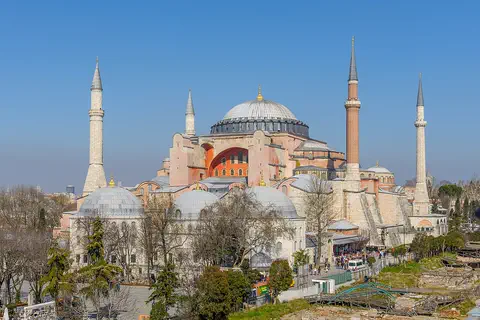
Hagia Sophia
Hagia Sophia in Istanbul was built in under six years, from 532 to 537, for the emperor Justinian. Its enormous dome seems to float on a ring of 40 windows. Over almost 1,500 years it has been a church, a mosque and a museum, and since 2020 it has been a mosque.
-
Watch
Landmark
Hermitage Museum
The Hermitage in Saint Petersburg is one of the world's great art museums. Empress Catherine the Great started it in 1764 as her private collection, and it opened to the public in 1852. Today it fills five connected buildings, including the green and white Winter Palace, and holds nearly three million objects, from the Stone Age to today.
-
 Watch
Landmark
Acropolis of Athens
The Acropolis is a steep, flat-topped rock in the middle of Athens. Walls have ringed its top for more than 3,300 years. In the 400s BCE, the Athenians built a grand gateway and three temples there, including the Parthenon. Restorers are still repairing them today.
-
 Watch
Landmark
Alhambra
The Alhambra is a palace and fortress above the city of Granada, in Spain. The Nasrid rulers built most of it between 1238 and 1358. It is famous for its courtyards, fountains, carved plaster and tiles, and the gardens of the Generalife next door.
-
 Watch
Landmark
Arc de Triomphe
The Arc de Triomphe is a huge stone arch at the top of the Champs-Élysées in Paris. Napoleon ordered it in 1806, but it took 30 years to finish. It is about 50 meters high and 45 meters wide, covered in giant carvings, and under it lies France's Tomb of the Unknown Soldier, with a flame that is rekindled every evening.
For parents & teachers
What children will learn
- Locate Moscow and Red Square and explain that St. Basil's was built for Ivan IV in the 1550s.
- Describe the cathedral as ten churches in one, with a tented central church and onion domes.
- Understand that buildings change over time: the colors were added over centuries.
- Discuss why historians are sometimes unsure about who built something.
Recommended ages: 3 to 17 · About 15 minutes
Talk about it
- Every dome of St. Basil's has a different pattern. Why might builders make each one different?
- Historians are not sure who designed the cathedral. Why might old records go missing?
- The cathedral has changed color and shape over the years. Is it still the same building? Why?
Try at home or in class
- Draw your own onion dome and fill it with a pattern of stripes, zigzags or diamonds using bright colors.
- Build a cluster of small towers from paper cups and cones around one tall center, like the ten churches of St. Basil's.
Key vocabulary: cathedral, onion dome, tsar, chapel, tented roof, fresco
Where these facts come from
- Wikidata , Wikimedia Foundation (CC0 1.0)
- St. Basil's Cathedral (Pokrovsky Cathedral) , State Historical Museum, Moscow
- Saint Basil the Blessed , Encyclopaedia Britannica
- Red Square , Encyclopaedia Britannica
- Kremlin and Red Square, Moscow , UNESCO World Heritage Centre
- Saint Basil's Cathedral: The mysterious origins of Moscow's multicolored landmark , CNN Style
- Wikimedia Commons , Wikimedia Foundation (Per file (public domain, CC0, CC BY or CC BY-SA); see each media record)
Checked, not yet human-reviewed. Last updated October 27, 2026. Spotted a mistake? Tell us.