
City Europe
Kyiv
Kyiv is the capital city of Ukraine. It sits on high hills beside a wide river. Its old churches have shiny golden and green domes.
Kyiv is the capital of Ukraine, on the high west bank of the Dnieper River. More than 1,000 years ago it was the center of Kyivan Rus, the first East Slavic state, and its 11th-century St. Sophia's Cathedral and Pechersk Lavra monastery are a UNESCO World Heritage Site. About 2.95 million people lived there in 2022.
Kyiv, Ukraine's capital, rises on wooded bluffs above the Dnieper just below the Desna. Capital of Kyivan Rus from about 882, it was sacked by the Mongols in 1240, then ruled by Lithuania, Poland and Russia, devastated in World War II, and became the capital of independent Ukraine in 1991. Its 11th-century St. Sophia's Cathedral and the Kyiv-Pechersk Lavra form a World Heritage Site (1990).
Photo: Rbrechko, CC BY-SA 4.0, via Wikimedia Commons
Discover Kyiv
Kyiv is the capital city of Ukraine.
It is built on tall, green hills beside a big river, the Dnieper. Golden domes shine on top of its old churches. It has parks, gardens and lots of trees.
Kyiv is the capital and biggest city of Ukraine, a large country in eastern Europe. It sits on the Dnieper River, 951 kilometers upstream from where the river flows into the Black Sea. About 2.95 million people lived there in 2022.
The old city stands on high, steep, wooded bluffs on the river's west bank, topped by the golden domes of churches and bell towers. Since World War II the city has spread across the river onto the flat land of the east bank. Because Kyiv was the center of the first East Slavic state more than 1,000 years ago, it is called the "Mother of Rus Cities."
Kyiv stands on the Dnieper (Dnipro) just below its confluence with the Desna, 951 km from the river's mouth on the Black Sea. The original city occupied the high right (western) bank, a line of bluffs rising to Batyyeva Hill, about 100 m above the river; since World War II the city has spread across the low, flat floodplain of the left bank. The city limits enclose 780 km² on both banks, and Ukraine's State Statistics Service counted a present population of 2,952,301 on January 1, 2022.
As the center of Kyivan Rus, the first East Slavic state, Kyiv earned the title 'Mother of Rus Cities.' It is a river port and a large railroad junction, an administrative and industrial center, and, Britannica notes, an attractive city for its sharply contrasted relief, its wide views across the Dnieper and its abundance of greenery and historic buildings.
- Country
- Ukraine (capital)
- People in the city (2022)
- about 2.95 million
- Area
- 780 km²
- River
- Dnieper (Dnipro), 951 km from the Black Sea

Famous places
Kyiv has very old churches.
St. Sophia's Cathedral is white, with green and golden domes. Inside are very old pictures made of tiny tiles. Another old place, the Lavra, has a tall bell tower and caves under the ground.
St. Sophia's Cathedral was built in the 1000s, when Kyiv was a powerful capital. Its many domes are green and gold, and inside, its walls glow with frescoes, paintings made on wet plaster, and mosaics, pictures made from tiny pieces of colored glass and stone. Today it is a museum. Nearby are the ruins of the Golden Gate, an old city gate from the same century.
The Kyiv-Pechersk Lavra, or Monastery of the Caves, was founded in the mid-1000s on the high riverbank. It has churches, a bell tower 96 meters tall and long underground passages. Together, St. Sophia's and the Lavra are a UNESCO World Heritage Site.
St. Sophia's Cathedral, built in the 11th century in the reign of Grand Prince Yaroslav I and now a museum, is, despite 18th-century Baroque modifications, one of the finest examples of early Rus-Byzantine church architecture: a core of a nave and four aisles, later widened with more aisles, and a crown of green-and-gold domes, with interior frescoes and mosaics and Yaroslav's tomb. UNESCO notes it was designed to rival Hagia Sophia in Constantinople. Close by stand the ruins of the 11th-century Golden Gate and the Baroque St. Andrew's Church, designed by Bartolomeo Rastrelli in the mid-18th century on the crest of the slope.
The Kyiv-Pechersk Lavra (Monastery of the Caves), founded in the mid-11th century, is still a working monastery as well as a museum. The monk Nestor helped compile the earliest surviving chronicle of Rus there. Its Cathedral of the Assumption, blown up in 1941 in circumstances that remain uncertain, has been completely rebuilt; it also has the 17th-century Church of All Saints, an 18th-century bell tower of 96 m and catacombs where early monks are entombed. UNESCO inscribed the two complexes in 1990.
- St. Sophia's Cathedral
- built in the 11th century; green and golden domes
- Kyiv-Pechersk Lavra
- monastery founded in the mid-1000s
- Lavra bell tower
- 96 m tall, 18th century
- UNESCO World Heritage Site
- inscribed 1990
More than a thousand years of history
People have lived where Kyiv is for a very, very long time.
More than 1,000 years ago, Kyiv was a rich, busy city. Traders sailed along the river. Builders made beautiful churches. Later the city was damaged many times, and each time people rebuilt it.
People lived here as long ago as the Late Stone Age, some 40,000 to 15,000 years ago. Kyiv celebrated its 1,500th birthday in 1982, although archaeologists think the town began in the 500s or 600s. Around 882 it became the capital of Kyivan Rus, a state that grew rich from trade along the Dnieper between the Baltic Sea and the Byzantine Empire. In its golden age Kyiv had hundreds of churches.
In 1240 a Mongol army destroyed much of the city. Later Kyiv was ruled by Lithuania, Poland and Russia. It was badly damaged in World War II but was restored by the mid-1950s. In 1991 Ukraine became independent, and Kyiv became the capital of the new country.
Mammoth bones and stone tools show settlement in the Late Paleolithic, and the Trypillya culture farmed here. Kyiv traditionally dates its founding to 482 CE and marked its 1,500th anniversary in 1982, but archaeology points to the 6th or 7th century. Varangians seized it in the mid-9th century, and about 882 Oleg of Novgorod made it the capital of Kyivan Rus, rich from the 'road from the Varangians to the Greeks'. Christianity was introduced in 988; by the 12th century the chronicles counted more than 400 churches. The Mongols stormed the city in 1240.
Lithuania took Kyiv in 1362 and Poland in 1569; after the Cossack revolt of Bohdan Khmelnytsky (1649) and the treaties of 1667 and 1686, it passed to Muscovy and later the Russian Empire. In 1918 Kyiv was proclaimed capital of an independent Ukraine, amid years of war; the Soviet capital moved to Kharkiv until 1934. German forces held the city from 1941 to 1943, murdering Jews and others at the Babi Yar ravine. The 1986 Chernobyl disaster struck 104 km to the north. Ukraine voted for independence on December 1, 1991. Mass protests filled the capital in 2004 and, centered on the Maidan, in 2013–14. In February 2022 Russia began a full-scale invasion of Ukraine; Britannica records that the Ukrainian military checked the Russian advance at several points and that civilians took up arms to defend the capital. In 2023 UNESCO added the city's World Heritage Site to its List of World Heritage in Danger.
Getting around Kyiv
In Kyiv, a little train called a funicular climbs up the steep hill.
Trains also run under the ground. Buses and trams roll along the streets. Long bridges cross the wide river.
Kyiv has a subway, as well as trains, buses, streetcars and trolleybuses, which are buses powered by electric wires overhead. Because the old city sits high above the river, a funicular railway carries people up and down the 90-meter slope.
Bridges join the two banks of the Dnieper, including the Paton road bridge, 1,500 meters long. Railways and highways link Kyiv with the rest of Ukraine and with Poland, and boats use the river, which has been made easier to navigate with dams and reservoirs.
Britannica describes efficient subway, rail, bus, streetcar and trolleybus service within the city, and trunk railways and all-weather roads to Kharkiv and the Donets Basin, southern Ukraine and Odesa, western Ukraine and Poland. Kyiv was linked by rail to Moscow and Odesa in the late 1860s. The Dnieper's navigability has been improved by a series of barrages and reservoirs, and the hydroelectric station at Vyshhorod, just upstream, was completed in 1968.
The left bank, almost unsettled before World War II, is tied to the old city by a railway bridge and by the 1,500 m Ye. O. Paton road bridge, named for its designer. In the riverside park below the Upper Town, a funicular railway climbs the 90 m slope. Boryspil International Airport is the city's main airport.
- In the city
- subway, trains, buses, streetcars and trolleybuses
- Funicular railway
- climbs a slope of about 90 m
- Paton Bridge
- 1,500 m long
- Main airport
- Boryspil International
Weather and seasons
Kyiv has snowy winters and warm summers.
Snow often covers the ground for months. In summer, people swim and play at a beach on an island in the river.
Kyiv has cold winters and warm summers. In January, the average daily high is just below freezing, about −1 °C, and the low about −6 °C; snow usually covers the ground from mid-November to the end of March. In July, highs average about 27 °C.
The rainiest months are in summer. When the wind blows from the north or northeast in winter, the temperature can drop sharply. In summer, people head to Trukhaniv Island in the Dnieper, opposite the city center, where there is a beach and water sports.
Britannica describes a moderately continental climate, with a January average of −6 °C, a July average of 20 °C and about 635 mm of precipitation a year, most in June and July. World Meteorological Organization normals for 1991–2020 give mean daily maxima and minima of −0.7 °C and −5.5 °C in January and 26.6 °C and 16.6 °C in July, with July the wettest month at about 77 mm.
Winter days above freezing are not uncommon, but northerly or northeasterly cold spells can bring sharp drops; Britannica cites a record low of −33 °C and a record high of 39 °C. Snow cover usually lasts from mid-November to the end of March, and the frost-free period averages 180 days, sometimes more than 200.
- January, average daily high and low
- about −1 °C and −6 °C
- July, average daily high and low
- about 27 °C and 17 °C
- Snow on the ground
- usually mid-November to the end of March
Living in Kyiv
Kyiv is a city of trees and parks.
A long park runs along the top of the riverbank, with wide views of the water. People go to the theater, the opera and museums. Many cheer for the city's soccer team.
Kyiv is a green city. A landscaped park runs along the top of the riverbank, with views across the Dnieper, and there are big botanical gardens and forest parks on the edge of the city. The main street, Khreshchatyk, is lined with trees and gardens, and its best-known square is Maidan Nezalezhnosti, Independence Square.
Kyiv has a national opera, many theaters and museums, and a large university, founded in 1834. Many people follow soccer: the Olympic Stadium is home to the Dynamo Kyiv club and hosted the final of the 2012 European Championship.
Khreshchatyk, the city's axis, runs along a small valley whose sides are terraced gardens among modern towers; Britannica describes its trees, squares, colored brick, granite and ceramic tiles. Across it runs the poplar-lined Taras Shevchenko Boulevard with the red-walled university (1834) and St. Volodymyr's Cathedral (1862–96). North of the center lies Podil, the old trading and Jewish quarter, with the House of Contracts (1817); to the south, Pecherskyy holds the parliament and government buildings and the Mariinsky Palace (1747–55).
Postwar suburbs are built of 'microregions', groups of 12- to 20-story apartment blocks for 2,500 to 5,000 people, each with shops, a clinic, a cinema and a primary school, set among parks; the 4,450 ha Pushcha-Vodytsya Forest Park lies to the north. Cultural life includes the Taras Shevchenko National Opera, the Ivan Franko and Lesia Ukrainka theaters and the National Art Museum. The Olympic Stadium, home of Dynamo Kyiv, hosted the 2012 European Championship final.
- University of Kyiv
- established 1834
- Pushcha-Vodytsya Forest Park
- 4,450 hectares
- Main street
- Khreshchatyk
Kyiv on the map
Find Kyiv on the globe.
It is in Ukraine, in eastern Europe. Look for the long Dnieper River. Kyiv sits on its banks, in the north of the country.
Kyiv is in the north-central part of Ukraine, in eastern Europe. It sits on the Dnieper River, just downstream from where the Desna River joins it. From Kyiv, the Dnieper flows 951 kilometers south to the Black Sea.
The old city is on the high west bank. Newer districts spread across the low, flat east bank. North of the old center is the river port.
Kyiv lies at about 50.4° N and 30.5° E, in north-central Ukraine, on the Dnieper just below its confluence with the Desna and 951 km above its mouth on the Black Sea. The steep right bank, rising about 100 m to Batyyeva Hill, carries the old Upper Town, Podil and Pecherskyy; the wide floodplain of the left bank holds postwar districts.
Ancient trade made the site important: from Kyiv, the Dnieper led south to the Byzantine Empire, while portages to the north connected it with rivers draining to the Baltic Sea, the 'road from the Varangians to the Greeks'. Trade also reached the Caspian Sea and Central Asia.
- Latitude
- about 50.4° north
- Longitude
- about 30.5° east
- Height of the bluffs
- about 100 m above the river
Amazing facts
-
Mammoth bones have been found where Kyiv stands.
Archaeologists have found mammoth bones and stone tools from people who lived here 15,000 to 40,000 years ago.
Stone and bone tools, the remains of dwellings of wood and skins and large accumulations of mammoth bones show Late Paleolithic settlement, some 40,000 to 15,000 years ago.
-
Long ago, Kyiv had hundreds of churches.
By the 1100s, old chronicles say, Kyiv had more than 400 churches.
According to the chronicles, Kyiv's wealth in the 12th century was shown by its more than 400 churches; it was famed for mosaics, frescoes and silverwork.
-
Kyiv's river had a famous trade road on the water.
Traders once traveled from the Baltic Sea to the Byzantine Empire along a route through Kyiv called the "road from the Varangians to the Greeks."
Kyivan Rus flourished on the 'road from the Varangians to the Greeks', the Dnieper route south to Byzantium and north by portages to rivers flowing to the Baltic.
-
Kyiv has a huge forest park full of trees with needles.
The Pushcha-Vodytsya Forest Park, north of Kyiv, covers about 4,450 hectares, mostly of conifers, trees with needles and cones.
North of the city, the coniferous Pushcha-Vodytsya Forest Park covers nearly 4,450 ha; to the south lies the deciduous Holosiivsky Park.
-
St. Sophia's Cathedral is about a thousand years old.
St. Sophia's Cathedral was built in the 1000s, and its walls are decorated with frescoes and mosaics.
St. Sophia's, built in the 11th century and now a museum, holds the tomb of Yaroslav I, during whose reign it was built.
Words to know
- capital
- the city where a country's government meets
- bluff
- a high, steep bank beside a river or the sea
- cathedral
- a large, important church
- monastery
- a place where monks live, work and pray together
- mosaic
- a picture made from many small pieces of colored stone or glass
- fresco
- a painting made on wet plaster on a wall or ceiling
- funicular
- a railway that pulls cars up and down a steep slope with a cable
Discovery challenge
-
Which river flows past Kyiv?
Kyiv stands on the high banks of which river?
Kyiv lies just below the confluence of the Desna with which river?
- The Dnieper
- The Nile
- The Amazon
Show the answer
The Dnieper
The Dnieper! It is a wide river.
The Dnieper, which flows 951 kilometers from Kyiv to the Black Sea.
The Dnieper (Dnipro); the old city sits on its high right bank.
-
What color are the domes of St. Sophia's?
What colors are the domes of St. Sophia's Cathedral today?
St. Sophia's white walls are crowned by domes of which colors?
- Green and gold
- Red and blue
- Black and white
Show the answer
Green and gold
Green and gold! They shine in the sun.
Green and gold, on top of white walls.
Green and gold, over white walls modified in the 18th-century Baroque style.
-
What helps people climb Kyiv's steep hill?
What carries people up the 90-meter slope from the river to the old city?
In the riverside park below the Upper Town, what climbs the 90 m slope?
- A funicular railway
- A ski lift
- A hot-air balloon
Show the answer
A funicular railway
A funicular! It is a little train pulled up the hill.
A funicular railway, pulled up and down the slope.
A funicular railway, in the landscaped park along the riverbank.
-
Kyiv was the center of which old land?
More than 1,000 years ago, Kyiv was the center of which state?
Which state, the first East Slavic state, had Kyiv as its capital from about 882?
- Kyivan Rus
- Ancient Egypt
- The Inca Empire
Show the answer
Kyivan Rus
Kyivan Rus! That is why Kyiv is called the Mother of Rus Cities.
Kyivan Rus, the first East Slavic state.
Kyivan (Kievan) Rus, made its capital by Oleg of Novgorod about 882.
-
What is under the Lavra monastery?
The Kyiv-Pechersk Lavra is also called the Monastery of the what?
What does 'Pechersk' refer to in the name of the Kyiv-Pechersk Lavra, founded in the mid-11th century?
- Caves
- Bridges
- Towers
Show the answer
Caves
Caves! Long passages run under the ground.
The Caves. Underground passages run beneath it.
Caves: it is the Monastery of the Caves, with catacombs beneath it.
Nearby places
-
 Watch
City
Minsk
Minsk, the capital of Belarus, lies on the Svislach River near the middle of the country. First written about in 1067, it was almost completely destroyed in World War II and rebuilt with wide avenues, parks and apartment blocks. About 2 million people lived there in 2026.
-
 Watch
City
Vilnius
Vilnius, the capital of Lithuania, grew where the Vilnia River flows into the Neris, below a castle on a hill. It was first written about in 1323, when it was already the capital of a huge state, and its old town of Gothic, Renaissance and Baroque buildings is a UNESCO World Heritage Site. About 618,000 people lived there in 2026.
-
 Watch
City
Warsaw
Warsaw is the capital of Poland, on the Vistula River. Much of the city was destroyed in World War II, and afterward its people rebuilt the Old Town so carefully that UNESCO made it a World Heritage Site. About 1.86 million people lived there in 2024.
-
 Watch
City
Bucharest
Bucharest, the capital of Romania, lies on a wide plain beside the Dâmbovița River. First written about in 1459, it became the capital of Walachia in 1659 and of Romania in 1862. Today it is a city of broad boulevards, a huge parliament palace, the Romanian Athenaeum concert hall and an open-air Village Museum.
-
 Watch
Landmark
Moscow Kremlin
The Moscow Kremlin is the oldest part of Moscow. It began as a wooden fort on a hill by the Moskva River. Its present walls and towers were built from 1485 to 1516. Inside stand golden-domed cathedrals, palaces, a tall bell tower and museums.
-
Watch
City
Moscow
Moscow, the capital of Russia, grew up on the Moscow River around a fortress called the Kremlin. About 13.3 million people lived there in 2025. Its rings of roads, snowy winters and palace-like subway stations make it like no other city.
-
 Watch
Landmark
St. Basil's Cathedral
St. Basil's Cathedral stands at the end of Red Square in Moscow. Tsar Ivan IV ordered it in 1555, and it was finished by 1561. It is really ten small churches in one building, each with its own colorful dome, and today it is a museum.
-
 Watch
City
Budapest
Budapest, the capital of Hungary, was made in 1873 by joining three towns on the Danube River: hilly Buda and old Óbuda on one bank and flat Pest on the other. About 1.7 million people live there (2026), with hot springs under the ground and the first underground railway built on the European mainland.
Explore next
-
 Watch
 Country
Ukraine
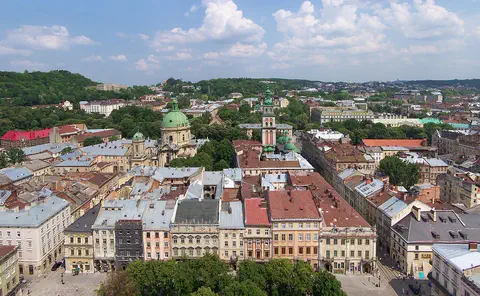
Ukraine is a large country in eastern Europe on the northern shore of the Black Sea. Most of it is level plain with some of the most fertile soil in the world, crossed by the Dnieper River. Its capital is Kyiv, and its official language is Ukrainian.
-
 Watch
Landmark
Hagia Sophia
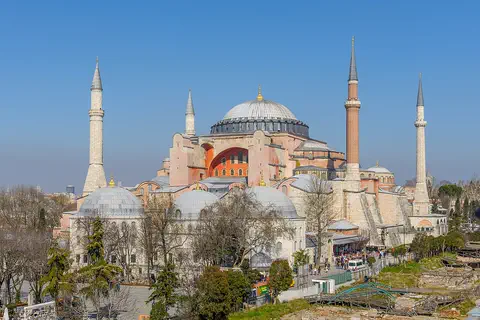
Hagia Sophia in Istanbul was built in under six years, from 532 to 537, for the emperor Justinian. Its enormous dome seems to float on a ring of 40 windows. Over almost 1,500 years it has been a church, a mosque and a museum, and since 2020 it has been a mosque.
-
Watch
City
Warsaw
Warsaw is the capital of Poland, on the Vistula River. Much of the city was destroyed in World War II, and afterward its people rebuilt the Old Town so carefully that UNESCO made it a World Heritage Site. About 1.86 million people lived there in 2024.
-
Watch
City
Moscow
Moscow, the capital of Russia, grew up on the Moscow River around a fortress called the Kremlin. About 13.3 million people lived there in 2025. Its rings of roads, snowy winters and palace-like subway stations make it like no other city.
-
 Watch
City
Istanbul
Istanbul is the biggest city in Türkiye, built on both sides of the Bosporus, the narrow strait between Europe and Asia. Once called Byzantium and then Constantinople, it was the capital of two great empires. About 15.7 million people lived in Istanbul province in 2023.
-
 Watch
City
Amsterdam
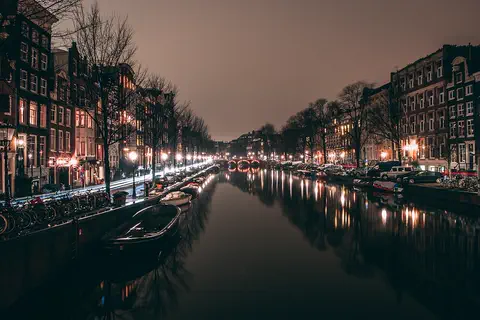
Amsterdam is the capital of the Netherlands. It began as a fishing village beside a dam on the Amstel River, which gave the city its name. Today about 942,000 people live among its rings of canals, hundreds of bridges, houseboats and bicycles.
-
 Watch
City
Athens
Athens is the capital of Greece and one of the oldest cities in the world. Above it rises the Acropolis, a rocky hill crowned by the marble Parthenon, built about 2,500 years ago. Ancient Athens was home to early democracy, great thinkers and theater.
-
 Watch
City
Barcelona
Barcelona, the capital of Catalonia in northeastern Spain, lies on the Mediterranean between mountains and the sea. It is famous for the buildings of the architect Antoni Gaudí, including the Sagrada Família, a giant church begun in 1882. About 1.7 million people live in the city (2025).
For parents & teachers
What children will learn
- Locate Kyiv on the Dnieper River in north-central Ukraine.
- Explain why Kyiv is called the 'Mother of Rus Cities'.
- Describe St. Sophia's Cathedral and the Kyiv-Pechersk Lavra as historic buildings.
- Explain how a river and high banks shaped where a city grew.
Recommended ages: 3 to 17 · About 15 minutes
Talk about it
- Kyiv's old city was built on high bluffs above a river. Why might early people choose a high place to build?
- Kyiv has been damaged and rebuilt many times. Why do people work so hard to restore old buildings?
- Traders once used rivers like roads. What do people use as 'roads' for goods today?
Try at home or in class
- Make a mosaic: cut colored paper into small squares and glue them into a picture of a dome.
- Build a funicular: tie a small box to a string, run it over a pencil at the top of a ramp made from a book, and pull it up the slope.
Key vocabulary: capital, bluff, cathedral, monastery, mosaic, fresco, funicular
Where these facts come from
- Wikidata , Wikimedia Foundation (CC0 1.0)
- Natural Earth vector data , Natural Earth (NACIS) (Public domain)
- Kyiv , Encyclopaedia Britannica
- Kyiv: History , Encyclopaedia Britannica
- Kyiv: Economy , Encyclopaedia Britannica
- Kyiv: Evolution of the modern city , Encyclopaedia Britannica
- Kyiv: Kyiv in an independent Ukraine , Encyclopaedia Britannica
- Kyiv: Saint-Sophia Cathedral and Related Monastic Buildings, Kyiv-Pechersk Lavra , UNESCO World Heritage Centre
- Kyiv: climatological information , World Meteorological Organization, World Weather Information Service
- Wikimedia Commons , Wikimedia Foundation (Per file (public domain, CC0, CC BY or CC BY-SA); see each media record)
Checked, not yet human-reviewed. Last updated October 27, 2026. Spotted a mistake? Tell us.