
City Europe
Warsaw
Warsaw is the capital city of Poland. A wide river flows through it. Its colorful Old Town was built again after a war.
Warsaw is the capital of Poland, on the Vistula River. Much of the city was destroyed in World War II, and afterward its people rebuilt the Old Town so carefully that UNESCO made it a World Heritage Site. About 1.86 million people lived there in 2024.
Warsaw, on the Vistula, became the Polish royal capital in 1611 and the country's capital again in 1945. Razed in 1944, it was rebuilt, and its reconstructed Old Town was listed by UNESCO in 1980 as an outstanding example of near-total reconstruction. The city held 1,862,402 people in 2024.
Photo: Rhododendrites, CC BY-SA 4.0, via Wikimedia Commons
Discover Warsaw
Warsaw is the capital city of Poland.
The Vistula River flows through the middle. The oldest part of the city has a big square and colorful houses. A castle stands nearby.
Warsaw is the capital and largest city of Poland, in the east-central part of the country. It sits on both banks of the Vistula River, about 386 kilometers southeast of the Baltic Sea port of Gdańsk. About 1.86 million people lived there in 2024.
Warsaw has been badly damaged in wars many times, and each time it has been rebuilt. Its motto is "It defies the storms." Today it is Poland's center of government, business, science and culture, with a carefully rebuilt Old Town next to modern office towers.
Warsaw, capital of Poland and of Mazowieckie province, lies in the middle of the Warsaw Plain, a glacier-formed basin 76 to 116 m above sea level, on the Vistula about 386 km southeast of Gdańsk. The river divides the city into left- and right-bank parts; it is about 1,190 m wide here, though embankments narrow its bed to a third of that. The city extends about 29 km from north to south and 26 km from east to west, and had 1,862,402 residents in 2024.
Britannica writes that Warsaw is notable among European capitals not for its size, age or beauty but for its indestructibility: devastated by Swedish and Prussian occupation in 1655–56, assaulted in 1794, and razed in 1944, it was rebuilt each time. Its motto, Contemnit procellas, means "It defies the storms." Since 1989 its economy has shifted rapidly toward services, banking and insurance, and new office towers have changed the skyline.
- Country
- Poland (capital)
- People (2024)
- 1,862,402
- River
- Vistula, about 1,190 m wide here
- UNESCO World Heritage
- Historic Centre of Warsaw, 1980
Famous places
The Old Town Market Square is full of tall, colorful houses.
On Castle Square stands the Royal Castle, where kings once lived. Warsaw has palaces in big parks too. In one church, the heart of a famous composer, Chopin, is kept.
Warsaw's Old Town has a market square lined with houses rebuilt in their 15th-century style, a Gothic cathedral and red-brick walls called the Barbican. On Castle Square stands the rebuilt Royal Castle.
Around the city are palaces in parks, such as the palace in Łazienki Park and the Wilanów Palace of King John III Sobieski. The Church of the Holy Cross holds the heart of the composer Frédéric Chopin, and his statue stands in Łazienki Park. The huge Palace of Culture and Science, built by the Soviet Union, towers south of the Old Town.
UNESCO inscribed the Historic Centre of Warsaw in 1980: more than 85% of it was destroyed by Nazi troops during the Warsaw Uprising of August 1944, and a five-year campaign by its citizens restored the Old Town, its churches, palaces and market place, which UNESCO calls an outstanding example of a near-total reconstruction spanning the 13th to the 20th century. The Gothic St. John's Cathedral and the red-brick Barbican date from the Middle Ages; the Market Square houses were rebuilt in their 15th-century style, and the Royal Castle on Zamkowy Square in late 18th-century style.
Baroque churches of the Counter-Reformation include the Jesuit Church and the Church of the Holy Cross, which holds Chopin's heart. Royal and aristocratic palaces stand in Łazienki Park and at John III Sobieski's Wilanów. The tsarist era left the Alexander Citadel; the colossal Orthodox cathedral of 1911 was demolished in the 1920s, and Britannica notes that its symbolic place was taken by the Soviet-built Palace of Culture and Science. Monuments include the Copernicus statue on Krakowskie Przedmieście and memorials to the 1943 Ghetto Uprising and the 1944 Warsaw Uprising.
- Old Town
- rebuilt after 1944; UNESCO 1980
- Royal Castle
- on Castle Square (Zamkowy Square)
- Church of the Holy Cross
- holds the heart of Frédéric Chopin
A city that rose again
Warsaw began as a small town by a river, with a castle to protect it.
Later, the king of Poland moved there. Long ago and in the last big war, much of the city was knocked down. Each time, people built it again.
Around the end of the 1200s, a small town grew up beside a castle on the Vistula. In 1611 King Sigismund III moved his court here from Kraków, and Warsaw became the capital of Poland. In 1791 a new constitution was proclaimed in the city.
For much of the 1800s Poland was divided among its neighbors, and Warsaw was ruled by Russia. In World War II, the city suffered terribly, and by 1945 it was almost completely destroyed. In February 1945 Warsaw became the capital again, and its people set about rebuilding their city.
Trading settlements on the site date to the 10th century; about the end of the 13th century the settlement of Jazdów moved north to a village called Warszowa, protected by a castle. Warsaw became capital of the duchy of Mazovia in the 15th century and joined the kingdom of Poland in 1526; the Sejm met here from 1569, and in 1611 King Sigismund III Vasa moved his court from Kraków. Under Stanisław II August Poniatowski (1764–95) it was the center of the Polish Enlightenment, and the constitution of May 3, 1791, was proclaimed here before the partitions of Poland. By 1903 the city had 756,000 people, and it passed one million in 1925.
In 1939 Nazi Germany besieged and occupied Warsaw. At the start of the 20th century the city had had the largest urban Jewish community in the world; the Nazis confined Warsaw's Jews in a walled ghetto and deported them to death camps, and the Ghetto Uprising of April 1943 was a last act of defiance. After the Home Army's Warsaw Uprising of 1944 was crushed, the city was razed on Hitler's order. On February 1, 1945, the government made Warsaw the capital, and reconstruction began. The fall of communism in 1989 brought a market economy and the reopening of the stock exchange, closed since World War II.
Getting around Warsaw
People in Warsaw ride trams on the busy streets.
There is a metro under the ground too. Bridges cross the wide river. The airport is named after the composer Chopin.
Trams share Warsaw's main streets with cars and buses. Plans for an underground railway were made as early as the 1920s, but the first metro train ran only on April 7, 1995, along 11 kilometers between Kabaty and Politechnika stations. The network has grown since.
Expressways run along both banks of the Vistula, and a ring road circles the inner suburbs. Warsaw is a hub for railways, roads and flights in eastern Europe. Its airport, Warsaw Frédéric Chopin Airport, is at Okęcie, south of the center.
Britannica describes Warsaw as the hub of main rail, road and air routes important to eastern Europe; by the mid-19th century it was already the center of a continent-wide rail network. Expressways follow both banks of the Vistula, and a ring road runs through the inner suburbs, while motor traffic still shares the main streets with a surface tramway. The first permanent bridge across the river was built in 1573.
An underground railway was planned in the 1920s; construction began in April 1983, and the first train ran on April 7, 1995, over an 11 km section from Kabaty to Politechnika, which drew few riders until the line reached the center. Warsaw Frédéric Chopin Airport, at Okęcie south of the center, handles international and domestic flights.
- First metro train
- April 7, 1995 (Kabaty to Politechnika, 11 km)
- First permanent bridge over the Vistula
- 1573
- Main airport
- Warsaw Chopin Airport, Okęcie
Weather and seasons
Warsaw has cold, snowy winters and warm summers.
Snow often covers the ground for weeks. Most rain falls in summer. The weather can change quickly.
Warsaw's climate is moderate and rather cool. Winds from the west bring frequent changes in the weather. In January the average temperature is about −3 °C, and in July about 19 °C. Over the year it averages about 8 °C.
About 541 millimeters of rain fall in a year, mostly in summer. Snow covers the ground for 50 to 64 days a year. The city has many parks, and Britannica says that park areas have tripled since the war.
Britannica describes a moderate, rather cool climate in which prevailing westerly winds bring frequent changes of weather. The yearly mean is about 8 °C, with about 19 °C in July and about −3 °C in January. Precipitation averages 541 mm a year, most of it in summer, and snow cover lasts 50 to 64 days a year.
The city lies in a glacier-formed basin, the Warsaw Plain, at 76 to 116 m above sea level. Postwar planning tripled the area of parks and placed industry on the outskirts, and the city has many large and small parks as well as swimming pools, sports centers and ice rinks.
- Average in January
- about −3 °C
- Average in July
- about 19 °C
- Days with snow cover
- 50 to 64 a year
Living in Warsaw
Warsaw is a busy city.
People work in offices, shops and factories. Many love the music of Chopin, Poland's famous composer. Families play in big parks and visit the Old Town.
Warsaw is Poland's busiest city for business and government. The national parliament, the Sejm, and the president's palace are here. Since 1989, new banks, companies and office towers have changed the skyline.
Music matters in Warsaw. The International Chopin Competition for pianists began here in 1927, and Chopin's statue stands in Łazienki Park. Warsaw is also home to the Polish Academy of Sciences and many museums and theaters. Most people in Warsaw are Polish, and most are Roman Catholic.
For centuries Warsaw was a city where a Polish-speaking Roman Catholic majority lived alongside Jews, Germans and Russians; early in the 20th century the largely Yiddish-speaking Jewish community made up almost half the population. World War II destroyed that diversity, and after 1945 the city was repopulated by returning refugees, migrants from the countryside and the families of officials of the new state. Today the population is almost entirely Polish and overwhelmingly Roman Catholic.
Under communism, state-owned industry dominated; since the 1990s, services, banking and insurance have grown fast, and the Warsaw Stock Exchange, closed since World War II, has reopened. As capital, Warsaw houses the central institutions of government, the Presidential Palace and the Sejm; the city is run by an elected council headed by a city president. Cultural life includes the International Chopin Competition (since 1927), the Henryk Wieniawski International Violin Competition (since 1935) and the headquarters of the Polish Academy of Sciences.
Warsaw on the map
Find Warsaw on the globe.
It is in Poland, in the middle of Europe. The long Vistula River flows through it. The sea is far away.
Warsaw is in east-central Poland, in central Europe, on a wide, flat plain. The Vistula River flows through it, and the Baltic Sea port of Gdańsk is about 386 kilometers away.
The Old Town and most of the center are on the left bank. Across the river is the district of Praga. The city stretches about 29 kilometers from north to south.
Warsaw lies at about 52.3° N and 21.0° E, in the Warsaw Plain, a glacier-formed basin in east-central Poland. The Vistula divides it into left- and right-bank parts, with the historic center and most of the city on the left bank and Praga on the right; Gdańsk, on the Baltic coast, is about 386 km away.
The city has grown from about 1.25 km² in the 17th century to 130 km² by 1937 and 445 km² by 1957, and it has kept growing since. Its present layout only partly follows the historic street pattern: after 1945, planners widened streets, moved industry to the outskirts and tripled the park area, while the Old and New towns and the royal route along Nowy Świat were carefully reconstructed.
- Latitude
- about 52.3° north
- Longitude
- about 21.0° east
- Distance to Gdańsk
- about 386 km northwest
- Size of the city
- about 29 km north–south, 26 km east–west
Amazing facts
-
Warsaw's emblem is a mermaid with a sword and a shield.
Since the late 1700s, Warsaw's emblem has been a mermaid holding a sword and a shield.
Since the second half of the 18th century, Warsaw's emblem has been a mermaid with sword and shield; its motto is Contemnit procellas, "It defies the storms."
-
The heart of the composer Chopin is kept in a Warsaw church.
The Church of the Holy Cross in Warsaw holds the heart of Frédéric Chopin, the famous Polish composer.
The Baroque Church of the Holy Cross contains the heart of the Polish French composer Frédéric Chopin.
-
People in Warsaw planned a metro for almost 70 years.
Plans for Warsaw's metro were made in the 1920s, but the first train did not run until 1995.
Planned from the 1920s and begun in April 1983, the Warsaw metro carried its first train on April 7, 1995, over 11 km from Kabaty to Politechnika.
-
Warsaw was once a very tiny town.
In the 1600s Warsaw covered only about 1.25 square kilometers. By 1957 it covered 445.
Warsaw grew from about 1.25 km² in the 17th century to 130 km² by 1937 and 445 km² by 1957, and it has grown since.
-
A big piano contest has been held in Warsaw for almost 100 years.
The International Chopin Competition for pianists began in Warsaw in 1927.
The International Chopin Competition for Pianists (1927) and the Wieniawski Violin Competition (1935) marked Warsaw's rise as a European cultural center between the wars.
Words to know
- capital
- the city where a country's government meets
- reconstruction
- building something again after it was damaged or destroyed
- Old Town
- the oldest part of a city, often with narrow streets and old buildings
- bank (of a river)
- the land along the side of a river
- constitution
- a written set of basic rules for how a country is governed
- emblem
- a picture or sign that stands for a place or group
- uprising
- a time when people fight back against those ruling them
Discovery challenge
-
Which river flows through Warsaw?
Which river divides Warsaw into a left bank and a right bank?
Which river, about 1,190 m wide at Warsaw, divides the city?
- The Vistula
- The Danube
- The Seine
Show the answer
The Vistula
The Vistula! It flows all the way to the sea.
The Vistula. The Old Town is on the left bank, and Praga is on the right.
The Vistula, embanked here to a third of its width.
-
What did people in Warsaw do after the war broke their Old Town?
What happened to Warsaw's Old Town after World War II?
Why did UNESCO list Warsaw's Historic Centre in 1980?
- They rebuilt it as it had been
- They left it in ruins
- They moved it to another city
Show the answer
They rebuilt it as it had been
They built it again, just like before!
People rebuilt it carefully in a five-year campaign, and UNESCO made it a World Heritage Site in 1980.
As an outstanding example of a near-total reconstruction, after more than 85% of the center was destroyed in 1944.
-
Which famous composer's heart is kept in Warsaw?
The heart of which composer is kept in Warsaw's Church of the Holy Cross?
Whose heart rests in the Church of the Holy Cross, and whose name the international piano competition (1927) bears?
- Frédéric Chopin
- Wolfgang Amadeus Mozart
- Ludwig van Beethoven
Show the answer
Frédéric Chopin
Chopin! He was a famous Polish composer.
Frédéric Chopin. Warsaw's airport is named after him too.
Frédéric Chopin, honored by the International Chopin Competition since 1927.
-
When did Warsaw's first metro train run?
In which year did the first metro train run in Warsaw?
In which year did Warsaw's metro open its first 11 km section?
- 1611
- 1945
- 1995
Show the answer
1995
1995! That was not very long ago.
1995. 1611 is when the king moved to Warsaw, and 1945 when rebuilding began.
April 7, 1995, Kabaty to Politechnika.
-
Which month is colder in Warsaw?
In which month is Warsaw colder, on average?
Which month averages about −3 °C in Warsaw?
- January
- July
Show the answer
January
January! It is often snowy.
January averages about −3 °C, and July about 19 °C.
January; July averages about 19 °C and the year about 8 °C.
Nearby places
-
 Watch
City
Vilnius
Vilnius, the capital of Lithuania, grew where the Vilnia River flows into the Neris, below a castle on a hill. It was first written about in 1323, when it was already the capital of a huge state, and its old town of Gothic, Renaissance and Baroque buildings is a UNESCO World Heritage Site. About 618,000 people lived there in 2026.
-
 Watch
City
Minsk
Minsk, the capital of Belarus, lies on the Svislach River near the middle of the country. First written about in 1067, it was almost completely destroyed in World War II and rebuilt with wide avenues, parks and apartment blocks. About 2 million people lived there in 2026.
-
 Watch
City
Prague
Prague, the capital of the Czech Republic, lies on the Vltava River in the heart of Europe. With Prague Castle on its hill, the 14th-century Charles Bridge and so many church towers that it is called the 'City of a Hundred Spires', its historic center is a UNESCO World Heritage Site. About 1.4 million people lived there in 2025.
-
 Watch
City
Berlin
Berlin, the capital of Germany, grew from two small trading towns on the Spree River. From 1961 to 1989 the Berlin Wall divided it. Today about 3.7 million people live there (2025), among lakes, forests, museums and the Brandenburg Gate.
-
Watch
Landmark
Brandenburg Gate
The Brandenburg Gate is a grand sandstone gateway in the center of Berlin, built from 1788 to 1791 with 12 columns and five passages. On top, a statue called the Quadriga shows a chariot pulled by four horses. From 1961 to 1989 the Berlin Wall shut it off, so the gate became a symbol first of a divided Germany and then of its reunification.
-
 Watch
City
Budapest
Budapest, the capital of Hungary, was made in 1873 by joining three towns on the Danube River: hilly Buda and old Óbuda on one bank and flat Pest on the other. About 1.7 million people live there (2026), with hot springs under the ground and the first underground railway built on the European mainland.
-
 Watch
City
Vienna
Vienna is the capital of Austria, on the Danube River. For centuries it was the home of emperors, and composers such as Haydn, Mozart and Beethoven lived and worked there. About 2 million people lived in the city at the start of 2026.
-
 Watch
City
Copenhagen
Copenhagen, the capital of Denmark, grew from a small harbor town into a royal city of palaces, canals and towers. Its name means "Merchants' Harbor." It has the Tivoli Gardens, opened in 1843, and the Little Mermaid statue, and about 673,000 people lived there in 2026.
Explore next
-
Watch
 Country
Poland
Poland lies near the center of Europe, between the Baltic Sea and the Carpathian Mountains. Most of it is low, flat land shaped by Ice Age glaciers, and about 37 million people live there. Its capital, Warsaw, stands on the Vistula River.
-
Watch
City
Berlin
Berlin, the capital of Germany, grew from two small trading towns on the Spree River. From 1961 to 1989 the Berlin Wall divided it. Today about 3.7 million people live there (2025), among lakes, forests, museums and the Brandenburg Gate.
-
Watch
City
Vienna
Vienna is the capital of Austria, on the Danube River. For centuries it was the home of emperors, and composers such as Haydn, Mozart and Beethoven lived and worked there. About 2 million people lived in the city at the start of 2026.
-
Watch
City
Minsk
Minsk, the capital of Belarus, lies on the Svislach River near the middle of the country. First written about in 1067, it was almost completely destroyed in World War II and rebuilt with wide avenues, parks and apartment blocks. About 2 million people lived there in 2026.
-
Watch
City
Prague
Prague, the capital of the Czech Republic, lies on the Vltava River in the heart of Europe. With Prague Castle on its hill, the 14th-century Charles Bridge and so many church towers that it is called the 'City of a Hundred Spires', its historic center is a UNESCO World Heritage Site. About 1.4 million people lived there in 2025.
-
 Watch
City
Kyiv
Kyiv is the capital of Ukraine, on the high west bank of the Dnieper River. More than 1,000 years ago it was the center of Kyivan Rus, the first East Slavic state, and its 11th-century St. Sophia's Cathedral and Pechersk Lavra monastery are a UNESCO World Heritage Site. About 2.95 million people lived there in 2022.
-
 Watch
City
Amsterdam
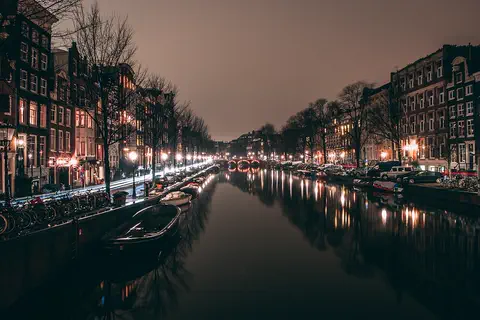
Amsterdam is the capital of the Netherlands. It began as a fishing village beside a dam on the Amstel River, which gave the city its name. Today about 942,000 people live among its rings of canals, hundreds of bridges, houseboats and bicycles.
-
 Watch
City
Athens
Athens is the capital of Greece and one of the oldest cities in the world. Above it rises the Acropolis, a rocky hill crowned by the marble Parthenon, built about 2,500 years ago. Ancient Athens was home to early democracy, great thinkers and theater.
For parents & teachers
What children will learn
- Locate Warsaw on the Vistula in east-central Poland.
- Explain how Warsaw's Old Town was destroyed in 1944 and rebuilt by its citizens.
- Describe key moments in Warsaw's history, from a castle town to a modern capital.
- Read average temperatures to describe a cool, changeable climate with snowy winters.
Recommended ages: 3 to 17 · About 15 minutes
Talk about it
- Warsaw's people rebuilt their Old Town to look as it did before. Why might people want to rebuild old buildings exactly?
- Warsaw's motto is "It defies the storms." What do you think it means? What would your town's motto be?
- Warsaw waited a long time for its metro. What big project would help your town?
Try at home or in class
- Build a small street of houses from blocks, take a photo, knock it down, then rebuild it from the photo. How close can you get?
- Design an emblem for your town or school with a picture and a short motto.
Key vocabulary: capital, reconstruction, Old Town, bank (of a river), constitution, emblem, uprising
Where these facts come from
- Wikidata , Wikimedia Foundation (CC0 1.0)
- Natural Earth vector data , Natural Earth (NACIS) (Public domain)
- UNESCO World Heritage List , UNESCO World Heritage Centre (Linked as a reference; site facts come from Wikidata)
- Warsaw , Encyclopaedia Britannica
- Warsaw: History , Encyclopaedia Britannica
- Historic Centre of Warsaw , UNESCO World Heritage Centre
- 20 lat temu wyruszył pierwszy pociąg metra w Warszawie , Dzieje.pl (Polish History Museum and PAP)
- Wikimedia Commons , Wikimedia Foundation (Per file (public domain, CC0, CC BY or CC BY-SA); see each media record)
Checked, not yet human-reviewed. Last updated October 27, 2026. Spotted a mistake? Tell us.