South America
Countries, cities, landmarks and natural wonders of South America. Pick one to explore it, or open the globe.
37 to explore
-
 Watch
Life around the world
Floating reed islands of the Uros, Lake Titicaca
In Puno Bay, on Lake Titicaca, Uro families live on islands they build from totora, a reed that grows in the lake's shallow water. Blocks of tangled reed roots form the base, layers of cut reeds go on top, and families keep adding fresh reeds. In 2013, Peru declared the Uros' knowledge of totora part of the nation's cultural heritage.
-
 Watch
Life around the world
Fog catchers of the Atacama, Chile
Chile's Atacama Desert is one of the driest places on Earth, yet thick sea fog called camanchaca drifts over its coastal hills. Fog catchers, tall nets of fine mesh, collect the tiny droplets, which drip into gutters and flow downhill to tanks.
-
 Watch
Life around the world
Cable car commute in La Paz, Bolivia
La Paz sits in a deep canyon, and its neighbor El Alto sits on the high plain above. Since May 2014, cable cars run by the state company Mi Teleférico have carried commuters between them and across the city. By 2025 there were 10 colored lines in La Paz and El Alto, about 33 kilometers long, and in 2024 the company carried 78.7 million passengers on its lines.
-
 Watch
Life around the world
River boats from Manaus, Brazil
Manaus, a city of about 2.3 million people, sits where the dark Rio Negro meets the muddy Solimões. Rivers are the main way to reach most towns in Amazonas state. Big wooden boats called recreios carry passengers and cargo for a day or more, with hooks for hammocks, while fast boats called expressos cut the time.
-
 Watch
Natural wonder
Iguaçu Falls
Iguaçu Falls, on the Iguaçu River where Brazil and Argentina meet, is a system of many waterfalls and rapids almost three kilometers wide, with drops of up to about 80 meters. Clouds of spray keep the rainforest around it green and wet.
-
 Watch
Natural wonder
Amazon rainforest
The Amazon rainforest covers about 6 million square kilometers around the Amazon River and its branches in northern South America, and about 60 percent of it is in Brazil. Britannica calls it the world's richest and most varied home for living things, with millions of kinds of insects, plants and animals.
-
 Watch
Natural wonder
Galápagos Islands
The Galápagos Islands are a group of volcanic islands in the Pacific Ocean, about 1,000 kilometers off the coast of Ecuador. Many of their animals live nowhere else on Earth, and they helped inspire Charles Darwin's theory of evolution by natural selection.
-
 Watch
Natural wonder
Angel Falls
Angel Falls is a waterfall in Canaima National Park in Venezuela. It pours off the cliff of Auyán-tepui, a giant table-shaped mountain, and falls about 979 meters. UNESCO calls it the world's highest waterfall.
-
 Watch
Natural wonder
Salar de Uyuni
Salar de Uyuni is a giant salt flat high in the Andes of Bolivia. It covers 10,582 square kilometers and was left behind when ancient lakes dried up. NASA calls it the largest salt flat in the world.
-
 Watch
 Country
Brazil
Brazil covers about half of South America and is the fifth-largest country in the world. It holds most of the Amazon River basin and much of the world's largest rainforest, and about 214 million people lived there in 2026, most of them near the Atlantic coast.
-
Watch
Natural wonder
Amazon River
The Amazon River flows from tiny streams in the Andes Mountains of Peru across Colombia and Brazil to the Atlantic Ocean. NASA calls it the largest river in the world: about 219,000 cubic meters of water pour into the ocean every second, nearly a fifth of all the water that rivers carry to the oceans.
-
 Watch
 Country
Chile
Chile stretches about 4,300 kilometers along the west coast of South America, between the Andes and the Pacific Ocean, but it averages only about 180 kilometers wide. Its north holds one of the driest deserts on Earth, and its south is cold, wet and full of fjords and ice.
-
 Watch
Natural wonder
Andes
The Andes run down the whole western side of South America, from the Caribbean coast to the continent's southern tip, through seven countries. Britannica measures them at about 8,900 kilometers, and their highest peak, Aconcagua, rises to 6,959 meters. They are still growing as one plate of Earth's crust slides under another, which is why the Andes have so many volcanoes and earthquakes.
-
 Watch
 Country
Argentina
Argentina covers most of the southern part of South America. The Andes mountains run down its western side, grassy plains called the Pampas spread across the middle, and windy Patagonia stretches to the far south. INDEC, the national statistics office, estimates that about 46.5 million people lived there in 2026, many of them in and around Buenos Aires.
-
 Watch
Natural wonder
Easter Island
Easter Island, called Rapa Nui by its first people, is a small volcanic island in the Pacific Ocean, about 3,540 kilometers west of Chile. Polynesian settlers who arrived long ago carved more than 600 giant stone statues, called moai, from the rock of a volcano and set many of them on stone platforms. Today the island's national park is a World Heritage Site cared for by the Rapa Nui people.
-
 Watch
 Country
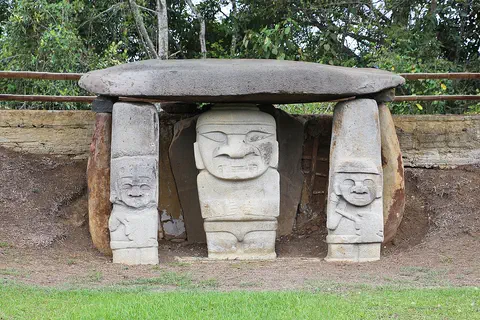
Colombia
Colombia is in the northwest of South America, with coasts on both the Caribbean Sea and the Pacific Ocean. Three ranges of the Andes run through it, and most people live in the cool mountains, where the capital, Bogotá, sits on a high plateau. About 53.4 million people lived there in 2026, according to DANE, the national statistics office.
-
Watch
Natural wonder
Lake Titicaca
Lake Titicaca lies 3,810 meters above sea level in the Andes of South America, on the border between Peru and Bolivia. Britannica calls it the world's highest lake that large ships can sail on. Some people still live on floating islands made of totora reeds, and a big, wrinkly frog lives in its water and nowhere else.
-
Watch
Natural wonder
Aconcagua
Aconcagua, in the Andes of Argentina near the border with Chile, is the highest mountain in the Western Hemisphere. Its height has been measured several ways: a 2012 expedition backed by Argentina's National Geographic Institute found 6,960.8 meters. Aconcagua formed from an old volcano, but it is not an active volcano today, and climbers first reached its top in 1897.
-
Watch
Natural wonder
Atacama Desert
The Atacama is a cool desert in northern Chile, squeezed between the Pacific coast and the Andes mountains, about 1,000 to 1,100 kilometers long. It is one of the driest places on Earth: the city of Arica, on its coast, averages less than 1 millimeter of rain a year. Its dry, clear air makes it a top place for giant telescopes.
-
 Watch
Natural wonder
Pantanal
The Pantanal is one of the world's largest freshwater wetlands, mostly in Brazil and reaching into Bolivia and Paraguay. Each rainy season its rivers overflow and flood the lowlands, making shallow lakes and marshes; in the dry season the water slowly drains away. This rhythm feeds an amazing number of animals, from jaguars and giant otters to about 600 kinds of birds.
-
 Watch
Natural wonder
Mount Roraima
Mount Roraima is a huge flat-topped mountain called a tepui, in the Guiana Highlands of South America, where Brazil, Venezuela and Guyana meet. Its summit stands about 2,772 meters high, ringed by sheer sandstone cliffs. Tepuis like it are some of the world's oldest rock formations, and they are home to unusual plants such as marsh pitcher plants.
-
 Watch
City
Bogotá
Bogotá is the capital and largest city of Colombia, built on a high plain in the Andes, 2,625 meters above sea level. Founded by the Spanish in 1538 on land of the Muisca people, it is home to about 8 million people (2024) and a famous museum of ancient gold.
-
 Watch
 Country
Bolivia
Bolivia is a landlocked country in the middle of South America. In the west, the Andes Mountains hold a high, cold plateau with Lake Titicaca and a huge salt flat; in the east, warm lowlands stretch toward the Amazon. It has two capitals, La Paz and Sucre, and about 12.6 million people lived there in 2025.
-
 Watch
City
Buenos Aires
Buenos Aires, the capital of Argentina, lies on the Río de la Plata, 240 kilometers from the Atlantic Ocean. Founded twice, in 1536 and 1580, it grew into South America's largest port and a city of wide avenues, lively neighborhoods and the tango. About 3.1 million people lived in the city in 2022.
-
 Watch
Landmark
Christ the Redeemer
Christ the Redeemer is a 30-meter statue of Jesus on top of Corcovado mountain in Rio de Janeiro, Brazil. Built from 1926 to 1931 out of reinforced concrete, it is covered in thousands of small soapstone triangles, and it stands on a pedestal 8 meters high.
-
 Watch
City
Concepción
Concepción is one of the largest cities of Chile, in the south-central part of the country, near where the Biobío River meets the Pacific Ocean. Founded in 1550 and moved to its present site after a great earthquake, it is now a center of industry and learning. Its commune had 230,375 people at the 2024 census.
-
 Watch
City
Curitiba
Curitiba is the capital of the state of Paraná, in southern Brazil, about 930 meters above the sea. About 1.8 million people live there (2025). The city is famous around the world for its bus rapid transit, begun in 1974, and for the lakes, flood-control systems and parks it built from the 1970s.
-
Watch
 Country
Ecuador
Ecuador is a country in northwestern South America, named after the equator, which crosses it. In a small space it holds Pacific beaches, high snowy volcanoes of the Andes, part of the Amazon rainforest and the Galápagos Islands, whose wildlife helped Charles Darwin develop his ideas.
-
 Watch
Landmark
Machu Picchu
Machu Picchu is a 15th-century Inca town on a ridge high in the Andes Mountains of Peru. Its stone buildings fit together without mortar, and farm terraces step down the slopes. It was left empty in the 1500s and became known to the outside world in 1911.
-
 Watch
 Country
Paraguay
Paraguay is a landlocked country in the heart of South America. The Paraguay River divides it into a hilly east, where most people live, and the hot, flat Chaco in the west. Guaraní and Spanish are both official languages, and about 7 million people lived there in 2025.
-
Watch
 Country
Peru
Peru is a country on the Pacific coast of South America. It has a dry desert coast, the high Andes mountains and the Amazon rainforest, and about 34 million people lived there in 2025, many of them in the capital, Lima.
-
 Watch
City
Rio de Janeiro
Rio de Janeiro is a city of about 6.7 million people (2025) on Brazil's Atlantic coast. Forested mountains, a giant statue on Corcovado, the Sugarloaf peak and famous beaches make it one of the most recognizable cities on Earth. It was Brazil's capital until 1960.
-
 Watch
City
Santiago
Santiago, the capital and largest city of Chile, lies in a basin in central Chile with the high Andes to the east. Founded by the Spanish in 1541, it mixes colonial churches with the tallest skyscraper in the city, the 300-meter Gran Torre Costanera. About 5.25 million people lived in the city in 2017.
-
 Watch
City
São Paulo
São Paulo, capital of the state of São Paulo, is the largest city in the Southern Hemisphere. It began as a small Jesuit mission in 1554 and grew huge after coffee became Brazil's main export. About 11.9 million people live in the city (2025), with families whose roots reach from Italy and Portugal to Japan and Lebanon.
-
 Watch
 Country
Uruguay
Uruguay is the second-smallest country in South America, between Brazil and Argentina. Its gently rolling grasslands are grazed by cattle and sheep, and almost half of its 3.5 million people live in and around the capital, Montevideo.
-
 Watch
City
Valparaíso
Valparaíso is a busy port on Chile's Pacific coast, built around a bay on steep hills. Founded in 1536, it became the leading port on South America's Pacific coast in the late 1800s. Its historic quarter, with hillside neighborhoods and funicular "elevators," is a UNESCO World Heritage Site, and Chile's National Congress meets here.
-
 Watch
 Country
Venezuela
Venezuela is a country on the north coast of South America. It has high Andes mountains, huge grassy plains called the Llanos, the great Orinoco River and flat-topped mountains called tepuis, where Angel Falls drops 979 meters.