
 Country
Africa
Mayotte
Mayotte is a group of green islands in the Indian Ocean, near Africa. A huge, calm lagoon surrounds them. Whales come there to have their babies.
Mayotte is a group of volcanic islands in the Mozambique Channel, between Africa and Madagascar. France governs it as an overseas department, and Comoros also claims it. It is ringed by one of the largest lagoons in the Indian Ocean, where humpback whales raise their calves, and a full census by INSEE, France's statistics office, counted 323,153 people on 1 January 2026.
Mayotte, the southeasternmost part of the Comoros archipelago, is administered by France as an overseas department (since 2011); Comoros has claimed it since 1975. Its main islands, Grande-Terre and Petite-Terre, sit inside a 1,100 km² lagoon edged by a 140 km barrier reef. INSEE's full census counted 323,153 people on 1 January 2026 (first results); its 2024 estimate put more than half of them under 20.
Photo: David Stanley from Nanaimo, Canada, CC BY 2.0, via Wikimedia Commons
Discover Mayotte
Mayotte is in the Indian Ocean, near Africa and Madagascar.
It has one big island and one small island. The capital is Mamoudzou.
Mayotte lies in the Mozambique Channel, the stretch of the Indian Ocean between Africa and Madagascar, about 310 kilometers northwest of Madagascar. It is part of the Comoros group of islands.
France governs Mayotte as an overseas department, so it uses the euro and French is the official language. Comoros, the country made up of the other main islands of the group, says Mayotte should belong to it. Mayotte has a large main island, Grande-Terre, and a small one, Petite-Terre. The capital, Mamoudzou, is on the east coast of Grande-Terre.
Britannica describes Mayotte as an overseas department of France comprising the two southeasternmost islands of the Comoros archipelago, in the Mozambique Channel about 310 km northwest of Madagascar. It is administered by a French-appointed prefect and an elected Departmental Council and is represented in the French Parliament. Comoros has claimed Mayotte since its 1975 declaration of independence and represents it at the United Nations; a 1979 UN resolution affirmed Comoros's sovereignty, while Mayotte's voters chose to stay with France.
The capital, Mamoudzou, is on the east coast of Grande-Terre. Petite-Terre (Pamandzi) lies about 2.4 km to the east, joined by a 1.9 km causeway to Dzaoudzi, a rocky outcrop with a town and port. French is official and the euro is the currency.
Mamoudzou, Petite-Terre and the lagoon
Mamoudzou is a busy harbor town. Many small boats float in the bay.
A small island called Petite-Terre lies across the water. It has the airport.
Mamoudzou is the capital and the biggest town. The photo, taken in 2013, looks over its harbor full of small boats, with a ferry at the dock, the large public market with a blue roof, and dry hills behind.
Across the water, Petite-Terre holds the town of Dzaoudzi and Mayotte's international airport. Around both islands spreads the lagoon, dotted with many small islets that are important resting places for birds.
Britannica names Mamoudzou, Koungou and Dzaoudzi as the main population centers. The photo, from September 2013, shows Mamoudzou's waterfront with the public market (the large blue-roofed building), a ferry and a crowded mooring of small boats below dry, wooded hills.
Petite-Terre (Pamandzi) has Dzaoudzi, its port and the international airport. The marine park describes many islets scattered through the lagoon, which play a vital ecological role for birds, and resting sites such as the Ngouja reef for migratory birds stopping at Mayotte.
Volcanic hills and a double barrier reef
Mayotte's hills were made by volcanoes long ago.
A wall of coral reef runs around the islands. Inside it is a huge, calm lagoon. Mangrove trees grow along the shore.
A chain of old volcanic mountains runs north to south across Grande-Terre. The highest, Mount Benara, is 660 meters high. It is warm and humid all year, from about 24 °C in August to 27 °C in December.
A coral barrier reef 140 kilometers long surrounds the islands, enclosing a lagoon of 1,100 square kilometers, the biggest in the western Indian Ocean. In some places there are two barrier reefs, one inside the other, which is very rare. Mangrove forests line about a third of the coast.
Britannica describes a north–south chain of volcanic mountains on Grande-Terre with summits of about 500–600 m (Wikidata gives Benara 660 m), surrounded by coral reefs some distance from shore. The climate is warm, humid and maritime, with monthly averages of 24 °C (August) to 27 °C (December).
The Mayotte Marine Natural Park describes the lagoon, 1,100 km² (1,300 km² with the Iris bank), as the largest in the western Indian Ocean and among the largest around volcanic islands. A 140 km barrier reef encloses it, and in places a second, inner barrier (18 km) runs inside the outer one, a feature found at fewer than ten sites worldwide. Mangroves of seven tree species line 30% of the coast (725 ha).
Whales, dugongs and sea turtles
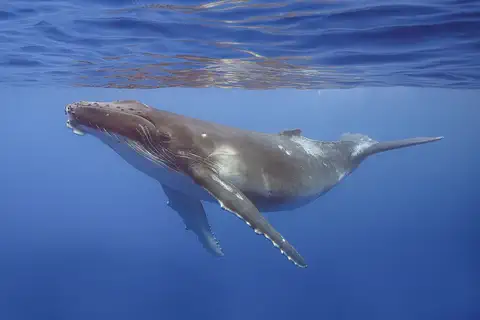
Humpback whale mothers have their babies in Mayotte's calm lagoon.
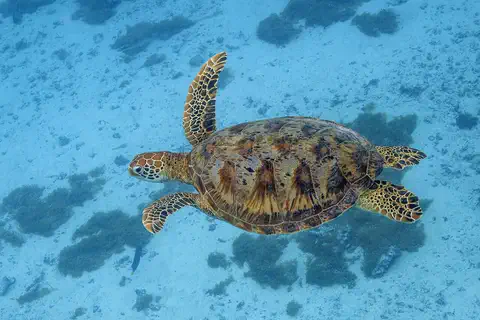
Sea turtles lay eggs on the beaches. A gentle sea cow called a dugong grazes in the lagoon.
Humpback whales visit Mayotte from July to November. Out at sea they find mates, and inside the wide, shallow lagoon mothers give birth and look after their calves before the long trip back to Antarctica.
The marine park lists 760 kinds of fish, 300 kinds of coral and 25 kinds of marine mammals, including the dugong. Green sea turtles lay their eggs on almost all of Mayotte's beaches. The whale and turtle photos here were taken near Moorea, in French Polynesia, and the dugong photo in Egypt.
The marine park says humpback whales are present from July to November: offshore waters are used for mating, while the broad, shallow lagoon offers ideal conditions for mothers to give birth and nurse before calves make their first journey to Antarctica. It records 760 fish species (including the Geyser and Zélée banks), 300 coral species (about 200 reef-building hard corals) and 25 marine mammal species, among them the dugong.
Nearly all of the island's beaches, black, white or ochre, are nesting beaches for sea turtles, and the park shows green turtles nesting at Moya beach. The humpback calf and green turtle photos here were taken off Moorea, French Polynesia; the dugong photo near Marsa Alam, Egypt.
Shimaoré, Kibushi and a young population
People in Mayotte speak French and local languages.
There are lots of children. More than half of the people are under 20.
French is the official language, but most people speak Shimaoré, a language close to Swahili, and in some coastal villages people speak a Malagasy language. Most people are Muslim, and French culture has a strong influence.
Mayotte's population is very young. In INSEE's 2024 estimate, more than half of the people were under 20. A full census counted 323,153 people on 1 January 2026.
Britannica describes most inhabitants as Mahorais of Malagasy origin, Sunni Muslim and strongly influenced by French culture, with a Roman Catholic minority. French is official; most people speak Comorian (Shimaoré, closely allied to Swahili), and in some coastal villages a Malagasy dialect is the main language. Schooling includes traditional Islamic schools and French primary and secondary schools.
INSEE's first results from a full census, taken between November 2025 and January 2026, give 323,153 people on 1 January 2026; its earlier estimate for 1 January 2024 (320,901) counted 172,577 (54%) under 20. Britannica describes the service sector as the main employer and lists vanilla, ylang-ylang, coffee and coconuts as cash crops on the central and northeastern plains, with cassava, bananas, maize and rice grown for home use. Britannica names ylang-ylang extract and farmed fish as the main exports.
Ocean traders to a French department
Long ago, people sailed to Mayotte across the sea.
Later, Arabs and people from Madagascar came. Today France governs Mayotte, and Comoros says it should be part of Comoros.
Mayotte's early people probably descended from peoples who spoke African (Bantu) languages and Malay and Indonesian languages. From the 1400s, Arab arrivals brought Islam, and in the late 1700s people from Madagascar settled and brought their language. France took control in 1843.
In 1975 the other Comoros islands became independent, but Mayotte's people chose to stay with France. Comoros still says Mayotte belongs to it. In a 2009 vote, most of Mayotte's voters chose to become a French department, which happened in 2011.
Britannica describes the early inhabitants as probably descended from peoples speaking Bantu and Malay and Indonesian languages. From the 15th century Arab arrivals converted them to Islam; Portuguese and French ships visited in the 16th century; at the end of the 18th century the Sakalava of Madagascar arrived and brought a Malagasy dialect. France gained control in 1843.
When the three northern islands declared independence in 1975, Mayotte's inhabitants chose to remain with France, which gave it special status as a territorial collectivity in 1976. In 1979 a UN resolution affirmed Comoros's sovereignty over Mayotte, and the African Union also supports Comoros's claim. In a March 2009 referendum 95% of voters favored becoming an overseas department, which took effect in March 2011. In December 2024 Cyclone Chido, a category 4 storm, caused severe damage across the island.
Mayotte on the map
Find Africa on the globe.
Look at its east side, near the big island of Madagascar. Small islands sit in the sea between them. Mayotte is the one closest to Madagascar.
Mayotte lies in the Mozambique Channel, about 13 degrees south of the equator, between Mozambique in Africa and Madagascar, which is about 310 kilometers to the southeast. The other Comoros islands, Anjouan, Mohéli and Grande Comore, lie to the northwest.
Mayotte has no land borders. Its islands are too small for the globe to draw, so PlayOwl marks them with dots: Mamoudzou, Dzaoudzi on Petite-Terre, Mount Benara and the Saziley beaches.
Mayotte lies at about 12.8° S, 45.1° E, at the southeastern end of the Comoros archipelago, about 310 km northwest of Madagascar. It has no land borders; its status is claimed by Comoros and administered by France.
At the globe's scale the islands have no outlines, so the map uses markers: Mamoudzou and Mount Benara on Grande-Terre, Dzaoudzi and the lake Dziani Dzaha on Petite-Terre, and the protected Saziley beaches in the southeast.
- Distance to Madagascar
- about 310 km
- Lagoon
- 1,100 km²
- People (census, 1 Jan 2026)
- 323,153
- Barrier reef
- 140 km
Amazing facts
-
Mayotte's lagoon is bigger than all its land.
Mayotte's lagoon covers about 1,100 square kilometers, almost three times the area of its land.
At 1,100 km², Mayotte's lagoon is nearly three times its 374 km² of land; the marine park calls it the largest lagoon in the western Indian Ocean.
-
In some places, Mayotte has two coral reefs, one inside the other.
Parts of Mayotte have a double barrier reef, an outer reef and an inner one. Fewer than ten places in the world have this.
Mayotte's lagoon has an 18 km inner barrier inside its outer reef, a double-barrier form found at fewer than ten sites worldwide.
-
Baby humpback whales are born in Mayotte's lagoon.
From July to November, humpback whale mothers use Mayotte's calm, shallow lagoon to give birth and feed their calves.
Humpbacks feed in Antarctic waters and migrate to Mayotte from July to November; the shallow lagoon is a favored calving and nursery area.
-
More than half of the people in Mayotte are children and teenagers.
More than half of Mayotte's people are under 20 years old.
INSEE's estimate for 1 January 2024 counts 172,577 people under 20 out of 320,901, or 54%.
Words to know
- lagoon
- a stretch of calm, shallow water cut off from the open sea by a reef
- barrier reef
- a long coral reef separated from the shore by a lagoon
- mangrove
- a tree that grows in salty water along tropical coasts
- dugong
- a large, gentle sea mammal that grazes on sea grass
- overseas department
- a part of France far from Europe that is run like the departments in France itself
- claim
- to say that something belongs to you
Discovery challenge
-
What surrounds Mayotte's islands?
What large body of calm water surrounds Mayotte, enclosed by a coral reef?
What 1,100 km² feature, enclosed by a 140 km barrier reef, surrounds Mayotte?
- A desert
- A lagoon
- A glacier
Show the answer
A lagoon
A big, calm lagoon.
A lagoon, one of the largest in the Indian Ocean.
A lagoon, the largest in the western Indian Ocean.
-
Which big animals have their babies in Mayotte's lagoon?
Which whales give birth in Mayotte's lagoon from July to November?
Which migratory whale uses Mayotte's lagoon as a calving and nursery area?
- Humpback whales
- Blue whales
- Killer whales
Show the answer
Humpback whales
Humpback whales.
Humpback whales, which come from Antarctic waters.
The humpback whale, present from July to November.
-
Which country governs Mayotte?
Which country governs Mayotte as an overseas department?
Which country has administered Mayotte as an overseas department since 2011?
- Madagascar
- Portugal
- France
Show the answer
France
France.
France. Comoros also claims Mayotte.
France; Comoros has claimed Mayotte since 1975.
-
Between which two places is Mayotte?
Mayotte lies in the sea between Africa and which big island?
Mayotte lies in the Mozambique Channel about 310 km northwest of which island?
- Madagascar
- Iceland
- Cuba
Show the answer
Madagascar
Africa and Madagascar.
Madagascar.
Madagascar.
Places to discover in Mayotte
Animals of Mayotte
-
Watch
3D
Animal
Humpback whale
The humpback whale is a baleen whale famous for leaping out of the water, slapping its giant flippers and singing long, complex songs. It lives in every ocean and makes one of the longest journeys of any mammal, between cold feeding waters and warm waters where calves are born. Once hunted almost to extinction, it is now recovering.
-
 Watch
Animal
Dugong
The dugong is a large, slow marine mammal that grazes on seagrass meadows in warm, shallow coastal seas from East Africa to the western Pacific. It is a relative of the manatee and, surprisingly, more closely related to elephants than to cows. It has a whale-like tail, a big bristly snout and very good hearing.
-
 Watch
Animal
Green sea turtle
The green sea turtle is the largest sea turtle with a hard shell. It lives in warm seas around the world and, unlike other sea turtles, grown-ups eat mostly seagrass and algae. Females swim hundreds or even thousands of kilometers to lay their eggs on the beaches where they hatched long ago.
Explore next
-
 Watch
City
Mamoudzou
Mamoudzou is the main town of Mayotte, on the island of Grande-Terre in the Indian Ocean. It faces a huge lagoon ringed by a coral reef, where humpback whales come to have their babies. The census of 2025–2026 counted about 94,600 people in Mamoudzou.
-
 Watch
 Country
Comoros
Comoros is made of three volcanic islands between Madagascar and the coast of Africa. People call them the perfumed islands, because of their fragrant plants such as vanilla and ylang-ylang. Mount Karthala, an active volcano, is the highest point, and the 2017 census counted 758,316 people.
-
 Watch
 Country
Madagascar
Madagascar is the fourth-largest island in the world, in the Indian Ocean off southeastern Africa. It split from other land more than 60 million years ago, so many of its plants and animals, such as its lemurs, live nowhere else. About 32.7 million people lived there in 2025.
-
 Watch
 Country
France
France is a country in northwestern Europe, between the Atlantic Ocean and the Mediterranean Sea. It has high mountains such as the Alps and the Pyrenees, long rivers such as the Loire and the Seine, and about 69.1 million people (2026). Its capital is Paris.
-
Watch
3D
Animal
Humpback whale
The humpback whale is a baleen whale famous for leaping out of the water, slapping its giant flippers and singing long, complex songs. It lives in every ocean and makes one of the longest journeys of any mammal, between cold feeding waters and warm waters where calves are born. Once hunted almost to extinction, it is now recovering.
-
Watch
Animal
Dugong
The dugong is a large, slow marine mammal that grazes on seagrass meadows in warm, shallow coastal seas from East Africa to the western Pacific. It is a relative of the manatee and, surprisingly, more closely related to elephants than to cows. It has a whale-like tail, a big bristly snout and very good hearing.
-
Watch
Animal
Green sea turtle
The green sea turtle is the largest sea turtle with a hard shell. It lives in warm seas around the world and, unlike other sea turtles, grown-ups eat mostly seagrass and algae. Females swim hundreds or even thousands of kilometers to lay their eggs on the beaches where they hatched long ago.
- Watch Geography Islands An island is a piece of land surrounded by water that is smaller than a continent. Islands form in different ways: some broke away from continents, some were built by volcanoes on the sea floor, and some were made by corals or by waves piling up sand. Because they are cut off by water, islands often have unusual plants and animals.
For parents & teachers
What children will learn
- Locate Mayotte in the Mozambique Channel and explain how a barrier reef encloses a lagoon.
- Describe Mayotte's status neutrally: administered by France, claimed by Comoros.
- Name some of the marine animals that depend on the lagoon.
- Describe the languages and young population of Mayotte.
Recommended ages: 3 to 17 · About 15 minutes
Talk about it
- Why might a calm, shallow lagoon be a good place for a whale to raise a calf?
- What might people do to keep turtle nesting beaches safe?
- More than half of Mayotte's people are under 20. What does a place with so many young people need?
Try at home or in class
- In a tray of water, build a ring of stones some distance around a sand island. Make waves outside the ring and watch how calm the water stays inside, like a lagoon.
- Count the people in your family or class who are under 20 and over 20. Is it more or less than half, like Mayotte?
Key vocabulary: lagoon, barrier reef, mangrove, dugong, overseas department, claim
Where these facts come from
- Wikidata , Wikimedia Foundation (CC0 1.0)
- Natural Earth vector data , Natural Earth (NACIS) (Public domain)
- Mayotte (land, people, economy, government, history) , Encyclopaedia Britannica
- Estimation de population au 1er janvier, par région, sexe et grande classe d'âge, 1975-2024 , INSEE
- La biodiversité du Parc , Parc naturel marin de Mayotte
- La baleine à bosse , Parc naturel marin de Mayotte
- Au 1er janvier 2026 la population à Mayotte est de 323 153 habitants (press release, 7 July 2026) , INSEE
- A Mayotte, l'Insee a recensé environ 323 000 habitants (first results of INSEE's full census, 1 January 2026) , Outremers360
- PlayOwl region table, version 1 , PlayOwl (PlayOwl original data)
- flag-icons 7.5.0 , Panayiotis Lipiridis and contributors (MIT)
Checked, not yet human-reviewed. Last updated November 1, 2026. Spotted a mistake? Tell us.
Picture credits
- Photo: David Stanley from Nanaimo, Canada, CC BY 2.0, via Wikimedia Commons · source · license
- Photo: Charles J. Sharp, CC BY-SA 4.0, via Wikimedia Commons · source · license
- Photo: Charles J. Sharp, CC BY-SA 4.0, via Wikimedia Commons · source · license
- Photo: Julien Willem, CC BY-SA 3.0, via Wikimedia Commons · source · license