
 Country
Africa
Mozambique
Mozambique is a long country in southeast Africa. It has white sandy beaches by the Indian Ocean. Elephants, lions and hippos live in its parks.
Mozambique stretches along the Indian Ocean coast of southeastern Africa. The great Zambezi River cuts through its middle, its beaches face the island of Madagascar, and parks like Gorongosa are home to elephants and lions. About 35.6 million people lived there in 2025, and Portuguese is the official language.
Mozambique runs along the Mozambique Channel from Cape Delgado to the south, a land of coastal lowlands rising westward to highland plateaus, cut by the Zambezi, whose lower valley belongs to the Great Rift Valley. A Portuguese colony for centuries, it became independent on June 25, 1975. Its 35.6 million people (World Bank, 2025) speak mostly Bantu languages, with Portuguese as the official language and lingua franca.
Photo: AmigoDia, CC BY-SA 3.0, via Wikimedia Commons
Discover Mozambique
Mozambique is a country in Africa.
It is long and has a very long beach. The Indian Ocean is next to it. The capital city is Maputo.
Mozambique is a country in southeastern Africa with a long coastline on the Indian Ocean. Across the water, called the Mozambique Channel, lies the big island of Madagascar. The land is low near the coast and rises toward high plateaus and mountains in the west.
The Zambezi River flows across the middle of the country. Mozambique is about the size of the U.S. states of Colorado, New Mexico and Utah put together. About 35.6 million people lived there in 2025. The capital, Maputo, is a port in the far south.
Mozambique is bordered by Tanzania to the north, the Mozambique Channel to the east, South Africa and Eswatini to the south and southwest, Zimbabwe to the west, and Zambia, Malawi and Lake Niassa (Lake Malawi) to the northwest. Lowlands dominate the south, narrowing to a coastal plain north of the Zambezi; inland the land rises steadily to high plains and mountains. Britannica notes that its coastline offers some of Africa's best natural harbors.
After independence in 1975, Mozambique endured a long civil war that formally ended in 1992. The World Bank counted 35,631,653 people in 2025. The economy rests on agriculture, the Zambezi's hydroelectric power, Indian Ocean shipping, and coal and natural gas, though Britannica notes that more than half the population has remained in poverty. Daniel Chapo has been president since January 2025.
Cities and famous places
Maputo is the capital, by a big bay.
It has tall buildings and busy cafés. Far to the north is a small island with an old stone town. It is a special World Heritage Site.
Maputo, the capital, sits beside the deep harbor of Maputo Bay. Until independence it was called Lourenço Marques. It is known for its colonial buildings and lively cafés. Other big cities include Beira, Quelimane, Nampula and Nacala, and most of the country's big towns are on or near the coast.
In the north, the Island of Mozambique is a small coral island joined to the mainland by a bridge. Its stone town and its palm-leaf-roofed town show how African, Swahili, Arab, Indian and Portuguese people mixed here. It was the first capital of Portuguese Mozambique and became a World Heritage Site in 1991.
Maputo, known until independence as Lourenço Marques, has fine colonial-era architecture beside the deepwater harbor of Maputo Bay and is the country's commercial and cultural center. Other major cities, mostly on or near the coast, include Beira, Quelimane, Chimoio, Tete, Nampula and Nacala.
UNESCO inscribed the Island of Mozambique in 1991. This coral island, 4 km off the coast of Nampula Province and linked by a bridge built in the 1960s, played a role in Indian Ocean trade from the 10th century and was the seat of Portuguese colonial government from 1507 to 1898, when the capital moved to Lourenço Marques. Its northern stone-and-lime town shows Swahili, Arab and European influences, its southern macuti town has traditional palm-leaf roofs, and the Fortress of St. Sebastian dates from 1558–1620. In the far south, Maputo National Park forms part of the transboundary iSimangaliso Wetland Park – Maputo National Park World Heritage property with South Africa.
Coast, rivers and highlands
Mozambique is warm most of the year.
The north gets lots of rain. The south is drier. Big rivers like the Zambezi and the Limpopo flow to the sea.
Mozambique is mostly tropical and warm, with average temperatures in the low to mid-20s °C. The north gets much more rain than the south, and some parts of the south are so dry that droughts happen. Big storms called cyclones sometimes strike, like Cyclone Idai in 2019.
The Zambezi River cuts through the middle of the country in a deep valley that is part of the Great Rift Valley, and the Limpopo flows through the south. Mount Binga, on the border with Zimbabwe, is the highest point at 2,436 meters.
The land rises gently from east to west. Four of five highland regions lie along the western and northwestern borders: the Chimoio Plateau with Mount Binga (2,436 m), the country's highest point, the Marávia highlands, the Angónia highlands and the Lichinga Plateau; Mount Namúli (2,419 m) dominates the northern interior. The lower Zambezi valley is part of the Eastern (Great) Rift Valley.
Much of the coast feels the Indian Ocean monsoon, strongest in the northeast. Daily temperatures average in the low to mid-20s °C. The north and the central region east of the Shire get 1,010–1,780 mm of rain a year, more around Beira and Quelimane, while the south-central interior is semiarid and subject to drought. In March 2019 Cyclone Idai devastated the Beira area, and Cyclone Kenneth struck the north weeks later. Forests survive in the north-central interior and on the Chimoio Plateau; the south turns to brush and savanna.

Animals of Mozambique
Elephants and lions live in Gorongosa park.
Hippos and crocodiles live in slow rivers. Flamingos wade in the water. Sharks and turtles swim along the coast.
Mozambique's wildlife includes elephants, lions, leopards, zebras, buffalo and many antelope. Crocodiles and hippopotamuses live in slow-moving rivers, and flamingos, storks, herons and pelicans are common, especially in the wetter northeast.
Gorongosa National Park has been bringing wildlife back. In 2018 and 2019 African wild dogs were returned to the park, and by 2019 it had 146 known lions and about 800 elephants. Along the coast, sea turtles nest on beaches and whale sharks swim offshore in the far south.
Britannica lists elephants, warthogs, leopards, baboons, zebras, antelopes, lions and buffalo, crocodiles and hippos in slow waterways, pythons, puff adders and cobras, and abundant waterbirds, especially in the moister northeast. Parks include Gorongosa, Zinave, Bazaruto and Banhine, the Niassa reserve on the Tanzanian border, and Limpopo National Park within the Great Limpopo Transfrontier Park with South Africa and Zimbabwe.
Gorongosa National Park reports a strong recovery: 14 African wild dogs were reintroduced in 2018 and 15 more in October 2019, the lion population reached 146 known individuals and the elephant population about 800 by 2019, and the park has supplied sable, waterbuck, oribi and reedbuck to rewild Zinave and the Maputo reserve. UNESCO describes the iSimangaliso–Maputo property as rich in nesting turtles, dolphins, migrating whales and whale sharks, and large waterbird colonies.

People, languages and food
About 35.6 million people live in Mozambique.
People speak many languages, like Makua and Tsonga. Many meals have cassava or corn porridge with a sauce. Music and dancing are popular.
Mozambique has many peoples, such as the Makua-Lomwe, Tsonga, Sena, Ndau, Chopi, Chewa, Yao, Makonde and Ngoni. Most people speak Bantu languages; Makua and Lomwe are spoken by almost half the population. Portuguese is the official language, and about two out of five people use it to talk across groups.
For many families, the daily food is cassava or a cornmeal porridge called massa, eaten with a sauce such as matapa, made from cassava leaves and peanuts or coconut. Chicken piri-piri and grilled prawns are famous dishes. Chopi xylophone orchestras and a lively music called marrabenta are well known.
Britannica stresses that ethnic categories are fluid and shaped by colonial history; some, such as Makua-Lomwe, were created by Portuguese officials. The Zambezi roughly divides matrilineal groups to the north from patrilineal groups to the south. Makua and Lomwe are spoken by almost half the population, Shona by more than one-tenth and Tsonga by almost one-seventh; Swahili, Yao, Makonde, Nyanja and Shangaan are shared with neighbors. Portuguese, official but the first language of only a tiny fraction, is a lingua franca for about two-fifths, concentrated in cities.
Staples are cassava or massa (cornmeal porridge) with sauces such as matapa; Indian influence shows in pilau and caril (curry), and piri-piri flavors chicken and Mozambique Channel prawns. Marrabenta, first played in the 1950s on guitars made from oil cans and fishing line, carried subtly political lyrics, and the Chopi xylophone ensemble is among the best-known traditions; the National Song and Dance Company is based in Maputo.

Traders, colonists and a new nation
Long ago, farmers came to Mozambique.
Later, ships came to trade across the ocean. Then Portugal ruled the land. In 1975, Mozambique became its own country.
From at least the 200s CE, Bantu-speaking farmers who used iron tools and kept cattle moved into Mozambique. The Island of Mozambique was part of trade across the Indian Ocean from the 900s.
In the 1500s Portugal made the Island of Mozambique its capital, and Portuguese rule spread over the country. In 1898 the capital moved to Lourenço Marques, today's Maputo. Mozambique became independent on June 25, 1975, with Samora Machel as its first president.
Iron Age, Bantu-speaking farmers and herders moved into Mozambique from at least the 3rd century CE, some along the coast and others onto the Zimbabwe plateau. The Island of Mozambique took part in intercontinental trade from the 10th century and was the seat of Portuguese colonial government from 1507 to 1898. Under Portugal's New State regime, African political dissent met imprisonment, deportation or execution; exiles founded Frelimo in Tanzania in 1962 under Eduardo Mondlane, and Frelimo began a war for independence in September 1964.
After the April 1974 coup in Portugal, Frelimo secured a cease-fire, and Mozambique became an independent one-party state on June 25, 1975, under Samora Machel. A long war followed with Renamo, an insurgency backed by Rhodesia, South Africa and others, until the 1992 peace agreement; multiparty elections came in 1994. Since 2017 an insurgency linked to the Islamic State has disrupted Cabo Delgado province. Daniel Chapo won the disputed October 2024 election and took office in January 2025.
Mozambique on the map
Find Mozambique on the globe.
It is in southeast Africa, by the Indian Ocean. A big island called Madagascar is across the water.
Mozambique has six land neighbors: Tanzania to the north, Malawi and Zambia to the northwest, Zimbabwe to the west, and South Africa and Eswatini to the south and southwest. To the east is the Mozambique Channel, with Madagascar on the other side.
Mozambique also shares a big lake, Lake Niassa, with Malawi. Its port cities, such as Maputo, Beira and Nacala, give it an important place in Indian Ocean trade.
Mozambique extends along the Indian Ocean from Cape Delgado in the north past Maputo in the south. It borders Tanzania, Malawi, Zambia, Zimbabwe, South Africa and Eswatini, and Lake Niassa (Lake Malawi) lies on its northwestern border.
The Mozambique Channel separates it from Madagascar, and the monsoon influence on the coast is softened in the south by the island barriers of Madagascar, the Comoros and the Seychelles. Rivers such as the Zambezi and Limpopo cross the country from inland neighbors to the Indian Ocean, and the Great Limpopo Transfrontier Park joins Mozambique's Limpopo National Park with Kruger in South Africa and Gonarezhou in Zimbabwe.
- Highest point
- Mount Binga, 2,436 m
- Rain in the north
- about 1,010 to 1,780 mm a year
- Independence
- June 25, 1975
- People (2025)
- 35,631,653
Amazing facts
-
Some old guitars in Mozambique were made from oil cans.
Marrabenta music began in the 1950s, played on homemade guitars made from oil or gasoline cans and fishing line.
Marrabenta originated in the 1950s on homemade guitars built from oil or gasoline cans and fishing line, and its lyrics were often subtly political.
-
Wild dogs came back to Gorongosa park.
Gorongosa National Park brought back African wild dogs in 2018, and by 2019 their numbers had grown to 40.
Gorongosa reintroduced 14 African wild dogs (painted wolves) in 2018; 26 pups from three litters brought them to 40, and 15 more were added in October 2019.
-
An island was once Mozambique's capital.
The small Island of Mozambique was the capital of Portuguese Mozambique for almost 400 years, from 1507 to 1898.
The Island of Mozambique's stone town was the first seat of Portuguese colonial government, from 1507 to 1898, before the capital moved to Lourenço Marques.
-
A yummy sauce in Mozambique is made with leaves and peanuts.
Matapa is a sauce made by cooking cassava leaves or other greens with ground peanuts or coconut.
Matapa, a common sauce, is made from cassava leaves or other greens cooked with ground peanuts or shredded coconut, usually in coconut milk.
Words to know
- channel
- a wide stretch of water between two areas of land
- cyclone
- a huge spinning storm that forms over warm ocean water
- lingua franca
- a shared language that people with different home languages use to talk to each other
- reintroduce
- to bring animals back to a place where they used to live
- colony
- a land ruled by a faraway country
- World Heritage Site
- a place UNESCO lists as important to all people, to be protected
Discovery challenge
-
Which ocean is next to Mozambique?
Which ocean does Mozambique's long coast face?
The Mozambique Channel is part of which ocean?
- The Arctic Ocean
- The Indian Ocean
- The Pacific Ocean
Show the answer
The Indian Ocean
The Indian Ocean is next to Mozambique.
Mozambique's coast faces the Indian Ocean, across from Madagascar.
The Mozambique Channel, between Mozambique and Madagascar, lies in the Indian Ocean.
-
Which big island is across the water from Mozambique?
Which large island lies across the Mozambique Channel?
The Mozambique Channel separates mainland Africa from which island?
- Iceland
- Madagascar
- Greenland
Show the answer
Madagascar
Madagascar is across the water.
Madagascar lies across the Mozambique Channel.
The channel separates Mozambique from Madagascar.
-
Which language is official in Mozambique?
Which language is official in Mozambique?
Which official language is a lingua franca for about two-fifths of Mozambicans?
- French
- Portuguese
- Arabic
Show the answer
Portuguese
Portuguese is the official language.
Portuguese is official, and many people also speak Makua, Tsonga and other languages.
Portuguese is the main language of only a tiny fraction but is a lingua franca for about two-fifths.
-
Which animals came back to Gorongosa park?
Which animals were reintroduced to Gorongosa National Park in 2018 and 2019?
Which carnivore, also called the painted wolf, was reintroduced to Gorongosa in 2018?
- African wild dogs
- Polar bears
- Kangaroos
Show the answer
African wild dogs
Wild dogs came back to Gorongosa.
African wild dogs were reintroduced in 2018 and 2019.
Fourteen painted wolves arrived in 2018 and 15 more in October 2019.
-
When did Mozambique become its own country?
In which year did Mozambique become independent?
On June 25 of which year did Mozambique become independent?
- 1507
- 1975
- 1992
Show the answer
1975
Mozambique became its own country in 1975.
Mozambique became independent on June 25, 1975.
Independence came on June 25, 1975, with Samora Machel as president.
Places to discover in Mozambique
Animals of Mozambique
-
 Watch
3D
Animal
African wild dog
The African wild dog, or painted dog, has a patchy coat unlike any other dog's, big round ears and only four toes on its front feet. It lives in close packs that hunt together, share food and care for the pups. It is endangered: the IUCN estimated in 2025 that only about 1,676 adults are left in the wild.
-
 Watch
3D
Animal
Lion
The lion is the only big cat that lives in a family group, called a pride. Lionesses hunt together, males guard the pride's land, and their roar can be heard about 8 kilometers away. Wild lions live in Africa, plus one small group in western India.
-
 Watch
Animal
Giant African millipede
The giant African millipede is one of the largest millipedes in the world, usually 16 to 28 centimeters long. It lives in the lowlands of East Africa, from Kenya to Mozambique, where it eats dead plants and helps turn them back into soil. Like all millipedes, it has two pairs of legs on most body rings and adds rings and legs as it grows.
-
 Watch
3D
Animal
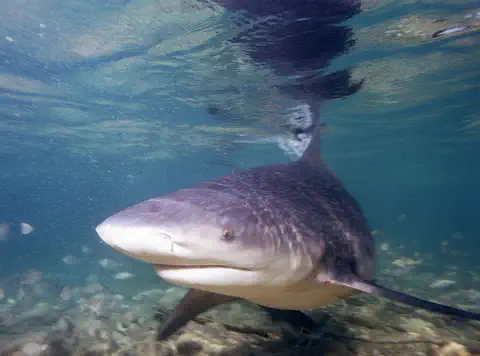
Bull shark
The bull shark is a large, stout shark of warm coasts around the world. It is one of very few sharks that can swim from the salty sea into fresh water, and it has been found thousands of kilometers up big rivers like the Amazon and the Mississippi.
Explore next
-
 Watch
Natural wonder
Great Rift Valley
The Great Rift Valley is a huge valley that runs through East Africa, where the continent is slowly being stretched and pulled apart. Long, steep cliffs line its sides, its floor holds lakes full of flamingos, and giant volcanoes such as Kilimanjaro and Mount Kenya rose beside it. Scientists think a new ocean may one day open here.
-
 Watch
 Country
Madagascar
Madagascar is the fourth-largest island in the world, in the Indian Ocean off southeastern Africa. It split from other land more than 60 million years ago, so many of its plants and animals, such as its lemurs, live nowhere else. About 32.7 million people lived there in 2025.
-
Watch
3D
Animal
African wild dog
The African wild dog, or painted dog, has a patchy coat unlike any other dog's, big round ears and only four toes on its front feet. It lives in close packs that hunt together, share food and care for the pups. It is endangered: the IUCN estimated in 2025 that only about 1,676 adults are left in the wild.
-
Watch
3D
Animal
Lion
The lion is the only big cat that lives in a family group, called a pride. Lionesses hunt together, males guard the pride's land, and their roar can be heard about 8 kilometers away. Wild lions live in Africa, plus one small group in western India.
-
Watch
Animal
Giant African millipede
The giant African millipede is one of the largest millipedes in the world, usually 16 to 28 centimeters long. It lives in the lowlands of East Africa, from Kenya to Mozambique, where it eats dead plants and helps turn them back into soil. Like all millipedes, it has two pairs of legs on most body rings and adds rings and legs as it grows.
-
 Watch
 Country
Malawi
Malawi is a narrow country in southeastern Africa that curves along the Great Rift Valley. Lake Malawi, one of the deepest lakes in the world, covers more than a fifth of the country, and it is home to hundreds of kinds of colorful fish. About 21 million people lived there in 2026.
-
Watch
3D
Animal
Bull shark
The bull shark is a large, stout shark of warm coasts around the world. It is one of very few sharks that can swim from the salty sea into fresh water, and it has been found thousands of kilometers up big rivers like the Amazon and the Mississippi.
-
 Watch
 Country
Democratic Republic of the Congo
The Democratic Republic of the Congo, or DR Congo, is the second-largest country in Africa. The mighty Congo River curves through its rainforests, volcanoes rise in the east, and its capital, Kinshasa, is a center of music, fashion and popular culture.
For parents & teachers
What children will learn
- Locate Mozambique, the Mozambique Channel, Madagascar and the Zambezi River.
- Describe how rainfall changes from the humid north to the dry south.
- Explain how national parks like Gorongosa bring wildlife back.
- Describe Mozambique's many languages, foods and music without treating them as one culture.
Recommended ages: 3 to 17 · About 15 minutes
Talk about it
- Why might a long coastline and good harbors be important for a country and its neighbors?
- How can bringing animals back to a park help people who live nearby?
- Why do you think many people in Mozambique speak more than one language?
Try at home or in class
- Make a homemade shaker or string instrument from clean recycled materials, inspired by marrabenta's oil-can guitars.
- On a map, trace the Zambezi River from Zambia through Mozambique to the Indian Ocean.
Key vocabulary: channel, cyclone, lingua franca, reintroduce, colony, World Heritage Site
Where these facts come from
- Wikidata , Wikimedia Foundation (CC0 1.0)
- Natural Earth vector data , Natural Earth (NACIS) (Public domain)
- UNESCO World Heritage List , UNESCO World Heritage Centre (Linked as a reference; site facts come from Wikidata)
- Mozambique (introduction, quick facts, land, relief) , Encyclopaedia Britannica
- Mozambique: Climate (plant and animal life, ethnic groups, languages) , Encyclopaedia Britannica
- Mozambique: Daily life and social customs (food, the arts) , Encyclopaedia Britannica
- Mozambique: History (precolonial period) , Encyclopaedia Britannica
- Mozambique: Mozambique under the New State regime (independence, one-party state) , Encyclopaedia Britannica
- Mozambique: Peace in Mozambique (1994 to the 2024 elections) , Encyclopaedia Britannica
- Island of Mozambique , UNESCO World Heritage Centre
- iSimangaliso Wetland Park , UNESCO World Heritage Centre
- Conservation , Gorongosa National Park
- Population, total: Mozambique , World Bank
- PlayOwl region table, version 1 , PlayOwl (PlayOwl original data)
- flag-icons 7.5.0 , Panayiotis Lipiridis and contributors (MIT)
- Wikimedia Commons , Wikimedia Foundation (Per file (public domain, CC0, CC BY or CC BY-SA); see each media record)
Checked, not yet human-reviewed. Last updated October 27, 2026. Spotted a mistake? Tell us.
Picture credits
- Photo: AmigoDia, CC BY-SA 3.0, via Wikimedia Commons · source · license
- Photo: Department of Defense. American Forces Information Service. Defense Visual Information Center. 1994, public domain, via Wikimedia Commons · source
- Photo: jon hanson from London, CC BY-SA 2.0, via Wikimedia Commons · source · license
- Photo: SSgt Robert Talenti, USAF, public domain, via Wikimedia Commons · source
- Photo: Giles Laurent, CC BY-SA 4.0, via Wikimedia Commons · source · license
- Photo: GinaFranchi, CC BY-SA 4.0, via Wikimedia Commons · source · license