
 Country
Europe
Romania
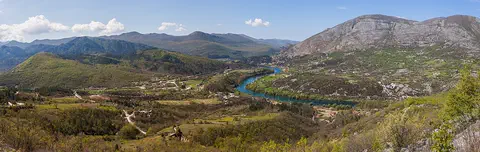
Romania is a country in Europe. It has big curving mountains and a long river. A giant wetland there is full of birds.
Romania is a country in southeastern Europe. The Carpathian Mountains curve around its middle, the Danube River runs along its southern edge to a huge delta on the Black Sea, and about 19 million people lived there at the start of 2026.
Romania is built around the Transylvanian Basin, ringed by the arcs of the Carpathians and an outer crescent of plains watered by the Danube. Most of its people speak a Romance language with Latin roots; communist rule ended in 1989, and the National Institute of Statistics counted about 19.04 million residents on 1 January 2026.
Photo: seisdeagosto, CC BY-SA 2.0, via Wikimedia Commons
Discover Romania
Romania is a country in Europe.
Big mountains curve across the middle. A long river runs along the bottom. The capital city is Bucharest.
Romania is in southeastern Europe, with the Black Sea on its southeast side. Its neighbors are Ukraine, Moldova, Bulgaria, Serbia and Hungary.
The Carpathian Mountains bend in a great curve around the middle of the country, a high land called the Transylvanian Basin. Wide, flat plains spread out beyond the mountains, and the Danube River flows along the south. The capital is Bucharest, and about 19 million people lived in Romania at the start of 2026.
Romania covers about 238,400 square kilometers, bounded by Ukraine to the north, Moldova to the northeast, the Black Sea to the southeast, Bulgaria to the south, Serbia to the southwest and Hungary to the west. Britannica describes a certain symmetry in its structure: the Transylvanian Basin at the center, the Carpathians and their subranges in a series of crescents around it, and an outer crescent of fertile plains extending to the frontiers.
Romania's National Institute of Statistics put the resident population at about 19.04 million on 1 January 2026. Less than half of the people live in rural areas, and Britannica notes that the population has declined since the 1990s, with falling birth rates and emigration among the causes it gives. About nine-tenths of the people are ethnically Romanian.
Cities and famous places
Bucharest is the capital of Romania.
It has wide streets and grand old buildings. In Transylvania, an old town has walls and towers. Some old villages have churches with strong walls.
Bucharest, the capital, was home to about 1.7 million people in 2021 and is the country's economic, administrative and cultural center. Iași, in the northeast, was once a capital of Moldavia, one of the lands that joined to form Romania.
In Transylvania, German craftsmen and merchants called the Saxons founded Sighișoara, a small medieval town with walls and towers, now a World Heritage Site. They also built villages with fortified churches. In the Orăștie Mountains stand the ruins of fortresses built by the Dacians about 2,000 years ago.
Britannica describes Bucharest between the world wars as by far the largest city and the industrial, financial and cultural center of the country. Iași and Suceava were old Moldavian capitals that traded with Transylvania's towns and profited from commerce between Baltic and Black Sea ports.
UNESCO inscribed Sighișoara in 1999: founded by German craftsmen and merchants, the Saxons of Transylvania, it is a fine example of a small fortified medieval town on the fringes of central Europe. The Saxons, encouraged to settle along the Carpathian arc in the 12th and 13th centuries, built fortified villages and churches, many inscribed in 1993. The six Dacian fortresses of the Orăștie Mountains, also inscribed in 1999, were built in the 1st centuries BCE and CE and conquered by the Romans early in the 2nd century CE.
Mountains, plains and the Danube
The Carpathian Mountains make a big curve in Romania.
The tallest one is Moldoveanu. The long Danube River flows to the sea. Where it ends, there is a huge wetland.
About a third of Romania is mountains and about a third is plains. The Carpathians form three groups, and the highest peaks, Moldoveanu at 2,544 meters and Negoiu, are in the Făgăraș Mountains. Saint Ana Lake, in an old volcano crater, is the only crater lake in Romania.
The Danube forms much of the southern border, and almost all of Romania's rivers flow into it. Where the Danube meets the Black Sea it splits into three arms and forms the Danube Delta, a huge wetland of lakes and marshes. Romania has four seasons.
The Carpathians divide into Eastern, Southern and Western ranges. The Southern Carpathians (Transylvanian Alps), of hard crystalline and volcanic rock, hold the highest peaks, Moldoveanu (2,544 m) and Negoiu (2,535 m) in the Făgăraș Mountains; the Eastern range includes volcanic chains with St. Ana Lake, Romania's only crater lake. Romania lies in an active earthquake zone where three tectonic plates meet. Plains cover about a third of the country, with black chernozem soils on loess in the Walachian Plain.
The Danube forms the southern frontier from Moldova Nouă to Călărași, and Romanian rivers supply nearly two-fifths of its discharge into the Black Sea. The delta, about 5,180 km², mostly in Romania, divides into the Chilia (two-thirds of the flow), Sfântu Gheorghe and Sulina arms. The climate is transitional between temperate and continental: average annual temperatures are about 11 °C in the south and 8 °C in the north, and rainfall averages about 640 mm, reaching about 1,400 mm in the Carpathians.
Animals of Romania
Brown bears and wolves live in Romania's forests.
Lynx and red deer live there too. Pelicans, swans and flamingos live in the big wetland. Chamois live high in the mountains.
Romania's forests are home to brown bears, red deer, wolves, foxes, wild pigs, lynx and martens, along with many songbirds. High in the Carpathians live chamois and eagles. Retezat National Park, Romania's first, opened in 1935 and is an important refuge for chamois.
In the Danube Delta, more than 300 kinds of birds have been counted, including pelicans, swans, wild geese, ibises and flamingos, and many migrating birds stop there each season.
Britannica lists the chamois (Rupicapra rupicapra) and eagles on the Alpine heights of the Carpathians and, in the forests, brown bears, red deer, wolves, foxes, wild pigs, lynx and martens. Retezat National Park, Romania's first (1935), covers about 38,000 hectares and is an important refuge for chamois.
UNESCO describes the Danube Delta, inscribed in 1991, as the largest and best preserved of Europe's deltas, with over 300 bird species and 45 freshwater fish species in its lakes and marshes. Pelicans, swans, wild geese, ibises and flamingos are protected by law, and rarer birds of the delta and Dobruja include Dalmatian pelicans, pygmy cormorants, spoonbills and red-breasted geese. Sturgeon fishing off the Danube mouth has been banned since 2006.
People, languages and food
About 19 million people live in Romania.
Most speak Romanian. Some speak Hungarian too. Many meals have soup, cabbage and meat. On the first day of March, people give red and white charms.
About nine in ten people in Romania are ethnic Romanians, and there are also many ethnic Hungarians, a small Roma community and an even smaller German one. Romanian, the official language, grew from Latin, the language of the ancient Romans. Hungarian is spoken by more than a million people.
Everyday dishes include soups with meat, vegetables and noodles, thick cabbage soup and stuffed cabbage leaves. On March 1, people celebrate Mărțișor, the start of spring, with charms tied with red and white ribbons. In the countryside, folk costumes with embroidered blouses are still worn, and almost every county has its own colors and styles.
Romanian, a Romance language, is official; Britannica notes it is technically the Daco-Romanian dialect, spoken by nine-tenths of the people. Hungarian is the only other language with more than a million speakers; Romany, German, Turkish and Serbian are spoken by smaller numbers. Almost nine-tenths of Romanians belong to the Romanian Orthodox Church; ethnic Hungarians and Germans are mostly Roman Catholic or Protestant, and Islam is practiced by Tatars and Turks in the Dobruja.
Cuisine owes much to Turkish and Greek cooking: meat and vegetable soups, cabbage soup, garlicky pork stew and stuffed cabbage leaves, with placinta turnovers for dessert. Mărțișor on March 1 marks the start of spring with red-and-white ribbon charms. Folk music includes the doina, a kind of lament, and instruments such as the nai (panpipes) and the cobza, a lute-like string instrument.
A long history
People have lived in Romania for a very long time.
Long ago, the Dacians built forts in the mountains. Then the Romans came. Today Romania is part of the European Union.
About 2,000 years ago, Dacian tribes lived in the mountains and built fortresses. In 105 CE the Romans took over southern Transylvania, and the Romans and Dacians mixed into one people. That is where the Romanian language comes from.
In the 1300s two lands, Walachia and Moldavia, appeared. They united in 1859, and in 1877 the new Romania declared its independence. Later, Transylvania and other regions joined it. From 1948 Romania had a communist government; communist rule ended in 1989, free elections were held in 1990, and Romania joined the European Union in 2007.
Dacian tribes had a developed society long before Rome; their fortresses date from the 1st centuries BCE and CE. The Romans under Trajan conquered southern Transylvania in 105 CE and withdrew under Aurelian in 271, by which time settlers and Dacians had intermarried; Britannica traces the Latin roots of Romanian to this mixture. The principalities of Walachia and Moldavia emerged in the 14th century, under pressure first from the Byzantines and Ottomans and later from the Habsburgs and Russia.
They united in 1859 and proclaimed independence from the Ottoman Empire in 1877. After World War I, Greater Romania acquired Transylvania and the Banat, Bukovina and Bessarabia, doubling its territory. Romania was occupied by Soviet troops in 1944 and was under communist rule from 1948; in 1989 the regime of Nicolae Ceaușescu, in power since 1965, was overthrown. Free elections followed in 1990, a democratic constitution was approved by referendum on 8 December 1991, and Romania joined NATO in 2004 and the EU in 2007.
Romania on the map
Find Romania on the globe.
It is in Europe, next to the Black Sea. The Danube River is at the bottom. Five countries are its neighbors.
Romania is in southeastern Europe, on the western shore of the Black Sea. Ukraine is to the north, Moldova to the northeast, Bulgaria to the south, Serbia to the southwest and Hungary to the west.
For a long way, the Danube River is the border with Serbia and Bulgaria. Inside the country, the Carpathian Mountains make a big curve, with Transylvania in the middle, Walachia to the south and Moldavia to the east.
Romania's historic regions roughly match its geography: Walachia, south of the Southern Carpathians, divided by the Olt River; Dobruja, between the lower Danube and the Black Sea, partly in Bulgaria; Moldavia, from the Eastern Carpathians to the Prut River on the Ukrainian border (the rest of the old principality is the country of Moldova); the Banat in the west, reaching into Hungary and Serbia; and Transylvania, enclosed by the Eastern and Southern Carpathians and the Bihor Mountains.
The Danube forms the southern frontier from Moldova Nouă to Călărași and passes the Iron Gate gorge, where a joint project with the former Yugoslavia built navigation works and two power stations now run jointly by Romania and Serbia.
- Highest point
- Moldoveanu, 2,544 m
- Danube Delta
- about 5,180 km², mostly in Romania
- Land and sea neighbors
- Ukraine, Moldova, Bulgaria, Serbia, Hungary; the Black Sea
- Southern border
- mostly the Danube, from Moldova Nouă to Călărași
Amazing facts
-
More than 300 kinds of birds live in the Danube Delta.
The Danube Delta is home to more than 300 kinds of birds and 45 kinds of freshwater fish.
UNESCO counts over 300 bird species and 45 freshwater fish species in the Danube Delta, which it calls the largest and best preserved of Europe's deltas.
-
Romania has a lake inside an old volcano.
Saint Ana Lake, in the Eastern Carpathians, fills an old volcano crater. It is the only crater lake in Romania.
St. Ana Lake lies among the volcanic necks and cones of the Harghita range, some with craters still preserved; it is Romania's only crater lake.
-
On March 1, people in Romania welcome spring with red and white ribbons.
Mărțișor, on March 1, celebrates the start of spring. People give charms tied with red and white ribbons, often worn all month.
On Mărțișor (March 1), men traditionally give women charms tied with red and white ribbons, worn throughout the month, to mark the beginning of spring.
-
The Danube splits into three big arms before it reaches the sea.
The Danube reaches the Black Sea through three arms. The biggest, the Chilia, carries about two-thirds of the water.
The Danube's final discharge is through the Chilia (two-thirds of the flow), Sfântu Gheorghe (one-fourth) and Sulina (the remainder) arms, and Romanian rivers supply nearly two-fifths of its discharge into the Black Sea.
-
Romania's first national park opened in 1935.
Retezat, Romania's first national park, opened in 1935 and protects mountain animals such as the chamois.
Retezat National Park, established in 1935, covers about 38,000 hectares of the Southern Carpathians and is an important refuge for the chamois (Rupicapra rupicapra).
Words to know
- delta
- the flat, wet land where a river splits into many channels before reaching the sea
- basin
- a large, lower area of land surrounded by higher ground
- crater lake
- a lake that fills the bowl-shaped top of an old volcano
- Romance language
- a language that grew from Latin, such as Romanian, Italian or Spanish
- principality
- a land ruled by a prince
- fortress
- a large building or group of buildings with strong walls, made to be defended
- World Heritage Site
- a place UNESCO lists as important to all people, to be protected
Discovery challenge
-
What is the capital city of Romania?
Which city is the capital of Romania?
Which city, in the old region of Walachia, is Romania's capital?
- Bucharest
- Budapest
- Belgrade
Show the answer
Bucharest
Bucharest is the capital of Romania.
Bucharest is the capital and the country's economic and cultural center. Budapest is the capital of Hungary, and Belgrade of Serbia.
Bucharest is the capital; Budapest and Belgrade are the capitals of two of Romania's neighbors, Hungary and Serbia.
-
Which big mountains curve across Romania?
Which mountains bend in a great curve around Transylvania?
Which mountain system, divided into Eastern, Southern and Western ranges, encircles the Transylvanian Basin?
- The Carpathians
- The Alps
- The Andes
Show the answer
The Carpathians
The Carpathian Mountains curve across Romania.
The Carpathians curve around Transylvania; their highest peak in Romania is Moldoveanu, 2,544 meters.
The Carpathians form crescents around the Transylvanian Basin; the Southern Carpathians hold Moldoveanu (2,544 m) and Negoiu (2,535 m).
-
More than 300 kinds of what live in the Danube Delta?
The Danube Delta is home to more than 300 kinds of what?
UNESCO counts over 300 species of which animal group in the Danube Delta?
- Birds
- Kangaroos
- Camels
Show the answer
Birds
Lots of birds live there, like pelicans and swans.
More than 300 kinds of birds live in the delta, including pelicans, swans and flamingos.
Over 300 bird species, among them Dalmatian pelicans, pygmy cormorants and spoonbills, use the delta, along with 45 freshwater fish species.
-
The Romanian language grew from the language of which people from long ago?
Romanian grew from the language of which ancient people?
Romanian is a Romance language. It grew from the Latin of which people, who conquered southern Transylvania in 105 CE?
- The Romans
- The Vikings
- The Aztecs
Show the answer
The Romans
It grew from the language of the Romans, called Latin.
Romanian grew from Latin, the language of the ancient Romans, who mixed with the Dacians who already lived there.
Roman settlers and Dacians intermarried between 105 and 271 CE, and the Latin roots of Romanian emerged from that mixture.
-
On March 1, people give charms with ribbons. What colors are the ribbons?
For Mărțișor on March 1, people give charms tied with ribbons of which colors?
Mărțișor marks the beginning of spring on March 1. What colors are the ribbons on its traditional charms?
- Red and white
- Blue and yellow
- Green and black
Show the answer
Red and white
The ribbons are red and white.
Mărțișor charms are tied with red and white ribbons and are often worn all through March.
Charms tied with red and white ribbons are traditionally worn throughout March to mark the start of spring.
Places to discover in Romania
-
Watch
City
Bucharest
Bucharest, the capital of Romania, lies on a wide plain beside the Dâmbovița River. First written about in 1459, it became the capital of Walachia in 1659 and of Romania in 1862. Today it is a city of broad boulevards, a huge parliament palace, the Romanian Athenaeum concert hall and an open-air Village Museum.
-
 Watch
Natural wonder
Danube
The Danube is Europe's second-longest river, after the Volga. It begins as two small streams in Germany's Black Forest and flows about 2,850 kilometers east to the Black Sea, passing through 10 countries and four capital cities. For more than 2,000 years it has been a border, a highway for boats and a home for wildlife, and it ends in a giant delta of reeds, lakes and birds.
Animals of Romania
-
 Watch
3D
Animal
Brown bear
The brown bear lives in more places than any other bear, from European forests to the mountains of Asia and the rivers of Alaska. It eats almost anything, from berries to salmon, and spends the long winter asleep in a cozy den. Grizzly bears and Kodiak bears are brown bears too.
-
 Watch
3D
Animal
Gray wolf
The gray wolf is the largest member of the dog family and the wild ancestor of pet dogs. Wolves live in family packs that hunt big animals like elk and moose together, and their howls can carry about 10 kilometers. After being wiped out in many places, wolves are coming back in parts of North America and Europe.
Explore next
-
Watch
City
Bucharest
Bucharest, the capital of Romania, lies on a wide plain beside the Dâmbovița River. First written about in 1459, it became the capital of Walachia in 1659 and of Romania in 1862. Today it is a city of broad boulevards, a huge parliament palace, the Romanian Athenaeum concert hall and an open-air Village Museum.
-
Watch
Natural wonder
Danube
The Danube is Europe's second-longest river, after the Volga. It begins as two small streams in Germany's Black Forest and flows about 2,850 kilometers east to the Black Sea, passing through 10 countries and four capital cities. For more than 2,000 years it has been a border, a highway for boats and a home for wildlife, and it ends in a giant delta of reeds, lakes and birds.
-
Watch
3D
Animal
Brown bear
The brown bear lives in more places than any other bear, from European forests to the mountains of Asia and the rivers of Alaska. It eats almost anything, from berries to salmon, and spends the long winter asleep in a cozy den. Grizzly bears and Kodiak bears are brown bears too.
-
Watch
3D
Animal
Gray wolf
The gray wolf is the largest member of the dog family and the wild ancestor of pet dogs. Wolves live in family packs that hunt big animals like elk and moose together, and their howls can carry about 10 kilometers. After being wiped out in many places, wolves are coming back in parts of North America and Europe.
-
 Watch
 Country
Belarus
Belarus is a landlocked country in eastern Europe. Ice sheets of the last ice age shaped its low hills and wide plains, it has more than 10,000 lakes and one of Europe's largest wetlands, and about 9.1 million people lived there in 2025.
-
 Watch
 Country
Bosnia and Herzegovina
Bosnia and Herzegovina is a mountainous country in southeastern Europe. It has forests, limestone hills and many rivers, and famous old stone bridges cross some of them. Its capital is Sarajevo. It touches the Adriatic Sea along only about 20 kilometers of coast.
-
 Watch
 Country
Bulgaria
Bulgaria is a country on the eastern side of the Balkan Peninsula, with the Danube River to the north and the Black Sea to the east. Mountains cross it from west to east, and about 6.4 million people lived there at the end of 2025.
-
 Watch
 Country
Croatia
Croatia is a crescent-shaped country in southeastern Europe. Its long coast on the Adriatic Sea is fringed by more than 1,100 islands, limestone mountains rise behind it, fertile plains lie in the north, and about 3.87 million people lived there in mid-2025.
For parents & teachers
What children will learn
- Locate Romania and name its neighbors, the Black Sea and the Danube.
- Describe how the Carpathians curve around Transylvania and how the Danube forms its delta.
- Describe some of Romania's wildlife, languages, foods and customs without treating them as one single culture.
- Outline Romania's history from the Dacians and Romans to union in 1859 and membership of the European Union.
Recommended ages: 3 to 17 · About 15 minutes
Talk about it
- Why might so many birds choose a delta to live in or rest in?
- Romanian grew from Latin. Can you think of English words that also come from Latin?
- Mărțișor welcomes spring. How do people where you live mark a change of season?
Try at home or in class
- Pour a little water slowly onto a tray of damp sand and watch it split into channels, like a river forming a delta.
- Make a simple charm with red and white yarn twisted together, as people do for Mărțișor.
Key vocabulary: delta, basin, crater lake, Romance language, principality, fortress, World Heritage Site
Where these facts come from
- Wikidata , Wikimedia Foundation (CC0 1.0)
- Natural Earth vector data , Natural Earth (NACIS) (Public domain)
- UNESCO World Heritage List , UNESCO World Heritage Centre (Linked as a reference; site facts come from Wikidata)
- Romania , Encyclopaedia Britannica
- Romania: Land (relief) , Encyclopaedia Britannica
- Romania: Drainage (soils, climate, plant and animal life, ethnic groups, languages, religion) , Encyclopaedia Britannica
- Romania: Settlement patterns , Encyclopaedia Britannica
- Romania: Daily life and social customs , Encyclopaedia Britannica
- Romania: Greater Romania , Encyclopaedia Britannica
- Romania: New constitution , Encyclopaedia Britannica
- Migrația internațională pozitivă nu reușește să ne compenseze scăderea naturală a populației (resident population on 1 January 2026, National Institute of Statistics figures) , Curs de Guvernare
- Bucharest , Encyclopaedia Britannica
- Danube Delta , UNESCO World Heritage Centre
- Historic Centre of Sighişoara , UNESCO World Heritage Centre
- Dacian Fortresses of the Orastie Mountains , UNESCO World Heritage Centre
- PlayOwl region table, version 1 , PlayOwl (PlayOwl original data)
- flag-icons 7.5.0 , Panayiotis Lipiridis and contributors (MIT)
- Wikimedia Commons , Wikimedia Foundation (Per file (public domain, CC0, CC BY or CC BY-SA); see each media record)
Checked, not yet human-reviewed. Last updated October 24, 2026. Spotted a mistake? Tell us.