
City Europe
Bucharest
Bucharest is the capital city of Romania. It has wide streets, grand old buildings, small old churches and a museum full of real village houses.
Bucharest, the capital of Romania, lies on a wide plain beside the Dâmbovița River. First written about in 1459, it became the capital of Walachia in 1659 and of Romania in 1862. Today it is a city of broad boulevards, a huge parliament palace, the Romanian Athenaeum concert hall and an open-air Village Museum.
Bucharest, Romania's economic, administrative and cultural center, lies in the middle of the Romanian plain on the Dâmbovița, a small tributary of the Danube. First recorded in 1459, capital of Walachia from 1659 and of Romania from 1862, it was heavily rebuilt in the 1980s. The 2021 census counted 1,716,961 people.
Photo: seisdeagosto, CC BY-SA 2.0, via Wikimedia Commons
Discover Bucharest
Bucharest is the capital city of Romania.
It sits on flat land beside a small river. Wide streets with many cars run between big, fancy old buildings. Parks and trees make green spaces.
Bucharest is the capital and biggest city of Romania, in southeastern Europe. It lies in the middle of the flat Romanian plain, on the banks of the Dâmbovița, a small river that flows into the Danube.
Bucharest is the center of Romania's business, government and culture. About 1.7 million people lived there at the 2021 census. From above, you can see wide boulevards, busy traffic and grand old buildings with domed corners.
Bucharest, both a city and a municipality, is the economic, administrative and cultural center of Romania. It lies in the middle of the Romanian plain on the Dâmbovița, a small northern tributary of the Danube; archaeological excavations show settlements dating back to the Neolithic Period.
The 2021 census counted 1,716,961 residents (Britannica gives an estimate of 1,819,419 for 2021 and 1,883,425 for 2011). The modern city is organized around squares from which streets and boulevards radiate; its two chief streets, Calea Victoriei and Bulevardul Magheru, run roughly parallel through the center.
- Country
- Romania (capital)
- People in the city (2021 census)
- about 1.7 million
- River
- Dâmbovița, a tributary of the Danube
- First written mention
- 1459
Famous places
Bucharest has a giant marble palace where the country's lawmakers meet.
There is a concert hall with tall columns in front. A museum shows real village houses brought from all over Romania. Little old churches hide between the buildings.
The Palace of the Parliament, a huge marble building, was built in the 1980s beside a vastly widened boulevard. Revolution Square is surrounded by grand buildings, including the Romanian Athenaeum, a concert hall famous for its columned front, and the former royal palace, now the National Museum of Art.
Bucharest has many small churches in the Byzantine style, such as the Old Court church from 1559 and Stavropoleos church from 1724. The Village Museum, opened in 1936, is an open-air museum of real country houses brought from many parts of Romania.
Bulevardul Unirii, called the 'Boulevard of the Victory of Socialism' under communism, was vastly expanded in the 1980s under Nicolae Ceaușescu and lined with buildings such as the palatial marble House of the People (Casa Poporului), now the Palace of the Parliament; a large area of old Bucharest was razed to make room for them. Republic Square, with the palace hall and the Crețulescu Church (1722), links to Revolution Square, ringed by administrative, political and cultural buildings including the columned Romanian Athenaeum and the former royal palace, now the National Art Museum.
The city's many churches are usually small and Byzantine in style; Britannica singles out the Curtea Veche (Old Court) church (1559), the church of the former Antim Monastery (1715) and Stavropoleos (1724). The Village Museum (1936) is a highly original ethnographic collection of peasant houses brought from across the country.
- Palace of the Parliament
- built in the 1980s as the House of the People
- Village Museum
- open-air museum of village houses, 1936
- Curtea Veche (Old Court) church
- 1559
- Stavropoleos church
- 1724
From fortress to capital
Long ago, a prince built a fortress here to protect his land.
A busy town grew around it. Craftspeople made furs, saddles and caps. Later, Bucharest became the capital of Romania.
People lived here as long ago as the Stone Age, but the name București first appears in writing in 1459, in a document signed by Vlad III, the ruler of Walachia. He built a fortress here to protect his land.
Bucharest grew into Walachia's main trading city and became its capital in 1659. Street names such as "Furriers' Lane" and "Saddlemakers' Lane" remember the craft guilds of that time. In 1862, after Walachia and Moldavia united, Bucharest became the capital of Romania, and it grew quickly after the country won full independence in 1877–78.
Neolithic settlements preceded the first written record of București in 1459, in a document of Vlad III, ruler of Walachia, who built the fortress to hold back the Ottoman Turks. Under the Ottoman suzerainty that followed, the city became Walachia's main economic center and, in 1659, its capital; streets named for furriers, saddlemakers and capmakers record its guilds, and Prince Constantin Brâncoveanu (1688–1714) built large thoroughfares.
Phanariote governors ruled from 1716 until a popular uprising led by Tudor Vladimirescu in 1821. Civic unrest in 1848 and 1859 helped bring about the union of Walachia and Moldavia, and Bucharest was proclaimed capital of the Romanian state in 1862; land reform (1864) and independence (1877–78) spurred growth. After World War I it became the leading city of a greatly enlarged country. Nationalization from 1948 brought large projects and uniform architecture, and in the 1980s the communist leader Nicolae Ceaușescu had a large area of the old city razed for the House of the People and its boulevard.
Getting around Bucharest
Bucharest has wide boulevards full of cars and buses.
The streets spread out from big squares like the spokes of a wheel. Airplanes fly from two airports.
Bucharest is laid out around big squares, with streets and boulevards spreading out from them. Its two main streets, Calea Victoriei and Bulevardul Magheru, run side by side through the center.
The city's factories have even built buses and trolleybuses. Travelers fly in and out through the international airport at Otopeni and the smaller Băneasa Airport.
The modern street plan radiates from squares; Calea Victoriei and Bulevardul Magheru run roughly parallel through the center, and Bulevardul Unirii was vastly widened in the 1980s. Under Prince Constantin Brâncoveanu (1688–1714) large thoroughfares had already been built.
Bucharest's manufactures include engineering products, notably machine tools and agricultural machinery, electrical and automotive equipment, buses and trolleybuses. Air travel uses the international airport at Otopeni and the smaller Băneasa Airport.
- Main airport
- Otopeni (international)
- Second airport
- Băneasa
- Main streets
- Calea Victoriei and Bulevardul Magheru
Weather and seasons
Bucharest has cold winters and hot summers.
Winter nights are below freezing. Summer days are hot. Early summer brings the most rain.
Bucharest has cold winters and hot summers. In January, days average about 3 °C and nights about −5 °C. In July and August, days average about 30 °C and nights about 15 °C, a big difference between the seasons.
About 594 millimeters of rain and snow falls in a year. June is the wettest month, and January and February are the driest.
World Meteorological Organization normals for 1981–2010 give mean daily maxima and minima of 2.8 °C and −4.8 °C in January and 29.8 °C and 15.4 °C in July, a seasonal swing of 27 °C in daytime highs.
Monthly totals add up to about 594 mm, from about 33 mm in January and February to 79 mm in June, with 7 to 12 days of precipitation each month; late spring and early summer (May to July) are wettest.
- January, average daily high and low
- about 3 °C and −5 °C
- July, average daily high and low
- about 30 °C and 15 °C
- Rain and snow in a year
- about 594 mm
Living in Bucharest
Bucharest is a city of music and plays.
Families go to concerts, the opera and the ballet. Students study at big universities. Children visit museums of art and of old village life.
Bucharest is Romania's center of learning and culture. The Polytechnical University was founded in 1818 and the University of Bucharest in 1864. The city has three central libraries, including the National Library.
Many theaters have long traditions, among them the National Theatre and the Theatre of Opera and Ballet, and a national philharmonic orchestra plays here. Families visit the Museum of the History of the City of Bucharest, the Art Museum of Romania and the open-air Village Museum.
Higher education centers on the Polytechnical University of Bucharest (1818) and the University of Bucharest (1864, from institutions dating to 1694), with academies in the arts and sciences and numerous research institutes; the Library of the Romanian Academy, the National Library and the Central University Library are the main libraries.
The National Theatre 'I.L. Caragiale' and the Theatre of Opera and Ballet have long traditions, and the city is the seat of a national philharmonic. The Art Museum of Romania holds large national, European and East Asian collections. Manufacturing (machine tools, agricultural machinery, electrical and automotive equipment, buses and trolleybuses, consumer goods) adds to the city's role as the country's economic center.
- Polytechnical University
- founded 1818
- University of Bucharest
- founded 1864
- Central libraries
- 3
Bucharest on the map
Find Bucharest on the globe.
Look for Romania, in southeastern Europe. Bucharest is in the south of the country, on flat land.
Bucharest is in southern Romania, in the middle of the flat Romanian plain. The Dâmbovița River flows through the city and on to join the Danube.
The city is laid out around big squares, with streets spreading out from them. The Palace of the Parliament stands on a wide boulevard, and the Village Museum is in the north of the city.
Bucharest lies at about 44.4° N and 26.1° E, in the middle of the Romanian plain on the Dâmbovița, a small northern tributary of the Danube.
Its plan radiates from squares; Calea Victoriei and Bulevardul Magheru run roughly parallel through the center, Republic Square links to Revolution Square, and the Palace of the Parliament stands on the rebuilt Bulevardul Unirii.
- Latitude
- about 44.4° north
- Longitude
- about 26.1° east
- Region
- middle of the Romanian plain
Amazing facts
-
Some Bucharest streets are named after old jobs.
Old street names such as Furriers' Lane, Saddlemakers' Lane and Capmakers' Lane remember the craft guilds of Bucharest.
Strada Blănarilor ('Furriers' Lane'), Strada Șelarilor ('Saddlemakers' Lane') and Strada Șepcarilor ('Capmakers' Lane') testify to the guilds that grew under Ottoman suzerainty.
-
Bucharest has a museum that is a whole village.
The Village Museum, opened in 1936, is made of real country houses moved from different parts of Romania.
The Village Museum (1936) is an ethnographic collection of peasant houses brought from various parts of the country.
-
Factories in Bucharest make buses and trolleybuses.
Factories in Bucharest make machine tools, farm machinery, buses and trolleybuses.
Bucharest's manufactures include machine tools, agricultural machinery, electrical and automotive equipment, buses and trolleybuses.
-
One of Bucharest's churches is more than 450 years old.
The Old Court church, built in 1559, is one of Bucharest's oldest churches.
Britannica highlights the Curtea Veche (Old Court) church of 1559, among the small Byzantine-style churches of architectural interest.
Words to know
- capital
- the city where a country's government meets
- plain
- a large area of flat land
- tributary
- a river that flows into a bigger river
- fortress
- a strong building or group of buildings made for defense
- guild
- a group of people who work in the same craft or trade
- boulevard
- a wide city street, often lined with trees
- open-air museum
- a museum whose buildings and displays are outdoors
Discovery challenge
-
Which country is Bucharest the capital of?
Bucharest is the capital of which country?
Since 1862, Bucharest has been the capital of which state?
- Romania
- Hungary
- Greece
Show the answer
Romania
Romania!
Romania, in southeastern Europe.
Romania, after the union of Walachia and Moldavia.
-
Which river flows through Bucharest?
Which small river flows through Bucharest?
Bucharest lies on which small northern tributary of the Danube?
- The Dâmbovița
- The Seine
- The Thames
Show the answer
The Dâmbovița
The Dâmbovița!
The Dâmbovița, which flows into the Danube.
The Dâmbovița.
-
What does the Village Museum show?
What can you see at Bucharest's Village Museum, opened in 1936?
What makes up the Village Museum's ethnographic collection?
- Real country houses
- Dinosaur skeletons
- Spaceships
Show the answer
Real country houses
Real old village houses!
Real country houses brought from many parts of Romania.
Peasant houses brought from various parts of the country.
-
When was Bucharest first written about?
In which year does the name București first appear in writing?
In which year does a document of Vlad III, ruler of Walachia, first record the name București?
- 1459
- 1959
- 1059
Show the answer
1459
1459, more than 550 years ago!
1459, in a document signed by Vlad III.
1459; Vlad III built its fortress to hold back the Ottoman Turks.
-
What is the Romanian Athenaeum?
The Romanian Athenaeum, with its columned front, is a famous what?
What kind of building is the Romanian Athenaeum, noted for its columned facade on Revolution Square?
- A concert hall
- A train station
- A sports stadium
Show the answer
A concert hall
A concert hall for music!
A concert hall on Revolution Square.
A concert hall, where the George Enescu Philharmonic gives performances.
Nearby places
-
 Watch
City
Sofia
Sofia, the capital of Bulgaria, lies in a valley near the middle of the Balkans, at the foot of Vitosha Mountain. The Romans called it Serdica, and an old church of St. Sofia later gave the city its name. About 1.2 million people lived there in 2025.
-
 Watch
City
Istanbul
Istanbul is the biggest city in Türkiye, built on both sides of the Bosporus, the narrow strait between Europe and Asia. Once called Byzantium and then Constantinople, it was the capital of two great empires. About 15.7 million people lived in Istanbul province in 2023.
-
 Watch
Landmark
Topkapı Palace
Topkapı Palace sits on a point of land where the Bosphorus Strait meets the sea in Istanbul. Sultan Mehmed II built it between 1460 and 1478, and for nearly 400 years it was the home of the Ottoman sultans and the center of their government. In 1924 it became a museum.
-
 Watch
City
Belgrade
Belgrade, the capital of Serbia, stands where the Sava River flows into the Danube. Its name, Beograd, means "white city", probably because of the white limestone walls of its old fortress above the rivers. At the 2022 census, about 1.2 million people lived in the city itself and about 1.7 million in the wider City of Belgrade.
-
 Watch
Landmark
Hagia Sophia
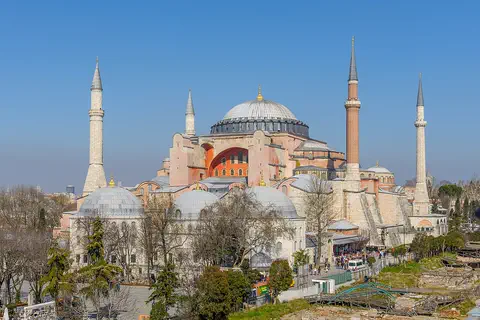
Hagia Sophia in Istanbul was built in under six years, from 532 to 537, for the emperor Justinian. Its enormous dome seems to float on a ring of 40 windows. Over almost 1,500 years it has been a church, a mosque and a museum, and since 2020 it has been a mosque.
-
 Watch
Landmark
Sultan Ahmed Mosque
The Sultan Ahmed Mosque in Istanbul was built between 1609 and about 1616 for the Ottoman ruler Sultan Ahmed I. Its central dome is ringed by half-domes and smaller domes, and six slender minarets rise around it. Many people call it the Blue Mosque because of the blue and green tiles and painted decoration inside. It is still a working mosque, where Muslims come to pray.
-
 Watch
Natural wonder
Mount Olympus
Mount Olympus is the highest mountain in Greece, about 2,918 meters tall, rising almost straight up from the shore of the Aegean Sea. It is made of limestone that formed in a warm, shallow sea long ago. Greece's first national park was created here in 1938, and nearly 2,000 kinds of plants grow on its slopes.
-
 Watch
City
Tirana
Tirana is the capital and largest city of Albania, on a plain about 27 kilometers from the Adriatic Sea. Founded in the early 1600s, it became the capital in 1920. About 389,000 people lived in the city in 2023.
Explore next
-
Watch
 Country
Romania
Romania is a country in southeastern Europe. The Carpathian Mountains curve around its middle, the Danube River runs along its southern edge to a huge delta on the Black Sea, and about 19 million people lived there at the start of 2026.
-
 Watch
Natural wonder
Danube
The Danube is Europe's second-longest river, after the Volga. It begins as two small streams in Germany's Black Forest and flows about 2,850 kilometers east to the Black Sea, passing through 10 countries and four capital cities. For more than 2,000 years it has been a border, a highway for boats and a home for wildlife, and it ends in a giant delta of reeds, lakes and birds.
-
 Watch
City
Budapest
Budapest, the capital of Hungary, was made in 1873 by joining three towns on the Danube River: hilly Buda and old Óbuda on one bank and flat Pest on the other. About 1.7 million people live there (2026), with hot springs under the ground and the first underground railway built on the European mainland.
-
 Watch
City
Vienna
Vienna is the capital of Austria, on the Danube River. For centuries it was the home of emperors, and composers such as Haydn, Mozart and Beethoven lived and worked there. About 2 million people lived in the city at the start of 2026.
-
 Watch
City
Athens
Athens is the capital of Greece and one of the oldest cities in the world. Above it rises the Acropolis, a rocky hill crowned by the marble Parthenon, built about 2,500 years ago. Ancient Athens was home to early democracy, great thinkers and theater.
- Watch Geography Villages, towns and cities A place where people live together is called a settlement. A village is a small settlement, often in the countryside. A town is bigger than a village but smaller than a city. A city is a large place with many people, buildings, roads and jobs. In 2025, the United Nations reported that 45 percent of the world's people live in cities.
-
Watch
City
Sofia
Sofia, the capital of Bulgaria, lies in a valley near the middle of the Balkans, at the foot of Vitosha Mountain. The Romans called it Serdica, and an old church of St. Sofia later gave the city its name. About 1.2 million people lived there in 2025.
-
 Watch
City
Amsterdam
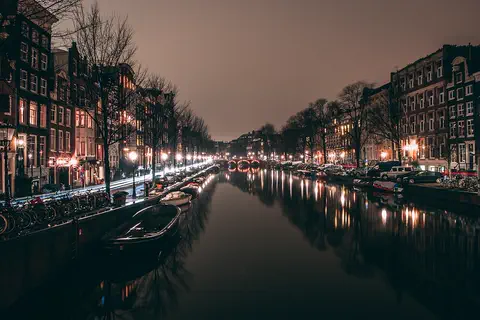
Amsterdam is the capital of the Netherlands. It began as a fishing village beside a dam on the Amstel River, which gave the city its name. Today about 942,000 people live among its rings of canals, hundreds of bridges, houseboats and bicycles.
For parents & teachers
What children will learn
- Locate Bucharest on the Romanian plain near the Danube.
- Explain how a fortress and a market town grew into a capital city.
- Name some of Bucharest's landmarks, from small churches to the Palace of the Parliament.
- Compare winter and summer temperatures in a continental climate.
Recommended ages: 3 to 17 · About 15 minutes
Talk about it
- Some Bucharest streets are named after the crafts once made there. What would a street named after your family's work be called?
- Parts of old Bucharest were knocked down to build a giant palace. Should cities keep old neighborhoods or build new ones?
- The Village Museum moved whole houses into a park. Which building near you would you save in a museum?
Try at home or in class
- Build a miniature 'village museum' from shoeboxes, each one a house from a different place.
- Make a street map of an imaginary city where all the streets spread out from one central square.
Key vocabulary: capital, plain, tributary, fortress, guild, boulevard, open-air museum
Where these facts come from
- Wikidata , Wikimedia Foundation (CC0 1.0)
- Natural Earth vector data , Natural Earth (NACIS) (Public domain)
- Bucharest , Encyclopaedia Britannica
- Romanian Athenaeum guided tour and Athenaeum Resonance Ensemble recital on European Night of Museums , Agerpres (Romanian national news agency)
- Bucharest: climatological information , World Meteorological Organization, World Weather Information Service
- Wikimedia Commons , Wikimedia Foundation (Per file (public domain, CC0, CC BY or CC BY-SA); see each media record)
Checked, not yet human-reviewed. Last updated October 27, 2026. Spotted a mistake? Tell us.