
Landmark Asia
Al-Masjid al-Haram
Al-Masjid al-Haram is a giant mosque in Mecca, in Saudi Arabia. In its middle is a building shaped like a cube, called the Kaaba. Millions of Muslims come here.
Al-Masjid al-Haram, the Great Mosque of Mecca in Saudi Arabia, was built around the Kaaba, a cube-shaped building that Muslims face when they pray. It is the most important place of pilgrimage in Islam. In 2026, 1,707,301 pilgrims came to Mecca for the hajj, and the mosque can hold up to about one million worshippers.
The Great Mosque of Mecca encloses the Kaaba, Islam's holiest shrine and the direction of Muslim prayer. Walls first enclosed the Kaaba in 638; the oldest standing parts are Sinan's Ottoman work of 1571; and Saudi enlargements from 1955 multiplied its area more than tenfold, to about 356,800 square meters after King Fahd's expansion, for crowds of more than a million.
Photo: Saudi Press Agency (SPA), CC BY-SA 4.0, via Wikimedia Commons
Discover Al-Masjid al-Haram
Al-Masjid al-Haram is a mosque in the city of Mecca. A mosque is a building where Muslims pray.
In the middle is an open courtyard. In the courtyard stands the Kaaba, a building shaped like a big box. For most of the year, it is covered with a black cloth.
Al-Masjid al-Haram, also called the Great Mosque of Mecca, is in Mecca, a city in western Saudi Arabia. The mosque was built around the Kaaba, a cube-shaped building in the middle of a large courtyard. Muslims everywhere face toward the Kaaba during their five daily prayers.
Each year, millions of Muslims travel here on pilgrimage, a special journey made for religious reasons. One of them is the hajj: in 2026, 1,707,301 pilgrims took part. Covered prayer halls surround the courtyard, and the mosque can hold up to about one million worshippers.
The Great Mosque of Mecca, or Masjid al-Haram, was built to enclose the Kaaba, which Muslims regard as the most sacred spot on Earth and toward which they orient their five daily prayers. Its plan is a rectangular central courtyard surrounded by covered prayer areas; the courtyard is where pilgrims perform the tawaf, walking around the Kaaba.
As a destination of both the hajj and the umrah pilgrimages, it receives millions of worshippers a year. Saudi Arabia's General Authority for Statistics counted 1,707,301 hajj pilgrims in 2026, of whom 1,546,655 came from outside the country. The oldest parts of the present structure date from the 16th century, and Britannica puts its capacity today at up to one million worshippers.
- City
- Mecca, Saudi Arabia
- Oldest standing parts
- Ottoman work from 1571
- Area after King Fahd's expansion
- about 356,800 m²
- Hajj pilgrims (2026)
- 1,707,301
From a wall to a vast mosque
Long ago, the Kaaba stood in an open space with no walls.
Then people built a wall around it. Over hundreds of years, the mosque grew bigger and bigger. Today it is huge.
At first the Kaaba stood in an open space. In 638, the caliph Umar, a leader of the early Muslim community, built a wall around it. Later leaders added roofs, columns and decorations. Between 775 and 785, the caliph al-Mahdi rebuilt and enlarged the mosque so that the Kaaba stood in the center of the courtyard.
After fire and flooding damaged it, the mosque was rebuilt in the early 1300s. In 1571 the Ottoman sultan Selim II sent his court architect, Sinan, to improve it. Sinan's work is the oldest part of the mosque still standing today.
The first Muslim structure on the site was a wall around the Kaaba, built in 638 by the second caliph, Umar ibn al-Khattab. Later caliphs added partial ceilings, columns and decoration. The Abbasid caliph al-Mahdi (775 to 785) rebuilt and expanded the mosque, moving the outer walls so that the Kaaba stood at the center of the courtyard.
Fire and flooding led to a rebuilding in the early 14th century. In 1571 the Ottoman sultan Selim II directed the court architect Sinan to improve the building, and Sinan replaced its flat roof with small domes. These Ottoman additions are the oldest surviving parts of the modern structure. In the 20th century came electric lighting, under Hussein ibn Ali (emir of Mecca from 1908), and in 1948 an electric public-address system.
Growing for millions of pilgrims
More and more people came to Mecca by airplane.
So builders made the mosque much bigger. They added moving stairs, tunnels and cool air. Now many more people fit inside.
In the late 1900s, air travel brought many more pilgrims to Mecca. Saudi Arabia's rulers paid for huge building projects. The first enlargement began in 1955 and was finished in 1973. It made the mosque more than five times bigger, so up to 500,000 people could pray there.
In 1984, King Fahd began another expansion, because more than a million people a year were coming for the hajj. Builders added escalators, tunnels and walkways for crowds, plus air-conditioning inside and outside. Afterward, the mosque could hold about 820,000 worshippers.
Britannica attributes the most drastic changes to the second half of the 20th century, when commercial air travel multiplied pilgrim numbers and oil wealth funded construction. The first Saudi enlargement, begun under King Saud in 1955 and completed in 1973, built around the Ottoman mosque and grew its area from about 27,000 m² to about 152,000 m², with a capacity of 500,000. The covered passage between the hills of al-Safa and al-Marwah, added in the 20th century, was enlarged and built into the mosque.
King Fahd's expansion, begun in 1984 as hajj numbers passed one million a year, cleared surrounding buildings for a wide paved plaza and added escalators, pedestrian tunnels and passageways, a modern communications system and indoor and outdoor air-conditioning. Afterward the mosque covered about 356,800 m² and held up to 820,000 worshippers; Britannica now gives a capacity of up to one million.
The Kaaba and the courtyard
The Kaaba is about 15 meters tall. It is made of gray stone and marble.
For most of the year, a huge black cloth covers it. The cloth has gold writing on it. Every year, it gets a brand new cloth.
Kaaba means "cube" in Arabic. It is about 15 meters high and about 10 by 12 meters at its base, built of gray stone and marble. Its corners point roughly north, south, east and west. Inside, there are just three pillars holding up the roof, and hanging silver and gold lamps.
For most of the year, the Kaaba is covered by the kiswah, an enormous cloth of black brocade, a heavy fabric with a woven pattern. A new kiswah is put on every year. Since 2022 this has happened on the first day of Muharram, the first month of the Islamic year.
The Kaaba (Arabic ka'bah, "cube") is roughly 15 m high and 10 by 12 m at the base, of gray stone and marble, with its corners oriented roughly to the points of the compass. Its interior holds only the three pillars supporting the roof and suspended silver and gold lamps. In its eastern corner is set the Black Stone, now in broken pieces held by a ring of stone and a heavy silver band.
The kiswah, a vast cloth of black brocade, covers the Kaaba for most of the year and is replaced annually, since 2022 on the first day of Muharram. A ceremonial washing with perfume and water from the nearby Zamzam well takes place in the same month, in recent times led by a representative of the Saudi government. Britannica notes that the Kaaba itself has been damaged and rebuilt several times over its history.
- Kaaba height
- about 15 m (50 ft)
- Kaaba base
- about 10 by 12 m (35 by 40 ft)
- Built of
- gray stone and marble
- Cover
- the kiswah, a black brocade cloth, renewed every year
The pilgrimage today
Pilgrims walk around the Kaaba seven times.
In the picture, many pilgrims are wearing white. People come from all over the world, by plane, by car and by ship.
Every Muslim who makes the hajj or the shorter umrah pilgrimage walks around the Kaaba seven times, counterclockwise. This is called the tawaf. Pilgrims also walk seven times between two small hills, al-Safa and al-Marwah, now joined to the mosque by a covered passage.
In 2026, Saudi Arabia counted 1,707,301 hajj pilgrims. Most came from other countries, nearly all of them by air, while others arrived by road or by sea. Escalators, tunnels and wide walkways help the crowds move.
During the hajj, pilgrims perform the tawaf, seven counterclockwise circuits of the Kaaba, touching or kissing the Black Stone if they can, though this is not required. They also complete the sa'y, seven passages between the low hills of al-Safa and al-Marwah, today inside the mosque's enclosed passageway.
GASTAT's register-based count, drawn from Interior Ministry records, gave 1,707,301 hajj pilgrims in 2026: 893,396 men and 813,905 women. Of the 1,546,655 who came from abroad, 1,485,729 arrived by air, 54,429 by road and 6,497 by sea. The 2025 hajj counted 1,673,230. The escalators, tunnels and cleared plaza of King Fahd's expansion were built to ease this kind of congestion.
Amazing facts
-
The word Kaaba means "cube".
The word Kaaba comes from the Arabic word for "cube", which fits its box shape.
Ka'bah means "cube" in Arabic; the building is roughly 15 m high on a 10 by 12 m base.
-
The Kaaba gets a new black cloth every year.
The black cloth that covers the Kaaba, the kiswah, is replaced every year. Since 2022, the new one has gone on at the start of the Islamic new year.
The kiswah is changed annually; since 2022 the change has been set on 1 Muharram, the start of the Hijri year.
-
The mosque has moving stairs and tunnels for the crowds.
To help huge crowds, the mosque was fitted with escalators, tunnels and air-conditioning in the expansion that began in 1984.
King Fahd's expansion added escalators, pedestrian tunnels, passageways, a communications system and indoor and outdoor air-conditioning.
-
Most hajj pilgrims arrive by airplane.
In 2026, 1,485,729 of the hajj pilgrims who came from other countries arrived by air.
Of 1,546,655 pilgrims from abroad in 2026, 1,485,729 came through air entry points, 54,429 by road and 6,497 by sea.
Words to know
- mosque
- a building where Muslims pray together
- pilgrimage
- a journey to a special place, made for religious reasons
- hajj
- the yearly pilgrimage to Mecca made by millions of Muslims
- courtyard
- an open space surrounded by walls or buildings
- brocade
- a heavy cloth with a raised pattern woven into it
- expansion
- making something bigger
Discovery challenge
-
Which country is the mosque in?
In which country is Al-Masjid al-Haram?
In which country does the Great Mosque of Mecca stand?
- Egypt
- Saudi Arabia
- Türkiye
Show the answer
Saudi Arabia
Saudi Arabia! The mosque is in the city of Mecca.
It is in Mecca, a city in western Saudi Arabia.
It stands in Mecca, inland from the Red Sea coast of western Saudi Arabia.
-
What shape is the Kaaba?
The word Kaaba means a shape. Which one?
Ka'bah is the Arabic word for which shape?
- A cube
- A ball
- A pyramid
Show the answer
A cube
A cube! It looks like a big box.
Kaaba means "cube" in Arabic, and the building is shaped like one.
Ka'bah means "cube"; the structure is roughly 15 m high on a 10 by 12 m base.
-
How many times do pilgrims walk around the Kaaba?
How many times do pilgrims walk around the Kaaba during the tawaf?
How many counterclockwise circuits of the Kaaba make up the tawaf?
- Three
- Seven
- One hundred
Show the answer
Seven
Seven times! They walk around and around.
Pilgrims walk around the Kaaba seven times, counterclockwise.
Seven circuits, counterclockwise, required of every pilgrim on the hajj or umrah.
-
What color is the cloth on the Kaaba?
What color is the kiswah, the cloth that covers the Kaaba?
What color is the brocade kiswah that covers the Kaaba for most of the year?
- White
- Red
- Black
Show the answer
Black
Black! It has gold writing on it.
The kiswah is black, with gold writing, and a new one is put on every year.
It is black brocade, embroidered in gold, and renewed annually, since 2022 on 1 Muharram.
Nearby places
-
 Watch
City
Mecca
Mecca is a city in western Saudi Arabia, in a dry valley ringed by mountains, about 70 kilometers from the Red Sea. About 2.4 million people lived there at the 2022 census. Its Great Mosque surrounds the Kaaba, and in 2026 more than 1.7 million pilgrims came to the city for the hajj.
-
 Watch
Landmark
Prophet's Mosque
The Prophet's Mosque in Medina, Saudi Arabia, began as the simple home and courtyard of the Prophet Muhammad, who helped build it after he came to Medina in 622. Rebuilt and enlarged many times, it now has a famous green dome over Muhammad's tomb, ten minarets and room for up to a million worshippers at the busiest times.
-
 Watch
Landmark
Aswan High Dam
The Aswan High Dam crosses the Nile River in southern Egypt. Finished in 1970, it is 111 meters high and 3,830 meters long. It controls the Nile's yearly flood, stores water for farms, makes electricity and created a huge reservoir, Lake Nasser. Ancient temples had to be moved to save them from the rising water.
-
 Watch
Landmark
Abu Simbel
Abu Simbel is two temples cut into the rock by King Ramesses II of Egypt, around 1264 BCE. Four seated statues of the king, each 21 meters tall, guard the Great Temple. In the 1960s, a new dam was about to flood them, so workers cut them into more than a thousand blocks and rebuilt them higher up.
-
 Watch
Landmark
Thebes
Thebes was one of the greatest cities of ancient Egypt and, for long periods, its capital. It lay on both banks of the Nile, where the town of Luxor is today. On the east bank stand the giant temples of Karnak and Luxor; on the west bank are royal tombs, including the Valley of the Kings.
-
 Watch
Natural wonder
Nile
The Nile flows north through northeastern Africa to the Mediterranean Sea, and its basin is shared by 11 countries. Its length is usually given as about 6,650 kilometers. Two great branches, the White Nile and the Blue Nile, meet at Khartoum in Sudan, and the green strip of farmland along its banks made it the lifeline of ancient Egypt.
-
 Watch
Natural wonder
Wadi Rum
Wadi Rum, in southern Jordan, is a desert of towering sandstone and granite mountains rising from valleys of red sand. Wind, water and salt have carved arches, gorges and honeycomb patterns into the rock. People have lived here for at least 12,000 years, leaving behind about 25,000 rock carvings and 20,000 inscriptions.
-
 Watch
Landmark
Petra
Petra, in southern Jordan, was the capital of the Nabataeans, who grew rich from trade in incense and spices. Many of its tombs and monuments are carved straight into red sandstone cliffs, and a narrow gorge called the Siq leads to its most famous facade, the Treasury.
Explore next
-
 Watch
 Country
Saudi Arabia
Saudi Arabia covers about four-fifths of the Arabian Peninsula. Most of it is dry desert, including the Empty Quarter, the largest sand area in the world. About 35.3 million people lived there in 2024, most of them in cities such as Riyadh, the capital.
-
Watch
City
Mecca
Mecca is a city in western Saudi Arabia, in a dry valley ringed by mountains, about 70 kilometers from the Red Sea. About 2.4 million people lived there at the 2022 census. Its Great Mosque surrounds the Kaaba, and in 2026 more than 1.7 million pilgrims came to the city for the hajj.
-
Watch
Landmark
Prophet's Mosque
The Prophet's Mosque in Medina, Saudi Arabia, began as the simple home and courtyard of the Prophet Muhammad, who helped build it after he came to Medina in 622. Rebuilt and enlarged many times, it now has a famous green dome over Muhammad's tomb, ten minarets and room for up to a million worshippers at the busiest times.
-
 Watch
Landmark
Hagia Sophia
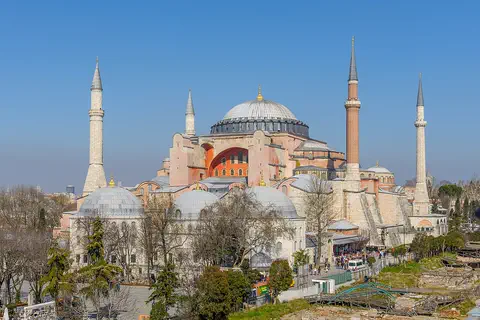
Hagia Sophia in Istanbul was built in under six years, from 532 to 537, for the emperor Justinian. Its enormous dome seems to float on a ring of 40 windows. Over almost 1,500 years it has been a church, a mosque and a museum, and since 2020 it has been a mosque.
-
 Watch
Landmark
Al-Aqsa Mosque
Al-Aqsa Mosque stands at the southern end of a huge raised plaza in the Old City of Jerusalem. Built in the early 700s, it has a silver-gray dome, and the golden Dome of the Rock stands nearby. The plaza is important to Muslims and to Jews.
-
 Watch
Landmark
Agra Fort
Agra Fort is a huge red sandstone fortress beside the Yamuna River in Agra, India. The Mughal emperor Akbar began it in 1565. Its walls, about 2.5 kilometers around, protect palaces, halls and mosques added by later emperors. It was both an army base and a royal home.
-
 Watch
Landmark
Angkor
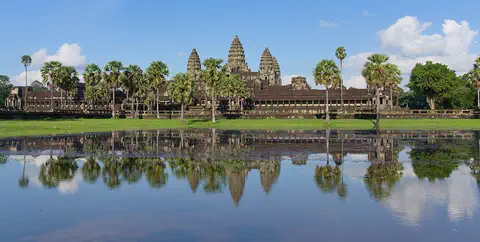
Angkor, in northwestern Cambodia, was the capital of the Khmer Empire from the 9th to the 15th century. Its kings built city after city here, with scores of temples, such as Angkor Wat and the Bayon, and giant reservoirs and canals to water the rice fields. Today it covers about 400 square kilometers, and more than 100,000 people live in villages inside it.
-
Watch
Landmark
Angkor Wat
Angkor Wat, near the town of Siem Reap in Cambodia, was built in the 12th century by the Khmer king Suryavarman II. Britannica (2026) calls it the world's largest religious structure. It was built as a Hindu temple and later became a Buddhist place of worship.
For parents & teachers
What children will learn
- Locate Mecca in Saudi Arabia and describe Al-Masjid al-Haram as a building: a courtyard around the Kaaba, surrounded by prayer halls.
- Explain why the mosque has been enlarged many times, and how its builders planned for huge crowds.
- Respectfully describe a pilgrimage as a journey people make for religious reasons.
Recommended ages: 3 to 17 · About 15 minutes
Talk about it
- Millions of people come to the same place at the same time. What would planners need to think about to keep everyone safe and comfortable?
- Many religions have special places people travel to. Why do you think visiting a place in person can matter so much to people?
- The mosque has been rebuilt and enlarged many times. How can builders change an old building while respecting its history?
Try at home or in class
- Use a stopwatch to time how long it takes to walk seven circles around a table, then talk about how crowds change walking speed.
- Draw a plan of a building for a very large crowd: mark entrances, exits, wide walkways and places to rest.
Key vocabulary: mosque, pilgrimage, hajj, courtyard, brocade, expansion
Where these facts come from
- Wikidata , Wikimedia Foundation (CC0 1.0)
- Great Mosque of Mecca , Encyclopaedia Britannica
- Kaaba , Encyclopaedia Britannica
- GASTAT: Total number of pilgrims for Hajj 2026 reaches (1,707,301) , General Authority for Statistics, Saudi Arabia
- GASTAT: Total number of pilgrims performing Hajj 1446H (2025) reaches (1,673,230) , General Authority for Statistics, Saudi Arabia
- Wikimedia Commons , Wikimedia Foundation (Per file (public domain, CC0, CC BY or CC BY-SA); see each media record)
Checked, not yet human-reviewed. Last updated October 27, 2026. Spotted a mistake? Tell us.