Animal
Desert locust
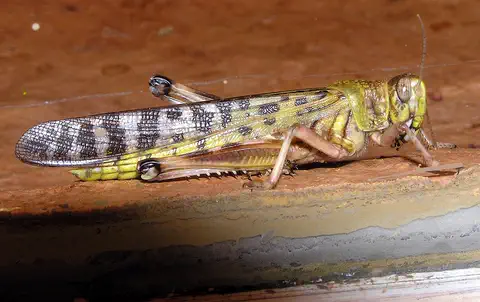
The desert locust is a big grasshopper that lives in dry, sandy places. When there are lots of them, they change color. Then they fly together in a huge group called a swarm.
The desert locust is a large grasshopper of the deserts of Africa, the Middle East and Southwest Asia. Most of the time it lives alone. But after good rains, when locusts become crowded, they change their color and behavior and can gather into enormous swarms that fly long distances and eat farmers' crops.
Schistocerca gregaria is a short-horned grasshopper (Acrididae) that shows phase polyphenism: crowding switches it from a solitarious to a gregarious form that differs in color and behavior and forms hopper bands and swarms. The FAO calls it the most destructive migratory pest in the world and monitors it continuously, because a single square kilometer of swarm can eat as much food in a day as about 35,000 people.
Photo: Arpingstone, public domain, via Wikimedia Commons
Meet the desert locust
The desert locust is a big grasshopper.
It has long back legs for jumping and wings for flying. Most of the time it lives alone. But sometimes many locusts come together and fly in a giant group.
Locusts are a kind of grasshopper, with big back legs for jumping. What makes them special is that they can change their behavior and travel long distances in groups. The desert locust is the best known of about a dozen kinds of grasshoppers that can do this.
Adults are about 6 to 9 centimeters long, and females are bigger than males. Most of the time desert locusts live alone in the desert and do little harm. But when there are many of them close together, they change, and huge groups called swarms can form.
The Food and Agriculture Organization of the United Nations (FAO) describes the desert locust as one of about a dozen short-horned grasshoppers (Acridoidea) able to change behavior and form swarms of adults and bands of hoppers (wingless nymphs). Locusts differ from other grasshoppers in this capacity to change and to migrate over long distances.
Adult males measure 60 to 75 millimeters and females 70 to 90 millimeters; CIRAD notes that the size difference between the sexes is much greater in the solitarious phase than in the gregarious phase. The two phases look so different that, until 1921, scientists thought they were two separate species.
Quick facts
- Group
- Invertebrate
- Length
- 60 to 90 mm
- Weight
- up to 2 g
- Top speed
- 16 to 19 km/h
- Lifespan in the wild
- 3 to 5 months
Where it lives
Desert locusts live in hot, dry deserts.
They live in Africa, the Middle East and parts of Asia. When it rains, plants grow in the desert, and the locusts have lots to eat.
In quiet years, desert locusts live in the dry deserts of Africa, the Middle East and Southwest Asia, in places that get less than 200 millimeters of rain a year. That area covers about 16 million square kilometers in about 30 countries.
They lay their eggs in damp, sandy soil, and their young need green plants to eat, so rain is important. In years when swarms form, they can spread much farther: into parts of about 60 countries, more than a fifth of all the land on Earth.
During recessions, the FAO says desert locusts are usually restricted to semi-arid and arid deserts receiving less than 200 millimeters of rain a year, about 16 million square kilometers in some 30 countries. During plagues they can spread over about 29 million square kilometers, into parts of 60 countries, more than 20 percent of the world's land surface.
CIRAD describes recession refuges along the India-Pakistan border, the Red Sea and Gulf of Aden coasts, and around desert mountain massifs (the central and southern Sahara, the southern edge of the Atlas, the Oman mountains and the Mekran valleys of Pakistan and Iran), where yearly rainfall is 50 to 300 millimeters. Breeding needs moist sandy soil 10 to 15 centimeters deep, bare patches for egg-laying and green vegetation for hoppers.
Continents
Its habitats


Where can you find this animal?
- Lives here naturally · Countries and seas named by a scientific source
- Sightings recorded · Records of wild sightings (GBIF)
Lives here naturally · Countries and seas named by a scientific source
Countries that belong to the FAO's three regional Desert Locust commissions (western, central and southwest Asian regions), which cover the dry deserts where the locust lives in quiet years (about 16 million square kilometers in some 30 countries with less than 200 mm of rain a year) and the lands nearby that swarms invade. Locusts live only in suitable desert and semi-desert areas within each cou
Places: Algeria, Burkina Faso, Chad, Gambia, Libya, Mali, Mauritania, Morocco and 23 more places.
Source: https://www.fao.org/locust-watch/en · checked October 2026
Sightings recorded · Records of wild sightings (GBIF)
Counts of GBIF records of wild observations (human and machine) and preserved specimens. Records include introduced populations, vagrants, escaped or released animals and misidentifications, so a country with records is not necessarily part of the native range.
Wild sightings have been recorded in Spain, Kenya, Morocco, Namibia, South Africa, Egypt, UK, Portugal and 48 more places.
Source: gbif · checked October 2026
Range maps show where scientists say an animal lives, often country by country. An animal may live in only part of a country shown, and sightings records can include animals that wandered far from home.
Big appetites
Desert locusts eat plants.
Each locust eats about as much as it weighs every day. A big swarm can eat a lot of food, so farmers keep watch for them.
Desert locusts eat green plants. An adult weighs about 2 grams and eats roughly its own weight in fresh food every day.
One locust does not eat much. But a swarm covering just one square kilometer can hold about 40 million locusts, and together they eat as much food in a day as about 35,000 people. That is why swarms can damage crops and the grazing land that animals need.
An adult consumes roughly its own weight, about 2 grams, of fresh vegetation per day. A 1 square kilometer swarm of about 40 million locusts therefore eats as much in a day as about 35,000 people, using the USDA figure of 2.3 kilograms of food per person per day (FAO).
The FAO notes that swarms target food crops and forage, and that during plagues the desert locust can threaten the livelihoods of a tenth of the world's population. CIRAD notes that solitarious locusts are harmless to crops; damage comes from the gregarious phase.
Did you know?
Locusts do not bite people.
Desert locusts do not attack people or animals, and there is no evidence that they carry diseases that harm people.
Locusts do not attack people or animals, and there is no evidence that they transmit human diseases (FAO).
Two ways to look
A desert locust can change its colors!
Locusts that live alone are brown or gray. Locusts that live in big groups are pink when they are young and bright yellow when they are grown up.
Desert locusts have strong back legs for jumping, two pairs of wings and short antennae. Their outer skeleton is made mostly of a tough material called chitin.
The most amazing thing about them is how they change. A locust that lives alone is brown, gray or beige and flies at night. When locusts become crowded, they act as a group, and their young grow up looking very different: pink when they are new adults and bright yellow when they are ready to lay eggs. These group locusts fly in the daytime.
Phase change is triggered by density; CIRAD gives a threshold of about 250 to 500 adults per hectare, or 0.5 to 5 hoppers per square meter. Solitarious adults are brown, gray or beige, never green; gregarious adults are pink when immature and turn bright yellow at sexual maturity. Solitarious hoppers are green or brown with no black and pass through 5 or 6 instars; gregarious hoppers are yellow with heavy black markings and have 5 instars.
Behavior changes too: solitarious adults fly at night, swarms by day. Chitin, the main constituent of the exoskeleton, increases with age from about 1.7 percent of fresh weight in hoppers to 4 percent in a two-month-old adult (FAO).
Egg, hopper, adult
A mother locust pushes her eggs into damp sand.
The eggs hatch into hoppers. Hoppers look like small locusts with no wings. They shed their skin and grow, and then they get wings!
A desert locust has three stages: egg, hopper and adult. The female pushes the end of her body into damp sand and lays a clump of eggs, called an egg pod, 10 to 15 centimeters under the surface.
The eggs hatch in about two weeks. The young, called hoppers, have no wings yet. They shed their skin five or six times over about 30 to 40 days, and then they are winged adults. Adults usually take two to four months to be ready to lay eggs. A whole life lasts about three to five months.
Development is incomplete (egg, hopper, adult). Eggs are laid in pods in sandy soil 10 to 15 centimeters deep; a solitarious female lays about 95 to 158 eggs per pod, a gregarious female usually fewer than 80, and females lay at least three times at intervals of about 6 to 11 days. Up to 1,000 egg pods have been found in one square meter (FAO).
Eggs hatch in about two weeks (range 10 to 65 days); hoppers develop through five or six instars in about 30 to 40 days; adults mature in three weeks to nine months, most often two to four months. CIRAD notes 2 to 3 generations a year, with a facultative arrest in the immature adult during dry periods, when breeding can stall for several months.
Swarms on the wind
A swarm is a giant group of locusts flying together.
They fly in the daytime and let the wind carry them. They can fly over a whole sea!
Swarms fly in the daytime, usually with the wind, at about 16 to 19 kilometers an hour. In a day, a swarm can travel anywhere from about 5 to 130 kilometers or more. Swarms can be smaller than one square kilometer or cover several hundred.
Locusts can stay in the air for a long time. They regularly fly across the Red Sea, about 300 kilometers. In 1988 a swarm crossed the Atlantic Ocean from West Africa to the Caribbean, about 5,000 kilometers, in about ten days.
Swarms contain at least 40 million and sometimes 80 million adults per square kilometer, and range from under one to several hundred square kilometers. They fly by day, downwind, at about 16 to 19 kilometers per hour, covering roughly 5 to 130 kilometers or more a day; the FAO's key facts give up to 150 kilometers. Daytime flight lets swarms use rising air to cross mountain barriers (CIRAD).
The FAO records spectacular long-distance movements: from northwest Africa to the British Isles in 1954, and from West Africa to the Caribbean, about 5,000 kilometers in about ten days, in 1988. Locusts do not attack people or animals, and there is no evidence that they carry diseases that harm humans.
Did you know?
Long ago, scientists thought lonely locusts and crowded locusts were two different animals!
Lonely desert locusts and crowded ones look so different that, until 1921, scientists thought they were two separate species.
The solitarious and gregarious phases differ so much in color and form that they were treated as separate species until 1921.
Watching the desert
People all over the world work together to watch for locusts.
They study the rain and the plants in the desert. Then they can help farmers before big swarms grow.
The desert locust is not endangered; there are often huge numbers of them, and it has no IUCN conservation status. Instead, people work to keep swarms from harming crops.
Countries that have locusts send information to the FAO, which watches the weather, the plants and satellite pictures, and warns countries up to six weeks ahead. Teams try to find and treat young locusts early, before swarms grow. In some countries people also collect and cook locusts, which are rich in protein.
Schistocerca gregaria has not been assessed for the IUCN Red List. Plagues develop irregularly rather than on a cycle: in the 20th century they occurred in 1926 to 1934, 1940 to 1948, 1949 to 1963, 1967 to 1969 and 1986 to 1989 (FAO), and a major upsurge struck Eastern Africa, Southwest Asia and the Red Sea region in 2020 to 2021.
The FAO's Desert Locust Information Service combines country reports with weather, habitat and satellite data to forecast up to six weeks ahead, and three regional commissions coordinate survey and control. Control relies mainly on small, concentrated doses of organophosphate pesticides; research on biological control focuses on pathogens and insect growth regulators. CIRAD stresses preventive control in known outbreak areas, since intensive treatment of vast areas carries greater environmental risk.
Did you know?
Locusts once flew all the way across an ocean.
In 1988, desert locusts flew from West Africa across the Atlantic Ocean to the Caribbean, about 5,000 kilometers, in about ten days.
In 1988 swarms crossed from West Africa to the Caribbean, about 5,000 kilometers, in roughly ten days.
Amazing facts
-
Long ago, scientists thought lonely locusts and crowded locusts were two different animals!
Lonely desert locusts and crowded ones look so different that, until 1921, scientists thought they were two separate species.
The solitarious and gregarious phases differ so much in color and form that they were treated as separate species until 1921.
-
Locusts once flew all the way across an ocean.
In 1988, desert locusts flew from West Africa across the Atlantic Ocean to the Caribbean, about 5,000 kilometers, in about ten days.
In 1988 swarms crossed from West Africa to the Caribbean, about 5,000 kilometers, in roughly ten days.
-
Locusts do not bite people.
Desert locusts do not attack people or animals, and there is no evidence that they carry diseases that harm people.
Locusts do not attack people or animals, and there is no evidence that they transmit human diseases (FAO).
-
In some places, people cook and eat locusts.
In several countries people collect locusts and roast, boil or fry them. Locusts are rich in protein.
About 62 percent of an adult's dry weight is protein and 17 percent fat; locusts are eaten in several countries.
Words to know
- swarm
- a huge group of flying insects moving together
- hopper
- a young locust that has no wings yet
- egg pod
- a clump of locust eggs laid together in the soil
- gregarious
- living and acting in a group
- solitarious
- living and acting alone (a word scientists use for lone locusts)
- molt
- to shed an old outer skin so the body can grow
Discovery challenge
-
What color are grown-up locusts from a big group?
What color are mature adult locusts that grew up in a crowd?
What color are sexually mature gregarious adults?
- Bright yellow
- Bright blue
- Black and white
Show the answer
Bright yellow
They are pink when young and bright yellow when grown up.
Crowded locusts are pink as young adults and turn bright yellow when they are ready to breed.
Gregarious adults are pink when immature and bright yellow at sexual maturity; solitarious adults are brown, gray or beige.
-
What is a baby locust with no wings called?
What is the wingless young stage of a locust called?
What do locust biologists call the wingless nymphs?
- A hopper
- A caterpillar
- A tadpole
Show the answer
A hopper
It is called a hopper. It hops before it can fly.
Young locusts are called hoppers; they molt five or six times before getting wings.
Hoppers: wingless nymphs that pass through 5 or 6 instars, forming bands in the gregarious phase.
-
What makes lots of locusts hatch in the desert?
What do desert locusts need to lay eggs and raise their young?
Which conditions favor desert locust breeding?
- Snow and ice
- Rain, damp sand and green plants
- Deep ocean water
Show the answer
Rain, damp sand and green plants
Rain makes the sand damp and the plants grow, so locusts can lay eggs.
Females lay eggs in damp, sandy soil, and hoppers need green plants to eat.
Moist sandy soil to 10 to 15 centimeters, bare patches for egg pods and green vegetation for hoppers.
-
Do locusts hurt people?
What does the FAO say about locusts and people?
According to the FAO, what risk do locusts pose to people directly?
- They bite people
- They do not attack people
- They sting people
Show the answer
They do not attack people
Locusts do not attack people. They eat plants.
Locusts do not attack people or animals; the problem is that big swarms eat crops.
None directly: they do not attack people or animals or carry human diseases; the harm is to crops and pasture.
Places where you might see it
-
 Watch
 Country
Mauritania
Mauritania is a large country in northwest Africa where the Sahara meets the Atlantic Ocean. Dunes cover about half the land, ancient trading towns stand by desert oases, and many kinds of migrating birds spend the winter on its coast. About 5.3 million people live there.
-
 Watch
 Country
Sudan
Sudan is a large country in northeastern Africa. The Blue Nile and the White Nile meet at its capital, Khartoum, and the river flows north through the desert. Long ago, the kingdom of Kush built pyramids, temples and palaces along the Nile here.
-
 Watch
 Country
India
India is a huge country in South Asia, shaped like a big triangle pointing into the Indian Ocean. The Himalayas rise along its north, heavy monsoon rains arrive every summer, and about 1.46 billion people (2025) live there, speaking hundreds of languages.
-
 Watch
 Country
Saudi Arabia
Saudi Arabia covers about four-fifths of the Arabian Peninsula. Most of it is dry desert, including the Empty Quarter, the largest sand area in the world. About 35.3 million people lived there in 2024, most of them in cities such as Riyadh, the capital.
-
 Watch
 Country
Algeria
Algeria is a country in North Africa and the largest country on the whole continent. More than four-fifths of it is the Sahara Desert, so most of its 47 million people (2025) live in the greener north, along the Mediterranean Sea. Its capital is Algiers.
Explore next
-
 Watch
3D
Animal
European mantis
The European mantis is the best-known praying mantis. It sits very still with its spiky front legs folded, then snatches insects that come close. It is native to Europe, Africa and much of Asia, and people brought it to North America more than 100 years ago.
-
 Watch
Animal
Common green darner
The common green darner is one of North America's larger and best-known dragonflies, up to about 8 centimeters long. It begins life as an underwater nymph, then becomes a fast flier that catches insects in the air. Many green darners migrate, in a relay that takes at least three generations each year.
-
Watch
Country
Mauritania
Mauritania is a large country in northwest Africa where the Sahara meets the Atlantic Ocean. Dunes cover about half the land, ancient trading towns stand by desert oases, and many kinds of migrating birds spend the winter on its coast. About 5.3 million people live there.
-
Watch
Country
Sudan
Sudan is a large country in northeastern Africa. The Blue Nile and the White Nile meet at its capital, Khartoum, and the river flows north through the desert. Long ago, the kingdom of Kush built pyramids, temples and palaces along the Nile here.
-
Watch
Country
India
India is a huge country in South Asia, shaped like a big triangle pointing into the Indian Ocean. The Himalayas rise along its north, heavy monsoon rains arrive every summer, and about 1.46 billion people (2025) live there, speaking hundreds of languages.
-
Watch
Country
Saudi Arabia
Saudi Arabia covers about four-fifths of the Arabian Peninsula. Most of it is dry desert, including the Empty Quarter, the largest sand area in the world. About 35.3 million people lived there in 2024, most of them in cities such as Riyadh, the capital.
-
Watch
Country
Algeria
Algeria is a country in North Africa and the largest country on the whole continent. More than four-fifths of it is the Sahara Desert, so most of its 47 million people (2025) live in the greener north, along the Mediterranean Sea. Its capital is Algiers.
-
 Watch
Animal
American lobster
The American lobster is a big crustacean that lives on the rocky sea floor of the northwest Atlantic Ocean. It has two very different claws, one for crushing and one for tearing, and it must climb out of its hard shell again and again to grow.
For parents & teachers
What children will learn
- Explain how crowding changes the desert locust's color and behavior.
- Put the stages of incomplete metamorphosis (egg, hopper, adult) in order.
- Use real numbers to explain why swarms matter for food and farming.
- Describe how countries share information to forecast and prevent swarms.
Recommended ages: 3 to 17 · About 15 minutes
Talk about it
- Why might rain in a desert lead to more locusts a few months later?
- Why is it easier to stop locusts when they are hoppers than when they are swarms?
- How does sharing information between countries help everyone?
Try at home or in class
- Weigh two paper clips on a kitchen scale (about 2 grams): that is about what one locust weighs and eats each day.
- Mark 8 centimeters on paper and draw a life-size desert locust with its long wings and jumping legs.
Key vocabulary: swarm, hopper, egg pod, gregarious, solitarious, molt
Where these facts come from
- GBIF Backbone Taxonomy and GBIF Occurrence Search , Global Biodiversity Information Facility (CC0 1.0 (backbone); occurrence counts are facts derived from records under CC0, CC BY and CC BY-NC)
- Wikidata , Wikimedia Foundation (CC0 1.0)
- Frequently Asked Questions (FAQs) about locusts , FAO Locust Watch
- Desert Locust , Food and Agriculture Organization of the United Nations (FAO)
- Locust Watch (regional Desert Locust commissions) , FAO Locust Watch
- Schistocerca gregaria: the Desert locust , CIRAD (French agricultural research centre), Locust pests
- Wikimedia Commons , Wikimedia Foundation (Per file: Public domain, CC0, CC BY or CC BY-SA only (credited on each page))
Checked, not yet human-reviewed. Last updated October 28, 2026. Spotted a mistake? Tell us.
Picture credits
- Photo: Arpingstone, public domain, via Wikimedia Commons · source