 Country
Europe
Ukraine
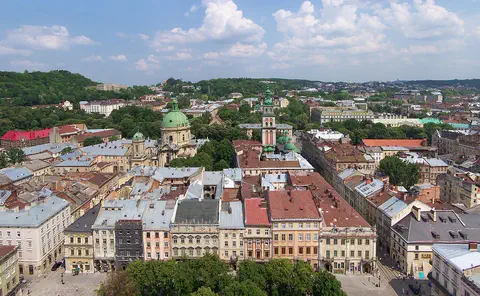
Ukraine is a big country in eastern Europe. It has wide, flat plains, rich black soil, long rivers and the Carpathian Mountains.
Ukraine is a large country in eastern Europe on the northern shore of the Black Sea. Most of it is level plain with some of the most fertile soil in the world, crossed by the Dnieper River. Its capital is Kyiv, and its official language is Ukrainian.
Ukraine occupies the southwestern part of the East European Plain, with mountains only at its edges. About two-thirds of it is covered by chernozem, among the world's most fertile soils. Independent since 1991, it has faced Russia's annexation of Crimea in 2014 and Russia's invasion in 2022.
Photo: Lestat (Jan Mehlich), CC BY-SA 3.0, via Wikimedia Commons
Discover Ukraine
Ukraine is a big country in Europe.
Most of it is flat land. The soil is dark and good for growing food. The Black Sea is in the south. The capital city is called Kyiv.
Ukraine is in eastern Europe. It covers about 603,500 square kilometers, which makes it a big country, and almost all of it is level plain. Mountains are found only at its edges: the Carpathians in the far west and the Crimean Mountains in the south.
The Black Sea and the Sea of Azov lie along its southern coast. Its capital, Kyiv, stands on the Dnieper, the longest river in the country. Ukrainian is the official language.
Ukraine occupies the southwestern portion of the East European (Russian) Plain. Its area is about 603,500 square kilometers, and it consists almost entirely of level plains at an average elevation of about 175 m; the Ukrainian Carpathians and the Crimean Mountains, on the borders, account for barely 5 percent of the area. Britannica put the urban share at 69.7 percent in 2022.
Population estimates differ widely: the World Bank estimated 39.0 million for 2025, while Britannica's 2026 estimate is 42.5 million. Ukraine declared independence from the Soviet Union on August 24, 1991, confirmed by a referendum on December 1, 1991, and Kyiv, the capital, was the center of the Kyivan state, which began to form in the mid-9th century.
Cities and famous places
Kyiv is the biggest city in Ukraine.
It is on a wide river. Kyiv has a very old church with green and gold domes. Lviv is a city in the west with colorful old houses.
Kyiv, the capital, lies on the Dnieper River. More than 1,000 years ago it was the center of a state called Kyivan Rus. Saint Sophia Cathedral, a place of worship whose story begins in the 1000s, is one of its most famous buildings.
Lviv, in the west, was founded in the Middle Ages and was an important center of trade for hundreds of years. Its medieval street plan has survived almost unchanged, with signs of the many different communities who lived there. Other large cities include Kharkiv and Dnipro.
Kyiv, the capital, had about 2.95 million people in 2022 (Wikidata). UNESCO inscribed its Saint-Sophia Cathedral and the Kyiv-Pechersk Lavra in 1990: the cathedral was designed to rival Hagia Sophia in Constantinople when Kyiv was the capital of an 11th-century Christian principality, and the Lavra helped spread Orthodox thought from the 17th to the 19th century.
Lviv, founded in the late Middle Ages, was for centuries an administrative, religious and commercial center; UNESCO (1998) notes that its medieval street plan survives virtually intact, with evidence of the different ethnic communities who lived there and many fine Baroque and later buildings. Kharkiv (1.42 million in 2022) and Dnipro (about 969,000) are other large cities. Both World Heritage sites have been on UNESCO's List of World Heritage in Danger since 2023.

Plains, black earth and rivers
Most of Ukraine is wide, flat land.
The soil is dark black and very good for farming. Long rivers flow to the sea. In the west there are green mountains with forests.
About two-thirds of Ukraine is covered by chernozem, which means black earth. It is dark, rich soil, among the most fertile in the world, and it is very good for growing crops. From north to south, Ukraine changes from woods and marshes to forest-steppe to steppe, a dry grassland.
The Dnieper River flows across the middle of the country to the Black Sea. In the far west, the Carpathian Mountains hold most of Ukraine's forests and its highest peak, Hoverla, 2,061 meters tall. Winters are colder in the east, and summers can be hot.
Britannica divides Ukraine's soils into three belts: sandy podzolized soils in the north and northwest (about one-fifth of the area), the black chernozems of the center (about two-thirds), and chestnut soils that become saline toward the Black Sea. The deep chernozems of the north are about 1.5 m thick and rich in humus, but intensive cultivation has caused widespread erosion. Natural vegetation zones run from the Polissya woodland and marsh through the forest-steppe to the steppe, whose fescue and feather grasses survive in reserves.
The Dnieper runs 980 km within Ukraine and drains more than half of it; almost all major rivers flow southeast to the Black Sea and the Sea of Azov. The Carpathians stretch more than 240 km in the far west and peak at Hoverla (2,061 m). The climate is temperate: January averages range from about −3 °C in the southwest to −8 °C in the northeast, and the Carpathians receive more than 1,200 mm of precipitation a year against less than 400 mm on the Black Sea lowlands.
Animals of Ukraine
Wolves, foxes and wildcats live in Ukraine.
Deer and wild pigs live there too. Storks and wild geese fly over. Many kinds of fish swim in the rivers.
Ukraine has about 350 kinds of birds, more than 100 kinds of mammals and more than 200 kinds of fish. Wolves, foxes, wildcats and martens are the most common hunters, and roe deer and wild pigs live there too. Storks, wild geese and ducks pass through on their migrations.
Askaniya-Nova, Ukraine's first nature reserve, began as a wildlife refuge in 1875 and protects a piece of wild steppe grassland. There, rare animals such as Przewalski's horse have been raised in a breeding program.
Britannica counts about 350 bird species, more than 100 mammals and more than 200 fish in Ukraine. The most common predators are wolves, foxes, wildcats and martens; hoofed animals include roe deer, wild pigs and sometimes elk (moose) and mouflons. Major birds are black and hazel grouse, owls, gulls and partridges, plus migrants such as wild geese, ducks and storks; river fish include pike, carp, bream, perch, sturgeons and sterlets.
Askaniya-Nova, the country's first nature reserve, began as a private refuge in 1875 and protects virgin steppe; some 40 mammal species, including the onager and Przewalski's horse, have been introduced there in a breeding program for endangered species. Britannica notes that coastal pollution in the Sea of Azov and the Black Sea has closed beaches and sharply reduced fish catches.
People, languages and food
Most people in Ukraine speak Ukrainian.
Many people also speak Russian. Some country homes have embroidery and weaving. Borscht is a soup that many people enjoy.
Ukrainian is the official language. The vast majority of people speak it. It is an East Slavic language, like Russian and Belarusian, written in a form of the Cyrillic alphabet. Russian is the most important minority language, and other people speak Polish, Romanian, Hungarian, Bulgarian, Yiddish and other languages.
Traditional handiwork such as embroidery and weaving is still found in country homes, where some people live in whitewashed houses of mud and thatch called khata. Popular traditional foods include borscht, cabbage rolls and varenyky, which are dumplings.
Ukrainian, the official language, is East Slavic and written in a form of Cyrillic. By the turn of the 21st century ethnic Ukrainians made up more than three-fourths of the population and Russians, the largest minority, less than one-fifth; Belarusians, Moldovans, Bulgarians, Poles, Hungarians, Romanians, Roma and others make up the rest. The Crimean Tatars, deported to Central Asia in 1944, began returning to Crimea in large numbers in 1989. In the late 19th century slightly more than a quarter of the world's Jews lived in ethnic Ukrainian territory; emigration and the Holocaust greatly reduced that population.
Britannica describes a culture shaped by both western Europe and Russia, with Russian heard throughout the country alongside Ukrainian. In the countryside, traditional whitewashed khata houses of mud and thatch still hold embroideries, weavings and handmade feather duvets. Traditional foods include borscht, cabbage rolls, varenyky and shashlyky (kebabs).
A long history
People have lived in Ukraine for a very long time.
Long ago, people from Greece built towns by the Black Sea. More than 1,000 years ago, Kyiv was the center of a big state. Today Ukraine is its own country.
About 2,600 years ago, Greek settlers built towns along the northern coast of the Black Sea. In the 800s, a state known as Rus began to form around Kyiv, and by the end of the 900s its lands stretched far to the north.
For many centuries, different parts of Ukraine were ruled by others, including Poland-Lithuania, Russia and later the Soviet Union. Ukraine was briefly independent from 1918 to 1920. In 1991, as the Soviet Union broke apart, Ukraine declared independence, and its people voted for it.
Greek colonies were founded on the northern Black Sea coast, in Crimea and along the Sea of Azov from the 7th–6th centuries BCE, while Cimmerians, Scythians and Sarmatians successively held the steppe in the 1st millennium BCE. The Kyivan state began to form in the mid-9th century CE; the role of the Varangians and the origin of the name Rus are debated by historians. Mongol-Tatar invasions from the 1220s culminated in the sack of Kyiv in 1240.
Ukraine then passed through long periods of domination by Poland-Lithuania, Russia and the Soviet Union, with a brief independence in 1918–20. Its legislature declared sovereignty on July 16, 1990, and independence on August 24, 1991, which voters confirmed on December 1, 1991. In 2014 Russia annexed Crimea after a referendum that the UN General Assembly declared to have no validity, reaffirming Ukraine's territorial integrity, and fighting began in the eastern Donbas. On February 24, 2022, Russia invaded Ukraine; on March 2, 2022, 141 countries voted for a UN General Assembly resolution demanding that Russia withdraw its forces.

Ukraine on the map
Find Ukraine on the globe.
It is in eastern Europe, by the Black Sea. Poland is to the west. Russia is to the east. It has seven neighbors in all.
Ukraine shares borders with seven countries: Belarus to the north, Russia to the east, Moldova and Romania to the southwest, and Hungary, Slovakia and Poland to the west. To the south lie the Black Sea and the smaller Sea of Azov.
The Crimean Peninsula sticks out into the Black Sea and is joined to the mainland by a narrow neck of land. Along the coasts, long, narrow strips of sand called spits reach out into the water. The Danube River flows along the southwestern border.
Ukraine is bordered by Belarus to the north, Russia to the east, the Sea of Azov and the Black Sea to the south, Moldova and Romania to the southwest, and Hungary, Slovakia and Poland to the west; in the far southeast the Kerch Strait separates it from Russia. The Crimean Peninsula joins the mainland at the Perekop Isthmus; the Crimean Mountains, peaking at Roman-Kosh (1,545 m), form its southern coast.
Crimea's status is disputed: Russia annexed it in 2014, and the UN General Assembly declared the referendum on which the annexation was based invalid. PlayOwl's maps follow Natural Earth's de facto conventions, which draw Crimea inside Russia, while the area given here (603,550 km², Wikidata; Britannica 603,549) is for Ukraine within its internationally recognized borders. The Arabat Spit on the Sea of Azov is about 113 km long but averages less than 8 km wide.
- Average elevation
- about 175 m
- Highest point
- Hoverla, 2,061 m
- Dnieper River in Ukraine
- 980 km
- Seas
- Black Sea and Sea of Azov
Amazing facts
-
Ukraine has some of the best farming soil in the world.
About two-thirds of Ukraine is covered by chernozem, or black earth, among the most fertile soils in the world.
Ukraine's deep chernozems are about 1.5 m thick and rich in humus; chernozems cover about two-thirds of the country.
-
A long, thin strip of sand stretches into the Sea of Azov.
The Arabat Spit is about 113 kilometers long but less than 8 kilometers wide on average.
Sandy spits line the Black Sea and Azov coasts; the Arabat Spit runs about 113 km but averages less than 8 km in width.
-
Ukraine has more than 300 kinds of birds.
About 350 kinds of birds, more than 100 kinds of mammals and more than 200 kinds of fish live in Ukraine.
Britannica counts about 350 bird species, more than 100 mammal species and more than 200 fish species in Ukraine.
-
Rare wild horses are raised on Ukraine's grassland.
At Askaniya-Nova, Ukraine's first nature reserve, rare Przewalski's horses have been raised in a breeding program.
Askaniya-Nova began as a private wildlife refuge in 1875; some 40 mammals, including the onager and Przewalski's horse, have been introduced there.
Words to know
- chernozem
- dark, very fertile soil rich in humus; the name means black earth
- humus
- the dark part of soil made from rotted plants and animals
- steppe
- a wide, dry, mostly treeless grassland
- spit
- a long, narrow strip of sand or gravel sticking out into the sea
- independence
- when a country governs itself instead of being ruled by another
- khata
- a traditional Ukrainian country house of mud and thatch, often whitewashed
Discovery challenge
-
What is the capital city of Ukraine?
Which city is the capital of Ukraine?
Which city on the Dnieper, once the center of Kyivan Rus, is Ukraine's capital?
- Lviv
- Kyiv
- Kharkiv
Show the answer
Kyiv
Kyiv is the capital of Ukraine.
Kyiv, on the Dnieper River, is the capital.
Kyiv was the center of the Kyivan state from the 9th century and is the capital today.
-
What color is Ukraine's rich farming soil?
Chernozem, the rich soil of Ukraine, gets its name from which color?
The name chernozem refers to the soil's color. Which color?
- Black
- Red
- White
Show the answer
Black
It is black, dark soil. Crops grow well in it.
Chernozem comes from Russian words for black earth; it is rich in humus.
The name comes from Russian words for black earth; these humus-rich soils cover about two-thirds of Ukraine.
-
Which sea is on Ukraine's southern coast?
Which sea lies along Ukraine's southern coast, together with the Sea of Azov?
Into which sea do most of Ukraine's major rivers, including the Dnieper, flow?
- The Baltic Sea
- The Black Sea
- The North Sea
Show the answer
The Black Sea
The Black Sea is on Ukraine's south coast.
The Black Sea and the Sea of Azov lie to the south.
Almost all major rivers flow southeast to the Black Sea and the Sea of Azov.
-
Which mountains are in the west of Ukraine?
In which mountains is Hoverla, Ukraine's highest peak?
Which range in western Ukraine holds Hoverla (2,061 m) and most of the country's forests?
- The Alps
- The Himalayas
- The Carpathians
Show the answer
The Carpathians
The Carpathian Mountains are in the west.
Hoverla, 2,061 meters, is in the Carpathians.
The Ukrainian Carpathians stretch more than 240 km and hold most of the country's rich forests.
-
In which year did Ukraine become its own country?
In which year did Ukraine declare independence from the Soviet Union?
In which year did Ukraine's legislature declare independence, confirmed by a referendum in December?
- 1991
- 1812
- 1066
Show the answer
1991
Ukraine became its own country in 1991.
Ukraine declared independence on August 24, 1991, and its people voted for it.
Independence was declared on August 24, 1991, and confirmed by the plebiscite of December 1, 1991.
Places to discover in Ukraine
-
Watch
City
Kyiv
Kyiv is the capital of Ukraine, on the high west bank of the Dnieper River. More than 1,000 years ago it was the center of Kyivan Rus, the first East Slavic state, and its 11th-century St. Sophia's Cathedral and Pechersk Lavra monastery are a UNESCO World Heritage Site. About 2.95 million people lived there in 2022.
-
 Watch
Natural wonder
Danube
The Danube is Europe's second-longest river, after the Volga. It begins as two small streams in Germany's Black Forest and flows about 2,850 kilometers east to the Black Sea, passing through 10 countries and four capital cities. For more than 2,000 years it has been a border, a highway for boats and a home for wildlife, and it ends in a giant delta of reeds, lakes and birds.
Explore next
-
Watch
City
Kyiv
Kyiv is the capital of Ukraine, on the high west bank of the Dnieper River. More than 1,000 years ago it was the center of Kyivan Rus, the first East Slavic state, and its 11th-century St. Sophia's Cathedral and Pechersk Lavra monastery are a UNESCO World Heritage Site. About 2.95 million people lived there in 2022.
-
 Watch
 Country
Poland
Poland lies near the center of Europe, between the Baltic Sea and the Carpathian Mountains. Most of it is low, flat land shaped by Ice Age glaciers, and about 37 million people live there. Its capital, Warsaw, stands on the Vistula River.
-
 Watch
 Country
Belarus
Belarus is a landlocked country in eastern Europe. Ice sheets of the last ice age shaped its low hills and wide plains, it has more than 10,000 lakes and one of Europe's largest wetlands, and about 9.1 million people lived there in 2025.
-
 Watch
 Country
Bosnia and Herzegovina
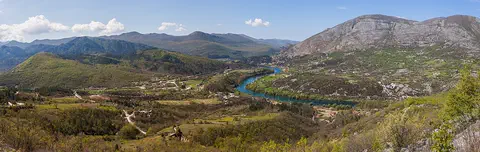
Bosnia and Herzegovina is a mountainous country in southeastern Europe. It has forests, limestone hills and many rivers, and famous old stone bridges cross some of them. Its capital is Sarajevo. It touches the Adriatic Sea along only about 20 kilometers of coast.
-
 Watch
 Country
Bulgaria
Bulgaria is a country on the eastern side of the Balkan Peninsula, with the Danube River to the north and the Black Sea to the east. Mountains cross it from west to east, and about 6.4 million people lived there at the end of 2025.
-
 Watch
 Country
Croatia
Croatia is a crescent-shaped country in southeastern Europe. Its long coast on the Adriatic Sea is fringed by more than 1,100 islands, limestone mountains rise behind it, fertile plains lie in the north, and about 3.87 million people lived there in mid-2025.
-
 Watch
 Country
Czechia
Czechia, also called the Czech Republic, is a landlocked country in central Europe. Mountains ring the old land of Bohemia, the Vltava River flows through the capital, Prague, and about 10.9 million people lived there in 2026.
-
 Watch
 Country
Hungary
Hungary is a landlocked country in central Europe, in a wide lowland called the Carpathian Basin. Wide plains cover much of it, the Danube River flows through its capital, Budapest, and about 9.5 million people lived there in 2026.
For parents & teachers
What children will learn
- Locate Ukraine in eastern Europe and name its neighbors and seas.
- Explain what chernozem is and why it matters for farming.
- Describe Ukraine's landscapes, wildlife, languages and traditions.
- Outline Ukraine's history from Greek colonies and Kyivan Rus to independence in 1991.
Recommended ages: 3 to 17 · About 15 minutes
Talk about it
- Why do you think good soil is so important to a country?
- Ukrainian and Russian are both heard in Ukraine. What languages do you hear where you live?
- Embroidery and weaving are traditional crafts in Ukraine. What traditions does your family keep?
Try at home or in class
- Compare soils: put a spoonful of garden soil, sand and potting compost in clear cups of water and see which is darkest and holds the most water.
- Design a cross-stitch pattern on squared paper, repeating lines, diamonds and flowers as in traditional embroidery.
Key vocabulary: chernozem, humus, steppe, spit, independence, khata
Where these facts come from
- Wikidata , Wikimedia Foundation (CC0 1.0)
- Natural Earth vector data , Natural Earth (NACIS) (Public domain)
- UNESCO World Heritage List , UNESCO World Heritage Centre (Linked as a reference; site facts come from Wikidata)
- Ukraine , Encyclopaedia Britannica
- Ukraine: Soils and climate , Encyclopaedia Britannica
- Ukraine: Plant and animal life , Encyclopaedia Britannica
- Ukraine: People , Encyclopaedia Britannica
- Ukraine: Cultural life , Encyclopaedia Britannica
- Ukraine: Languages, religion and settlement , Encyclopaedia Britannica
- Chernozem (FAO soil group) , Encyclopaedia Britannica
- Ukraine: History , Encyclopaedia Britannica
- Ukraine: The crisis in Crimea and eastern Ukraine , Encyclopaedia Britannica
- Ukraine: The Russian invasion of Ukraine , Encyclopaedia Britannica
- Backing Ukraine's territorial integrity, UN Assembly declares Crimea referendum invalid , UN News
- General Assembly resolution demands end to Russian offensive in Ukraine , UN News
- Population, total: Ukraine (SP.POP.TOTL) , World Bank
- Kyiv: Saint-Sophia Cathedral and Related Monastic Buildings, Kyiv-Pechersk Lavra , UNESCO World Heritage Centre
- List of World Heritage in Danger , UNESCO World Heritage Centre
- L'viv – the Ensemble of the Historic Centre , UNESCO World Heritage Centre
- PlayOwl region table, version 1 , PlayOwl (PlayOwl original data)
- flag-icons 7.5.0 , Panayiotis Lipiridis and contributors (MIT)
- Wikimedia Commons , Wikimedia Foundation (Per file (public domain, CC0, CC BY or CC BY-SA); see each media record)
Checked, not yet human-reviewed. Last updated October 24, 2026. Spotted a mistake? Tell us.