
Landmark Europe
Saint Sophia Cathedral
Saint Sophia Cathedral is a very old church in Kyiv, Ukraine. It has white walls and lots of green and gold domes. Inside are mosaics and wall paintings that are about 1,000 years old!
Saint Sophia Cathedral in Kyiv, Ukraine, was begun in the first half of the 1000s, probably in 1037, for the ruler Yaroslav the Wise. Local builders worked with masters from the Byzantine Empire. Inside, it keeps mosaics and wall paintings from the 11th century, and outside, its domes were reshaped in the Ukrainian Baroque style. It became a World Heritage Site in 1990.
Begun in the first half of the 11th century, probably in 1037, under Yaroslav the Wise, Kyiv's Saint Sophia Cathedral was designed, UNESCO says, to rival Hagia Sophia in Constantinople. It keeps what UNESCO calls the biggest preserved collection of mosaics and frescoes of that period, inside a five-nave church later reshaped in the Ukrainian Baroque style; it was inscribed on the World Heritage List in 1990.
Photo: Rbrechko, CC BY-SA 4.0, via Wikimedia Commons
Discover Saint Sophia Cathedral
Saint Sophia Cathedral is in Kyiv, the capital of Ukraine.
A cathedral is a large, important church. This one is about 1,000 years old. Today it is a museum.
Saint Sophia Cathedral stands in the historic center of Kyiv, the capital of Ukraine. UNESCO says it was designed to rival the church of Hagia Sophia in Constantinople.
It was built in the 11th century as the main church of Kyiv, then the capital of a state called Kyivan Rus'. Around it stand monastery buildings from the 1600s and 1700s, and the whole group is now used as a museum.
UNESCO's statement places the cathedral in the historic center of Kyiv and calls it one of the major monuments of the architecture and monumental art of the early 11th century. It was built by local builders and Byzantine masters in the reign of the Great Prince of Kyiv, Yaroslav the Wise, as the main church of the capital of Kyivan Rus'.
The World Heritage property, inscribed in 1990, joins two components: the cathedral with its monastic buildings, and the Kyiv-Pechersk Lavra monastery. UNESCO notes that Saint Sophia and its buildings are used as a museum for education and for state events.
- Where
- Historic center of Kyiv, Ukraine
- Begun
- first half of the 11th century, probably 1037
- Built for
- Yaroslav the Wise, Great Prince of Kyiv
- World Heritage
- inscribed 1990
Begun around 1037
A ruler named Yaroslav the Wise had the cathedral built about 1,000 years ago.
Local builders worked together with builders from far away.
Building began in the first half of the 11th century. ICOMOS, in its evaluation for UNESCO, wrote that it probably began in 1037, as an old chronicle called the Tale of Bygone Years says, and not in 1017 as another chronicle gives.
The project was the idea of Yaroslav the Wise, ruler of Kyiv. Local builders worked with masters from the Byzantine Empire, whose capital was Constantinople.
ICOMOS's evaluation dates the start of construction to the first half of the 11th century, 'probably in 1037' as related in the Tale of Bygone Years, rather than the 1017 of the Novgorod Chronicles. The project was Yaroslav the Wise's initiative, and it was meant to replace Kyiv's very first church, the Dessiatinnaya, or Church of the Tithes.
The monastery buildings around it were first built of wood in 1633, burned in 1697 and rebuilt in stone from 1699; in the 18th century came the bell tower, the Metropolitan's house, the refectory, the west gate, the south entrance tower, the Brothers' building and the seminary, all inside a stone wall.
Five naves and many domes
Inside, twelve columns divide the church into five long halls.
The walls were built from layers of stone and brick.
Inside, ICOMOS says, twelve columns divide the church into five naves, long halls side by side, and extra naves were added around this core. The roofs step up like a pyramid toward the main dome.
The walls were built of stone and brick together, a method called opus mixtum. In the 1600s and 1700s the outside was changed in the Ukrainian Baroque style: the domes were given new shapes, a large window was added and buttresses were built to support the walls.
ICOMOS describes a five-nave church in opus mixtum, alternating stone and brick, its interior divided by twelve columns into five naves and covered in mosaics, paintings and marble work. UNESCO adds supplementary naves around the five-nave core and a pyramidal composition of the cross-domed church.
The Ukrainian Baroque left its mark on the exterior: the original galleries were transformed, the cupolas reshaped, a large window and a system of exterior buttresses added. After 1882 a narthex in the Byzantine style was added on the west side, and murals and mosaics were restored, often ineptly, ICOMOS judged.
Mosaics and frescoes from the 11th century
Inside, the walls are covered with very old pictures.
Some are mosaics, made of many tiny pieces. Others are painted on the walls.
The cathedral has kept its old interiors. UNESCO says its collection of 11th-century mosaics, pictures made of many small pieces, and frescoes, paintings on plaster, is unique for how complete it is.
In the towers that hold its staircases, there are also rare frescoes of non-religious scenes. In 1987 the reconstruction work at Saint Sophia won the European Gold Medal for the Protection of Historic Monuments.
UNESCO calls the cathedral's mosaics and frescoes of the 11th century the biggest preserved collection of that period and an outstanding example of Byzantine art, unique for its integrity. Among them is a complex of secular frescoes in the stair towers, also in the Byzantine tradition.
Its architecture and decoration, UNESCO says, founded a school that influenced building and monumental art in Kyivan Rus' and then in Eastern Europe. Reconstruction work at Saint Sophia received the European Gold Medal for the Protection of Historic Monuments in 1987.
- Interior art
- 11th-century mosaics and frescoes
- Columns inside
- 12, dividing five naves
- Reconstruction award
- European Gold Medal, 1987
Green and gold domes
In the photo, the cathedral has white walls and green roofs.
Many domes rise on top. The biggest one is shiny gold!
The photo was taken on 7 October 2017. It shows the cathedral from above: white walls, green roofs, green onion-shaped domes and a large gold dome in the middle, each topped by a cross. In a few places, patches of bare brick and stone show through the white walls.
Trees with autumn leaves, lawns and brick paths surround it. In 2023 UNESCO added the property to its List of World Heritage in Danger.
The photograph (7 October 2017) looks down on the cathedral: white walls under green roofs, onion domes on drums with arched windows, the large central gilded dome and smaller gilded ones, and, on the apses, exposed patches of brick-and-stone masonry. A brick-paved square, lawns, benches and autumn trees surround it, with city buildings beyond.
UNESCO has listed the property on the List of World Heritage in Danger since 2023. Its statement also notes that the setting of the cathedral, first designed to be seen from all around, changed in the 19th century as the city around it changed.
Amazing facts
-
The cathedral was built to rival the church of Hagia Sophia, far away in Constantinople.
UNESCO says Saint Sophia was designed to rival Hagia Sophia in Constantinople.
Designed to rival Hagia Sophia in Constantinople, UNESCO says, Kyiv's cathedral symbolized a 'new Constantinople'.
-
Some of the old wall paintings show scenes that are not about religion.
The staircase towers hold rare frescoes of non-religious scenes.
The mural paintings include a complex of unique secular frescoes in the stair towers, made in the Byzantine tradition.
-
The first buildings around the cathedral were made of wood.
The monastery buildings around the cathedral were first built of wood in 1633 and rebuilt in stone from 1699.
Built of wood in 1633 and burned in 1697, the monastic buildings were rebuilt in stone from 1699.
-
Old books disagree about when building started!
One old chronicle says building began in 1017, another says 1037; ICOMOS thought 1037 more likely.
The Tale of Bygone Years gives 1037 and the Novgorod Chronicles 1017; ICOMOS favored 1037.
Words to know
- cathedral
- a large, important church
- mosaic
- a picture made from many small pieces of glass or stone
- fresco
- a painting made on fresh, wet plaster on a wall or ceiling
- nave
- a long hall inside a church
- Baroque
- a richly decorated building and art style of the 1600s and 1700s
- chronicle
- an old written record of events in the order they happened
Discovery challenge
-
In which city is Saint Sophia Cathedral?
In which capital city does Saint Sophia Cathedral stand?
In which city's historic center does Saint Sophia Cathedral stand?
- Kyiv
- Paris
- Madrid
Show the answer
Kyiv
Kyiv, in Ukraine!
Kyiv, the capital of Ukraine.
Kyiv.
-
Who had the cathedral built?
Which ruler started the building of Saint Sophia?
During whose reign was the cathedral built, according to UNESCO?
- Yaroslav the Wise
- Charlemagne
- Napoleon
Show the answer
Yaroslav the Wise
Yaroslav the Wise!
Yaroslav the Wise, ruler of Kyiv.
Yaroslav the Wise, Great Prince of Kyiv.
-
What colors are the domes?
What colors are the domes in the photo?
In the photo, what colors are the domes, reshaped in the Baroque period?
- Green and gold
- Red and blue
- Black and white
Show the answer
Green and gold
Green and gold!
Green, with a big gold dome in the middle.
Green, with gilded central and smaller domes.
-
What is a mosaic made of?
What is a mosaic made of?
Which two kinds of 11th-century wall art does the cathedral keep?
- Small pieces of glass or stone
- Folded paper
- Knitted wool
Show the answer
Small pieces of glass or stone
Tiny pieces of glass or stone!
Many small pieces of glass or stone.
Mosaics made of many small pieces, and frescoes painted on plaster.
-
When did Saint Sophia become a World Heritage Site?
In which year was Saint Sophia inscribed on the World Heritage List?
In which year did UNESCO inscribe the cathedral and the Kyiv-Pechersk Lavra?
- 1990
- 1037
- 1699
Show the answer
1990
In 1990!
In 1990.
1990.
Nearby places
-
Watch
City
Kyiv
Kyiv is the capital of Ukraine, on the high west bank of the Dnieper River. More than 1,000 years ago it was the center of Kyivan Rus, the first East Slavic state, and its 11th-century St. Sophia's Cathedral and Pechersk Lavra monastery are a UNESCO World Heritage Site. About 2.95 million people lived there in 2022.
-
 Watch
City
Gomel
Gomel is a city in the southeast of Belarus, on the Sozh River, a branch of the Dnieper. Store norske leksikon calls it the country's second-largest city. The 2009 census counted 492,136 people there.
-
 Watch
City
Chișinău
Chișinău is the capital of Moldova, a country in eastern Europe. It was first written about in 1436, and from 1817 a new part of the town was laid out on a grid of straight streets. It has many parks and lakes, and electric trolleybuses have carried its people since 1949. The 2024 census counted 567,038 people in the city.
-
 Watch
City
Kharkiv
Kharkiv is the second-largest city in Ukraine, in the northeast of the country, where three rivers meet. An official estimate put its population at about 1.42 million at the start of 2022. It is a city of universities, factories and railways.
-
 Watch
City
Minsk
Minsk, the capital of Belarus, lies on the Svislach River near the middle of the country. First written about in 1067, it was almost completely destroyed in World War II and rebuilt with wide avenues, parks and apartment blocks. About 2 million people lived there in 2026.
-
 Watch
City
Lviv
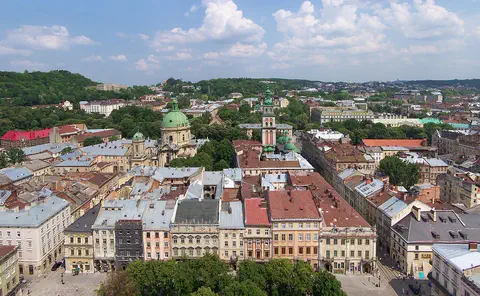
Lviv is a city in western Ukraine, founded in 1256 and named after Lev, a prince's son. Its old center, with a market square, castle hill and churches of many kinds, is on UNESCO's World Heritage List. Ukraine's statistics service estimated 717,273 people there at the start of 2022.
-
 Watch
Natural wonder
Białowieża Forest
Białowieża Forest is a forest of conifers and broadleaved trees in Poland and Belarus. UNESCO calls it an immense range of primary forest, and it is home to the largest free-roaming population of European bison.
-
 Watch
Natural wonder
Carpathians
The Carpathians are a long mountain range in Europe, shared by seven countries that protect it together under the Carpathian Convention. They hold some of Europe's last untouched forests, nearly 4,000 kinds of plants and big populations of brown bears, wolves and lynxes.
Explore next
-
Watch
 Country
Ukraine
Ukraine is a large country in eastern Europe on the northern shore of the Black Sea. Most of it is level plain with some of the most fertile soil in the world, crossed by the Dnieper River. Its capital is Kyiv, and its official language is Ukrainian.
-
Watch
City
Kyiv
Kyiv is the capital of Ukraine, on the high west bank of the Dnieper River. More than 1,000 years ago it was the center of Kyivan Rus, the first East Slavic state, and its 11th-century St. Sophia's Cathedral and Pechersk Lavra monastery are a UNESCO World Heritage Site. About 2.95 million people lived there in 2022.
-
 Watch
Landmark
Hagia Sophia
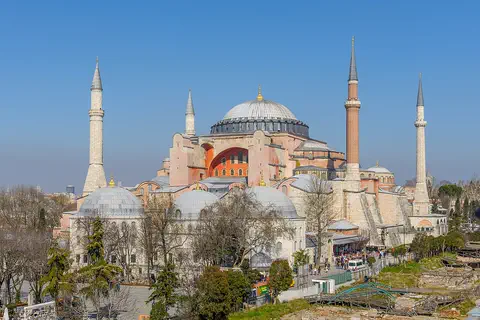
Hagia Sophia in Istanbul was built in under six years, from 532 to 537, for the emperor Justinian. Its enormous dome seems to float on a ring of 40 windows. Over almost 1,500 years it has been a church, a mosque and a museum, and since 2020 it has been a mosque.
-
 Watch
Landmark
St. Basil's Cathedral
St. Basil's Cathedral stands at the end of Red Square in Moscow. Tsar Ivan IV ordered it in 1555, and it was finished by 1561. It is really ten small churches in one building, each with its own colorful dome, and today it is a museum.
-
 Watch
Landmark
St Mark's Basilica
St Mark's Basilica stands on St Mark's Square in Venice, Italy. The church you see today was begun in 1063 and dedicated in 1094, and for nearly a thousand years it was the chapel of the doges, the rulers of Venice. It has 8,000 square meters of gold mosaics, which is why it is called the Church of Gold. Since 1807 it has been Venice's cathedral.
-
 Watch
Landmark
Aachen Cathedral
Aachen Cathedral in western Germany grew around the Palatine Chapel, the chapel of Emperor Charlemagne's palace, built around the year 800 with eight sides and a dome. A tall Gothic choir with very tall windows, called the Glass House, was added from 1355 to 1414. German kings were crowned here until 1531, and in 1978 it became a World Heritage Site.
-
 Watch
Landmark
Acropolis of Athens
The Acropolis is a steep, flat-topped rock in the middle of Athens. Walls have ringed its top for more than 3,300 years. In the 400s BCE, the Athenians built a grand gateway and three temples there, including the Parthenon. Restorers are still repairing them today.
-
 Watch
Landmark
Afsluitdijk
The Afsluitdijk is a dike 32 kilometers long in the Netherlands. It runs between the provinces of North Holland and Friesland and closes off the IJsselmeer lake from the Wadden Sea. Its last gap was closed on 28 May 1932, and for more than 90 years it has helped protect a large part of the country from floods.
For parents & teachers
What children will learn
- Locate Kyiv in Ukraine and describe Saint Sophia Cathedral and the buildings around it.
- Explain the difference between a mosaic and a fresco.
- Describe how an 11th-century building can be reshaped in a later style and still keep its old parts.
Recommended ages: 4 to 17 · About 15 minutes
Talk about it
- Two old chronicles give different years for the start of building. How do historians decide which record to trust?
- The domes were reshaped in a later style, but old walls still show. Is it better to keep a building as it first was, or let it change?
- The cathedral is now a museum. Why might a city turn an old building into a museum?
Try at home or in class
- Make a paper mosaic: cut colored paper into small squares and glue them into a picture of a dome.
- Draw the cathedral from above and color the roofs green and the central dome gold.
Key vocabulary: cathedral, mosaic, fresco, nave, Baroque, chronicle
Where these facts come from
- Wikidata , Wikimedia Foundation (CC0 1.0)
- Kyiv: Saint-Sophia Cathedral and Related Monastic Buildings, Kyiv-Pechersk Lavra (World Heritage List) , UNESCO World Heritage Centre
- Advisory Body Evaluation: Cathedral of St. Sophia of Kiev (No 527) , ICOMOS, via UNESCO World Heritage Centre
- File:80-391-0151 Kyiv St.Sophia's Cathedral RB 18 2 (cropped).jpg , Wikimedia Commons
- UNESCO World Heritage List , UNESCO World Heritage Centre (Linked as a reference; site facts come from Wikidata)
- Wikimedia Commons , Wikimedia Foundation (Per file (public domain, CC0, CC BY or CC BY-SA); see each media record)
Checked, not yet human-reviewed. Last updated November 1, 2026. Spotted a mistake? Tell us.