
Landmark Asia
Harmandir Sahib (Golden Temple)
The Golden Temple is in the city of Amritsar, in India. It stands in the middle of a big pool. Its top floors shine with gold.
Harmandir Sahib, often called the Golden Temple, is the most important gurdwara, or place of worship, for Sikhs. It stands on a small island in a pool in Amritsar, India, and a marble causeway leads out to it. Its upper stories are covered in gilded copper, and its free kitchen serves meals to about 100,000 people a day.
Harmandir Sahib is the chief gurdwara of Sikhism and its most important pilgrimage site. Britannica dates the first temple to 1604, built by Guru Arjan on an island in the Amrita Saras pool; rebuilt by 1776 after repeated destruction, it was faced with marble and gilded copper under Maharaja Ranjit Singh (1801 to 1839), blending Mughal and Rajput styles.
Photo: Oleg Yunakov, CC BY-SA 3.0, via Wikimedia Commons
Discover the Golden Temple
The Golden Temple is in Amritsar, a city in India.
It sits on a little island in a big pool of water. A long path goes out to it over the water. The top of the temple shines with gold. People from everywhere may visit.
Harmandir Sahib, which many people call the Golden Temple, is in the city of Amritsar in Punjab, a state in northwestern India. It is the most important gurdwara, a Sikh place of worship, and the main place of pilgrimage for Sikhs.
The temple stands on a small island in the middle of a pool called the Amrita Saras, which means "Pool of Nectar." The city's name comes from this pool. A marble causeway, a raised path, crosses the water to reach the temple. Anyone may visit, whatever their religion, as long as they cover their heads, take off their shoes and wash their hands and feet first.
Britannica calls the Golden Temple the chief gurdwara, or house of worship, of Sikhism and the Sikhs' most important pilgrimage site. It is the focus of a complex of buildings in Amritsar, Punjab, about 25 km east of the border with Pakistan.
The temple occupies a small island in a tank, or pool, called the Amrita Saras ("Pool of Nectar"), from which the city takes its name, and is joined to land on its west side by a marble causeway. Facing the causeway stands the Akal Takht, the chief center of authority of Sikhism. The complex is open to anyone regardless of caste, religion or race, provided visitors cover their heads, remove their shoes and wash their feet and hands, as at every gurdwara. India placed Sri Harimandir Sahib on its UNESCO Tentative List in 2004; it is not a World Heritage Site.
- City
- Amritsar, Punjab, India
- Pool
- Amrita Saras, dug from 1577
- First temple
- 1604, built by Guru Arjan
- Free meals
- about 100,000 a day
A pool, a temple and a city
Long ago, a Sikh teacher had a big pool dug.
A town grew up around it. Later, the next teacher built a temple in the middle of the pool. The temple was knocked down more than once. Each time, people built it again.
Sikhs call their great teachers Gurus. In 1577 Ram Das, the fourth Guru, founded Amritsar on land granted by the Mughal emperor Akbar, and had the pool dug. The first temple on the island in the pool was built in 1604 by the fifth Guru, Arjan.
Arjan placed the temple low, so that everyone, even the humblest person, had to step down to go in. He gave it doors on all four sides, to show that people of every background were welcome. Britannica says its foundation stone was laid by Mian Mir, a well-known Sufi Muslim from Lahore. Invaders from Afghanistan destroyed the temple several times, and it was finally rebuilt by 1776.
Britannica credits the founding of Amritsar in 1577 to Ram Das, the fourth Sikh Guru, on a site granted by the Mughal emperor Akbar; Ram Das ordered the excavation of the tank. The first Harmandir Sahib was built in 1604 by Arjan, the fifth Guru, who set it on a lower level so that even the humblest had to step down to enter and gave it entrances on all four sides as a sign that it was open to people of all castes and creeds. Britannica adds that the foundation stone was laid by Mian Mir, a Sufi Muslim saint from Lahore.
The temple was destroyed several times by Afghan invaders and finally rebuilt by 1776; India's UNESCO submission notes the third destruction in 1762, by Ahmad Shah Abdali. The city was annexed to British India in 1849. In June 1984 the complex, above all the Akal Takht, was damaged when the Indian army attacked armed separatists who had occupied and fortified it; many people were killed, and reports of the number differ. The Akal Takht has since been repaired, and the complex now includes a memorial to those killed.
Marble below, gold above
The temple has three floors.
The bottom is white marble with colorful flower patterns. The top floors are covered in shiny metal sheets painted with gold. A low golden dome sits on the very top.
The temple got its golden look during the rule of Maharaja Ranjit Singh, who led a Sikh kingdom from 1801 to 1839. Workers faced the lower stories with white marble and set designs into it made of precious stones. They covered the inside walls with paintings, mirrors and gold leaf, very thin sheets of gold. The upper stories were covered with gilded copper panels, copper coated with a layer of gold. That is why people began to call it the Golden Temple.
Britannica says the building mixes two styles: Mughal style, from Islamic buildings, and Rajput style, from Hindu buildings.
Under Maharaja Ranjit Singh (reigned 1801 to 1839), founder of the Sikh empire, the lower stories were faced with white marble inlaid with designs in precious stones, the interior walls were decorated with frescoes, mirror work and gold leaf, and the upper stories were overlaid with gilded copper panels; Britannica's Amritsar article describes the upper part as a gold-foil-covered copper dome. The result is a blend of Mughal (Islamic) and Rajput (Hindu) styles.
India's UNESCO Tentative List entry describes the exterior as a three-storied composition topped by a low fluted dome of gilt metal, with the lowest floor partly below the level of the pool. Inside is one large hall with richly decorated ceilings. Floral designs cover the building, inlaid in marble, painted in tempera or embossed in metal. On the first floor, a small pavilion set with mirrors of many sizes and colors is known as the Shish Mahal.
Around the pool
A wide path goes all the way around the pool.
Visitors walk around it. Big gateways lead in from the city. Across from the temple stands another important building, the Akal Takht.
A wide walkway, called the parikrama, runs all the way around the pool, and pilgrims walk around the temple along it. Five gateways lead down into the complex from the streets outside. Outside each one are places to leave shoes and to wash feet.
At the land end of the causeway stands the Akal Takht, five stories tall, the chief center of authority for Sikhs. On the north side is the main entrance, beside a hall with a clock tower. On the east side are guest houses for pilgrims and the big dining hall of the free kitchen.
India's UNESCO Tentative List entry describes the precinct in detail. A parikrama, or circumambulatory path, surrounds the pool, with a raised platform toward the water and colonnades and rooms on the other side. Five deories (gateways), each higher than the precinct, lead into it, with shoe houses and foot-washing basins outside. On the east side of the temple, steps called the har-ki-pauri descend into the pool.
On the axis of the temple and causeway stands the five-storied Akal Takht, where the Adi Granth, the Sikh scripture, rests each night. Britannica places the Teja Singh Samundri Hall (Clock Tower), with the offices of the Shiromani Gurdwara Parbandhak Committee that manages the main gurdwaras, at the main entrance on the north side, and guest houses and the dining hall on the east. The UNESCO entry says 74 bungas, residences built by Sikh chiefs between 1765 and 1833, once stood around the pool.
- Entrances to the temple
- 4, one on each side
- Gateways into the complex
- 5
- Akal Takht
- 5 stories, facing the causeway

Music all day and a free kitchen
Every day, people sing in the temple from early morning until late at night.
Nearby is a giant free kitchen. Everyone sits on the floor and eats together. It serves meals to huge crowds every day.
The most important practice at the temple is the singing of gurbani, the sayings of the Gurus, which goes on all day. Early each morning the Adi Granth, the Sikh holy book, is carried from the Akal Takht to the temple's central room, and singing continues until late at night, when the book is carried back.
The complex is also famous for its langar, a free kitchen. Britannica says it serves a vegetarian meal to about 100,000 people a day. Everyone sits on the floor and eats together, whatever their religion or background.
The central ritual is the continuous singing (kirtan) of gurbani, the sayings of the Gurus. It begins in the early morning when the doors of the Akal Takht open and the Adi Granth, which Sikhs also call the Guru Granth Sahib and regard as a living Guru, is brought to the temple's central room; singing continues until late at night, when the book is returned. Pilgrims bathe in the pool and walk around the central temple.
Britannica describes the langar, the free kitchen, as feeding a vegetarian meal to approximately 100,000 people each day, with all visitors seated on the floor and eating together without distinction of religion, race or caste. India's UNESCO entry describes the langar building as three stories of exposed brickwork.
Amazing facts
-
To go into the temple, you step down, not up.
Guru Arjan built the temple on a low level, so that everyone, even the humblest person, had to step down to go in.
Unlike most great shrines, raised on platforms, Harmandir Sahib was set low by Arjan so that even the humblest had to step down to enter.
-
The city of Amritsar is named after the temple's pool.
Amritsar takes its name from the Amrita Saras, the "Pool of Nectar" that surrounds the temple.
The city's name derives from the Amrita Saras ("Pool of Nectar"), the tank excavated on Ram Das's orders in 1577.
-
The temple has a door on every side.
The temple has four entrances, one on each side, as a sign that people of every background are welcome.
Arjan gave the temple entrances on all four sides, signifying that it was open to worshippers of all castes and creeds.
-
One room in the temple is covered in little mirrors.
On the first floor is a small room set with mirrors of many sizes and colors. It is called the Shish Mahal.
The first-floor pavilion, set with mirror pieces of different sizes and colors, is known as the Shish Mahal, India's UNESCO submission notes.
Words to know
- gurdwara
- a Sikh place of worship
- Guru
- in Sikhism, one of the ten great teachers who led the faith
- causeway
- a raised path across water or wet ground
- gilded
- covered with a thin layer of gold
- pilgrimage
- a journey to a special place for religious reasons
- langar
- a free kitchen at a gurdwara where everyone eats together
Discovery challenge
-
What is all around the Golden Temple?
What surrounds the Golden Temple on every side?
What does the Golden Temple's island stand in?
- Sand
- A pool of water
- A forest
Show the answer
A pool of water
A pool! The temple sits on an island in the water.
A pool called the Amrita Saras. A marble causeway crosses it to the temple.
The Amrita Saras, a tank dug from 1577, which gives Amritsar its name; a marble causeway joins the island to land on the west.
-
What makes the top of the temple shine?
What covers the upper stories of the Golden Temple?
With what were the upper stories overlaid in Ranjit Singh's reign?
- Gilded copper
- Glass
- Painted wood
Show the answer
Gilded copper
Copper covered with gold! That is why it shines.
Gilded copper panels, copper coated with gold, were added under Maharaja Ranjit Singh.
Gilded copper panels, while the lower stories were faced with marble inlaid with precious stones.
-
How many doors does the temple have?
How many entrances did Guru Arjan give the temple?
How many sides of the temple have an entrance?
- One
- Two
- Four
Show the answer
Four
Four! There is a door on every side.
Four, one on each side, to show that people of every background were welcome.
All four, signifying openness to worshippers of all castes and creeds.
-
What does the temple's kitchen give people?
What does the langar at the Golden Temple give visitors?
What does the langar provide to about 100,000 people a day?
- Free meals
- Tickets
- Books
Show the answer
Free meals
Free food! Everyone eats together.
A free vegetarian meal, served to about 100,000 people a day, all sitting together on the floor.
A free vegetarian meal, eaten together on the floor without distinction of religion, race or caste.
Nearby places
-
 Watch
Natural wonder
Ganges
The Ganges, called the Ganga in India, flows about 2,510 kilometers from a glacier in the Himalayas across the plains of northern India to the Bay of Bengal, through India and Bangladesh. Its basin is home to hundreds of millions of people who farm, fish and travel on it. For many Hindus it is the holiest of rivers. Near the sea it builds a giant delta with the Brahmaputra.
-
 Watch
Natural wonder
K2
K2 is the world's second highest mountain, 8,611 meters tall, in the Karakoram Range of Asia. It got its short name in 1856, when a surveyor marked it as the second peak he measured in the Karakoram. It is one of the hardest mountains to climb, and its summit was first reached in 1954.
-
 Watch
Landmark
Fatehpur Sikri
Fatehpur Sikri, the "City of Victory," was built on a ridge near Agra, India, by the Mughal emperor Akbar from 1571. It was his capital until 1585. Its red sandstone palaces, halls and great mosque still stand, and its gateway, the Buland Darwaza, is 40 meters tall.
-
 Watch
Landmark
Agra Fort
Agra Fort is a huge red sandstone fortress beside the Yamuna River in Agra, India. The Mughal emperor Akbar began it in 1565. Its walls, about 2.5 kilometers around, protect palaces, halls and mosques added by later emperors. It was both an army base and a royal home.
-
 Watch
Landmark
Taj Mahal
The Taj Mahal is a white marble tomb in Agra, India, beside the Yamuna River. The Mughal emperor Shah Jahan had it built in memory of his wife, Mumtaz Mahal. More than 20,000 workers spent about 22 years on the tomb, its gardens, a mosque and a great gateway.
-
 Watch
Landmark
Mohenjo-daro
Mohenjo-daro was the largest city of the Indus civilization, which UNESCO calls one of the world's three great ancient civilizations. Built of baked brick and flourishing by about 2500 BCE beside the Indus River, it had streets in a neat grid, houses with bathrooms and covered drains. Its ruins were found in 1922.
-
 Watch
Natural wonder
Himalayas
The Himalayas are a giant wall of mountains in Asia, between the high Plateau of Tibet and the plains of India. They hold the highest mountains in the world, including Mount Everest. They rose when the land carrying India crashed into Asia, and their snow and ice feed great rivers such as the Ganges and the Indus.
-
 Watch
Natural wonder
Chitwan National Park
Chitwan National Park, in the lowlands of southern Nepal, was Nepal's first national park. Its sal forests, tall grasslands and rivers are home to the second-largest population of greater one-horned rhinoceroses in the world, 694 in 2021, and to Bengal tigers, 145 counted in and around the park in 2026.
Explore next
-
Watch
 Country
India
India is a huge country in South Asia, shaped like a big triangle pointing into the Indian Ocean. The Himalayas rise along its north, heavy monsoon rains arrive every summer, and about 1.46 billion people (2025) live there, speaking hundreds of languages.
-
Watch
Landmark
Taj Mahal
The Taj Mahal is a white marble tomb in Agra, India, beside the Yamuna River. The Mughal emperor Shah Jahan had it built in memory of his wife, Mumtaz Mahal. More than 20,000 workers spent about 22 years on the tomb, its gardens, a mosque and a great gateway.
- Watch Geography What is a World Heritage Site? World Heritage Sites are places so important that they belong, in a way, to everyone. Under a 1972 agreement, countries nominate their most outstanding places, experts check them, and a UNESCO committee decides. By 2026 the list held 1,273 sites: cultural places like the Taj Mahal, natural places like the Galápagos, and mixed ones like Machu Picchu.
-
Watch
Landmark
Agra Fort
Agra Fort is a huge red sandstone fortress beside the Yamuna River in Agra, India. The Mughal emperor Akbar began it in 1565. Its walls, about 2.5 kilometers around, protect palaces, halls and mosques added by later emperors. It was both an army base and a royal home.
-
 Watch
Landmark
Al-Aqsa Mosque
Al-Aqsa Mosque stands at the southern end of a huge raised plaza in the Old City of Jerusalem. Built in the early 700s, it has a silver-gray dome, and the golden Dome of the Rock stands nearby. The plaza is important to Muslims and to Jews.
-
 Watch
Landmark
Al-Masjid al-Haram
Al-Masjid al-Haram, the Great Mosque of Mecca in Saudi Arabia, was built around the Kaaba, a cube-shaped building that Muslims face when they pray. It is the most important place of pilgrimage in Islam. In 2026, 1,707,301 pilgrims came to Mecca for the hajj, and the mosque can hold up to about one million worshippers.
-
 Watch
Landmark
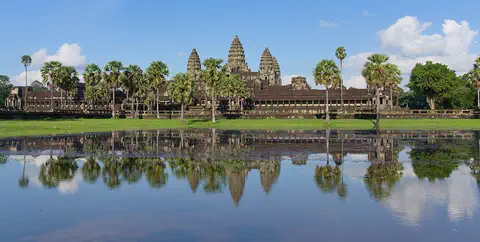
Angkor
Angkor, in northwestern Cambodia, was the capital of the Khmer Empire from the 9th to the 15th century. Its kings built city after city here, with scores of temples, such as Angkor Wat and the Bayon, and giant reservoirs and canals to water the rice fields. Today it covers about 400 square kilometers, and more than 100,000 people live in villages inside it.
-
Watch
Landmark
Angkor Wat
Angkor Wat, near the town of Siem Reap in Cambodia, was built in the 12th century by the Khmer king Suryavarman II. Britannica (2026) calls it the world's largest religious structure. It was built as a Hindu temple and later became a Buddhist place of worship.
For parents & teachers
What children will learn
- Locate Amritsar in India and describe the Golden Temple's setting on an island in a pool.
- Explain how the temple was built, destroyed and rebuilt, and when its gold covering was added.
- Describe the langar and how it serves free meals to everyone.
- Use respectful, factual words to describe a place of worship.
Recommended ages: 3 to 17 · About 15 minutes
Talk about it
- Guru Arjan built the temple low and gave it four doors. What might a building's shape say about who is welcome?
- The langar feeds about 100,000 people a day. How do you think a kitchen that big is organized?
- Visitors cover their heads and take off their shoes. What rules do other special places you know ask visitors to follow?
Try at home or in class
- Draw a bird's-eye plan of the complex: a square pool, the temple on an island, a causeway to one side and a walkway all around.
- Cover a small cardboard box with foil on top and white paper below to show how gold was added to the upper stories and marble to the lower one.
Key vocabulary: gurdwara, Guru, causeway, gilded, pilgrimage, langar
Where these facts come from
- Wikidata , Wikimedia Foundation (CC0 1.0)
- Golden Temple , Encyclopaedia Britannica
- Amritsar , Encyclopaedia Britannica
- Sri Harimandir Sahib, Amritsar, Punjab (Tentative List, submitted 2004) , UNESCO World Heritage Centre
- Wikimedia Commons , Wikimedia Foundation (Per file (public domain, CC0, CC BY or CC BY-SA); see each media record)
Checked, not yet human-reviewed. Last updated October 27, 2026. Spotted a mistake? Tell us.