
Landmark Asia
Fatehpur Sikri
Fatehpur Sikri is an old royal city in India. An emperor named Akbar built it of red stone. It has palaces, a big mosque and a giant gate.
Fatehpur Sikri, the "City of Victory," was built on a ridge near Agra, India, by the Mughal emperor Akbar from 1571. It was his capital until 1585. Its red sandstone palaces, halls and great mosque still stand, and its gateway, the Buland Darwaza, is 40 meters tall.
The first planned city of the Mughals, Fatehpur Sikri was raised by Akbar (r. 1556 to 1605) on a Vindhyan ridge west-southwest of Agra and served as his capital from about 1571 to 1585. Its red sandstone ensemble blends Indian and Persian forms; UNESCO listed it in 1986.
Photo: Marcin Białek, CC BY-SA 3.0, via Wikimedia Commons
Discover Fatehpur Sikri
Fatehpur Sikri is in India, a big country in Asia.
It is a whole royal city made of red stone. An emperor named Akbar lived there long ago. It has palaces, halls, a mosque and a very tall gate. Today, visitors come to walk through it.
Fatehpur Sikri stands on a rocky ridge in northern India, about 37 kilometers from the city of Agra. Its name means "City of Victory." The Mughal emperor Akbar built it in the late 1500s and made it the capital of his empire.
Akbar's court lived and worked here for only a short time, and later the city was almost empty. Because of that, its palaces, meeting halls and great mosque were never crowded out by newer buildings. Almost everything is built of red sandstone. UNESCO made it a World Heritage Site in 1986.
Fatehpur Sikri lies in Agra District, Uttar Pradesh, about 37 km (23 miles) west-southwest of Agra. UNESCO describes it as the first planned city of the Mughals, built southeast of an artificial lake on outcrops of the Vindhyan hills, with administrative, residential and religious buildings for the court, the army, the emperor's servants and a whole city.
Britannica dates its time as Akbar's capital to about 1571 to 1585; UNESCO calls it the capital for only some 10 years. Its ensemble, built in red sandstone with little marble, survives largely intact, and UNESCO calls it a unique example of very high-quality architecture from 1571 to 1585. It was inscribed as a World Heritage Site in 1986, and today a town of 32,905 people (2011 census) lives below the ridge.
- Where
- Agra District, Uttar Pradesh, India; about 37 km from Agra
- Capital of the Mughal Empire
- about 1571 to 1585
- Built of
- Red sandstone, with a little marble
- World Heritage Site
- 1986
An emperor's city of victory
Long ago, Emperor Akbar's son was born in a village called Sikri.
Akbar decided to build his new capital city at Sikri. Later he moved away, and the city became quiet.
In 1568 and 1569, Akbar visited Salim Chishti, a Muslim hermit who lived in the village of Sikri. In 1569, Akbar's son Salim was born at Sikri. He later became the emperor Jahangir.
Akbar chose Sikri for his new capital and began building in 1571. After he won the region of Gujarat, the word "Fatehpur," meaning "city of victory," was added to its name. But in 1585 Akbar moved his capital to Lahore. By 1610 the city was almost empty. Historians still discuss why: a poor water supply is often suggested.
Britannica records that in 1568 to 1569 the childless Akbar visited the Muslim hermit Salim Chishti at Sikri; his son Salim, the future emperor Jahangir, was born there in 1569, and Akbar made the site his capital. UNESCO dates the city's construction to 1571 to 1573. The prefix Fatehpur, "city of victory," marked the conquest of Gujarat, which Britannica dates to 1573 and UNESCO to 1572.
In 1585 Akbar moved his capital to Lahore. UNESCO says Fatehpur Sikri then remained a place of temporary visits by Mughal emperors; Britannica says it was almost completely deserted by 1610. The reasons are debated by scholars: an inadequate water supply is often cited, but Akbar's attention may simply have shifted to military campaigns in the Punjab. UNESCO notes that the city's planning influenced later Mughal town planning, namely at Shahjahanabad (Old Delhi).
A planned city in red stone
Builders made the city from red sandstone, a soft red stone that is easy to carve.
Straight roads crossed each other like a grid. A long wall with nine gates went around it. Pipes and channels carried water away.
Fatehpur Sikri was planned before it was built. It was laid out as a rectangle, with roads and lanes crossing at right angles, like squares on graph paper. It even had a system for draining away rainwater and managing water.
A wall 6 kilometers long, with towers and nine gates, protected it on three sides. The palaces, the government buildings and the great mosque stood together in the middle. Builders used red sandstone for almost everything, with only a little marble. Its style mixes ideas from India and from Persia (today's Iran).
UNESCO describes an originally rectangular plan with a grid of roads and by-lanes cutting at right angles and an efficient drainage and water-management system. A wall 6 km long, fortified by towers and pierced by nine gates, bounded the city on three sides. The administrative block, royal palaces and Jama Masjid sit at its center.
The buildings are red sandstone with little marble. UNESCO calls them a fusion of Indo-Islamic styles and an amalgamation of indigenous and Persian forms; Britannica speaks of Muslim and Hindu architectural influences. Britannica says Akbar personally directed the building of the Jama Masjid, completed in 1571 by Britannica's date and in 1571 to 1572 by UNESCO's; UNESCO calls it the earliest building on the summit of the ridge.
Gate, mosque, halls and palaces
The city has a giant gate called the Buland Darwaza. It is 40 meters tall. That is very, very high!
Behind it is a huge mosque. There are halls where the emperor met people. One building has five floors of open columns, so the breeze blows through.
The most famous part is the Buland Darwaza, or "Lofty Gate," 40 meters high and finished in 1575. It is the entrance to the Jama Masjid, a great mosque about 165 meters long. Inside its courtyard is the carved tomb of Salim Chishti.
The emperor held public meetings in the Hall of Public Audience, the Diwan-i-Am, and important guests in the Hall of Private Audience, the Diwan-i-Khas. The Panch Mahal has five stories of open columns, shaped like a Persian wind-catcher tower. There are also palaces, a pool, baths, stables and a large inn for travelers.
UNESCO gives the Buland Darwaza, the southern gate of the mosque's court, a height of 40 m; completed in 1575, it is in UNESCO's words the greatest monumental structure of Akbar's reign. The Jama Masjid (Britannica: some 165 m long) holds the tomb of Shaikh Salim Chishti, a masterpiece of sculpted decoration completed in 1580 to 1581 and further embellished under Jahangir in 1606.
The Diwan-i-Am is ringed by porticos, broken on the west by the emperor's raised seat behind perforated stone screens. On the north side of the palace court stands the Diwan-i-Khas, also called the Jewel House. The Panch Mahal is an entirely columnar five-story structure laid out asymmetrically on the pattern of a Persian badgir, or wind-catcher. UNESCO also lists the Anup Talao (Peerless Pool), the Khwabgah (sleeping chamber), Birbal's House, the caravanserai, baths, waterworks, stables and the Hiran tower. The largest residence, popularly called Jodha Bai's palace, has carved pillars and an azure-blue ribbed roof; Britannica notes it belonged to Akbar's wife Maryam-uz-Zamani.
- Buland Darwaza (Lofty Gate)
- 40 m high, completed 1575
- Jama Masjid
- Completed 1571 to 1572; about 165 m long
- City wall
- 6 km long, nine gates
- Panch Mahal
- Five stories of open columns
Fatehpur Sikri today
Today, people visit the old royal city.
A busy town lies at the bottom of the hill. Experts look after the old buildings so they last a long time.
Today the Archaeological Survey of India looks after Fatehpur Sikri. Visitors climb the ridge to walk through its courtyards, palaces and halls, while a busy modern town lies below.
Keeping the site safe takes work. Mining and blasting once threatened the old buildings, so mining is now banned within 10 kilometers. Old paintings and painted writing inside the mosque, the tomb and the palaces have been carefully cleaned and restored.
UNESCO states that the Archaeological Survey of India manages the property under the Ancient Monuments and Archaeological Sites and Remains Act of 1958, its 1959 rules and the 2010 amendment. The inscribed area is 60.735 ha with a buffer zone of 475.542 ha.
Mining once threatened the site; it has been banned within a 10 km radius, though UNESCO says illegal blasting needs continuous monitoring. UNESCO also warns that unplanned growth of the town could harm the site's visual integrity and calls for clear visitor guidelines. Repairs since the British period have treated the Buland Darwaza, Jama Masjid, Panch Mahal, Diwan-i-Am and other buildings without changing the original structures, and paintings and painted inscriptions have been chemically preserved and restored.
Amazing facts
-
The Panch Mahal has five floors of columns and almost no walls.
The Panch Mahal is five stories of open columns, built like a Persian wind-catcher tower.
The Panch Mahal is an entirely columnar five-story structure laid out asymmetrically on the pattern of a Persian badgir, or wind-catcher.
-
The giant gate was built to remember a victory.
The Buland Darwaza, 40 meters tall, was finished in 1575 to remember Akbar's victory in Gujarat.
UNESCO says the Buland Darwaza was completed in 1575 to commemorate the victory of Gujarat in 1572.
-
The emperor's son was born here.
Akbar's son Salim was born at Sikri in 1569. He later became the emperor Jahangir.
Salim, born at Sikri in 1569, ruled as Jahangir; under him, in 1606, Salim Chishti's tomb was further embellished.
-
Later, the royal city became almost empty.
Akbar moved his capital away in 1585, and by 1610 Fatehpur Sikri was almost completely deserted.
Scholars still debate the decline: water shortage is often cited, but Akbar's attention may have shifted to campaigns in the Punjab.
Words to know
- emperor
- a ruler of an empire, a group of lands under one leader
- Mughal
- the family of emperors who ruled much of India from the 1500s
- sandstone
- a rock made of grains of sand pressed together; it can be red, yellow or brown
- mosque
- a building where Muslims pray
- capital
- the city where a country's or empire's rulers live and govern
- wind-catcher
- a tall open building shape that catches breezes to cool the rooms
Discovery challenge
-
Which emperor built Fatehpur Sikri?
Which Mughal emperor built Fatehpur Sikri as his capital?
Which emperor made Fatehpur Sikri the capital of the Mughal Empire around 1571?
- Akbar
- Napoleon
- Augustus
Show the answer
Akbar
Akbar! He built the red stone city.
The Mughal emperor Akbar built it and made it his capital.
Akbar (r. 1556 to 1605) made it his capital from about 1571 to 1585.
-
What does the name Fatehpur mean?
What does the word "Fatehpur" in the city's name mean?
What does the prefix "Fatehpur," added after the Gujarat campaign, mean?
- City of water
- City of victory
- City of gold
Show the answer
City of victory
City of victory! It was named after a win.
Fatehpur means "city of victory." It was added after Akbar won Gujarat.
"City of victory": the prefix marked the conquest of Gujarat (1573 in Britannica, 1572 in UNESCO).
-
What stone is the city made of?
What stone did the builders use for almost all of Fatehpur Sikri?
Which material dominates Fatehpur Sikri's buildings, with only a little marble?
- Gray granite
- Red sandstone
- White chalk
Show the answer
Red sandstone
Red sandstone! That is why the city looks red.
Builders used red sandstone for almost everything, with only a little marble.
UNESCO: the buildings are constructed in red sandstone with little use of marble.
-
Akbar moved away in 1585. Which city did he go to?
In 1585, to which city did Akbar move his capital?
After 1585, which city replaced Fatehpur Sikri as Akbar's capital?
- Cairo
- Rome
- Lahore
Show the answer
Lahore
Lahore! Then Fatehpur Sikri became quiet.
Akbar moved to Lahore, and by 1610 Fatehpur Sikri was almost empty.
Lahore; Fatehpur Sikri then served only for temporary imperial visits (UNESCO) and was almost deserted by 1610 (Britannica).
Nearby places
-
 Watch
Landmark
Agra Fort
Agra Fort is a huge red sandstone fortress beside the Yamuna River in Agra, India. The Mughal emperor Akbar began it in 1565. Its walls, about 2.5 kilometers around, protect palaces, halls and mosques added by later emperors. It was both an army base and a royal home.
-
 Watch
Landmark
Taj Mahal
The Taj Mahal is a white marble tomb in Agra, India, beside the Yamuna River. The Mughal emperor Shah Jahan had it built in memory of his wife, Mumtaz Mahal. More than 20,000 workers spent about 22 years on the tomb, its gardens, a mosque and a great gateway.
-
 Watch
Natural wonder
Ganges
The Ganges, called the Ganga in India, flows about 2,510 kilometers from a glacier in the Himalayas across the plains of northern India to the Bay of Bengal, through India and Bangladesh. Its basin is home to hundreds of millions of people who farm, fish and travel on it. For many Hindus it is the holiest of rivers. Near the sea it builds a giant delta with the Brahmaputra.
-
 Watch
Landmark
Harmandir Sahib (Golden Temple)
Harmandir Sahib, often called the Golden Temple, is the most important gurdwara, or place of worship, for Sikhs. It stands on a small island in a pool in Amritsar, India, and a marble causeway leads out to it. Its upper stories are covered in gilded copper, and its free kitchen serves meals to about 100,000 people a day.
-
 Watch
Natural wonder
Himalayas
The Himalayas are a giant wall of mountains in Asia, between the high Plateau of Tibet and the plains of India. They hold the highest mountains in the world, including Mount Everest. They rose when the land carrying India crashed into Asia, and their snow and ice feed great rivers such as the Ganges and the Indus.
-
 Watch
Natural wonder
Chitwan National Park
Chitwan National Park, in the lowlands of southern Nepal, was Nepal's first national park. Its sal forests, tall grasslands and rivers are home to the second-largest population of greater one-horned rhinoceroses in the world, 694 in 2021, and to Bengal tigers, 145 counted in and around the park in 2026.
-
 Watch
Natural wonder
Ajanta Caves
The Ajanta Caves are about 30 halls and rooms carved by hand into a curving cliff above the Waghora River in western India. Buddhist communities made them in two big phases, starting more than 2,000 years ago. Their wall paintings and stone carvings are some of the most famous ancient art in India, and they have been a UNESCO World Heritage Site since 1983.
-
 Watch
Natural wonder
Mount Everest
Mount Everest, in the Himalayas on the border of Nepal and China, is what Britannica calls the highest mountain in the world. In 2020 China and Nepal announced its height as 8,848.86 meters. It grew as two giant plates of Earth's crust pushed together, and it is still rising a tiny bit each year.
Experiments to try
Explore next
-
Watch
 Country
India
India is a huge country in South Asia, shaped like a big triangle pointing into the Indian Ocean. The Himalayas rise along its north, heavy monsoon rains arrive every summer, and about 1.46 billion people (2025) live there, speaking hundreds of languages.
-
Watch
Landmark
Taj Mahal
The Taj Mahal is a white marble tomb in Agra, India, beside the Yamuna River. The Mughal emperor Shah Jahan had it built in memory of his wife, Mumtaz Mahal. More than 20,000 workers spent about 22 years on the tomb, its gardens, a mosque and a great gateway.
-
Watch
Landmark
Agra Fort
Agra Fort is a huge red sandstone fortress beside the Yamuna River in Agra, India. The Mughal emperor Akbar began it in 1565. Its walls, about 2.5 kilometers around, protect palaces, halls and mosques added by later emperors. It was both an army base and a royal home.
- Watch Geography What is a World Heritage Site? World Heritage Sites are places so important that they belong, in a way, to everyone. Under a 1972 agreement, countries nominate their most outstanding places, experts check them, and a UNESCO committee decides. By 2026 the list held 1,273 sites: cultural places like the Taj Mahal, natural places like the Galápagos, and mixed ones like Machu Picchu.
- Watch Try it What If? Lab What if buildings had different foundations? A building's whole weight presses down through its foundation onto the ground. A wide foundation spreads that weight out, like snowshoes on snow. In our model, a 200-tonne building on sand is safe on a 40-square-meter footing. Shrink the footing to 8 square meters and it presses five times harder, more than the sand can take, so the building would sink and could crack or tilt.
-
 Watch
Landmark
Al-Aqsa Mosque
Al-Aqsa Mosque stands at the southern end of a huge raised plaza in the Old City of Jerusalem. Built in the early 700s, it has a silver-gray dome, and the golden Dome of the Rock stands nearby. The plaza is important to Muslims and to Jews.
-
 Watch
Landmark
Al-Masjid al-Haram
Al-Masjid al-Haram, the Great Mosque of Mecca in Saudi Arabia, was built around the Kaaba, a cube-shaped building that Muslims face when they pray. It is the most important place of pilgrimage in Islam. In 2026, 1,707,301 pilgrims came to Mecca for the hajj, and the mosque can hold up to about one million worshippers.
-
 Watch
Landmark
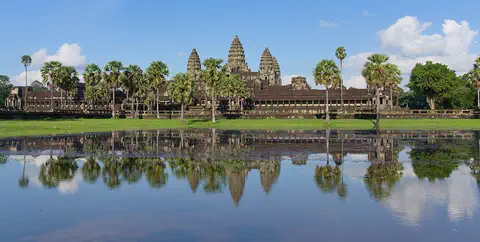
Angkor
Angkor, in northwestern Cambodia, was the capital of the Khmer Empire from the 9th to the 15th century. Its kings built city after city here, with scores of temples, such as Angkor Wat and the Bayon, and giant reservoirs and canals to water the rice fields. Today it covers about 400 square kilometers, and more than 100,000 people live in villages inside it.
For parents & teachers
What children will learn
- Locate Fatehpur Sikri near Agra in northern India and explain who built it and when.
- Describe how the city was planned, with a grid of roads, a wall with nine gates and water channels.
- Name its main buildings: the Buland Darwaza, the Jama Masjid, the audience halls and the Panch Mahal.
- Discuss why a capital city might be abandoned, and how historians weigh different explanations.
Recommended ages: 3 to 17 · About 15 minutes
Talk about it
- Fatehpur Sikri was planned before it was built. What would you put in the middle of a city you planned, and why?
- Historians are not sure why the city was left empty. How can we find out about something that happened over 400 years ago?
- The Panch Mahal has open columns instead of walls. How do you think it felt on a hot day?
Try at home or in class
- Draw a city plan on graph paper with roads crossing at right angles, a wall with gates and a central square.
- Make a wind-catcher from a cardboard tube with a slot near the top, hold it near a fan and feel the air come out of the bottom.
Key vocabulary: emperor, Mughal, sandstone, mosque, capital, wind-catcher
Where these facts come from
- Wikidata , Wikimedia Foundation (CC0 1.0)
- UNESCO World Heritage List , UNESCO World Heritage Centre (Linked as a reference; site facts come from Wikidata)
- Fatehpur Sikri , UNESCO World Heritage Centre
- Fatehpur Sikri , Encyclopaedia Britannica
- Wikimedia Commons , Wikimedia Foundation (Per file (public domain, CC0, CC BY or CC BY-SA); see each media record)
Checked, not yet human-reviewed. Last updated October 27, 2026. Spotted a mistake? Tell us.