
Landmark Asia
Temple of Artemis at Ephesus
Long ago, a giant temple with many columns stood near Ephesus, in Türkiye. It was one of the Seven Wonders of the ancient world. Today only one column stands in a grassy field.
The Temple of Artemis at Ephesus was one of the Seven Wonders of the ancient world. It was rebuilt several times, and its 6th-century BCE version was more than 300 feet long. After a fire in 356 BCE it was built again just as big. Today only scattered stones and one column remain.
The Artemision of Ephesus, a temple of ancient Greek religion, grew from a 7th-century BCE shrine into the colossal Ionic temple of the 6th century, rebuilt on the same plan after a fire in 356 BCE. Counted among the Seven Wonders, it was destroyed by the Goths in 262 CE and rediscovered in 1869.
Photo: Arkiyolok, CC BY-SA 4.0, via Wikimedia Commons
Discover the Temple of Artemis
The Temple of Artemis was near the old city of Ephesus, in Türkiye.
It was a huge building with rows and rows of tall columns. People came from far away to see it. Now it is gone, and one tall column stands in a field.
The Temple of Artemis stood just outside the ancient city of Ephesus, near the modern town of Selçuk in western Türkiye. It was a temple, a building for worship in ancient Greek religion, and people traveled from all around the Mediterranean to visit it.
It was rebuilt several times on the same spot. The temple of the 500s BCE was more than 300 feet (about 90 meters) long and 150 feet (about 45 meters) wide. It was counted among the Seven Wonders of the ancient world. Little of it is left today.
The Artemision lay at the foot of Ayasuluk Hill, outside the Hellenistic and Roman city of Ephesus; Britannica suggests that its site marks that of the classical Greek city, then probably on the seaboard. UNESCO describes the sanctuary, founded by the 2nd millennium BCE, as one of the largest and most powerful of the ancient world, drawing pilgrims from around the Mediterranean.
Its most famous phases were the 6th-century BCE temple, to which the Lydian king Croesus contributed, more than 300 ft long and 150 ft wide, and its 4th-century successor, built to the same size and plan after a fire in 356 BCE. Ancient writers counted it among the Seven Wonders. Since 2015 the site has been part of UNESCO's Ephesus World Heritage property.
- Where
- Near Selçuk and Ephesus, western Türkiye
- Size of the 6th-century temple
- more than 300 ft long, 150 ft wide
- Fire
- 356 BCE; rebuilt on the same plan
- Found again
- 1869, by J. T. Wood
Built, burned and built again
The temple was built again and again, each time bigger and finer.
Once, a big fire burned it down. People built it again. Much later, it was wrecked and forgotten. Then, about 150 years ago, a man found it again.
The first temples here were small. By the 600s BCE there was a large temple, and in the 500s BCE a huge new one was built, with gifts of columns from King Croesus of Lydia. In 356 BCE that temple burned down. The people of Ephesus built a new one just as big on the same spot.
In 262 CE the Goths wrecked the city and the temple, and it was never rebuilt. Over the centuries its stones were taken away and its site was forgotten. In 1869 the English engineer John Turtle Wood, digging for the British Museum, finally found it.
Britannica traces three rapid early phases before about 550 BCE; in 1904 D. G. Hogarth found beneath the later platforms the remains of three older structures, the earliest a small green-schist platform with a sealed deposit of early coins and objects dating to about 600 BCE. The Austrian Archaeological Institute (ÖAI) dates the oldest monumental temple to the 7th century BCE at the latest, followed in the 6th century by a completely new building attributed to Kroisos (Croesus).
That temple seems to have burned in 356 BCE, the year, the ÖAI notes, that Alexander the Great was born; the Ephesians then raised a monumental temple on the same site. The Goths destroyed city and temple in 262 CE. UNESCO adds that Christian pilgrimage to the Church of Mary and the Basilica of St. John eclipsed the temple from the 5th century. Its site 'remained unsuspected', Britannica says, until Wood struck a corner of it in May 1869 (the ÖAI gives 1870).
A forest of carved columns
The temple had lots and lots of tall stone columns.
Some columns had carved people around the bottom. The roof edge had carvings too.
The temple built in the 500s BCE was famous for its great size and its decoration. Many of its columns had carved figures all around their lowest drums, the round blocks at the bottom. Along the edge of the roof ran a gutter covered with small, detailed carvings.
When the temple was rebuilt after the fire of 356 BCE, the builders copied the carved column drums. One of them was made by Scopas, a famous sculptor. The new roof gutter had swirling plant patterns instead of figures. Inside stood great works of art.
Britannica describes the Croesus temple as remarkable for its great size, over 300 ft by 150 ft, for its columnae caelatae, columns with carved figures around their lower drums, and for elaborate figured friezes on the sima, its roof gutter. Ancient writers name several architects, but Britannica cautions that they cannot be firmly matched to phases: at best Chersiphron and Metagenes to the Croesus temple, and Chirocrates or Dinocrates to the 4th-century one, with repairs around 400 BCE linked to Paeonius and Demetrius.
The 4th-century temple, laid out on the platform of the earlier one, copied its columnae caelatae, one carved by Scopas, but replaced the crowded figured sima with a more conventional, vigorous rinceau (scrolling plant) ornament. Its cella held major works of sculpture.
What is left today
Today the temple's place is a grassy field. Water fills part of it.
One tall column stands up. Broken stones lie all around. Some of the temple's carvings are now in a museum in London.
Today the site of the temple is a low, marshy field. A single tall column stands near a pool of water, and broken marble blocks lie scattered in the grass. Behind it rises Ayasuluk Hill, the castle hill of the town of Selçuk.
When John Turtle Wood dug here, he found the remains of the last temple and, beneath it, the platform of the older one, just as big. Many carved pieces from both temples were sent to the British Museum in London, where people can still see them.
UNESCO notes that little remains of the famous temple. Wood's excavation exposed the scanty remains of the latest building, after 350 BCE, and below them the platform of an earlier temple of identical size and plan, later identified as the 6th-century temple; sculptured fragments of both went to the British Museum. Hogarth's 1904 mission found the three older structures and the deposit of early coins.
The ÖAI's work at Ephesus began in the Artemision itself: Otto Benndorf opened the Austrian excavation there on 20 May 1895, before moving to Ayasuluk Hill. Over the centuries, UNESCO records, the component sites were subject to stone robbing.
- Excavated by
- J. T. Wood (from 1869), D. G. Hogarth (1904), Austrian teams (from 1895)
- Oldest finds
- coins and objects from about 600 BCE
- Carved fragments
- sent to the British Museum
- Destroyed
- 262 CE, by the Goths
A wonder among wonders
Long ago, people wrote about seven amazing works. They are called the Seven Wonders.
This temple was one of them. Today we learn about it from old books. We also learn from digging and from museums.
The Seven Wonders of the ancient world were seven amazing buildings and statues described by ancient writers. The Temple of Artemis was one of them, and so was the Lighthouse of Alexandria.
Archaeologists use the old stones, the pieces in museums and descriptions by ancient writers to understand how big and beautiful the temple once was.
UNESCO places the Artemision within a long settlement history at Ephesus, from Çukuriçi Höyük in the seventh millennium BCE to Ayasuluk and the medieval town, and counts the temple among the 'seven wonders of the world', its pilgrimages eventually eclipsed by Christian ones.
What survives is mostly evidence, not architecture: the platforms, foundations and scattered blocks on the site, sculpture in the British Museum, the deposits Hogarth recovered and the testimony of ancient authors. Britannica's caution about matching architects to phases shows how much of the temple's story is still reconstructed from incomplete sources.
Amazing facts
-
Very old coins were found under the temple.
Under the temple, archaeologists found a hidden deposit of very early coins and other objects from about 600 BCE.
The earliest phase, a small green-schist platform, held a sealed deposit of primitive coins and objects of about 600 BCE.
-
A king gave columns to help build the temple.
King Croesus of Lydia gave many columns for the great temple of the 500s BCE.
Croesus presented many columns, and some golden cows, for the 6th-century rebuilding of the Artemision.
-
The temple burned the year a famous king was born.
The temple burned in 356 BCE, the same year Alexander the Great was born.
The ÖAI notes that the fire of 356 BCE fell in the year of Alexander the Great's birth.
-
The man who found it was a railway engineer.
John Turtle Wood, who found the temple, was an English railway engineer working for the British Museum.
Wood, a railway engineer, made sondages from 1863 and located the temple in 1869 to 1870, before his sponsors ended support in 1874.
Words to know
- temple
- a building used for worship
- Seven Wonders
- seven famous buildings and statues of the ancient world described by ancient writers
- column
- a tall, upright post that holds up part of a building
- drum
- one of the round stone blocks stacked to make a column
- excavation
- careful digging to find and study things from the past
- platform
- a raised, flat base that a building stands on
Discovery challenge
-
What happened to the temple in 356 BCE?
What happened to the Temple of Artemis in 356 BCE?
What event of 356 BCE led to the building of the 4th-century temple?
- It burned down
- It sank in the sea
- It was painted gold
Show the answer
It burned down
It burned down. Then people built it again.
It burned, and the people of Ephesus rebuilt it just as big on the same spot.
A fire; the successor temple was built on the same plan and platform.
-
How many columns still stand at the temple today?
How much of the temple still stands today?
What stands at the Artemision site today?
- One column
- The whole temple
- Half the roof
Show the answer
One column
Just one tall column!
A single column, with scattered stones around it.
A single column amid scattered blocks; UNESCO notes that little remains.
-
Where did many of the temple's carvings go?
Where were many carved pieces of the temple sent after they were dug up?
Which museum received the sculptured fragments from Wood's excavation?
- The British Museum in London
- A museum on the Moon
- Nowhere; they were thrown away
Show the answer
The British Museum in London
The British Museum, in London!
They went to the British Museum in London.
The British Museum, which sponsored Wood's work.
-
What was special about some of the temple's columns?
What decorated the bottoms of many of the temple's columns?
What were the temple's columnae caelatae?
- Carved figures
- Painted stripes
- Nothing at all
Show the answer
Carved figures
Carved figures all around the bottom!
Carved figures around their lowest drums.
Columns with figures carved around their lower drums.
Nearby places
-
 Watch
Landmark
Ephesus
Ephesus was a great Greek and Roman city on the west coast of what is now Türkiye. Its ruins include ancient streets, a theater for nearly 25,000 people and the Library of Celsus, whose two-story front has been rebuilt. Archaeologists have been digging there since 1895.
-
 Watch
Landmark
Mausoleum at Halicarnassus
The Mausoleum at Halicarnassus was the tomb of Mausolus, ruler of Caria, in what is now southwestern Turkey. Built around 353 to 351 BCE, it was covered in sculptures by four famous Greek artists and became one of the Seven Wonders of the World. An earthquake probably brought it down, and its stones went into other buildings, but its name lives on in the word 'mausoleum'.
-
 Watch
Natural wonder
Pamukkale
Pamukkale, in southwestern Türkiye, is a hillside of bright white terraces and pools built by warm spring water. The water is full of a dissolved mineral called calcium carbonate, and as it flows over the slope it leaves the mineral behind as a rock called travertine. Its name means "cotton castle". On top stand the ruins of Hierapolis, an ancient spa town.
-
 Watch
City
Athens
Athens is the capital of Greece and one of the oldest cities in the world. Above it rises the Acropolis, a rocky hill crowned by the marble Parthenon, built about 2,500 years ago. Ancient Athens was home to early democracy, great thinkers and theater.
-
 Watch
Landmark
Parthenon
The Parthenon is an ancient Greek temple on the Acropolis, a rocky hill in Athens. Built of marble between 447 and 438 BCE, it has 46 outer columns and was decorated with carvings. It has been a temple, a church and a mosque, and today experts are restoring it.
-
 Watch
Landmark
Acropolis of Athens
The Acropolis is a steep, flat-topped rock in the middle of Athens. Walls have ringed its top for more than 3,300 years. In the 400s BCE, the Athenians built a grand gateway and three temples there, including the Parthenon. Restorers are still repairing them today.
-
 Watch
Landmark
Sultan Ahmed Mosque
The Sultan Ahmed Mosque in Istanbul was built between 1609 and about 1616 for the Ottoman ruler Sultan Ahmed I. Its central dome is ringed by half-domes and smaller domes, and six slender minarets rise around it. Many people call it the Blue Mosque because of the blue and green tiles and painted decoration inside. It is still a working mosque, where Muslims come to pray.
-
 Watch
Landmark
Hagia Sophia
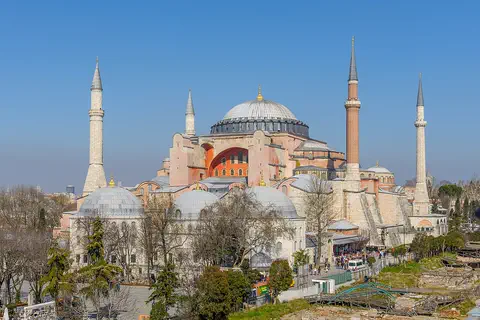
Hagia Sophia in Istanbul was built in under six years, from 532 to 537, for the emperor Justinian. Its enormous dome seems to float on a ring of 40 windows. Over almost 1,500 years it has been a church, a mosque and a museum, and since 2020 it has been a mosque.
Explore next
-
Watch
Landmark
Ephesus
Ephesus was a great Greek and Roman city on the west coast of what is now Türkiye. Its ruins include ancient streets, a theater for nearly 25,000 people and the Library of Celsus, whose two-story front has been rebuilt. Archaeologists have been digging there since 1895.
-
 Watch
 Country
Türkiye (Turkey)
Türkiye, also called Turkey, lies partly in Asia and partly in Europe. A narrow waterway called the Bosporus runs through its biggest city, Istanbul, and its land is mostly mountains and high plains. About 86 million people live there.
-
 Watch
Landmark
British Museum
The British Museum in London was founded in 1753 and opened in 1759. It holds treasures from all over the world, like the Rosetta Stone, which helped people learn to read Egyptian hieroglyphs. Its grand building with columns was built from 1823 to 1847, and in 2025 it had more than 6.4 million visits.
-
Watch
Landmark
Parthenon
The Parthenon is an ancient Greek temple on the Acropolis, a rocky hill in Athens. Built of marble between 447 and 438 BCE, it has 46 outer columns and was decorated with carvings. It has been a temple, a church and a mosque, and today experts are restoring it.
-
 Watch
Landmark
Lighthouse of Alexandria
The Lighthouse of Alexandria was one of the Seven Wonders of the ancient world. Finished in about 280 BCE on the island of Pharos, it was said to be more than 110 meters tall. An earthquake in the 1300s brought it down, and in 1477 a fortress was built on its ruins.
-
 Watch
Landmark
Great Pyramid of Giza
The Great Pyramid of Giza was built more than 4,500 years ago as the tomb of King Khufu of Egypt. About 2.3 million stone blocks were cut, moved and stacked to make it. Egypt's antiquities ministry calls it the last of the Seven Wonders of the Ancient World still standing.
- Watch Geography What is a World Heritage Site? World Heritage Sites are places so important that they belong, in a way, to everyone. Under a 1972 agreement, countries nominate their most outstanding places, experts check them, and a UNESCO committee decides. By 2026 the list held 1,273 sites: cultural places like the Taj Mahal, natural places like the Galápagos, and mixed ones like Machu Picchu.
-
Watch
Landmark
Acropolis of Athens
The Acropolis is a steep, flat-topped rock in the middle of Athens. Walls have ringed its top for more than 3,300 years. In the 400s BCE, the Athenians built a grand gateway and three temples there, including the Parthenon. Restorers are still repairing them today.
For parents & teachers
What children will learn
- Locate the Temple of Artemis near Ephesus and explain that it was one of the Seven Wonders.
- Describe how the temple was rebuilt after the fire of 356 BCE and later destroyed.
- Explain how archaeologists learned about the temple from excavation, museum fragments and ancient writers.
- Name one feature of the temple's design, such as its carved column drums.
Recommended ages: 3 to 17 · About 15 minutes
Talk about it
- Only one column of a giant temple stands today. How can archaeologists work out what the whole building looked like?
- The temple was rebuilt on the same plan after it burned. Why might people choose to rebuild something exactly as it was?
- Many carvings from the temple are in a museum far away. What are the good and hard parts of keeping ancient objects in museums?
Try at home or in class
- Stack paper cups or cardboard rolls into 'columns' made of drums, and decorate the bottom drum with drawn figures.
- Measure 300 feet (about 90 meters) outside with a tape measure or by counting steps to feel how long the temple was.
Key vocabulary: temple, Seven Wonders, column, drum, excavation, platform
Where these facts come from
- Wikidata , Wikimedia Foundation (CC0 1.0)
- UNESCO World Heritage List , UNESCO World Heritage Centre (Linked as a reference; site facts come from Wikidata)
- Ephesus , UNESCO World Heritage Centre
- Ephesus , Encyclopaedia Britannica
- The History of Ephesos , Austrian Archaeological Institute (ÖAI), Austrian Academy of Sciences
- Exploring Ephesos (research history) , Austrian Archaeological Institute (ÖAI), Austrian Academy of Sciences
- Wikimedia Commons , Wikimedia Foundation (Per file (public domain, CC0, CC BY or CC BY-SA); see each media record)
Checked, not yet human-reviewed. Last updated October 27, 2026. Spotted a mistake? Tell us.