
Natural wonder Asia
Pamukkale
Pamukkale is a white hillside in Türkiye. Warm water runs down it and fills little pools. The white rock looks like cotton or snow, but it is made by the water.
Pamukkale, in southwestern Türkiye, is a hillside of bright white terraces and pools built by warm spring water. The water is full of a dissolved mineral called calcium carbonate, and as it flows over the slope it leaves the mineral behind as a rock called travertine. Its name means "cotton castle". On top stand the ruins of Hierapolis, an ancient spa town.
Pamukkale ("cotton castle") is a cascade of travertine terraces, petrified waterfalls and pools built by calcite-laden hot springs that emerge from a cliff almost 200 m high above the Çürüksu plain in Denizli Province. Together with the ruins of Hierapolis, a Hellenistic and Roman spa town founded at the end of the 2nd century BCE, it was inscribed by UNESCO in 1988 as a mixed cultural and natural World Heritage Site.
Photo: Biologg, CC BY-SA 4.0, via Wikimedia Commons
Discover Pamukkale
Pamukkale is in Türkiye.
It is a big hill covered in white rock. Warm water bubbles out of the ground at the top. It runs down the hill into little pools, one below another, like steps. The name Pamukkale means cotton castle.
Pamukkale is a natural wonder in the province of Denizli, in southwestern Türkiye. Warm springs come out near the top of a cliff almost 200 meters high, and their water spills down toward the plain below. Over a very long time, the water has covered the slope with white rock, shaped into pools, steps and stone "waterfalls" that look frozen in place.
The Turkish name Pamukkale means "cotton castle", because the white slope looks soft and fluffy from far away. UNESCO lists Pamukkale together with Hierapolis, the ruins of an ancient town on top of the hill.
UNESCO describes Pamukkale as an "unreal landscape" of mineral forests, petrified waterfalls and terraced basins, created by calcite-laden water from springs in a cliff almost 200 m high above the Çürüksu plain, in Denizli Province in southwestern Türkiye. Fresh deposits of calcium carbonate keep the formations a dazzling white, which is the origin of the name, "cotton castle". The European Geosciences Union notes that the site lies within an active fault, which favors the formation of hot springs.
The property, Hierapolis-Pamukkale, was inscribed in 1988 under criteria (iii) and (iv) for the ancient town and (vii) for the natural landscape. UNESCO stresses the tight link between the two: the springs that built the terraces also fed the baths and canals of the town above.
- Country
- Türkiye (Denizli Province)
- Name means
- Cotton castle
- Made of
- Travertine (a kind of limestone)
- Height of the cliff
- almost 200 m
- World Heritage Site
- since 1988 (with Hierapolis)
Rock made by water
The warm water carries something hidden inside it. It is a white mineral, too tiny to see.
When the water flows over the hill, it leaves the mineral behind. At first it is soft, like jelly. Then it slowly turns into hard white rock.
The water at Pamukkale comes up warm from underground, between 35 and 60 degrees Celsius at its source, the European Geosciences Union says. It carries a lot of dissolved calcium carbonate, the same mineral found in chalk and limestone.
When the water meets the air and spreads out over the slope, it leaves calcium carbonate behind. The new layer starts out soft, like a jelly, and slowly hardens into rock. This rock is called travertine. Britannica describes travertine as a dense, banded kind of limestone that forms from river and spring water. Layer after layer, the water has been building Pamukkale's terraces for about 400,000 years.
Travertine, Britannica explains, is a dense, banded rock of calcite (CaCO₃), a light-colored variety of limestone deposited from spring and river waters; the Mammoth Hot Springs in Yellowstone are another place where it is actively forming. At Pamukkale, the European Geosciences Union reports, the water leaves its source at 35–60 °C carrying a high concentration of calcium carbonate, and on contact with air it deposits the mineral, at first as a soft gel that hardens over time.
The same source estimates that about 500 mg of calcium carbonate is deposited for every liter of water, and that the travertines have been forming for the last 400,000 years. The rate depends on the weather, the air temperature and how long water flows from the spring.
Pools, steps and frozen waterfalls
The white rock makes rows of pools.
Each pool has a white edge, like a little wall. Water fills it and spills over into the next pool. Some walls are short. Some are taller than a grown-up.
The travertine has built a giant staircase down the slope. Each step holds a shallow basin of water behind a white rim, like a little wall, and water spills from one basin down into the next.
UNESCO says some of these steps are less than a meter high, while others are as high as six meters. The water has also made stone stalactites, like the ones in caves, and "petrified waterfalls": white curtains of rock that look like waterfalls turned to stone. The European Geosciences Union says the big terraces are each about 60 to 70 meters long.
UNESCO describes the forms as petrified waterfalls, stalactites and pools with step-like terraces, ranging from less than 1 m to as much as 6 m in height. According to the European Geosciences Union, spring water travels along a 320-meter channel to the head of the travertine ridge before falling onto large terraces, each about 60–70 m long.
The terraces are an active, fragile landform whose whiteness, UNESCO notes, comes from fresh deposits of calcium carbonate. Access to the travertine terraces is prohibited in order to sustain the water flow and to maintain the color and structure of the formations, and the European Geosciences Union reports that thermal water is now released over the terraces in a controlled program.
Warm water for an ancient town
Long ago, people built a town on top of the white hill.
They used the warm water for baths. They washed wool in it, too. Little canals carried the water to farms and villages.
People have used Pamukkale's warm water for more than 2,000 years. UNESCO explains that the springs fed the baths of the ancient town of Hierapolis, with big hot basins and swimming pools. The hot springs were also used for scouring and drying wool.
People dug a whole system of canals to carry the thermal water to nearby villages and fields. UNESCO says this water system stretches about 70 kilometers to the northwest and westward along the valley of the Menderes River. Today, special areas let visitors bathe in the hot springs, while the white terraces themselves are protected.
UNESCO treats the combination of the natural formations and an elaborate canal system as exceptional: the springs supplied a hydraulic network extending some 70 km northwest to Alaşehir and westward along the Menderes valley, carrying thermal water to villages and fields. In Hierapolis the water fed immense hot basins and swimming pools, and the springs were also used for scouring and drying wool.
That long human use continues today and brings pressure. UNESCO identifies high numbers of international tourists, an important economic resource for the region, as the main threat to the property's integrity, especially at the small lake around the ancient civic agora where visitors swim among fallen columns, causing biological pollution and erosion of the Roman marble.
Hierapolis: the town on the hill
On top of the hill are the ruins of an old town called Hierapolis.
You can see a big stone theater, old baths and a long street. Earthquakes knocked the town down many times.
Hierapolis was founded in the 2nd century BCE by a king of Pergamon, Türkiye's Ministry of Culture and Tourism says. It later came under Rome and grew into an important town. Earthquakes destroyed it again and again. After a great earthquake in the year 60, the town was rebuilt in a neat grid of streets, with a main street about one kilometer long lined with shops and workshops.
Archaeologists have uncovered baths, a big theater, a monumental gateway, churches and huge cemeteries. An Italian team has been digging and restoring here since 1957. After another earthquake in the 1300s, the town was abandoned.
Türkiye's Ministry of Culture and Tourism dates the foundation to Eumenes II, king of Pergamon, in the 2nd century BCE; UNESCO says Hierapolis passed to Rome in 133 BCE, was destroyed by an earthquake in 60 CE and rebuilt, and reached its height in the 2nd and 3rd centuries CE. The rebuilt town followed a Roman grid plan around a main colonnaded street of about 1 km with two monumental gates. Surviving remains include baths, a monumental arch, a nymphaeum, the theater from the time of Severus and necropolises that UNESCO says extend over 2 km, the largest in southwest Anatolia according to the ministry.
From the 4th century Hierapolis was a bishopric with several churches, built between the 4th and 6th centuries. It was damaged again in the 7th century, was a small town under the Seljuk Sultanate in the 13th century and was abandoned after an earthquake in the 14th. An Italian excavation team has worked here since 1957, restoring monuments by anastylosis (rebuilding with the original pieces).
Visiting safely
The white pools are very delicate.
Visitors stay on the paths. They swim only in the places that are allowed. Walk slowly, because wet rock can be slippery.
Pamukkale is easily damaged. In the past, hotels stood on the site and a road crossed the terraces. UNESCO reports that the hotels and buildings around the thermal pool have been removed, the road has been closed and private cars are not allowed in, except in emergencies. Public transport carries visitors instead.
Visitors follow marked routes with information panels and are kept off the travertine terraces so the water can keep flowing over them. There are special places where bathing in the hot springs is allowed. Follow the signs and the staff, and remember that wet stone can be slippery.
UNESCO records a series of management changes: the site was registered as a first-degree natural and archaeological site in 1980, and in 1990 about 66 km² was declared a special protected area. Hotel buildings on the site and structures around the thermal pool were removed, the road through the southeastern terraces was closed, private vehicles are banned except for emergencies, public transport is provided and tourist facilities are kept at the edge of the monumental zone, with visitor centers at the north and south entrances.
Access to the travertine terraces is prohibited to sustain the water flow and preserve their color and structure, and designated areas are provided for bathing. Visitors protect the site by staying on marked routes, bathing only where permitted and taking care on wet, slippery surfaces.
Amazing facts
-
Pamukkale means cotton castle.
The Turkish name Pamukkale means "cotton castle", because the white terraces look like cotton.
UNESCO explains that the name, "cotton castle", comes from the dazzling white coating of fresh calcium carbonate.
-
The new rock starts out soft, like jelly!
When the spring water leaves its mineral behind, the new layer is soft like jelly at first, then hardens into rock.
The calcium carbonate is first deposited as a soft gel that hardens into travertine over time (European Geosciences Union).
-
Long ago, people washed wool in the warm water.
The hot springs were used not only for baths but also for washing and drying wool.
UNESCO notes the springs were used for scouring and drying wool as well as for the thermal baths.
-
The old theater is used for shows again today.
The ancient theater of Hierapolis is used again for performances, with thousands of people watching.
UNESCO records that the theater is back in use for performances attended by thousands of people.
Words to know
- hot spring
- a place where warm water flows up out of the ground
- travertine
- a kind of limestone rock that forms when spring or river water leaves calcium carbonate behind
- calcium carbonate
- a white mineral found in chalk, limestone and shells
- terrace
- a flat step cut into or built on a slope
- archaeologist
- a scientist who learns about the past by digging up and studying old objects and buildings
- necropolis
- a large ancient cemetery
Discovery challenge
-
What makes Pamukkale's white rock?
What builds Pamukkale's white terraces?
What deposits the travertine at Pamukkale?
- Warm spring water
- Snow and ice
- Sand blown by the wind
Show the answer
Warm spring water
Warm water leaves a white mineral behind.
Warm spring water full of calcium carbonate leaves the mineral behind as travertine.
Calcite-laden water from hot springs, depositing calcium carbonate as it flows.
-
What does the name Pamukkale mean?
What does the Turkish name Pamukkale mean?
What is the meaning of the name Pamukkale, according to UNESCO?
- Cotton castle
- Blue river
- Hot mountain
Show the answer
Cotton castle
Cotton castle, because it looks soft and white.
Cotton castle: the white slope looks like cotton.
Cotton castle, from the dazzling white coating of fresh calcium carbonate.
-
What kind of rock is Pamukkale made of?
Which rock forms Pamukkale's terraces?
Which variety of limestone makes up the terraces?
- Travertine
- Granite
- Coal
Show the answer
Travertine
Travertine, a white rock made by water.
Travertine, a kind of limestone laid down by spring water.
Travertine, a dense, banded calcite limestone.
-
What is on top of the white hill?
What stands on top of Pamukkale?
Which archaeological site is listed together with Pamukkale?
- The ruins of the old town of Hierapolis
- A big modern airport
- A glacier
Show the answer
The ruins of the old town of Hierapolis
The ruins of an old town.
The ruins of Hierapolis, an ancient spa town.
Hierapolis, a Hellenistic and Roman spa town, inscribed with Pamukkale in 1988.
-
How can visitors help keep the pools white?
Why are visitors kept off the white terraces?
Why does the site prohibit access to the travertine terraces?
- So the water keeps flowing and the rock stays white
- So the snow does not melt
- So the trees can grow on them
Show the answer
So the water keeps flowing and the rock stays white
Staying off helps the water keep the rock white.
To keep the water flowing over them and protect their color and shape.
To sustain the water flow and maintain the color and structure of the travertine (UNESCO).
Nearby places
-
 Watch
Landmark
Temple of Artemis at Ephesus
The Temple of Artemis at Ephesus was one of the Seven Wonders of the ancient world. It was rebuilt several times, and its 6th-century BCE version was more than 300 feet long. After a fire in 356 BCE it was built again just as big. Today only scattered stones and one column remain.
-
 Watch
Landmark
Ephesus
Ephesus was a great Greek and Roman city on the west coast of what is now Türkiye. Its ruins include ancient streets, a theater for nearly 25,000 people and the Library of Celsus, whose two-story front has been rebuilt. Archaeologists have been digging there since 1895.
-
 Watch
Landmark
Mausoleum at Halicarnassus
The Mausoleum at Halicarnassus was the tomb of Mausolus, ruler of Caria, in what is now southwestern Turkey. Built around 353 to 351 BCE, it was covered in sculptures by four famous Greek artists and became one of the Seven Wonders of the World. An earthquake probably brought it down, and its stones went into other buildings, but its name lives on in the word 'mausoleum'.
-
 Watch
Landmark
Sultan Ahmed Mosque
The Sultan Ahmed Mosque in Istanbul was built between 1609 and about 1616 for the Ottoman ruler Sultan Ahmed I. Its central dome is ringed by half-domes and smaller domes, and six slender minarets rise around it. Many people call it the Blue Mosque because of the blue and green tiles and painted decoration inside. It is still a working mosque, where Muslims come to pray.
-
 Watch
Landmark
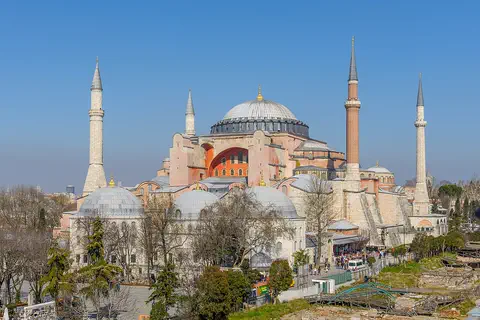
Hagia Sophia
Hagia Sophia in Istanbul was built in under six years, from 532 to 537, for the emperor Justinian. Its enormous dome seems to float on a ring of 40 windows. Over almost 1,500 years it has been a church, a mosque and a museum, and since 2020 it has been a mosque.
-
 Watch
Landmark
Topkapı Palace
Topkapı Palace sits on a point of land where the Bosphorus Strait meets the sea in Istanbul. Sultan Mehmed II built it between 1460 and 1478, and for nearly 400 years it was the home of the Ottoman sultans and the center of their government. In 1924 it became a museum.
-
 Watch
City
Istanbul
Istanbul is the biggest city in Türkiye, built on both sides of the Bosporus, the narrow strait between Europe and Asia. Once called Byzantium and then Constantinople, it was the capital of two great empires. About 15.7 million people lived in Istanbul province in 2023.
-
 Watch
City
Ankara
Ankara is the capital of Türkiye, in the interior of Anatolia, about 200 kilometers from the Black Sea. People have lived here since the Stone Age, and Romans, Byzantines, Seljuks and Ottomans all left buildings behind. It became the capital in 1923, and today it is a city of government, universities and museums.
Experiments to try
Explore next
-
 Watch
 Country
Türkiye (Turkey)
Türkiye, also called Turkey, lies partly in Asia and partly in Europe. A narrow waterway called the Bosporus runs through its biggest city, Istanbul, and its land is mostly mountains and high plains. About 86 million people live there.
-
 Watch
Natural wonder
Yellowstone National Park
Yellowstone National Park sits on top of a giant volcano in the western United States. Heat from melted rock deep underground powers more than 10,000 hot springs, geysers, mudpots and steam vents, and the park is home to bison, wolves and two kinds of bears.
-
Watch
Landmark
Ephesus
Ephesus was a great Greek and Roman city on the west coast of what is now Türkiye. Its ruins include ancient streets, a theater for nearly 25,000 people and the Library of Celsus, whose two-story front has been rebuilt. Archaeologists have been digging there since 1895.
- Watch Geography Weathering and erosion Weathering is rocks breaking apart where they are: ice in cracks, rain, wind-blown sand and growing roots all do it. Erosion is the next step, when gravity, rain, rivers, waves, wind and glaciers carry the broken pieces away. Over thousands to millions of years, they carve valleys, cliffs and canyons.
- Watch Geography Earthquakes and faults Earthquakes happen when rocks suddenly slip along a crack in the Earth called a fault. The slip sends waves of shaking through the ground. Seismometers record the waves so scientists can find where an earthquake happened and how big it was, and engineers design buildings to stay standing.
- Watch Geography What is a World Heritage Site? World Heritage Sites are places so important that they belong, in a way, to everyone. Under a 1972 agreement, countries nominate their most outstanding places, experts check them, and a UNESCO committee decides. By 2026 the list held 1,273 sites: cultural places like the Taj Mahal, natural places like the Galápagos, and mixed ones like Machu Picchu.
- Watch What If? Lab What if we used heat from inside Earth? The deeper you go underground, the hotter the rocks and water get. In Iceland, hot water from underground heats most homes, and in Kenya, underground steam makes more than 40 percent of the country's electricity. Explore what would happen if we used Earth's own heat: in volcanic places like Iceland, at hot springs, and even just a few feet under your own backyard.
-
 Watch
Natural wonder
Mount Everest
Mount Everest, in the Himalayas on the border of Nepal and China, is what Britannica calls the highest mountain in the world. In 2020 China and Nepal announced its height as 8,848.86 meters. It grew as two giant plates of Earth's crust pushed together, and it is still rising a tiny bit each year.
For parents & teachers
What children will learn
- Locate Pamukkale in southwestern Türkiye.
- Explain how spring water deposits calcium carbonate to build travertine terraces.
- Describe how people used the hot springs in the ancient town of Hierapolis.
- Explain why the terraces are protected from visitors today.
Recommended ages: 3 to 17 · About 15 minutes
Talk about it
- The water has been building Pamukkale for about 400,000 years. What else in nature changes so slowly?
- How can a place be both a natural wonder and an archaeological site?
- What rules would you make to protect a fragile place that many people want to visit?
Try at home or in class
- Dissolve as much salt as you can in a cup of warm water, then paint some on dark paper and let it dry. Look at the white crust the water leaves behind, like the mineral at Pamukkale (salt, not calcium carbonate).
- Make a staircase of pools from a stack of paper cups or a muffin tin and pour water in at the top. Watch how each pool fills and spills into the next.
Key vocabulary: hot spring, travertine, calcium carbonate, terrace, archaeologist, necropolis
Where these facts come from
- Wikidata , Wikimedia Foundation (CC0 1.0)
- UNESCO World Heritage List , UNESCO World Heritage Centre (Linked as a reference; site facts come from Wikidata)
- Hierapolis-Pamukkale , UNESCO World Heritage Centre
- Imaggeo on Mondays: Turkey's cotton castle , European Geosciences Union (GeoLog)
- Hierapolis Archaeological Site , Republic of Türkiye Ministry of Culture and Tourism (muze.gov.tr)
- Travertine , Encyclopaedia Britannica
- Denizli , Encyclopaedia Britannica
- Wikimedia Commons , Wikimedia Foundation (Per file (public domain, CC0, CC BY or CC BY-SA); see each media record)
Checked, not yet human-reviewed. Last updated October 27, 2026. Spotted a mistake? Tell us.