
Landmark Asia
Ephesus
Ephesus is a very old city in Türkiye. Today it is ruins, with stone streets, a giant theater and a library with a tall, carved front.
Ephesus was a great Greek and Roman city on the west coast of what is now Türkiye. Its ruins include ancient streets, a theater for nearly 25,000 people and the Library of Celsus, whose two-story front has been rebuilt. Archaeologists have been digging there since 1895.
Refounded by Lysimachus around 300 BCE and capital of the Roman province of Asia, Ephesus was a harbor city whose coastline retreated as the Kaystros river silted up. Its Roman monuments, among them the Library of Celsus and Terrace House 2, made it a World Heritage Site in 2015.
Photo: Benh LIEU SONG, CC BY-SA 3.0, via Wikimedia Commons
Discover Ephesus
Ephesus is in a country called Türkiye.
Long ago, it was a big, busy city by the sea. Now it is ruins. You can walk on its old stone streets and see a giant theater and a beautiful library.
Ephesus was one of the great cities of the ancient world. It stood near the Aegean Sea, on the west coast of what is now Türkiye, close to the modern town of Selçuk. Greeks, then Romans, lived and traded there, and under the Romans it became the capital of a whole province.
Today its ruins cover the valley between two hills. Visitors walk along ancient streets lined with monuments, past fountains and baths, to a huge theater and the famous Library of Celsus. UNESCO made Ephesus a World Heritage Site in 2015.
Britannica calls Ephesus the most important Greek city in Ionian Asia Minor; its ruins lie near Selçuk in western Türkiye. The center of the ancient city stretches between two ridges, Bülbüldağ to the south and Panayırdağ to the north, the Austrian Archaeological Institute (ÖAI) explains.
UNESCO's serial World Heritage Site, inscribed in 2015, joins three areas that together trace settlement from the seventh millennium BCE at Çukuriçi Höyük, through Ayasuluk Hill and the Artemision, to the Hellenistic and Roman city. UNESCO describes Ephesus as an outstanding example of a settlement landscape shaped by environmental change, a Roman harbor city with a sea channel and harbor basin along the Kaystros river.
- Where
- Near Selçuk, western Türkiye
- Hellenistic city founded
- about 300 BCE, by Lysimachus
- Theater seats
- nearly 25,000
- World Heritage Site
- since 2015
A city that kept moving
People have lived near Ephesus for thousands of years.
The river carried mud to the sea, and the coast moved farther away. So the city moved too. Later, the Romans made it a very important city.
People lived near Ephesus more than 8,000 years ago. Over thousands of years, the river Kaystros carried mud into the sea, and the coastline kept moving west. This led the city and its harbors to move several times.
Around 300 BCE, King Lysimachus founded a new, planned city between two hills. In 133 BCE the region became part of the Roman Empire, and Ephesus became the capital of the Roman province of Asia. It grew rich, filled with grand buildings. In 262 CE the Goths attacked and damaged it badly. Later, as the harbor filled with mud, the city slowly faded.
UNESCO traces a settlement history from the Neolithic Çukuriçi Höyük, about 1 km southeast of the later city, through Ayasuluk Hill in the Bronze Age, where the ÖAI identifies a town probably called Apaša in Hittite sources. Sedimentation of the Kaystros pushed the shoreline west and forced relocations of the city and its harbors; Britannica notes that by the mid-20th century the coast lay three miles farther west.
Lysimachus refounded the city around 300 BCE (Britannica: 286 to 281 BCE) on a Hippodamian grid with a 9 km wall, resettling people from nearby towns. Asia Minor passed to Rome in 133 BCE, and Ephesus became capital of the province of Asia. The Goths destroyed the city and the Temple of Artemis in 262 CE. Church councils met there in 431 and 449, Justinian built the Basilica of St. John in the 6th century, and the Seljuqs took the town in 1090. The Isa Bey Mosque on Ayasuluk was dedicated in 1375.
Streets, water and a harbor
Roman builders brought fresh water from the mountains into the city.
People collected the water at fancy fountains. A long street, lined with statues and buildings, went through the middle of town.
Ephesus was a planned city, with streets laid out in a grid. One street did not follow the grid: Curetes Street, an older route that wound down between the hills. Over time it became a grand avenue lined with monuments and fountains, and later only people on foot could use it.
The Romans cared about water. Aqueducts, long channels for water, brought fresh water from the mountains into the city. People collected it at public fountains, some of them grand buildings decorated with carvings and statues. A sea channel kept ships moving to the harbor, though the mud from the river made that harder and harder.
The ÖAI describes Lysimachus's planned city: a 9 km fortification wall on the mountain slopes and a Hippodamian grid, with few Hellenistic monuments still visible beyond the great theater, begun in the 3rd century BCE and fundamentally altered under Rome. Curetes Street, originally a processional route, kept its irregular course and became an inner-city boulevard of honorific monuments and public foundations; once the Heracles Gate was built in late antiquity, carriages could no longer pass.
Roman investment focused on water: aqueducts brought mountain water to public fountains, and nymphaea such as the Nymphaeum Traiani, the end point of a long pipeline, were elaborate monuments to their donors. Britannica dates the triumphal arch to 3 BCE and an aqueduct to 4 to 14 CE, and notes that in Roman times a sea channel to the harbor was maintained only with difficulty.
The library, the theater and the houses
The Library of Celsus held thousands of book rolls. Its front has two floors of columns and statues.
The theater is giant. Nearly 25,000 people could sit in it! Some old houses still have painted walls and floors made of tiny tiles.
At the bottom of Curetes Street stands the Library of Celsus, built in the early 2nd century CE. It held about 10,000 book rolls on two floors. It was founded by Tiberius Julius Celsus Polemaeanus and his son, Tiberius Julius Aquila, and Celsus is buried in a room behind it. Archaeologists re-erected its front in the 1970s, finishing in 1978.
The great theater could seat nearly 25,000 people. Wealthy families lived in terrace houses. One block, Terrace House 2, still has wall paintings, mosaics and marble panels, now protected under a roof.
The ÖAI calls the Library of Celsus the crowning glory of Curetes Street: a Trajanic public library of the early 2nd century CE holding around 10,000 book rolls on two floors, whose richly decorated facade served its founders, Tiberius Iulius Celsus Polemaeanus and his son Tiberius Iulius Aquila, as self-presentation. Celsus's burial chamber lies behind it, his garlanded sarcophagus still in place. The facade was re-erected over almost ten years and completed in 1978.
Britannica describes the theater, completed in its present form under Trajan, as seating nearly 25,000 (the ÖAI gives 22,000 seats, one of the largest of antiquity either way), and the roofed odeum as holding 1,400. Nearby stood the so-called Temple of Hadrian, re-erected in 1957. UNESCO highlights Terrace House 2, whose wall paintings, mosaics and marble paneling show how the upper levels of Roman society lived; a protective roof was built over it in 1999 and 2000, and it has been open to visitors since.
- Library of Celsus
- early 2nd century CE; about 10,000 book rolls
- Library front rebuilt
- finished 1978, after almost ten years
- Great theater
- nearly 25,000 seats
- Odeum (small roofed theater)
- about 1,400 seats
Digging up Ephesus
Archaeologists have been digging at Ephesus for more than 100 years.
They find old buildings and fit the broken pieces back together. Millions of visitors come every year to walk the old streets.
In 1863 John Turtle Wood, an English railway engineer, began searching here for the Temple of Artemis for the British Museum. In 1895 Austrian archaeologists began excavating, and they still work at Ephesus today. In the 1950s they uncovered Curetes Street, and later they put buildings like the library front back together.
Today researchers use modern methods, some of which do not even need digging. Ephesus has become Türkiye's most visited archaeological site, with around 4 million visitors a year (2025), the Austrian team says.
The ÖAI's research history runs from early travelers' accounts, through John Turtle Wood's British Museum excavations (1863 to 1874), which uncovered the theater and other buildings and located the Artemision, to Otto Benndorf's Austrian excavation, begun on 20 May 1895 with imperial approval and private funding; the Austrian Archaeological Institute itself was founded in 1898 in response to its success. In the 1950s, large-scale clearances exposed Curetes Street; re-erections followed, from the Temple of Hadrian (1957) to the library facade (1978).
Since the 1990s the emphasis has shifted to study, publication and targeted, often non-destructive fieldwork. The ÖAI reports about 4 million visitors a year (2025), making Ephesus the most visited archaeological site in Türkiye. UNESCO notes that earlier repairs with unsuitable materials are being corrected with reversible techniques.
Amazing facts
-
The man who built the library is buried behind it.
Celsus, the man the library honors, is buried in a room behind it, and his stone coffin is still in its original place.
Celsus's burial chamber lies behind the library; his garland-decorated sarcophagus still stands where it was placed.
-
Ephesus was once by the sea. Now it is far from it.
Mud from the river Kaystros slowly built new land, so the coast moved miles away from the old harbor.
Silt from the Kaystros moved the shoreline west; by the mid-20th century the coast lay three miles farther west.
-
Carts could not go down one busy street.
In late Roman times, Curetes Street became a street for people on foot, because a gate stopped carriages from getting through.
The ÖAI describes late-antique Curetes Street as a pedestrian zone once the Heracles Gate blocked carriages.
-
The library front took almost ten years to rebuild.
Putting the Library of Celsus's front back together took almost ten years. It was finished in 1978.
The re-erection of the library facade, completed in 1978 after almost ten years, was one of the ÖAI's landmark projects.
Words to know
- ruins
- what is left of buildings after they have fallen down or been damaged
- archaeologist
- a scientist who digs up and studies things people left long ago
- aqueduct
- a long channel or bridge built to carry water
- harbor
- a sheltered place where ships can stay
- silt
- fine mud carried by rivers
- mosaic
- a picture made of many tiny pieces of stone, glass or tile
Discovery challenge
-
Which building at Ephesus held book rolls?
Which building at Ephesus held about 10,000 book rolls?
Which Trajanic building on Curetes Street held about 10,000 book rolls on two floors?
- The Library of Celsus
- The theater
- The harbor
Show the answer
The Library of Celsus
The Library of Celsus! It was full of book rolls.
The Library of Celsus, built in the early 2nd century CE.
The Library of Celsus, founded by Celsus Polemaeanus and his son Aquila.
-
Why did the sea move away from Ephesus?
Why did the coastline move away from Ephesus over time?
What process forced Ephesus to relocate its city and harbors several times?
- A river filled the sea with mud
- The sea froze
- People drained it with pumps
Show the answer
A river filled the sea with mud
A river carried mud that made new land.
The river Kaystros carried mud into the sea, building new land, so the coast moved west.
Sedimentation from the Kaystros shifted the shoreline west.
-
About how many people could sit in the big theater?
About how many people could the great theater of Ephesus seat?
What is the approximate capacity of the great theater, completed under Trajan?
- About 250
- Nearly 25,000
- About 2 million
Show the answer
Nearly 25,000
Nearly 25,000! That is a lot of people.
Nearly 25,000 people. The smaller roofed odeum held about 1,400.
Nearly 25,000; the odeum held about 1,400.
-
When did archaeologists finish rebuilding the library's front?
In which year was the front of the Library of Celsus rebuilt?
In which year was the re-erection of the library facade completed?
- 1895
- 1978
- 2015
Show the answer
1978
In 1978, after almost ten years of work.
1978. (1895 is when Austrian excavations began, and 2015 when UNESCO listed the site.)
1978; excavation began in 1895 and World Heritage listing came in 2015.
Nearby places
-
 Watch
Landmark
Temple of Artemis at Ephesus
The Temple of Artemis at Ephesus was one of the Seven Wonders of the ancient world. It was rebuilt several times, and its 6th-century BCE version was more than 300 feet long. After a fire in 356 BCE it was built again just as big. Today only scattered stones and one column remain.
-
 Watch
Landmark
Mausoleum at Halicarnassus
The Mausoleum at Halicarnassus was the tomb of Mausolus, ruler of Caria, in what is now southwestern Turkey. Built around 353 to 351 BCE, it was covered in sculptures by four famous Greek artists and became one of the Seven Wonders of the World. An earthquake probably brought it down, and its stones went into other buildings, but its name lives on in the word 'mausoleum'.
-
 Watch
Natural wonder
Pamukkale
Pamukkale, in southwestern Türkiye, is a hillside of bright white terraces and pools built by warm spring water. The water is full of a dissolved mineral called calcium carbonate, and as it flows over the slope it leaves the mineral behind as a rock called travertine. Its name means "cotton castle". On top stand the ruins of Hierapolis, an ancient spa town.
-
 Watch
City
Athens
Athens is the capital of Greece and one of the oldest cities in the world. Above it rises the Acropolis, a rocky hill crowned by the marble Parthenon, built about 2,500 years ago. Ancient Athens was home to early democracy, great thinkers and theater.
-
 Watch
Landmark
Parthenon
The Parthenon is an ancient Greek temple on the Acropolis, a rocky hill in Athens. Built of marble between 447 and 438 BCE, it has 46 outer columns and was decorated with carvings. It has been a temple, a church and a mosque, and today experts are restoring it.
-
 Watch
Landmark
Acropolis of Athens
The Acropolis is a steep, flat-topped rock in the middle of Athens. Walls have ringed its top for more than 3,300 years. In the 400s BCE, the Athenians built a grand gateway and three temples there, including the Parthenon. Restorers are still repairing them today.
-
 Watch
Landmark
Sultan Ahmed Mosque
The Sultan Ahmed Mosque in Istanbul was built between 1609 and about 1616 for the Ottoman ruler Sultan Ahmed I. Its central dome is ringed by half-domes and smaller domes, and six slender minarets rise around it. Many people call it the Blue Mosque because of the blue and green tiles and painted decoration inside. It is still a working mosque, where Muslims come to pray.
-
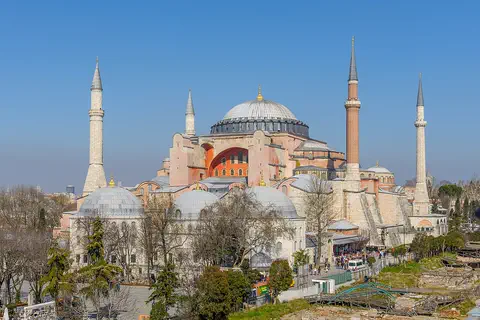 Watch
Landmark
Hagia Sophia
Hagia Sophia in Istanbul was built in under six years, from 532 to 537, for the emperor Justinian. Its enormous dome seems to float on a ring of 40 windows. Over almost 1,500 years it has been a church, a mosque and a museum, and since 2020 it has been a mosque.
Explore next
-
 Watch
 Country
Türkiye (Turkey)
Türkiye, also called Turkey, lies partly in Asia and partly in Europe. A narrow waterway called the Bosporus runs through its biggest city, Istanbul, and its land is mostly mountains and high plains. About 86 million people live there.
-
Watch
Landmark
Temple of Artemis at Ephesus
The Temple of Artemis at Ephesus was one of the Seven Wonders of the ancient world. It was rebuilt several times, and its 6th-century BCE version was more than 300 feet long. After a fire in 356 BCE it was built again just as big. Today only scattered stones and one column remain.
-
 Watch
Landmark
Pompeii
Pompeii was a Roman town near Naples, in Italy. In 79 CE the volcano Vesuvius erupted and buried it under ash and small stones. Digging began in 1748, and today you can walk its streets, shops, baths and houses. In 2025, 4,000,090 people visited.
-
 Watch
Landmark
Palmyra
Palmyra is an ancient city built on an oasis in the Syrian desert. About 2,000 years ago it grew rich from caravans carrying goods between the Roman Empire and lands to the east. Its ruins, with a colonnaded street 1,100 meters long, are a UNESCO World Heritage Site.
-
Watch
Landmark
Acropolis of Athens
The Acropolis is a steep, flat-topped rock in the middle of Athens. Walls have ringed its top for more than 3,300 years. In the 400s BCE, the Athenians built a grand gateway and three temples there, including the Parthenon. Restorers are still repairing them today.
- Watch Geography What is a World Heritage Site? World Heritage Sites are places so important that they belong, in a way, to everyone. Under a 1972 agreement, countries nominate their most outstanding places, experts check them, and a UNESCO committee decides. By 2026 the list held 1,273 sites: cultural places like the Taj Mahal, natural places like the Galápagos, and mixed ones like Machu Picchu.
- Watch Geography River deltas A delta is land a river builds where it slows down and empties into a sea, a lake or another river. The slowing water drops its sand and mud, which pile up into low, flat, watery land. Many deltas are fan-shaped, like the Greek letter delta (Δ), but some look like a bird's foot.
-
Watch
Natural wonder
Pamukkale
Pamukkale, in southwestern Türkiye, is a hillside of bright white terraces and pools built by warm spring water. The water is full of a dissolved mineral called calcium carbonate, and as it flows over the slope it leaves the mineral behind as a rock called travertine. Its name means "cotton castle". On top stand the ruins of Hierapolis, an ancient spa town.
For parents & teachers
What children will learn
- Locate Ephesus in western Türkiye and describe it as a Greek and Roman harbor city.
- Explain how river silt moved the coastline and the city.
- Describe the Library of Celsus, the theater and the terrace houses.
- Explain how archaeologists excavate and rebuild ancient buildings.
Recommended ages: 3 to 17 · About 15 minutes
Talk about it
- Ephesus had to move because its harbor filled with mud. What other ways can nature change where people live?
- Archaeologists rebuilt the library front. Should ruins be rebuilt, or left as they were found?
- Around 4 million people visit Ephesus each year. How can a place welcome visitors and still protect old buildings?
Try at home or in class
- Make a 'river' of muddy water flow into a tray of clear water and watch where the mud settles, like silt building new land.
- Draw a building front with two floors of columns, doorways and alcoves, like the Library of Celsus.
Key vocabulary: ruins, archaeologist, aqueduct, harbor, silt, mosaic
Where these facts come from
- Wikidata , Wikimedia Foundation (CC0 1.0)
- UNESCO World Heritage List , UNESCO World Heritage Centre (Linked as a reference; site facts come from Wikidata)
- Ephesus , UNESCO World Heritage Centre
- Ephesus , Encyclopaedia Britannica
- The History of Ephesos , Austrian Archaeological Institute (ÖAI), Austrian Academy of Sciences
- Exploring Ephesos (research history) , Austrian Archaeological Institute (ÖAI), Austrian Academy of Sciences
- Wikimedia Commons , Wikimedia Foundation (Per file (public domain, CC0, CC BY or CC BY-SA); see each media record)
Checked, not yet human-reviewed. Last updated October 27, 2026. Spotted a mistake? Tell us.