
Natural wonder North America
Belize Barrier Reef
The Belize Barrier Reef is a long coral reef in the sea off Belize. Turtles, manatees and hundreds of kinds of fish live there.
The Belize Barrier Reef runs along the coast of Belize in the Caribbean Sea. UNESCO calls it the largest barrier reef in the northern hemisphere. About 450 sand and mangrove islands called cayes lie in the reef area, and seven protected areas along the reef form a World Heritage site.
The Belize Barrier Reef is, in UNESCO's words, the largest barrier reef in the northern hemisphere and part of the largest reef complex in the Atlantic-Caribbean region. Seven marine protected areas covering 12% of the reef complex form the Belize Barrier Reef Reserve System, inscribed in 1996 for its array of reef types, its intact ecosystem gradient and its biodiversity.
Photo: Bernt Rostad, CC BY 2.0, via Wikimedia Commons
Discover the Belize Barrier Reef
The Belize Barrier Reef is in the Caribbean Sea. It runs along the coast of Belize.
In this photo, clear blue-green water is in front. Far out, white waves break in a long line.
The Belize Barrier Reef lies off the coast of Belize, a country in Central America. UNESCO calls it the largest barrier reef in the northern hemisphere. Seven protected areas along the reef make up the Belize Barrier Reef Reserve System, a World Heritage site since 1996.
This photo by Bernt Rostad was taken off Ambergris Caye on 11 June 2010. Clear turquoise water fills the front, low brown rocks stick out of the water, and a long line of white waves breaks farther out under a pale blue sky.
UNESCO (property 764, inscribed 1996, criteria vii, ix, x; a serial site of seven marine protected areas, 96,300 ha): the largest barrier reef in the northern hemisphere and the largest reef complex in the Atlantic-Caribbean region, which UNESCO says represents the second largest reef system in the world. The seven areas make up 12% of the entire reef complex; outside the barrier reef lie three atolls, Turneffe, Lighthouse Reef and Glover's Reef.
The photo (Bernt Rostad via Flickr, CC BY 2.0, 11 June 2010, Ambergris Caye) shows clear water, low rocks at the surface and a line of breaking surf offshore.
- Reserve System on the World Heritage List
- 1996
- Sand and mangrove cayes (about)
- 450
- Kinds of fish recorded
- over 500
How a barrier reef grows
Coral reefs are built by hard corals.
Baby corals stick to rocks under the sea. As they grow, the reef grows too.
NOAA explains that coral reefs are built by hard, or stony, corals. A reef begins when young coral larvae swimming in the sea attach to rocks or other hard surfaces near the edge of land. As the corals grow and spread, the reef takes one of three main shapes: a fringing reef, a barrier reef or an atoll.
A barrier reef runs along a shore but farther out, with a lagoon of open water between it and the land. NOAA says a coral reef can take up to 10,000 years to form.
NOAA: reefs are built by hard (stony) corals; free-swimming larvae attach to submerged rock or other hard surfaces along the edges of islands or continents, and growing corals produce fringing, barrier or atoll structures. Barrier reefs border shorelines at a distance, separated by a lagoon of open, often deep water. Massive corals grow 0.3-2 cm a year and branching corals up to 10 cm; a reef can take up to 10,000 years to form, and barrier reefs and atolls 100,000 to 30 million years, depending on size.
UNESCO: in Belize, the rise and fall of sea level over the millennia, together with karst topography and clear water, produced patch, fringing, pinnacle and barrier reefs, faros, off-shelf atolls, rare deep-water reefs, the Blue Hole and Rocky Point, where the barrier reef touches the shore.
Turtles, manatees and fish
Sea turtles and manatees find homes here. So do hundreds of kinds of fish.
Seabirds nest on some of the islands, called cayes.
UNESCO lists more than 500 kinds of fish and 65 kinds of stony coral on the reef. Animals that need protection live here too, such as the West Indian manatee, green, hawksbill and loggerhead sea turtles, and the American crocodile.
Red-footed boobies nest on Half Moon Caye. UNESCO also names top hunters on land, in the sea and in the air: jaguars at Bacalar Chico, great hammerhead sharks at the Blue Hole and ospreys at Glover's Reef.
UNESCO records about 247 taxa of marine flora (246 in its criteria text) and 178 terrestrial plants, over 500 fish species, 65 scleractinian corals, 45 hydroids and 350 molluscs, plus many sponges, marine worms and crustaceans. Species of conservation concern include the West Indian manatee (Trichechus manatus), green (Chelonia mydas), hawksbill (Eretmochelys imbricata) and loggerhead (Caretta caretta) turtles and the American crocodile (Crocodylus acutus).
Bird colonies: red-footed booby on Half Moon Caye, brown booby on Man O'War Caye, common noddy on Glover's Reef. Top predators named by UNESCO: jaguars of Bacalar Chico, great hammerheads of the Blue Hole, ospreys of Glover's Reef; endemic species include island lizards, fishes, tunicates and sponges.
Cayes, mangroves and atolls
Hundreds of islands called cayes sit along the reef.
Some cayes have white sand. Others are green with mangrove trees.
The reef area has about 450 cayes, islands of sand or mangroves. UNESCO describes bright white sand cayes and green mangrove cayes set in blue water.
The reserve covers every step from land to deep ocean: beach forests, wetlands and mangroves, seagrass beds, reefs in the lagoon, the outer barrier reef and atolls. Animals use these places to lay eggs, feed and raise their young.
UNESCO: about 450 sand and mangrove cayes; rare littoral forest on sand cayes is home to endangered plants and animals. The property contains an intact ecosystem gradient from the terrestrial to the deep ocean (littoral, wetland and mangrove ecosystems, seagrass beds with lagoonal reefs, the outer barrier reef platform and oceanic atolls) that supports spawning, nesting, foraging and nursery functions.
UNESCO quotes Charles Darwin as calling it the most remarkable reef in the West Indies.
Safe in the water, kind to the reef
Always swim with a buddy. Children should wear a life jacket in the sea.
The sun's rays bounce off water. Wear a hat and sunscreen.
The CDC says to always swim with a buddy, choose places with lifeguards when you can, and have children wear life jackets in natural water. Oceans can hide dangerous currents, waves and rocks, and weather can change quickly, so check the forecast first.
The sun's rays also reflect off water and sand. UNESCO says climate change brings risks of coral bleaching, stronger hurricanes and rising seas, and that overharvesting sea life, building on the coast and tourism need careful management.
CDC drowning prevention: swim with a buddy, preferably where lifeguards are present; life jackets for children in and around natural water; natural waters hide currents, waves, rocks and poor visibility; check the forecast, as conditions change fast. CDC sun safety: UV reflects off water and sand; use shade, covering clothing, a brimmed hat and broad-spectrum SPF 15+ sunscreen.
UNESCO: climate change brings risks of coral bleaching, stronger and more frequent hurricanes and sea-level rise; other management challenges are overharvesting of marine resources, coastal development, tourism and industrial development.
Amazing facts
-
About 450 islands called cayes sit along this reef.
The Belize reef area has about 450 cayes, islands of sand or mangroves.
UNESCO counts approximately 450 sand and mangrove cayes in the reef complex.
-
Red-footed boobies are seabirds that nest on Half Moon Caye.
Half Moon Caye has a nesting colony of red-footed boobies, a kind of seabird.
UNESCO lists major bird colonies: red-footed booby on Half Moon Caye, brown booby on Man O'War Caye and common noddy on Glover's Reef.
-
Some corals grow only 2 centimeters or less each year.
Massive corals grow just 0.3 to 2 centimeters a year, so a reef can take up to 10,000 years to form.
NOAA: massive corals grow 0.3-2 cm a year and branching corals up to 10 cm; reefs can take up to 10,000 years to form.
Words to know
- barrier reef
- a coral reef that runs along a shore but farther out, with a lagoon between it and the land
- coral larva
- a young coral that swims freely before it attaches to a hard surface and starts to grow
- lagoon
- a body of water between a reef and the land, or inside an atoll
- caye
- a low island of sand or mangroves, often on or near a reef
- atoll
- a ring-shaped coral reef or chain of islands around a central lagoon
- mangrove
- a tree that grows in salty water along tropical coasts
Discovery challenge
-
Off which country is this reef?
The reef runs along the coast of which Central American country?
Which country's coast holds the seven protected areas of the Reserve System?
- Belize
- Chile
- Egypt
Show the answer
Belize
Belize.
Belize, on the Caribbean Sea.
Belize (UNESCO property 764).
-
What do baby corals stick to when a reef begins?
According to NOAA, what do coral larvae attach to when a reef begins to form?
What do free-swimming coral larvae settle on to start a reef, NOAA says?
- Rocks and other hard surfaces
- Floating ice
- Sea foam
Show the answer
Rocks and other hard surfaces
Rocks under the sea.
Rocks or other hard surfaces near the edge of land.
Submerged rock or other hard surfaces along island and continental edges (NOAA).
-
Which of these animals lives at the reef?
Which sea mammal does UNESCO list as a species of concern on the reef?
Trichechus manatus, listed by UNESCO for the property, is which animal?
- West Indian manatee
- Walrus
- Narwhal
Show the answer
West Indian manatee
The manatee.
The West Indian manatee.
The West Indian manatee (UNESCO).
-
What lies between the reef and the land?
What separates a barrier reef from the land?
In NOAA's description, what separates a barrier reef from its adjacent land mass?
- A lagoon of open water
- A desert
- A glacier
Show the answer
A lagoon of open water
A lagoon of water.
A lagoon of open water.
A lagoon of open, often deep water (NOAA).
-
Who should you swim with?
What does the CDC say you should always do when you swim?
Which practice does the CDC recommend for every swim?
- Swim with a buddy
- Swim alone far out
- Use a foam toy as a life jacket
Show the answer
Swim with a buddy
Always with a buddy.
Always swim with a buddy, ideally where there are lifeguards.
The buddy system, preferably at lifeguarded sites; foam toys are not safety devices (CDC).
Nearby places
-
 Watch
City
Belmopan
Belmopan is the capital of Belize. It was built inland in the valley of the Belize River, after a hurricane badly damaged Belize City on the coast in 1961, and the government moved there in 1970. In mid-2025 about 22,584 people lived in Belmopan.
-
 Watch
Landmark
Tikal
Tikal was one of the great cities of the ancient Maya, in the forests of northern Guatemala. People lived here for well over a thousand years, until about the year 900, and built steep temple pyramids, palaces and wide plazas. Today it is a national park, protected for both its ruins and its wildlife.
-
 Watch
Landmark
Calakmul
Calakmul is the ruin of a great Maya city in the rainforest of southern Mexico. People lived in this region for about 1,500 years, from about 500 BCE to about 1000 CE, and UNESCO calls Calakmul the largest site in the area. Today the city and the forest around it are a World Heritage Site.
-
 Watch
Landmark
Quiriguá
Quiriguá is the ruin of a Maya city in eastern Guatemala, near the Motagua River. People lived there from about 200 to 900 CE. It is known for its tall carved stones, called stelae, and large carved boulders, most of them made in the 8th century.
-
 Watch
Landmark
Copán
Copán is the ruins of a Maya city in the Copan Valley of Honduras. It grew into one of the great Maya cities between about AD 300 and 900, and it is known for its carved stone monuments called stelae and a giant stairway covered in writing.
-
 Watch
City
Tegucigalpa
Tegucigalpa is the capital of Honduras, in Central America. It sits on hills ringed by mountains, at nearly 1,000 meters above sea level. Founded in 1578 as a mining town, it joined Comayagüela, across the Choluteca River, in 1938 to form the Distrito Central. An official projection gave the Distrito Central 1,326,460 people in 2023.
-
 Watch
Landmark
Chichén Itzá
Chichén Itzá is the ruin of a great Maya city on the Yucatán Peninsula in Mexico. Its people built pyramids, a huge ball court and a round building for watching the sky. Its most famous pyramid, El Castillo, has 365 steps, as many as the days in a year.
-
 Watch
Landmark
Uxmal
Uxmal is a Maya town in the Yucatán, Mexico, whose main buildings went up between the 700s and 900s. At its height up to 20,000 people lived there. UNESCO calls its buildings the pinnacle of late Maya art and architecture, with a 35-meter pyramid, a long palace and a courtyard of four buildings. It became a World Heritage Site in 1996.
Explore next
-
 Watch
 Country
Belize
Belize is on the Caribbean coast of Central America, south of Mexico. Along its shore runs a huge barrier reef, the largest in the Northern Hemisphere, and forests cover about three-fifths of the land. Maya cities once stood here, and today English is the official language. The 2022 census counted about 397,000 people.
-
 Watch
Natural wonder
Great Barrier Reef
The Great Barrier Reef stretches about 2,300 kilometers along the coast of Queensland, Australia. It is made of about 2,500 separate reefs and more than 900 islands, built by tiny coral animals, and it is home to more than 1,500 kinds of fish.
-
 Watch
Animal
West Indian manatee
The West Indian manatee is a large, slow, plant-eating marine mammal nicknamed the sea cow. It lives in warm coasts, rivers and springs from Florida and the Caribbean to Brazil, grazing on seagrass and other water plants for up to 8 hours a day. It cannot stand cold water for long, and being hit by boats is one of the dangers it faces.
-
 Watch
3D
Animal
Hawksbill sea turtle
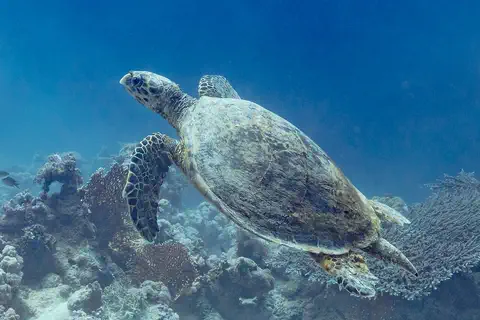
The hawksbill sea turtle lives in warm seas around the world, mostly near coral reefs. Its pointed, hawk-like beak reaches into cracks in the reef to find sponges, its favorite food. Its beautiful patterned shell once made it a target for hunters, and today it is critically endangered.
- Watch Geography Islands An island is a piece of land surrounded by water that is smaller than a continent. Islands form in different ways: some broke away from continents, some were built by volcanoes on the sea floor, and some were made by corals or by waves piling up sand. Because they are cut off by water, islands often have unusual plants and animals.
-
 Watch
Natural wonder
Grand Canyon
The Grand Canyon is a huge, steep-sided canyon in Arizona carved by the Colorado River. It is about 447 kilometers long and, on average, 1.6 kilometers deep, and its walls show layers of rock almost two billion years old.
-
 Watch
Natural wonder
Niagara Falls
Niagara Falls is a set of three waterfalls on the Niagara River, which flows from Lake Erie to Lake Ontario across the border between Canada and the United States. About 500 waterfalls in the world are taller, but Niagara is famous for its height together with the enormous amount of water that pours over it.
-
 Watch
Natural wonder
Yellowstone National Park
Yellowstone National Park sits on top of a giant volcano in the western United States. Heat from melted rock deep underground powers more than 10,000 hot springs, geysers, mudpots and steam vents, and the park is home to bison, wolves and two kinds of bears.
For parents & teachers
What children will learn
- Locate the Belize Barrier Reef in the Caribbean Sea.
- Explain how corals build fringing reefs, barrier reefs and atolls.
- Name animals that depend on the reef, cayes and mangroves.
- Explain how to stay safe in natural water.
Recommended ages: 3 to 17 · About 15 minutes
Talk about it
- Massive corals grow 2 centimeters a year or less. What could that mean for a reef that gets damaged?
- How could mangroves, seagrass and the reef all depend on each other?
- What could visitors do to protect a reef while enjoying it?
Try at home or in class
- Draw three side views: a fringing reef next to the shore, a barrier reef with a lagoon behind it, and a ring-shaped atoll.
- Measure 2 centimeters on a ruler: that is about the most a massive coral grows in a year.
Key vocabulary: barrier reef, coral larva, lagoon, caye, atoll, mangrove
Where these facts come from
- Wikidata , Wikimedia Foundation (CC0 1.0)
- Belize Barrier Reef Reserve System (World Heritage List) , UNESCO World Heritage Centre
- How do coral reefs form? , NOAA National Ocean Service
- Preventing Drowning , US Centers for Disease Control and Prevention
- Sun Safety Facts , US Centers for Disease Control and Prevention
- Belize Barrier Reef, Ambergris Caye (Wikimedia Commons file page) , Wikimedia Commons
- UNESCO World Heritage List , UNESCO World Heritage Centre (Linked as a reference; site facts come from Wikidata)
- Wikimedia Commons , Wikimedia Foundation (Per file (public domain, CC0, CC BY or CC BY-SA); see each media record)
Checked, not yet human-reviewed. Last updated November 1, 2026. Spotted a mistake? Tell us.