Animal
Hawksbill sea turtle
The hawksbill is a sea turtle with a pointy mouth like a bird's beak. It swims around coral reefs and eats sponges.
The hawksbill sea turtle lives in warm seas around the world, mostly near coral reefs. Its pointed, hawk-like beak reaches into cracks in the reef to find sponges, its favorite food. Its beautiful patterned shell once made it a target for hunters, and today it is critically endangered.
Eretmochelys imbricata is a medium-sized sea turtle of tropical and subtropical oceans, the only sea turtle that can live mainly on sponges. Hunted for centuries for 'tortoiseshell', it is listed by the IUCN as Critically Endangered and is protected under CITES and the U.S. Endangered Species Act, though illegal trade, bycatch and loss of reefs and beaches still threaten it.
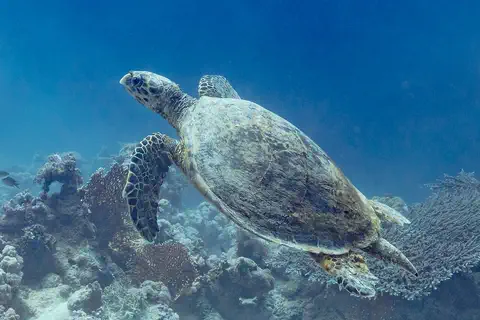
Photo: Diego Delso, CC BY-SA 4.0, via Wikimedia Commons
Meet the hawksbill sea turtle
This is the hawksbill sea turtle.
It has a pointy mouth that looks like a bird's beak. Its shell has pretty patterns of brown, orange and yellow. It swims with big flippers.
The hawksbill sea turtle gets its name from its mouth. Its head comes to a narrow point, and its sharp, hooked beak looks like the beak of a hawk.
Its shell is one of the most beautiful in the sea, patterned with amber, orange, red, yellow, brown and black, and the plates on its back overlap like roof tiles. Hawksbills are smaller than green turtles: an adult's shell is about 60 to 90 centimeters long, and it weighs about 45 to 68 kilograms.
Eretmochelys imbricata is one of six sea turtle species in the family Cheloniidae. NOAA gives adult shell lengths of 2 to 3 feet (about 0.6 to 0.9 meters) and weights of 100 to 150 pounds (about 45 to 68 kilograms); the Smithsonian notes that hawksbills are smaller than green and loggerhead turtles.
The species is recognized by its tapered head and V-shaped lower jaw, which give it a hawk-like profile, and by its mottled carapace with serrated edges and overlapping scutes. It has two pairs of scales between the eyes and four scutes along each side of the shell. Its flippers each carry two claws.
Quick facts
- Group
- Reptile
- Length
- 0.6 to 0.9 m
- Weight
- 45 to 68 kg
- Lifespan in the wild
- 50 to 60 years
Where it lives
Hawksbills live in warm seas all around the world.
They like coral reefs best. They rest in little caves in the reef.
Hawksbills live in warm tropical and subtropical waters of the Atlantic, Pacific and Indian Oceans. Grown-up hawksbills spend most of their time near the coast, especially on healthy coral reefs, where ledges and little caves give them places to rest.
They also live around rocky areas, lagoons, mangroves and shallow sandbanks, and they are seldom seen in water deeper than about 20 meters. The biggest groups live in the Caribbean Sea and the Indian and Indo-Pacific Oceans.
The species occurs in tropical and subtropical waters of all the major oceans. Adults largely live in nearshore foraging grounds, especially coral reefs, but also rocky areas, lagoons, high-energy shoals and estuaries that support sponge growth; in the eastern Pacific large populations use mangrove estuaries. FWS notes they are seldom seen deeper than about 65 feet (20 meters).
NOAA reports the largest populations in the western Atlantic (Caribbean), Indian and Indo-Pacific Oceans. The largest nesting populations are in Australia, with about 6,000 to 8,000 nesting each year near the Great Barrier Reef, and in the Solomon Islands. The map shows the oceans and the coastal countries the IUCN lists; many small island nations where hawksbills live are too small to show.
Its habitat

Where can you find this animal?
- Lives here naturally · Countries and seas named by a scientific source
- Sightings recorded · Records of wild sightings (GBIF)
Lives here naturally · Countries and seas named by a scientific source
Tropical and subtropical waters of the Atlantic, Pacific and Indian Oceans, mostly coral reefs and other shallow coastal habitats. Countries shown have hawksbills somewhere along their coasts; many small island nations where they live are too small to show.
Places: Atlantic Ocean, Pacific Ocean, Indian Ocean, Australia, Belize, Brazil, Cambodia, China and 46 more places.
Source: iucn-red-list · checked October 2026
Sightings recorded · Records of wild sightings (GBIF)
Counts of GBIF records of wild observations (human and machine) and preserved specimens. Records include introduced populations, vagrants, escaped or released animals and misidentifications, so a country with records is not necessarily part of the native range.
Wild sightings have been recorded in Australia, Mexico, Brazil, Colombia, Indonesia, Jamaica, Philippines, Egypt and 95 more places.
Source: gbif · checked October 2026
Range maps show where scientists say an animal lives, often country by country. An animal may live in only part of a country shown, and sightings records can include animals that wandered far from home.
What it eats
Hawksbills love to eat sponges.
Sponges are soft animals that grow on coral reefs. The turtle's pointy beak reaches into small holes to find them.
A hawksbill's favorite food is sea sponges, simple animals that grow on coral reefs. The Smithsonian says sponges can make up as much as 95 percent of a hawksbill's diet. NOAA notes it is the only sea turtle that can survive on a diet made mostly of sponges.
Its narrow head and sharp beak let it reach into small holes and cracks in the reef that other animals cannot get into. Hawksbills also eat algae, corals, sea urchins, crabs and shrimp, small fish and jellyfish.
Hawksbills are omnivores, but in many areas sponges are their preferred food; the Smithsonian gives sponges as up to 95 percent of the diet, and NOAA describes the hawksbill as the only sea turtle able to survive mainly on sponges. The tapered head and sharp beak reach into small holes and crevices in reefs.
Other foods include marine algae, corals, mollusks, tunicates, crustaceans, sea urchins, small fish and jellyfish. Where sponges are scarce, as in Hawaii, they feed more opportunistically. NOAA notes that hawksbills play a key role in the function of marine ecosystems.
Did you know?
Mother hawksbills like small, hidden beaches.
Hawksbills often nest on small, hidden 'pocket' beaches with a rocky approach, laying their eggs high up under the plants.
Nesting is typically on small, isolated pocket beaches with little sand and a rocky approach, with nests placed high on the beach under or in vegetation.
An amazing body
The hawksbill's mouth is shaped like a bird's beak.
Its shell has plates that overlap, like tiles on a roof. Its front flippers are long and strong for swimming.
Look at the hawksbill's head. It comes to a point, and the lower jaw is shaped like a V, so the whole mouth looks like a hawk's beak. That shape helps it pick food out of tight spaces in the reef.
The shell is made of plates called scutes, which overlap like roof tiles, and the edges are jagged like a saw. Long front flippers, each with two claws, push it through the water. Hatchlings are only 5 to 8 centimeters long and mostly brown.
The skull tapers to a point and the lower jaw is V-shaped, producing the narrow, hawk-like beak that gives the species its name and lets it probe reef crevices. The carapace is an elongated oval of overlapping scutes with serrated edges.
Key identification features are two pairs of scales between the eyes and four scutes along each side of the carapace. Each flipper bears two claws. The shell is mottled amber, orange, red, yellow, brown and black, the 'tortoiseshell' that made the species so valuable to hunters. Hatchlings are only 2 to 3 inches long and mostly brown.
Growing up
A mother hawksbill crawls onto a beach at night.
She digs a hole and lays lots of eggs. About two months later, baby turtles hatch and hurry to the sea.
Every few years, a female hawksbill swims back to nest on a beach near where she hatched. She comes ashore at night, often on a small, quiet beach, and digs a nest high up under the plants. She lays about 130 to 160 eggs, and she may nest three to five times in one season.
After about two months the hatchlings dig out and crawl toward the brightest horizon, which on a natural beach is the sea. They drift in floating seaweed in the open ocean for about one to five years, then move to coral reefs to grow up. They take 20 to 35 years to become adults.
Females return every 1 to 5 years to nest in the general area where they hatched, laying three to five clutches a season (FWS gives an average of about 4.5, about 14 days apart). Clutches average 130 to 160 eggs according to NOAA; FWS gives about 140 in Florida and the U.S. Caribbean. Nesting is mostly between April and November, at night, often on small, isolated 'pocket' beaches, high up under vegetation.
Eggs incubate for about 60 days. Hatchlings orient toward the brightest horizon, normally the sea, then spend about 1 to 5 years in pelagic habitat sheltering in floating algal mats before settling on coastal reefs. Maturity takes an estimated 20 to 35 years, and NOAA estimates a lifespan of 50 to 60 years, though this is unconfirmed.
Reef life and long journeys
Hawksbills spend their days on the reef.
They nibble sponges and rest in little caves. Some swim very far to get from their feeding reef to their nesting beach.
Grown-up hawksbills spend the rest of their lives in coastal feeding areas, especially coral reefs, resting under ledges and in little caves in the coral, both day and night.
When it is time to nest, many make long journeys. One female that nested in the U.S. Virgin Islands was tracked swimming about 1,870 kilometers (1,160 miles) to her feeding area off Nicaragua. Others travel 800 to 1,650 kilometers between the Solomon Islands and Australia.
After settling on coastal foraging grounds, hawksbills largely remain there for the rest of their lives, using reef ledges and caves as shelter by day and by night. Like other sea turtles, many migrate long distances between feeding areas and nesting beaches.
NOAA cites a female from Buck Island Reef National Monument, St. Croix, tracked 1,160 miles to the Miskito Cays of Nicaragua, and Solomon Islands turtles traveling 500 to 1,000 miles (800 to 1,650 kilometers) to feeding areas off Australia; Hawaiian hawksbills, by contrast, stay within their island chain. Because turtles from many countries mix on shared feeding grounds, FWS stresses that recovery needs countries to work together.
Did you know?
Baby hawksbills find the sea by looking for light.
Hatchlings crawl toward the brightest horizon, which on a natural beach is the sea. Bright lights on land can confuse them.
Hatchlings move away from the dark silhouette of dunes and vegetation toward the brightest horizon, which is why beachfront lighting can disorient them.
Saving hawksbills
There are not many hawksbills left.
People used to take their pretty shells. Now there are rules to protect them. You can help by keeping beaches clean and dark at night.
Hawksbills are critically endangered. For centuries people hunted them for their beautiful shells, called 'tortoiseshell', to make combs and jewelry, and this nearly wiped them out. International trade in sea turtle products is now banned, but some illegal hunting continues.
Hawksbills also get caught in fishing gear by accident, lose nesting beaches to buildings, and lose their reefs to pollution and warming seas. Bright lights on beaches can confuse hatchlings. You can help by using less plastic, never releasing balloons, and watching turtles only from a respectful distance.
The IUCN lists the hawksbill as Critically Endangered (assessed 2008, flagged as needing an update) with a decreasing population; NOAA lists it as endangered under the U.S. Endangered Species Act. Historical hunting for tortoiseshell nearly drove it to extinction. CITES forbids international trade in turtle products, and FWS notes the legal trade ended when Japan stopped importing shell in 1993, but illegal harvest of shells, eggs and turtles remains widespread.
Other threats include bycatch in gillnets and hook-and-line fisheries, loss of nesting beaches to coastal development and rising seas, artificial lighting, nest predation, boat strikes, marine debris and coral reef decline. There is hope: NOAA reports encouraging signs of recovery in the Arnavon Islands after two decades of conservation and monitoring.
IUCN Red List
How is the hawksbill sea turtle doing in the wild?
- Least Concern
- Near Threatened
- Vulnerable
- Endangered
- Critically Endangered (this animal)
- Extinct in the Wild
- Extinct
Critically Endangered
At extremely high risk of disappearing from the wild.
See the IUCN Red List assessment · The IUCN Red List of Threatened Species 2022.2
Amazing facts
-
Hawksbills eat sponges, and lots of them!
Sponges can make up as much as 95 percent of a hawksbill's diet.
NOAA describes the hawksbill as the only sea turtle that can survive on a diet consisting mainly of sponges.
-
Baby hawksbills find the sea by looking for light.
Hatchlings crawl toward the brightest horizon, which on a natural beach is the sea. Bright lights on land can confuse them.
Hatchlings move away from the dark silhouette of dunes and vegetation toward the brightest horizon, which is why beachfront lighting can disorient them.
-
Some hawksbills swim very, very far.
One hawksbill swam about 1,870 kilometers from the U.S. Virgin Islands to Nicaragua.
A female tagged at Buck Island Reef National Monument was tracked 1,160 miles to foraging grounds in Nicaragua's Miskito Cays.
-
Mother hawksbills like small, hidden beaches.
Hawksbills often nest on small, hidden 'pocket' beaches with a rocky approach, laying their eggs high up under the plants.
Nesting is typically on small, isolated pocket beaches with little sand and a rocky approach, with nests placed high on the beach under or in vegetation.
Words to know
- sponge
- a simple sea animal with a soft, holey body that grows on reefs
- scute
- one of the hard plates on a turtle's shell
- carapace
- the top part of a turtle's shell
- hatchling
- a baby animal that has just come out of its egg
- bycatch
- animals caught by accident in fishing gear
- critically endangered
- at very high risk of disappearing from the wild
Discovery challenge
-
What is a hawksbill's favorite food?
Which food makes up most of a hawksbill's diet?
Which food is the hawksbill specialized to eat?
- Sea sponges
- Seaweed only
- Big fish
Show the answer
Sea sponges
Hawksbills love sponges from the coral reef.
Sponges can be up to 95 percent of its food; it also eats algae, sea urchins and jellyfish.
Sponges; NOAA says it is the only sea turtle that can survive mainly on them.
-
Why is it called a hawksbill?
How did the hawksbill get its name?
Which feature gives the hawksbill its common name?
- It can fly like a hawk
- Its mouth looks like a hawk's beak
- It eats hawks
Show the answer
Its mouth looks like a hawk's beak
Its pointy mouth looks like a hawk's beak.
Its narrow head and hooked beak look like a hawk's beak.
The tapered head and V-shaped lower jaw give a hawk-like beak.
-
Where do baby hawksbills go after they hatch?
Where do hawksbill hatchlings head after leaving the nest?
Where do hawksbill hatchlings spend their first years?
- Into the sea
- Into the forest
- Up a mountain
Show the answer
Into the sea
They crawl to the sea and swim away.
They crawl toward the brightest horizon, the sea, then drift in floating seaweed for a few years.
Into the open sea, sheltering in floating algal mats for about 1 to 5 years before moving to reefs.
-
How can people help hawksbills?
Which action helps hawksbill turtles?
Which action reduces a known threat to hawksbills?
- Leaving bright lights on at the beach
- Buying turtle-shell jewelry
- Using less plastic
Show the answer
Using less plastic
Using less plastic keeps the sea clean for turtles.
Less plastic means less trash in the sea. Bright lights and shell jewelry harm turtles.
Marine debris is a threat; beach lighting disorients hatchlings, and the shell trade drove the species' decline.
Places where you might see it
-
 Watch
 Country
Australia
Australia is a country and the smallest continent, surrounded by ocean in the Southern Hemisphere. Much of its middle is dry and flat, most people live near the coast, and its animals include kangaroos, koalas and the platypus, a mammal that lays eggs.
-
 Watch
 Country
Mexico
Mexico is a large country in southern North America, between the Pacific Ocean and the Gulf of Mexico. It has smoking volcanoes, ancient cities built by the Maya and other peoples, and about 132 million people, many of them in and around Mexico City.
-
 Watch
 Country
Eritrea
Eritrea is a country in the Horn of Africa with a long coast on the Red Sea. Its capital, Asmara, sits high in cool mountains, while the coast below has one of the highest average temperatures in the world. About 3.6 million people live there, and its name comes from the Latin words for the Red Sea.
Explore next
-
 Watch
Animal
Green sea turtle
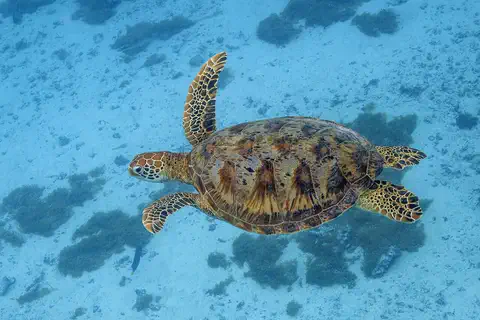
The green sea turtle is the largest sea turtle with a hard shell. It lives in warm seas around the world and, unlike other sea turtles, grown-ups eat mostly seagrass and algae. Females swim hundreds or even thousands of kilometers to lay their eggs on the beaches where they hatched long ago.
-
 Watch
Animal
Loggerhead sea turtle
The loggerhead sea turtle is named for its huge head and powerful jaws, which crush crabs, conchs and other hard-shelled animals. Babies hatch on sandy beaches, ride the open ocean for years and may cross an entire ocean before coming home to nest.
-
Watch
Country
Australia
Australia is a country and the smallest continent, surrounded by ocean in the Southern Hemisphere. Much of its middle is dry and flat, most people live near the coast, and its animals include kangaroos, koalas and the platypus, a mammal that lays eggs.
-
Watch
Country
Mexico
Mexico is a large country in southern North America, between the Pacific Ocean and the Gulf of Mexico. It has smoking volcanoes, ancient cities built by the Maya and other peoples, and about 132 million people, many of them in and around Mexico City.
-
 Watch
Animal
Leatherback sea turtle
The leatherback sea turtle is the largest turtle on Earth. Instead of a hard shell it has tough, rubbery skin over a layer of tiny bones. It eats jellyfish, dives deeper than any other turtle and swims thousands of kilometers between feeding waters and the beaches where it lays its eggs.
-
 Watch
Animal
Ocellaris clownfish
The ocellaris clownfish is a small orange-and-white reef fish from the Indian and Pacific Oceans. It shelters among the stinging tentacles of a sea anemone, protected by a slimy coat, and every clownfish starts life as a male.
-
Watch
Country
Eritrea
Eritrea is a country in the Horn of Africa with a long coast on the Red Sea. Its capital, Asmara, sits high in cool mountains, while the coast below has one of the highest average temperatures in the world. About 3.6 million people live there, and its name comes from the Latin words for the Red Sea.
-
 Watch
3D
Animal
Flatback sea turtle
The flatback sea turtle is named for its flat, smooth shell. It stays in shallow coastal seas around northern Australia, eats soft sea animals such as sea cucumbers and jellyfish, and nests only on Australian beaches, where its big hatchlings dash for the waves at night.
For parents & teachers
What children will learn
- Describe the hawksbill's beak and shell and how they relate to its name and its decline.
- Explain why the hawksbill depends on coral reefs and sponges.
- Describe the sea turtle life cycle from nest to adult.
- Name threats to hawksbills and actions that help them.
Recommended ages: 3 to 17 · About 15 minutes
Talk about it
- Why might an animal that takes 20 to 35 years to grow up be slow to recover when many are lost?
- Why do you think countries need to work together to protect sea turtles?
- How could beach towns change their lights to help hatchlings?
Try at home or in class
- Measure 75 centimeters on the floor with tape to see the length of an adult hawksbill's shell, and 6 centimeters for a hatchling.
- Overlap paper squares like roof tiles to make a model shell, then compare it with squares placed edge to edge.
Key vocabulary: sponge, scute, carapace, hatchling, bycatch, critically endangered
Where these facts come from
- The IUCN Red List of Threatened Species , International Union for Conservation of Nature (IUCN terms of use (no redistribution of Red List data or range maps))
- GBIF Backbone Taxonomy and GBIF Occurrence Search , Global Biodiversity Information Facility (CC0 1.0 (backbone); occurrence counts are facts derived from records under CC0, CC BY and CC BY-NC)
- Eretmochelys imbricata (Hawksbill Turtle), Red List assessment 2008 , IUCN Red List of Threatened Species
- Hawksbill Turtle , NOAA Fisheries
- Hawksbill Sea Turtle (Eretmochelys imbricata) , U.S. Fish and Wildlife Service
- Sea turtles , Smithsonian Ocean, Smithsonian Institution
- Wikidata , Wikimedia Foundation (CC0 1.0)
- Wikimedia Commons , Wikimedia Foundation (Per file: Public domain, CC0, CC BY or CC BY-SA only (credited on each page))
Checked, not yet human-reviewed. Last updated October 28, 2026. Spotted a mistake? Tell us.