
Animal
Chinstrap penguin
The chinstrap penguin has a thin black line under its chin, like the strap of a helmet. It lives on rocky islands near Antarctica and eats krill.
The chinstrap penguin is named for the thin black band that runs under its chin from ear to ear, like a helmet strap. It breeds in huge colonies on the Antarctic Peninsula and nearby islands, raises two chicks each summer and dives for krill close to shore.
Pygoscelis antarcticus is a medium-sized penguin of the Antarctic Peninsula and nearby islands of the South Atlantic, feeding mainly on Antarctic krill. Still very abundant, it is listed as Least Concern with about 8 million mature birds in the IUCN's 2020 assessment, but its population is decreasing.
Photo: Photo: Gordon Leggett, CC BY-SA 4.0, via Wikimedia Commons
Meet the chinstrap penguin
The chinstrap penguin is a black and white penguin.
It has a white face and a black cap. A thin black line goes under its chin, like a strap. Its feet are pink.
The chinstrap penguin gets its name from the narrow band of black feathers that runs from ear to ear just below its chin, like the strap of a helmet. It has a black cap, a white face, reddish-brown eyes and pinkish feet.
It is about the same size as an Adélie penguin: around 71 centimeters tall and 3.5 to 5.5 kilograms. Males and females look alike, but males are a little bigger. It is closely related to the Adélie and gentoo penguins.
Pygoscelis antarcticus shares the genus Pygoscelis with its close relatives, the Adélie and gentoo penguins. The Australian Antarctic Division gives adult weights of 3.5 to 5.5 kilograms; males are larger and heavier, though the sexes look alike. National Geographic gives a typical size of about 28 inches (71 centimeters).
Its namesake field mark is a narrow black band from ear to ear beneath the chin and cheeks, below a black cap and white face. The tail is long and black, the flippers black above and white below, the feet pinkish to orange with black soles, and the irises reddish brown. Other English names include bearded penguin, ringed penguin and stonecracker penguin.
Quick facts
- Group
- Bird
- Height
- 0.71 m
- Weight
- 3.5 to 5.5 kg
Where it lives
Chinstrap penguins live near Antarctica.
They nest on rocky, icy islands in the cold Southern Ocean. In winter they swim far out to sea.
Chinstrap penguins breed mainly on the Antarctic Peninsula and on islands in the South Atlantic such as the South Shetland, South Orkney and South Sandwich Islands. A few breed farther away, on South Georgia, Bouvet Island, Heard Island and the Balleny Islands.
They nest on rocky, ice-free coasts. Almost all their colonies are south of 60 degrees south, where they are protected by the Antarctic Treaty. In winter they leave and live at sea, north of the pack ice.
The IUCN's 2020 global assessment lists breeding populations in Antarctica, Bouvet Island and South Georgia and the South Sandwich Islands, small resident numbers in Chile, the Falkland Islands and the French Southern Territories, and vagrants farther north. It divides the population into spatial units: the Antarctic Peninsula region, the South Orkney Islands, the South Sandwich Islands, South Georgia and small subpopulations on the edges of the range.
Colonies occupy rocky, ice-free coasts; the Australian Antarctic Division adds a small breeding population on the Balleny Islands south of New Zealand and on Heard Island. Almost all colonies lie south of 60 degrees south and are covered by the Antarctic Treaty System. From March to early May the birds leave and winter at sea north of the pack-ice zone.
Continent
Its habitat

Where can you find this animal?
- Lives here naturally · Countries and seas named by a scientific source
- Sightings recorded · Records of wild sightings (GBIF)
Lives here naturally · Countries and seas named by a scientific source
Breeds mainly on the Antarctic Peninsula and the South Shetland, South Orkney and South Sandwich Islands, with smaller colonies on South Georgia, Bouvet, Heard and the Balleny Islands (these islands have no separate map shape). Winters at sea north of the pack ice. Small numbers also occur around the Falkland Islands, Chile and the French Southern Territories.
Places: Antarctica and Southern Ocean.
Source: iucn-red-list · checked October 2026
Sightings recorded · Records of wild sightings (GBIF)
Counts of GBIF records of wild observations (human and machine) and preserved specimens. Records include introduced populations, vagrants, escaped or released animals and misidentifications, so a country with records is not necessarily part of the native range.
Wild sightings have been recorded in Antarctica, Argentina, UK, Australia, Falkland Is., United States, Norway, Canada and 10 more places.
Source: gbif · checked October 2026
Range maps show where scientists say an animal lives, often country by country. An animal may live in only part of a country shown, and sightings records can include animals that wandered far from home.
What it eats
Chinstrap penguins mostly eat krill.
Krill are tiny animals that look like shrimp. The penguins also eat small fish. They catch them close to their island.
Chinstrap penguins feed mainly on Antarctic krill, small shrimp-like animals, and on fish. They are near-shore feeders, hunting close to their breeding colonies.
They catch prey by chasing it underwater, using their flippers to "fly" through the sea. They usually feed less than 40 meters deep. They hunt both day and night, but dive most around midnight and around noon, and they dive deeper in daylight than in the dark.
The diet is dominated by Antarctic krill, with fish also taken. Chinstraps are near-shore foragers that pursuit-dive close to their colonies, using their flippers for underwater propulsion. Most dives are shallower than 40 meters, and although they forage around the clock, diving effort peaks near midnight and noon, with deeper dives by day.
Because they depend so heavily on krill, chinstraps are sensitive to changes in its abundance: the Australian Antarctic Division reports recent evidence suggesting that numbers are declining significantly because of reductions in krill. The IUCN notes that Pygoscelis penguins are major consumers of Antarctic krill and carry marine nutrients onto land in their guano.
Did you know?
Chinstrap parents feed both of their chicks.
Chinstrap penguins usually raise two chicks each summer and feed them evenly.
Unlike penguin species in which the stronger chick is fed preferentially, chinstraps generally rear both chicks.
Climbers and divers
Chinstrap penguins are good climbers.
They hop and jump up steep rocks. On land they also slide on their tummies.
Chinstrap penguins nest on rocky coasts, and they are skilled climbers. They use their feet and flippers to scramble up rocks, and they can jump long distances to reach a foothold.
On land they often toboggan: they lie on their stomachs and push themselves along with their feet and flippers. In the water, their flippers work like wings, letting them speed after krill.
The Australian Antarctic Division describes chinstraps as tobogganing on land, lying on the stomach and propelling themselves with the feet and flippers, and as agile climbers that use all four limbs and can jump large distances to reach footholds.
The flippers, black above and white below, drive pursuit dives. Feet are pinkish to orange with black soles. Chicks are covered in silver to light gray down at hatching, and a second, darker gray down appears at two to three weeks.
Two chicks each summer
Chinstrap penguins make a round nest of stones.
The mother lays two eggs. Mom and Dad take turns keeping them warm. Then they feed both fluffy gray chicks.
Chinstraps return to their colonies in October and November, usually to the same partner, and build a round nest of stones. In late November the female lays two eggs. Both parents take turns keeping them warm for 33 to 36 days.
Unlike some penguins, chinstrap parents usually raise both chicks rather than feeding the stronger one first. After a few weeks the fluffy gray chicks join a group of chicks called a creche. At about 7 to 8 weeks old they grow adult feathers and head out to sea.
Birds return between October and November, often to the same partner, and first breed at about three years of age. Two eggs, each weighing about 94 to 122 grams, are laid in late November in a circular nest of stones. Both sexes incubate for 33 to 36 days, in shifts of 5 to 10 days at first that shorten toward hatching.
Chinstraps generally rear two chicks each summer, feeding them evenly rather than favoring the stronger one, as some other penguins do. Chicks gather in creches after a few weeks and fledge at about 7 to 8 weeks. Breeding success is lower in years when extensive sea ice persists near the colonies, because it makes it harder for adults to reach the sea to feed.

Huge colonies
Chinstrap penguins live together in giant groups.
One island has more than a million pairs! Skuas and seals are dangers for them.
Chinstrap penguins nest in enormous colonies. National Geographic reports that the largest, on Zavodovski Island in the South Sandwich Islands, has about 1.2 million breeding pairs, and Baily Head in the South Shetland Islands has more than 100,000 pairs.
At sea, the main predator is the leopard seal. On land, skuas, sheathbills and giant petrels take eggs and chicks. Volcanoes can be a danger too: in 2016 an eruption on Zavodovski Island covered much of the colony in ash.
Colonies can be immense: National Geographic cites about 1.2 million breeding pairs on Zavodovski Island in the South Sandwich Islands and more than 100,000 pairs at Baily Head in the South Shetlands. The IUCN notes that colonial penguins are more vulnerable to predators in very small colonies, so large colonies offer some self-protection.
Leopard seals are the main predator at sea, while sheathbills, skuas and southern giant petrels take eggs and chicks on land. Zavodovski Island is volcanic, and a 2016 eruption covered much of the colony in ash while the birds were molting, when they cannot go to sea because their feathers are not waterproof.
Did you know?
A chinstrap penguin has pink feet.
Chinstrap penguins' feet are pink to orange with black soles.
The feet range from pinkish to orange, with black soles, and the irises are reddish brown.
Fewer chinstraps
There are still millions of chinstrap penguins.
But there are fewer than before. They need lots of krill to eat. Rules stop visitors from getting too close to their nests.
The chinstrap penguin is listed as Least Concern, and there are still about 8 million adults. But the IUCN says the population is going down, and scientists think that less krill to eat is a big reason.
Almost all chinstrap colonies are protected under the Antarctic Treaty. Tourists who visit Antarctica must keep a safe distance from breeding birds, and countries work together to manage krill fishing in the Southern Ocean.
The IUCN's 2020 global assessment lists Pygoscelis antarcticus as Least Concern, with about 8,000,000 mature individuals and a decreasing trend; its Green Status assessment rates the species as Moderately Depleted. Listed threats are fishing and harvesting of marine resources, volcanic activity and climate-driven habitat shifting.
National Geographic notes that numbers rose in the mid-twentieth century, which some attribute to a rebound in krill after centuries of seal and whale hunting, and that some populations are now declining, though not precipitously. Almost all colonies lie within the Antarctic Treaty area, and restrictions keep tourists from approaching breeding birds too closely.
IUCN Red List
How is the chinstrap penguin doing in the wild?
- Least Concern (this animal)
- Near Threatened
- Vulnerable
- Endangered
- Critically Endangered
- Extinct in the Wild
- Extinct
Least Concern
Not at risk of disappearing from the wild right now.
See the IUCN Red List assessment · The IUCN Red List of Threatened Species 2021.3
Amazing facts
-
Chinstrap penguins are great at climbing rocks.
Chinstrap penguins climb steep rocks using all four limbs and can jump long distances to reach a foothold.
Chinstraps climb with all four limbs and can leap considerable distances between footholds on steep, rocky slopes.
-
One chinstrap colony has more than a million pairs.
The biggest chinstrap colony, on Zavodovski Island in the South Sandwich Islands, has about 1.2 million breeding pairs.
Zavodovski Island in the South Sandwich Islands holds some 1.2 million breeding pairs, which National Geographic calls the largest colony.
-
Chinstrap parents feed both of their chicks.
Chinstrap penguins usually raise two chicks each summer and feed them evenly.
Unlike penguin species in which the stronger chick is fed preferentially, chinstraps generally rear both chicks.
-
A chinstrap penguin has pink feet.
Chinstrap penguins' feet are pink to orange with black soles.
The feet range from pinkish to orange, with black soles, and the irises are reddish brown.
Words to know
- colony
- a large group of animals of the same kind living close together
- krill
- small, shrimp-like animals that live in the ocean
- creche
- a group of young penguins that stay together while their parents feed
- pack ice
- large pieces of sea ice floating close together
- molt
- to lose old feathers and grow new ones
- toboggan
- to slide over snow on your belly or on a sled
Discovery challenge
-
Why is it called a chinstrap penguin?
Where does the chinstrap penguin get its name?
Which field mark gives the chinstrap penguin its name?
- A black band under its chin
- A white ring around its eye
- Orange feathers on its head
Show the answer
A black band under its chin
It has a thin black line under its chin, like a strap.
A narrow band of black feathers runs from ear to ear under its chin, like a helmet strap.
The narrow black band from ear to ear beneath the chin and cheeks; a white eye ring marks the Adélie instead.
-
What do chinstrap penguins mostly eat?
What is the main food of chinstrap penguins?
Which prey dominates the chinstrap penguin's diet?
- Krill
- Seaweed
- Seeds
Show the answer
Krill
They mostly eat krill, tiny shrimp-like animals.
Mainly Antarctic krill, plus fish, caught close to their colonies.
Antarctic krill, supplemented by fish, taken by near-shore pursuit diving mostly above 40 meters.
-
How many eggs does a chinstrap penguin lay?
How many eggs does a chinstrap penguin usually lay?
What is the chinstrap penguin's usual clutch?
- One
- Two
- Ten
Show the answer
Two
Two eggs, and both chicks are fed.
Two eggs in late November, and the parents usually raise both chicks.
Two eggs, incubated by both parents for 33 to 36 days; both chicks are usually reared.
-
Are there more or fewer chinstrap penguins than before?
What is happening to chinstrap penguin numbers?
What population trend did the IUCN's 2020 assessment give for the chinstrap penguin?
- Going down
- Going up very fast
- They are all gone
Show the answer
Going down
There are fewer than before, but still millions.
Their numbers are going down, probably because there is less krill, but there are still about 8 million adults.
Decreasing, from about 8 million mature individuals; the Green Status rates it Moderately Depleted.
Explore next
-
 Watch
Animal
Adélie penguin
The Adélie penguin is a medium-sized penguin, about 70 centimeters tall, with a black back, a white front and a bright white ring around each eye. It breeds in summer on rocky, ice-free ground all around Antarctica, building nests of pebbles, and spends the winter far out at sea among the pack ice.
-
 Watch
Animal
Gentoo penguin
The gentoo penguin is the penguin with the red-orange bill, orange feet and a white band across the top of its head. It lives on the Antarctic Peninsula and on islands around Antarctica, builds nests of stones, and usually lays two eggs. National Geographic says no other diving bird swims faster.
-
 Watch
Animal
Emperor penguin
The emperor penguin is the largest penguin in the world. It lives around Antarctica, and it is the only animal that breeds during the dark, freezing Antarctic winter. Fathers keep the egg warm on their feet for about two months, huddled together against the storms.
-
 Watch
3D
Animal
Antarctic krill
Antarctic krill are small, shrimp-like crustaceans about 6 centimeters long that live in the icy Southern Ocean around Antarctica. They gather in enormous swarms, and almost all the bigger animals of the Antarctic, from penguins to blue whales, depend on them for food.
-
 Watch
Animal
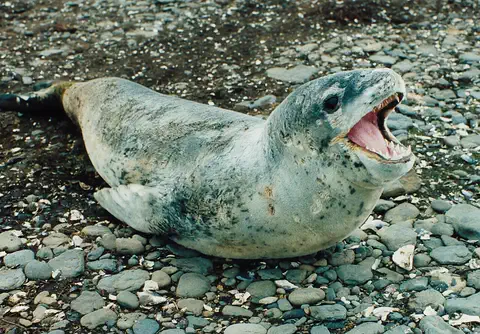
Leopard seal
The leopard seal is a large, slender seal of the icy seas around Antarctica, named for the dark spots on its gray coat. It is a fast, powerful hunter with a big head and long teeth, and it eats everything from tiny krill to fish, penguins and young seals.
-
 Watch
Animal
African fish eagle
The African fish eagle is a big eagle of Africa's lakes, rivers and coasts, with a white head, chest and tail and a chestnut-brown body. It snatches fish from the surface of the water, and its loud, ringing call is one of the best-known sounds of Africa.
-
 Watch
Animal
African penguin
The African penguin is a penguin of warm, sunny coasts. It lives only in South Africa and Namibia, nests in burrows and under bushes, and hunts sardines and anchovies in the cold sea. Its numbers have fallen so far that it is now Critically Endangered, and people are working hard to protect it.
-
 Watch
Animal
American crow
The American crow is an all-black bird found across much of North America, from fields and beaches to city centers. It eats almost anything, lives in close family groups, gathers in huge winter roosts, and a University of Washington study found that wild crows can recognize and remember a human face.
For parents & teachers
What children will learn
- Identify the chinstrap penguin by its chin band and compare it with the Adélie penguin.
- Locate the Antarctic Peninsula and the islands where chinstraps breed.
- Describe the chinstrap breeding cycle, including raising two chicks.
- Explain how krill links penguins, the Southern Ocean and fishing.
Recommended ages: 3 to 17 · About 15 minutes
Talk about it
- Why might a penguin that eats mostly krill be affected if krill becomes scarce?
- How might living in a huge colony help a penguin?
- Why do you think tourists are asked to stay back from penguin nests?
Try at home or in class
- Draw a chinstrap, an Adélie and an emperor penguin side by side and label the features that tell them apart.
- Find the Antarctic Peninsula and the South Sandwich Islands on a globe or map.
Key vocabulary: colony, krill, creche, pack ice, molt, toboggan
Where these facts come from
- The IUCN Red List of Threatened Species , International Union for Conservation of Nature (IUCN terms of use (no redistribution of Red List data or range maps))
- GBIF Backbone Taxonomy and GBIF Occurrence Search , Global Biodiversity Information Facility (CC0 1.0 (backbone); occurrence counts are facts derived from records under CC0, CC BY and CC BY-NC)
- Wikidata , Wikimedia Foundation (CC0 1.0)
- Pygoscelis antarcticus (Chinstrap Penguin), Red List global assessment 2020 , IUCN Red List of Threatened Species
- Chinstrap penguin , Australian Antarctic Division
- Chinstrap penguin , National Geographic
- Antarctic wildlife , British Antarctic Survey
- Wikimedia Commons , Wikimedia Foundation (Per file: Public domain, CC0, CC BY or CC BY-SA only (credited on each page))
Checked, not yet human-reviewed. Last updated October 24, 2026. Spotted a mistake? Tell us.