
Animal
Cattle
Cattle are big farm animals. A grown-up girl is called a cow, and a baby is called a calf. Cows eat grass and give milk.
Cattle are large farm animals that people tamed from wild oxen long ago. They eat grass and digest it with a stomach that has four parts. Farmers around the world keep cattle for milk, meat and leather, and in some places oxen still pull plows and carts.
Domestic cattle (Bos taurus, with the humped zebu cattle of South Asian origin) descend from the aurochs, a wild ox that people first domesticated about 10,500 years ago in the Near East. As ruminants with a four-chambered stomach they turn grass into milk, meat and power, which has made them one of the most important animals in human history.
Photo: Keith Weller/USDA, public domain, via Wikimedia Commons
Meet cattle
Cattle are big, strong farm animals.
A girl is called a cow. A boy is called a bull. A baby is called a calf. Many cattle have horns, and all of them have a long tail with a tuft on the end.
Cattle are large, sturdy mammals with short necks, two hollow horns on many breeds, and a long tail with a tuft at the end. Their short hair can be black, white, brown, reddish or patched.
Farmers have special names for them. A young female is a heifer, and once she has a calf she is a cow. An adult male is a bull. Depending on the breed, a cow weighs about 360 to 1,100 kilograms, and a big bull can weigh as much as a small car or more.
Cattle are domesticated bovids raised for meat, milk, hides and draft work. Modern cattle are usually grouped as taurine cattle (Bos taurus, European breeds such as Jersey and Shorthorn), zebu (Bos indicus, humped breeds such as Brahman) and crosses between them, such as Santa Gertrudis.
Size depends strongly on breed: Britannica gives 360 to 1,100 kilograms for mature cows and 450 to 1,800 kilograms for bulls. A male castrated for work or beef is a steer, and a working steer of about two or three years is an ox. Cattle have no upper incisors; a tough dental pad takes their place.
Quick facts
- Group
- Mammal
- Height
- 1.24 to 1.32 m
- Weight
- 360 to 1,800 kg
Where cattle live
Cattle live on farms all over the world.
They live in fields and on big grassy ranches. They live in hot places and cold places. Farmers give them water and shelter.
Cattle are domesticated, which means they live with people rather than in the wild. Farmers keep them on every continent except Antarctica, in fields, barns, dairies and huge grassy ranches called rangelands.
Their wild ancestor, the aurochs, once lived across Europe, northern Africa and southern Asia. It is now extinct: the last known aurochs died in Poland in 1627. Some cattle that escaped from farms live on their own, but they are still domestic animals, not a wild species.
Cattle are farmed on every inhabited continent, from tropical pastures to cold uplands. Many are raised on rangeland, unimproved land used for grazing, while dairy and beef systems also keep cattle in barns and feedlots.
The wild ancestor, Bos primigenius, ranged across Europe, North Africa and southern Asia. Britannica records that the aurochs survived in central Poland until 1627. It was black, about 1.8 meters tall at the shoulder, with forward-curving horns. Because cattle are domestic, the map shows the continents where they are farmed, not a wild range.
Continents
Its habitat

Where can you find this animal?
- Kept by people · Countries and seas named by a scientific source
- Sightings recorded · Records of wild sightings (GBIF)
Kept by people · Countries and seas named by a scientific source
Cattle are domesticated: farmers keep them on every continent except Antarctica. This is not a wild range. Their wild ancestor, the aurochs, lived in Europe, North Africa and southern Asia and died out in 1627.
Places: Africa, Asia, Europe, North America, South America and Australia and Oceania.
Source: https://animaldiversity.org/accounts/Bos_taurus/ · checked October 2026
Sightings recorded · Records of wild sightings (GBIF)
Counts of GBIF records of wild observations (human and machine) and preserved specimens. Records include introduced populations, vagrants, escaped or released animals and misidentifications, so a country with records is not necessarily part of the native range.
Wild sightings have been recorded in Chile, Colombia, Australia, Netherlands, Portugal, France, Kenya, Germany and 132 more places.
Source: gbif · checked October 2026
Range maps show where scientists say an animal lives, often country by country. An animal may live in only part of a country shown, and sightings records can include animals that wandered far from home.
What cattle eat
Cattle eat grass.
They wrap their long tongue around the grass and pull. Later they bring the food back up and chew it again. This is called chewing the cud.
Cattle are herbivores that graze on grass and other soft plants. A cow wraps its long tongue around a bunch of grass and cuts it with its bottom front teeth against a hard pad at the top of its mouth.
Cattle are ruminants. Their stomach has four chambers. Bacteria in the first chamber start breaking down the tough grass, then the cow brings it back up as cud, chews it again and swallows it. All this takes days, but it lets a cow get food from grass that people cannot digest.
Cattle graze grasses, stems and other herbaceous plants, twisting them around the tongue and cutting them with the lower incisors against the dental pad. The jaws grind in a circular motion that crushes coarse plant material.
As ruminants they have a four-chambered stomach: rumen, reticulum, omasum and abomasum. Microbes in the rumen ferment the plant matter; partly digested food (cud) is regurgitated, rechewed and swallowed again before enzymes in the later chambers finish digestion. Animal Diversity Web gives a total passage time of 70 to 100 hours, one of the slowest among animals, which squeezes the most nutrients from low-quality forage.
Did you know?
A cow chews its food two times.
Cattle bring partly digested food back up and chew it again. This is called chewing the cud.
Rumination, regurgitating and rechewing cud, breaks plant fibers into smaller pieces that rumen microbes can ferment more easily.
A body for grazing
Cows have big, soft noses that sniff the grass.
They have big eyes and ears that turn to listen. Mother cows make milk for their calves.
Cattle use all their senses to understand the world: smell, touch, sight and hearing. They also use these senses to talk to each other, with moos, touches, body postures and smells.
A cow's udder makes milk to feed her calf. People breed some kinds of cattle, such as Jersey and Holstein-Friesian, to make a lot of milk, and others, such as Charolais, mainly for beef. Zebu cattle, such as the Brahman, have a hump over the shoulders and droopy ears.
Cattle perceive and communicate through chemical signals, touch, visual cues and sound. Under the chin many breeds have a dewlap, a fold of loose skin, and where horns are present they are hollow.
Centuries of selective breeding have produced breeds specialized for different jobs. Dairy breeds such as Jersey and Holstein-Friesian were selected for milk yield, beef breeds such as Charolais and Hereford for meat, and zebu breeds such as Brahman are recognized by their shoulder hump and drooping ears. Many modern breeds are recent: Britannica notes that breeds as they are known today did not always exist.
Growing up
A baby cow is called a calf.
It grows inside its mother for about nine months, just like a human baby. Soon after it is born, it can stand up and walk. It drinks its mother's milk.
A cow carries her calf for about nine months, about as long as a human pregnancy. Usually just one calf is born, though twins sometimes happen.
A newborn calf learns to recognize its mother and can stand and walk soon after birth. It drinks milk for about six months and becomes independent by about a year old. Young females can be old enough to breed at about one year, though farmers often wait longer.
Gestation is about nine months (Animal Diversity Web cites an average of 277 days), and a single calf is usual, twins occasional. Calves are precocial: they stand, walk and learn to recognize their mother soon after birth.
Calves nurse for about six months and become independent over the following six. Females can reach sexual maturity at about one year, and cattle tend to breed once a year. The maximum lifespan can exceed 20 years, but in farming most cattle are culled much younger, so few reach old age.

Life in the herd
Cattle like to be together in a group called a herd.
Mother cows look after their calves. They moo to call each other. They often lie down to chew their cud.
Cattle are social animals that live in groups called herds. A herd has a pecking order: each animal knows which others it should give way to, and calves take on their mother's place in the order.
Mother cows are very protective of their calves and will chase off anything that seems to threaten them. Cows also help look after each other's young. Cattle are active by day, and they spend long hours grazing and then lying down to chew their cud.
Herds are organized by a dominance hierarchy in which each animal yields to those ranked above it, and calves adopt their mother's rank. Females defend their calves and share some care of young within the group.
Animal Diversity Web notes that herding and large size would have protected the wild ancestors against predators such as wolves and lions, which mostly took calves and sick or old animals. Domestic cattle are mainly diurnal, alternating bouts of grazing with long periods of rumination.
Did you know?
All cows came from a wild ox long ago.
A study of ancient DNA suggests that all today's taurine cattle descend from about 80 wild aurochs tamed in the Near East.
Ancient DNA from Iranian sites suggests a founding population of roughly 80 aurochs about 10,500 years ago.
Cattle and people
People get milk, cheese and butter from cows.
In some places, cattle help farmers pull plows. Farmers take care of their cattle. Kind farming keeps cows and the land healthy.
Cattle are not endangered, because people keep huge numbers of them. They give us milk, cheese, butter, yogurt and meat, and leather comes from their hides. Strong oxen pull plows and carts, and dung is used as fertilizer and even as fuel.
Keeping so many cattle also brings challenges. Too many cattle in one place can overgraze the land, cause soil erosion and damage riverbanks. People also discuss how animals are treated on large farms and how raising cattle affects the climate.
Cattle are not assessed by the IUCN because they are a domesticated animal, but their wild ancestor is extinct. Few animals matter more to people: cattle provide milk and dairy foods, meat, leather and other products, draft power, and dung for fertilizer and fuel, and in many societies they also carry cultural importance and serve as a store of wealth.
Where numbers are pushed high, grazing can cause erosion, overgrazing, damage to riparian habitats and the spread of non-native plants, and range cattle can pass diseases to wildlife. Britannica notes current debates about the ethics of intensive farming and the contribution of commercial meat production to global warming.
Did you know?
The wild aurochs was taller than most cows.
The extinct aurochs was black and stood about 1.8 meters tall at the shoulder.
The aurochs survived in central Poland until 1627; it stood about 1.8 meters at the shoulder, with spreading, forward-curving horns.
Amazing facts
-
Cows have no top front teeth.
Cattle have no upper front teeth. They press grass against a tough pad at the top of the mouth and cut it with their bottom teeth.
In place of upper incisors, cattle have a dental pad; the lower incisors cut forage against it.
-
A cow chews its food two times.
Cattle bring partly digested food back up and chew it again. This is called chewing the cud.
Rumination, regurgitating and rechewing cud, breaks plant fibers into smaller pieces that rumen microbes can ferment more easily.
-
All cows came from a wild ox long ago.
A study of ancient DNA suggests that all today's taurine cattle descend from about 80 wild aurochs tamed in the Near East.
Ancient DNA from Iranian sites suggests a founding population of roughly 80 aurochs about 10,500 years ago.
-
The wild aurochs was taller than most cows.
The extinct aurochs was black and stood about 1.8 meters tall at the shoulder.
The aurochs survived in central Poland until 1627; it stood about 1.8 meters at the shoulder, with spreading, forward-curving horns.
Words to know
- domesticated
- tamed and bred by people over many generations to live with them
- ruminant
- an animal that brings up its food and chews it again, with a stomach of several chambers
- cud
- food that a cow brings back up from its stomach to chew again
- heifer
- a young female cow that has not yet had a calf
- aurochs
- the extinct wild ox that cattle came from
- herd
- a group of animals that live and move together
Discovery challenge
-
What is a baby cow called?
What is a baby cow called?
Which word is the farm name for a young bovine of either sex?
- Calf
- Kitten
- Chick
Show the answer
Calf
A baby cow is called a calf.
A baby is a calf. A young female is a heifer, and once she has a calf she is a cow.
Calf is used for both sexes; males become bulls (or steers and oxen if castrated) and females become heifers, then cows.
-
How many parts does a cow's tummy have?
How many chambers does a cow's stomach have?
How many chambers make up the ruminant stomach of cattle?
- One
- Four
- Ten
Show the answer
Four
A cow's tummy has four parts.
Four chambers: rumen, reticulum, omasum and abomasum.
Four: the rumen, where microbes ferment plant matter, then the reticulum, omasum and abomasum.
-
What did cows come from?
Which wild animal are cattle descended from?
From which extinct species were cattle domesticated?
- A wild ox called the aurochs
- A wild horse
- A deer
Show the answer
A wild ox called the aurochs
Cows came from a big wild ox called the aurochs.
Cattle descend from the aurochs, a wild ox that is now extinct.
Cattle descend from Bos primigenius, the aurochs; ancient DNA points to domestication about 10,500 years ago in the Near East.
-
When can a newborn calf walk?
What can a calf do soon after it is born?
Which describes a newborn calf's abilities?
- Only after a year
- Soon after birth
- Never
Show the answer
Soon after birth
A calf can stand and walk soon after it is born.
It can stand, walk and recognize its mother soon after birth.
Calves are precocial, standing and walking soon after birth.
Experiments to try
Explore next
-
 Watch
3D
Animal
Domestic sheep
Domestic sheep are farm animals that people tamed in western Asia thousands of years ago. They graze on grass, digest it with a four-part stomach and stick together in flocks. People keep sheep for wool, meat, milk and leather.
-
 Watch
3D
Animal
Domestic goat
Domestic goats are lively farm animals that came from a wild goat of Asia. They reach up to nibble leaves, twigs and weeds that other farm animals leave behind, and people keep them for milk, cheese, meat, wool and leather.
-
 Watch
3D
Animal
American bison
The American bison is the largest land animal in North America. Once tens of millions roamed the Great Plains, but by the 1890s fewer than a thousand were left. Careful protection, starting with a tiny herd in Yellowstone, brought bison back.
-
 Watch
Animal
African buffalo
The African buffalo is a huge, cow-like grazer with heavy, curving horns. It lives in herds that can number in the thousands, and a herd will rush to protect a calf in danger. It lives across much of Africa south of the Sahara, from open savannas to rainforests.
-
 Watch
3D
Animal
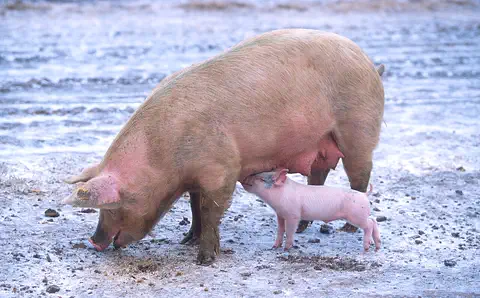
Domestic pig
Domestic pigs live with people on every continent except Antarctica. Their ancestor is the wild boar, which people began taming about 9,000 years ago. Pigs are among the smartest farm animals, with a super-sensitive snout for digging up food.
- Watch What If? Lab What if cows could not digest grass? A cow's own body can't break down the tough stuff in grass. Tiny microbes living in its huge stomach do it instead, and the cow chews its food twice to help them. Imagine those helpers gone and follow what might change.
-
 Watch
3D
Animal
Chicken
The chicken is a domesticated bird: people raise it on farms and in backyards all over the world for eggs and meat. Its wild ancestor is the red junglefowl of the forests of southern and Southeast Asia, and scientists think chickens were first domesticated about 3,500 years ago near rice fields in Southeast Asia.
-
 Watch
3D
Animal
Bull-headed dung beetle
The bull-headed dung beetle is a shiny black beetle about 1 centimeter long. Large males have two long, curved horns on their heads, like a bull. These beetles dig tunnels under cow dung and pack dung into balls for their young, which cleans up pastures and helps the soil. They came from Europe and now also live in North America and Australia.
For parents & teachers
What children will learn
- Explain what domesticated means and where cattle came from.
- Describe how a ruminant's four-chambered stomach digests grass.
- Describe the cattle life cycle and herd behavior.
- Discuss the benefits and environmental challenges of keeping cattle.
Recommended ages: 3 to 17 · About 15 minutes
Talk about it
- Which foods or things in your home might come from cattle?
- Why might people have wanted to tame wild oxen long ago?
- How could farmers keep cattle while protecting rivers and soil?
Try at home or in class
- Read the labels on milk, cheese, butter and yogurt at home and sort the foods that come from cows.
- Draw a cow's four stomach chambers as four connected bags and trace the path of a mouthful of grass, including the trip back up as cud.
Key vocabulary: domesticated, ruminant, cud, heifer, aurochs, herd
Where these facts come from
- GBIF Backbone Taxonomy and GBIF Occurrence Search , Global Biodiversity Information Facility (CC0 1.0 (backbone); occurrence counts are facts derived from records under CC0, CC BY and CC BY-NC)
- Wikidata , Wikimedia Foundation (CC0 1.0)
- Cattle , Encyclopaedia Britannica
- Aurochs , Encyclopaedia Britannica
- Bos taurus (cattle) , Animal Diversity Web, University of Michigan Museum of Zoology
- All domestic cattle descend from a small herd of aurochs in the Near East , Johannes Gutenberg University Mainz
- Wikimedia Commons , Wikimedia Foundation (Per file: Public domain, CC0, CC BY or CC BY-SA only (credited on each page))
Checked, not yet human-reviewed. Last updated October 28, 2026. Spotted a mistake? Tell us.