
Animal
Common murre
The common murre is a black and white seabird. It flies fast over the sea and dives under the water to catch fish.
The common murre is a seabird of cold northern oceans that looks a little like a flying penguin. It dives deep to chase fish, nests in huge crowds on cliff ledges, and its chicks flutter down from the cliff to the sea before they can even fly.
Uria aalge is a large auk of the low-Arctic and boreal North Atlantic and North Pacific. A pursuit diver that reaches depths of 170 to 230 meters, it breeds in dense cliff colonies and lays a single egg on bare rock. Globally Least Concern, it lost about half its Alaska population after the 2014-2016 Pacific marine heat wave.
Photo: Charles J. Sharp, CC BY-SA 4.0, via Wikimedia Commons
Meet the common murre
The common murre is a seabird.
It is dark brown on top and white underneath, like a little suit. It has a long, pointed beak. When it stands on a cliff, it sits up straight like a penguin.
The common murre is a large seabird of the auk family, about the size of a crow. It is dark brown to charcoal on top and white underneath, with a long, pointed beak. Standing upright on a cliff ledge, it looks a bit like a penguin, but unlike penguins, murres can fly.
In Britain and Ireland it is called the guillemot. Murres spend most of their lives at sea and come to land only to nest.
Uria aalge is a member of the auk family, Alcidae. Audubon gives a length of 40 to 45 centimeters, a wingspan of 74 to 84 centimeters and a weight of 800 to 1,000 grams. The plumage is sharply two-toned in summer, charcoal above and white below, with more white on the face in winter; males and females look alike.
In the UK it is known as the guillemot, and the RSPB notes a 'bridled' form with a white ring around the eye and a white line behind it. It comes ashore only to breed, spending the rest of its life at sea.
Quick facts
- Group
- Bird
- Length
- 0.4 to 0.45 m
- Wingspan
- 0.74 to 0.84 m
- Weight
- 0.8 to 1 kg
Where it lives
Common murres live by cold seas in the north of the world.
They nest on steep cliffs by the sea. The rest of the year they live out on the ocean.
Common murres live in the cool and cold waters of the North Atlantic and North Pacific oceans. They nest on cliffs and rocky islands in places such as Alaska, California, Canada, Greenland, Iceland, Norway, Britain, Ireland, Russia and Japan.
Away from their colonies they live at sea, usually over the continental shelf, and they avoid thick pack ice. Murres in the far north must leave in winter when the water freezes, and some travel south along the coasts.
The IUCN describes a circumpolar distribution in the low-Arctic and boreal waters of the North Atlantic and North Pacific. Breeding colonies stretch from Alaska and California to Japan and Korea in the Pacific, and from eastern Canada and Greenland to Iceland, Norway, Britain, Ireland, France, Spain and Portugal in the Atlantic.
Audubon notes that murres favor cool water over the continental shelf, avoid pack ice and nest on cliff ledges or flat rock on sea stacks. Many birds are resident year-round, but those from northern colonies in western Alaska must leave when the sea freezes, and some move south along both North American coasts, reaching New England and southern California in winter.
Continents
Its habitat

Where can you find this animal?
- Lives here naturally · Countries and seas named by a scientific source
- Sightings recorded · Records of wild sightings (GBIF)
- Visits for part of the year · Countries and seas named by a scientific source
Lives here naturally · Countries and seas named by a scientific source
Cold and cool coastal and shelf seas of the North Atlantic and North Pacific, with breeding colonies on sea cliffs and islands; the coasts of these countries, not their inland areas.
Places: Atlantic Ocean, Pacific Ocean, Arctic Ocean, Canada, Germany, Greenland, Iceland, Ireland and 14 more places.
Source: iucn-red-list · checked October 2026
Sightings recorded · Records of wild sightings (GBIF)
Counts of GBIF records of wild observations (human and machine) and preserved specimens. Records include introduced populations, vagrants, escaped or released animals and misidentifications, so a country with records is not necessarily part of the native range.
Wild sightings have been recorded in UK, United States, Sweden, Netherlands, Norway, Canada, Denmark, Ireland and 34 more places.
Source: gbif · checked October 2026
Visits for part of the year · Countries and seas named by a scientific source
Coastal waters where the IUCN lists common murres only outside the breeding season.
Places: Belgium, Estonia, Latvia, Lithuania, Netherlands and Poland.
Source: iucn-red-list · checked October 2026
Range maps show where scientists say an animal lives, often country by country. An animal may live in only part of a country shown, and sightings records can include animals that wandered far from home.
What it eats
Murres eat fish.
A murre dives under the water and swims fast to catch little fish. Then it brings a fish back to its chick.
Common murres eat mostly fish such as herring, cod, capelin, sand lance and haddock. They also eat crustaceans, marine worms and squid.
To catch them, murres dive underwater and swim after the fish. Their deepest dives reach about 170 to 230 meters. They hunt mostly in daylight. In the nesting season, parents fly back and forth between the cliff and the sea, often feeding close to the colony but sometimes traveling tens of kilometers.
The common murre is a pursuit-diving seabird that forages mainly in daylight (IUCN). Schooling fish are the key prey in the breeding season, though bottom-living fish can matter too: in the UK sand eels and herring-family fish dominate, while in Labrador, Canada, shannies made up 84 percent of the diet in 1996 and capelin 44.7 percent in 1997.
Maximum dive depths are about 170 to 230 meters. Foraging distances vary by colony and year, often within tens of kilometers, and birds feed where fish concentrate, such as over ridges and at fronts between bodies of water of different temperature.
Did you know?
In Britain, the murre is called the guillemot.
Murres are called guillemots in Britain and Ireland, and some have a white 'spectacle' ring around the eye.
The British name is guillemot; the 'bridled' form carries a white eye-ring and post-ocular line (RSPB).
An amazing body
A murre is dark on top and white underneath.
It has a long, pointed beak for catching fish. It flaps its wings hard when it flies.
A murre is a strong diver with a long, pointed beak for grabbing fish. When it flies, it flaps hard, often low over the water; Audubon describes its flight as labored.
In summer the murre is dark brown above and white below, with a sharp line between them. In winter its face turns more white. Some murres have a white ring around the eye with a white line behind it.
Audubon describes the murre's flight as labored, but underwater it is a pursuit diver, reaching 170 to 230 meters (IUCN).
Plumage is sharply two-toned in breeding season (charcoal to dark brown above, white below) and shows more white on the face in winter. The RSPB describes a 'bridled' form with a white eye-ring and stripe behind the eye, and notes the guillemot is browner and less black than the similar razorbill.
Growing up on a cliff
A murre lays just one egg, right on the bare rock.
Both parents keep the egg warm. When the chick is a few weeks old, it flutters down into the sea, and its parents keep feeding it there.
Common murres do not build nests. The female lays one egg on the bare rock of a cliff ledge, packed so close to her neighbors that they can touch. Eggs can be white, tan, blue or green, with dark markings.
Both parents take turns keeping the egg warm for about 28 to 37 days. When the chick is only 15 to 25 days old, before it can fly, it flutters down from the cliff to the sea. Its parents keep feeding it at sea for several weeks, and it can fly at about 50 to 70 days old.
Murres nest in dense colonies on cliff ledges and the flat tops of sea stacks, laying a single egg on bare rock (Audubon). Incubation is shared and lasts 28 to 37 days; while one parent forages, the other stays at the colony with the egg or chick (IUCN).
At just 15 to 25 days old, still unable to fly, the chick leaves the ledge and flutters down to the water. Parental care continues at sea for several weeks, and flight probably comes at about 50 to 70 days. Murres first breed at 4 to 5 years old.
Seabird cities
Murres nest together in huge, noisy crowds on cliffs.
Lots and lots of murres can share one cliff! They also swim together in big groups on the sea.
Murres are very social. They nest in colonies, crowded together on cliff ledges, and the RSPB calls these busy places seabird cities. Some cliffs are packed with murres.
When murres leave the cliff to go fishing, they often splash down on the water and gather in big floating groups, called rafts, near the colony before flying off to feed.
Breeding is highly colonial: incubating birds sit so close that neighbors can touch (Audubon), and the RSPB describes guillemots as among the most common birds of Britain's seabird cities. Departing birds usually splash down to form large rafts close to the colony before heading to foraging areas (IUCN).
One parent always remains with the chick while the other forages. Most foraging happens in daylight. Studies at colonies such as the Isle of May in Scotland and the Pribilof Islands in Alaska have tracked how far murres travel to feed.
Did you know?
Murres can dive very deep to catch fish.
Common murres can dive down to about 170 to 230 meters to catch fish.
The IUCN gives maximum dive depths of 170 to 230 meters for the common murre, a pursuit diver that forages mainly by day.
Murres and a changing ocean
There are millions of common murres.
But they need lots of fish and clean seas. People help murres by keeping the ocean clean and leaving enough fish for them.
Common murres are listed as Least Concern, and there are millions of them. But they face many problems. Oil spills are very dangerous because murres spend so much time on the water. Overfishing can leave them short of food, and some are caught in fishing nets.
Murres are also sensitive to warmer seas, which change the food they depend on. Scientists watch murre colonies closely to learn how the ocean is changing.
The IUCN's 2018 assessment lists the species as Least Concern, using an older (1996) estimate of about 18 million individuals, with North American numbers increasing but sharp declines in Iceland. Threats include competition with fisheries (the collapse of Barents Sea capelin cut Bear Island's breeding population by 85 percent), gillnet bycatch, oil pollution, unregulated hunting in parts of the North Atlantic, and sensitivity to sea temperature.
The most dramatic event came after the 2014-2016 northeast Pacific marine heat wave known as 'the blob'. A 2024 study led by the U.S. Fish and Wildlife Service estimated that about 4 million Alaska murres, about half the state's population, died, mainly because changes in the food web left them without enough food. Colonies had not recovered by 2022.
IUCN Red List
How is the common murre doing in the wild?
- Least Concern (this animal)
- Near Threatened
- Vulnerable
- Endangered
- Critically Endangered
- Extinct in the Wild
- Extinct
Least Concern
Not at risk of disappearing from the wild right now.
See the IUCN Red List assessment · The IUCN Red List of Threatened Species 2021.3
Amazing facts
-
Murre chicks flutter down to the sea before they can fly.
At just 15 to 25 days old, a murre chick flutters down from its cliff to the sea, weeks before it can really fly.
Chicks leave the colony at 15 to 25 days, still flightless, and complete their growth at sea under parental care, flying at about 50 to 70 days.
-
Murres don't build nests. They lay their egg on bare rock.
Murres build no nest at all: the egg sits on bare rock, with neighbors so close they can touch.
No nest is built; the single egg is laid on bare rock in colonies packed so densely that incubating neighbors touch (Audubon).
-
Murres can dive very deep to catch fish.
Common murres can dive down to about 170 to 230 meters to catch fish.
The IUCN gives maximum dive depths of 170 to 230 meters for the common murre, a pursuit diver that forages mainly by day.
-
In Britain, the murre is called the guillemot.
Murres are called guillemots in Britain and Ireland, and some have a white 'spectacle' ring around the eye.
The British name is guillemot; the 'bridled' form carries a white eye-ring and post-ocular line (RSPB).
Words to know
- seabird
- a bird that lives and feeds mostly at sea
- colony
- a large group of animals nesting or living close together
- auk
- a family of diving seabirds that includes murres and puffins
- raft
- a group of seabirds floating together on the water
- incubate
- to keep an egg warm until it hatches
- marine heat wave
- a long period when part of the ocean is much warmer than usual
Discovery challenge
-
How many eggs does a murre lay?
How many eggs does a common murre lay each time it nests?
What is the common murre's clutch size?
- One
- Five
- Twelve
Show the answer
One
A murre lays just one egg, on bare rock.
Each pair lays a single egg on a bare cliff ledge.
A single egg, laid on bare rock without a nest.
-
How does a murre catch fish?
How does a common murre catch its food?
Which foraging method does the common murre use?
- It dives and swims underwater
- It digs in the sand
- It catches insects in the air
Show the answer
It dives and swims underwater
It dives under the water and swims after fish.
Murres dive and swim underwater to chase fish, down to about 170 to 230 meters.
It is a pursuit diver, foraging mainly by day on schooling and bottom-living fish.
-
What does a murre chick do when it is a few weeks old?
What does a murre chick do at 15 to 25 days old?
What happens when a murre chick is 15 to 25 days old?
- It flies south alone
- It flutters down from the cliff to the sea
- It builds its own nest
Show the answer
It flutters down from the cliff to the sea
It flutters down to the sea, where its parents keep feeding it.
Before it can fly, the chick flutters down to the water, and its parents care for it at sea.
Still flightless, it leaves the ledge for the sea, where parental care continues for several weeks.
-
Where do murres nest?
Where do common murres build their colonies?
Which nesting sites do common murres use?
- Inside hollow trees
- On sea cliffs and rocky islands
- In deserts
Show the answer
On sea cliffs and rocky islands
They nest on steep sea cliffs.
They nest in crowded colonies on cliff ledges and rocky islands by the sea.
Cliff ledges and the flat tops of sea stacks, in dense colonies.
Places where you might see it
-
 Watch
 Country
Iceland
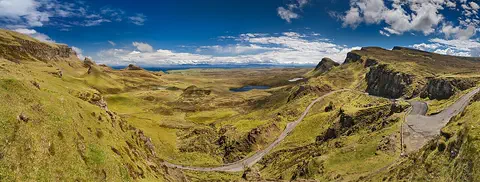
Iceland is an island country in the North Atlantic, close to the Arctic Circle. It sits on the border between two giant plates of Earth's crust and has about 200 volcanoes, many hot springs and huge glaciers, and about 396,500 people lived there in mid-2026.
-
 Watch
 Country
United Kingdom
The United Kingdom, or UK, lies on islands off the northwest coast of Europe. It is made up of four parts, England, Scotland, Wales and Northern Ireland, and about 69.5 million people live there. Its capital is London.
Explore next
-
 Watch
3D
Animal
Atlantic puffin
The Atlantic puffin is a small seabird of the North Atlantic, often called the clown of the sea because of its huge, colorful bill. It spends most of its life far out on the ocean and comes ashore only in summer to nest in burrows on islands and cliff tops. Underwater, its small wings work like flippers.
-
 Watch
Animal
Emperor penguin
The emperor penguin is the largest penguin in the world. It lives around Antarctica, and it is the only animal that breeds during the dark, freezing Antarctic winter. Fathers keep the egg warm on their feet for about two months, huddled together against the storms.
-
 Watch
3D
Animal
Atlantic cod
The Atlantic cod is a large, speckled fish of the cold North Atlantic. It has a whisker-like barbel on its chin and three fins along its back. For hundreds of years people have caught cod for food, so many that some cod populations crashed and are still being rebuilt today.
-
Watch
Country
Iceland
Iceland is an island country in the North Atlantic, close to the Arctic Circle. It sits on the border between two giant plates of Earth's crust and has about 200 volcanoes, many hot springs and huge glaciers, and about 396,500 people lived there in mid-2026.
-
Watch
Country
United Kingdom
The United Kingdom, or UK, lies on islands off the northwest coast of Europe. It is made up of four parts, England, Scotland, Wales and Northern Ireland, and about 69.5 million people live there. Its capital is London.
-
 Watch
Animal
Adélie penguin
The Adélie penguin is a medium-sized penguin, about 70 centimeters tall, with a black back, a white front and a bright white ring around each eye. It breeds in summer on rocky, ice-free ground all around Antarctica, building nests of pebbles, and spends the winter far out at sea among the pack ice.
-
 Watch
Animal
African fish eagle
The African fish eagle is a big eagle of Africa's lakes, rivers and coasts, with a white head, chest and tail and a chestnut-brown body. It snatches fish from the surface of the water, and its loud, ringing call is one of the best-known sounds of Africa.
-
 Watch
Animal
African penguin
The African penguin is a penguin of warm, sunny coasts. It lives only in South Africa and Namibia, nests in burrows and under bushes, and hunts sardines and anchovies in the cold sea. Its numbers have fallen so far that it is now Critically Endangered, and people are working hard to protect it.
For parents & teachers
What children will learn
- Describe how the common murre is adapted to diving for fish.
- Explain how murres nest in colonies and how chicks go to sea early.
- Locate the North Atlantic and North Pacific on a map.
- Discuss how ocean warming and fishing can affect seabirds.
Recommended ages: 3 to 17 · About 15 minutes
Talk about it
- Why might nesting on a narrow cliff ledge keep eggs safe?
- Why could a warmer ocean leave seabirds without enough food?
- How do scientists use seabird colonies to learn about the ocean?
Try at home or in class
- Measure 45 centimeters with a ruler to see how long a murre is, then compare with a crow if you can spot one.
- Draw a sea cliff with narrow ledges and place paper murres on it close enough to touch, like a real colony.
Key vocabulary: seabird, colony, auk, raft, incubate, marine heat wave
Where these facts come from
- The IUCN Red List of Threatened Species , International Union for Conservation of Nature (IUCN terms of use (no redistribution of Red List data or range maps))
- GBIF Backbone Taxonomy and GBIF Occurrence Search , Global Biodiversity Information Facility (CC0 1.0 (backbone); occurrence counts are facts derived from records under CC0, CC BY and CC BY-NC)
- Uria aalge, global Red List assessment 2018 , IUCN Red List of Threatened Species
- Common Murre , National Audubon Society, Guide to North American Birds
- Guillemot , RSPB
- Surveys show full scale of massive die-off of common murres following the 'warm blob' in the Pacific Ocean , University of Washington News
- Wikidata , Wikimedia Foundation (CC0 1.0)
- Wikimedia Commons , Wikimedia Foundation (Per file: Public domain, CC0, CC BY or CC BY-SA only (credited on each page))
Checked, not yet human-reviewed. Last updated October 27, 2026. Spotted a mistake? Tell us.