Animal
West Indian Ocean coelacanth
The coelacanth is a big, deep-sea fish with fins that look a bit like legs. Scientists thought it had disappeared long ago, until one was found alive.
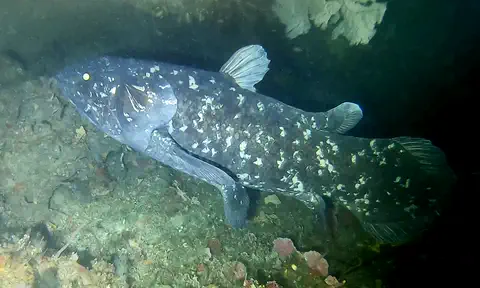
The West Indian Ocean coelacanth is a large, blue, spotted fish that lives in deep, rocky waters off eastern Africa. Its group was known only from fossils and thought to have died out about 66 million years ago, until a living one was found in South Africa in 1938.
Latimeria chalumnae is one of two living species of coelacanth, lobe-finned fishes (Sarcopterygii) more closely related to land vertebrates than to ray-finned fishes. Its 1938 rediscovery, about 66 million years after the group's youngest known fossils, made headlines worldwide. It lives in deep, rocky habitats of the western Indian Ocean, gives birth to live young and is listed as Critically Endangered.
Photo: Bruce A.S. Henderson, CC BY 4.0, via Wikimedia Commons
Meet the coelacanth
The coelacanth is a big fish that lives deep in the sea.
Its fins are thick and fleshy, a bit like little legs. People thought coelacanths were gone forever. Then one was found alive!
The coelacanth (say SEE-luh-kanth) is a large, steel-blue fish with pale spots and thick, fleshy fins that look a little like limbs. It can grow to about 2 meters long and 100 kilograms.
Scientists knew coelacanths from fossils millions of years old, and the youngest fossils are about 66 million years old. So everyone thought the whole group had died out. That is why finding a living one in 1938 was such a big surprise.
Latimeria chalumnae, the West Indian Ocean coelacanth, reaches about 2 meters and 100 kilograms. Coelacanths belong to the lobe-finned fishes, Sarcopterygii, with several fleshy, limb-like fins; the Natural History Museum notes that lobe-finned fishes are more closely related to tetrapods than to ray-finned fishes, which make up about 99 percent of known fish species.
The group was first described by Louis Agassiz in 1836 from a fossil tail, and fossil coelacanths range from about 409 to 66 million years old. With no younger fossils known, scientists assumed coelacanths were extinct, so a living fish was a scientific sensation. 'Living fossil' is a phrase scientists and writers often use for it, meaning a living species whose group was long known only from fossils.
Quick facts
- Group
- Fish
- Length
- up to 2 m
- Weight
- up to 100 kg
- Lifespan in the wild
- up to 100 years
Where it lives
Coelacanths live deep in the sea near Africa.
In the daytime they rest in dark underwater caves. At night they come out to look for food.
West Indian Ocean coelacanths live off the east coast of Africa and nearby islands: around the Comoro Islands, Madagascar, Mozambique, Tanzania, Kenya and South Africa.
They live deep down, usually 90 to 300 meters below the surface, where the water is 18 degrees Celsius or colder. They like rocky places with caves, especially deep water around volcanic islands like the Comoros. During the day they shelter in the caves.
The species is known from the western Indian Ocean: the Comoro Islands, where the first well-studied population was found, and the coasts of South Africa, Mozambique, Madagascar, Kenya and Tanzania. Coelacanths had not been officially recorded off Tanzania until September 2003, after which a spate of catches produced 21 confirmed specimens, 19 of them off Tanga in six months (Benno and colleagues, 2006).
The Natural History Museum describes a typical depth of 90 to 300 meters in water of 18 degrees Celsius or less, with fish sheltering in caves by day. In the past coelacanths lived in many habitats, including shallow seas and freshwater lakes and rivers; today the living species are tied to deep water, particularly around volcanic islands such as the Comoros.
Continent
Its habitat

Where can you find this animal?
- Lives here naturally · Countries and seas named by a scientific source
- Sightings recorded · Records of wild sightings (GBIF)
Lives here naturally · Countries and seas named by a scientific source
Deep, rocky slopes and caves of the western Indian Ocean, usually 90 to 300 m down. Also lives around the Comoro Islands, which are too small to show on this map. Tanzania is from Benno and colleagues (2006); the IUCN's 2000 list (Comoros; South Africa marked extinct) is out of date. Each country is shaded as a whole, but coelacanths live only in a few deep coastal sites.
Places: South Africa, Mozambique, Madagascar, Tanzania and Kenya.
Source: https://www.nhm.ac.uk/discover/coelacanths-the-fish-that-outdid-the-loch-ness-mo · checked October 2026
Sightings recorded · Records of wild sightings (GBIF)
Counts of GBIF records of wild observations (human and machine) and preserved specimens. Records include introduced populations, vagrants, escaped or released animals and misidentifications, so a country with records is not necessarily part of the native range.
Wild sightings have been recorded in South Africa, Tanzania, Mozambique, Madagascar, Germany, Indian Ocean, Southern Ocean, Arctic Ocean and 2 more places.
Source: gbif · checked October 2026
Range maps show where scientists say an animal lives, often country by country. An animal may live in only part of a country shown, and sightings records can include animals that wandered far from home.
A night hunter
Coelacanths hunt at night.
They eat squid, cuttlefish and fish. A special sense in their snout helps them find food in the dark.
Coelacanths rest in caves during the day and come out at night to hunt. They eat cuttlefish, squid and fish.
They have an amazing way of finding food. Inside the snout is a special organ that scientists think can sense the tiny electric signals that other animals give off. A hinge inside the skull also lets a coelacanth open its mouth especially wide.
Coelacanths leave their daytime caves at night to hunt cuttlefish, squid and fish. The rostral organ in the snout is thought to detect the weak electrical impulses produced by prey.
Feeding is helped by the intracranial joint, a hinge within the skull that lets the mouth open especially wide; the Natural History Museum notes that this feature is not seen in any other living vertebrate.
Did you know?
Fishers in the Comoro Islands already knew the coelacanth.
Before scientists knew about it, fishers in the Comoro Islands called the coelacanth gombessa and caught a few each year.
When the second specimen reached scientists in 1952, Comorian fishers already knew the fish as gombessa and caught two or three a year while night fishing.
Fins like legs
The coelacanth has thick, fleshy fins that look like little legs.
It has two fins on its back and eyes made for the dark sea. Its body is covered in blue scales.
The coelacanth's fins are thick and fleshy, a little like limbs, so coelacanths belong to a group called lobe-finned fishes. Surprisingly, lobe-finned fishes are more closely related to four-limbed animals, such as frogs, lizards, birds and people, than to almost all other fish.
Instead of a strong bony backbone, a coelacanth is supported by a notochord, a flexible rod. Its skull has a hinge that lets it open its mouth extra wide, and its eyes are made for seeing in dim light.
Coelacanths have multiple fleshy, lobed fins. The body is supported by a notochord rather than a robust vertebral column, the bony skull has an intracranial joint that no other living vertebrate shares, and the eyes are adapted for low light.
When Latimeria was found it was hailed as a possible 'missing link' between fish and land animals. That idea has since been rejected. The Natural History Museum notes that its expert Peter Forey argued in 1990 that such a link would be expected in fresh water and with a stout backbone, and that analysis of the coelacanth genome, sequenced in 2013, and other DNA shows lungfishes are more closely related to land vertebrates than coelacanths are.
Live babies
Coelacanth mothers have live babies.
The eggs hatch inside the mother. The babies grow inside her for more than a year before they are born.
In 1975 scientists discovered that coelacanths give birth to live young. The eggs hatch inside the mother's body, and the babies keep growing there.
The mother carries her pups for more than a year. When they are born, each pup is already about 30 centimeters long, as long as a school ruler. Scientists think coelacanths may live for a very long time, perhaps around 100 years, but this is not known for sure.
Coelacanths are live-bearers, a fact discovered in 1975. Eggs hatch inside the female's body, and the pups grow to about 30 centimeters before birth after a gestation of more than a year, according to the Natural History Museum.
It has been suggested that coelacanths live about 100 years, though this is not confirmed. Numbers are uncertain: the museum notes that a 2011 study estimated the Grande Comore population at only 300 to 400 individuals, while other populations are not well known.
Drifting and headstands
Coelacanths rest in dark caves in the daytime.
At night they come out. They drift slowly with the moving water. Sometimes they even stand on their heads!
Coelacanths spend the day sheltering in caves and come out at night to hunt. When the scientist J.L.B. Smith saw their leg-like fins, he guessed they might walk on the sea floor.
When scientists finally watched them in the wild, they found that coelacanths do not walk. They drift with the current, holding their body and tail stiff, and use their fins to steer. Their paired fins move in the same pattern as the legs of a walking reptile. They have even been seen doing headstands, hanging head-down for several minutes.
By day coelacanths shelter in caves; at night they forage. Smith predicted they would use their lobed fins to walk on the seabed, but observations show they typically drift with the current, body and tail held rigid. The sail-like first dorsal fin and the lobed fins stabilize and turn the fish, and the lobed fins also help propel it; diagonal pectoral and pelvic fins work in tandem, like the legs of a walking reptile.
Coelacanths have also been observed performing 'headstands', rotating to a vertical, head-down position and holding it for several minutes. The behavior is linked to the rostral organ in the snout, which is thought to detect the weak electrical impulses of prey.
Did you know?
The coelacanth is named after the woman who found it.
The coelacanth's scientific name, Latimeria chalumnae, honors Marjorie Courtenay-Latimer, who found it, and the Chalumna River.
J.L.B. Smith named Latimeria chalumnae after Marjorie Courtenay-Latimer and the mouth of the Chalumna River, near where the 1938 fish was caught.
Found again: the 1938 story
In 1938 a museum worker in South Africa saw a strange blue fish.
It had been caught in a fishing net. A fish scientist said it was a coelacanth. People all over the world were amazed.
On 22 December 1938, Marjorie Courtenay-Latimer, the curator of the East London Museum in South Africa, saw an unusual fish that had been caught in a fishing net. It was 1.5 meters long, with shiny blue scales and strange, fleshy fins.
She wrote to J.L.B. Smith, a fish expert at Rhodes University, and sent a drawing. When Smith saw the fish in February 1939, he was certain: it was a coelacanth. He named it Latimeria chalumnae, after Courtenay-Latimer and the Chalumna River, near where it was caught.
On 22 December 1938 Marjorie Courtenay-Latimer, curator of the East London Museum, examined a 1.5-meter fish taken in a trawl net. She sought help from J.L.B. Smith of Rhodes University, who replied from her drawing that it resembled forms long extinct; on seeing it in February 1939 he confirmed it as a coelacanth and named it Latimeria chalumnae after her and the mouth of the Chalumna River.
Smith searched for a second specimen until 1952, when Ahmadi Abdulla, a fisherman from the Comoro Islands, about 2,000 kilometers away, claimed the reward. Local fishers there already knew the fish as gombessa and caught two or three a year. In 1997 a second species, Latimeria menadoensis, was found in Indonesia.
Did you know?
A coelacanth can open its mouth extra wide.
A coelacanth has a hinge inside its skull that lets it open its mouth extra wide, something no other living animal with a backbone has.
The intracranial joint, a hinge within the skull that widens the gape, is found in no other living vertebrate.
Protecting the coelacanth
There are not many coelacanths.
Some get caught by accident in fishing nets. Now there are laws to protect them.
The West Indian Ocean coelacanth is Critically Endangered, the most serious level of risk for animals still living in the wild. Nobody knows exactly how many there are, but one island, Grande Comore, may have only 300 to 400.
Coelacanths are not good to eat, but they are sometimes caught by accident in deep nets. In the past some were caught on purpose for scientists, museums and aquariums. Today international law protects them from being bought and sold.
The IUCN lists Latimeria chalumnae as Critically Endangered (A2bcd), but the assessment dates from 2000 and is flagged as needing an update; it predates the Tanzanian and recent South African records. Fishing is the listed threat. Both coelacanth species are protected from international trade under CITES.
Historically, coelacanths had little value as food and were released, but once scientists wanted them, rewards and later a black market encouraged targeted catches; Smith himself warned against rewarding captures. Off Tanzania, a burst of catches in deep-set nets after 2003 raised concern that fishing might threaten the population, and Tanzanian authorities planned studies of its size and status to guide conservation (Benno and colleagues, 2006).
IUCN Red List
How is the west indian ocean coelacanth doing in the wild?
- Least Concern
- Near Threatened
- Vulnerable
- Endangered
- Critically Endangered (this animal)
- Extinct in the Wild
- Extinct
Critically Endangered
At extremely high risk of disappearing from the wild.
See the IUCN Red List assessment · The IUCN Red List of Threatened Species 2022.2
Amazing facts
-
The coelacanth is named after the woman who found it.
The coelacanth's scientific name, Latimeria chalumnae, honors Marjorie Courtenay-Latimer, who found it, and the Chalumna River.
J.L.B. Smith named Latimeria chalumnae after Marjorie Courtenay-Latimer and the mouth of the Chalumna River, near where the 1938 fish was caught.
-
Coelacanths sometimes stand on their heads in the water.
Coelacanths have been seen doing headstands, hanging head-down in the water for several minutes.
Observed 'headstands', in which the fish holds a vertical, head-down position for minutes, are linked to the electrosensory rostral organ in the snout.
-
Fishers in the Comoro Islands already knew the coelacanth.
Before scientists knew about it, fishers in the Comoro Islands called the coelacanth gombessa and caught a few each year.
When the second specimen reached scientists in 1952, Comorian fishers already knew the fish as gombessa and caught two or three a year while night fishing.
-
A coelacanth can open its mouth extra wide.
A coelacanth has a hinge inside its skull that lets it open its mouth extra wide, something no other living animal with a backbone has.
The intracranial joint, a hinge within the skull that widens the gape, is found in no other living vertebrate.
Words to know
- fossil
- the remains or traces of a living thing from long ago, preserved in rock
- lobe-finned fish
- a fish with thick, fleshy fins that look a little like limbs
- curator
- a person who looks after a museum's collection
- notochord
- a flexible rod that supports the body instead of a bony backbone
- extinct
- no longer alive anywhere in the world
- critically endangered
- at extremely high risk of disappearing from the wild
Discovery challenge
-
Why was finding a living coelacanth such a surprise?
Why was finding a living coelacanth in 1938 such a surprise?
Why did the 1938 coelacanth astonish scientists?
- People thought coelacanths had died out long ago
- It could fly
- It was bright pink
Show the answer
People thought coelacanths had died out long ago
People only knew coelacanths from very old fossils. They thought they were all gone.
Coelacanths were known only from fossils, the youngest about 66 million years old, so scientists thought they were extinct.
The youngest known fossil coelacanths are about 66 million years old, so the group was assumed extinct until the 1938 fish was identified.
-
What do a coelacanth's fins look like?
What is special about a coelacanth's fins?
What kind of fins define coelacanths and their relatives?
- Thin and see-through
- Thick and fleshy, a bit like legs
- Long and sharp like needles
Show the answer
Thick and fleshy, a bit like legs
Its fins are thick and fleshy, like little legs.
Its fins are thick and fleshy, a little like limbs.
Coelacanths are lobe-finned fishes (Sarcopterygii) with multiple fleshy, limb-like fins.
-
Who found the first living coelacanth?
Who spotted the first living coelacanth in 1938?
Which museum curator recognized the 1938 fish as unusual?
- Marjorie Courtenay-Latimer
- A sea captain from the Moon
- Nobody
Show the answer
Marjorie Courtenay-Latimer
Marjorie Courtenay-Latimer, who worked at a museum in South Africa, found it.
Marjorie Courtenay-Latimer, curator of the East London Museum in South Africa, spotted it and asked J.L.B. Smith for help.
Marjorie Courtenay-Latimer, curator of the East London Museum, recognized it as unusual; J.L.B. Smith confirmed it in February 1939.
-
When do coelacanths hunt?
When do coelacanths come out to hunt?
When do coelacanths leave their caves to feed?
- At night
- At noon
- Never
Show the answer
At night
They rest in caves by day and hunt at night.
They shelter in caves during the day and come out at night to hunt cuttlefish, squid and fish.
They shelter in caves by day and forage at night for cuttlefish, squid and fish.
Places where you might see it
-
 Watch
 Country
South Africa
South Africa is the southernmost country in Africa, with the Atlantic Ocean on one side and the Indian Ocean on the other. A high plateau covers most of it, about 63.5 million people (2026) live there, and it has 12 official languages and three capital cities.
-
 Watch
 Country
Madagascar
Madagascar is the fourth-largest island in the world, in the Indian Ocean off southeastern Africa. It split from other land more than 60 million years ago, so many of its plants and animals, such as its lemurs, live nowhere else. About 32.7 million people lived there in 2025.
-
 Watch
 Country
Tanzania
Tanzania is a country in East Africa, just south of the Equator, on the Indian Ocean. It has Mount Kilimanjaro, Africa's highest mountain, deep lakes in the East African Rift, and the Serengeti, where huge herds of wildebeest travel each year.
Explore next
-
 Watch
3D
Animal
Axolotl
The axolotl is a salamander from the canals and lakes of Mexico City. Unlike most amphibians, it keeps its baby features, such as feathery gills and a fin, its whole life. It can regrow lost legs and even parts of its heart, but in the wild it is critically endangered.
-
 Watch
3D
Animal
Whale shark
The whale shark is the largest fish in the world. This gentle giant swims through warm seas with its huge mouth open, filtering tiny plankton and small fish from the water, and every whale shark has its own pattern of pale spots.
-
 Watch
3D
Animal
Common octopus
The common octopus is a soft-bodied mollusc with eight sucker-lined arms. It lives in coastal waters, hides in a den by day, hunts snails and clams at night, and can change its color, skin texture and shape to vanish against rocks or sand. It lives only one to two years.
-
Watch
Country
South Africa
South Africa is the southernmost country in Africa, with the Atlantic Ocean on one side and the Indian Ocean on the other. A high plateau covers most of it, about 63.5 million people (2026) live there, and it has 12 official languages and three capital cities.
-
Watch
Country
Madagascar
Madagascar is the fourth-largest island in the world, in the Indian Ocean off southeastern Africa. It split from other land more than 60 million years ago, so many of its plants and animals, such as its lemurs, live nowhere else. About 32.7 million people lived there in 2025.
-
Watch
Country
Tanzania
Tanzania is a country in East Africa, just south of the Equator, on the Indian Ocean. It has Mount Kilimanjaro, Africa's highest mountain, deep lakes in the East African Rift, and the Serengeti, where huge herds of wildebeest travel each year.
-
 Watch
3D
Animal
Chambered nautilus
The chambered nautilus is a relative of octopuses and squids that lives inside a coiled shell full of sealed rooms. It moves up and down along deep reef slopes by changing how much gas and water are in its shell, and it finds food mostly by smell.
-
 Watch
Animal
Alligator gar
The alligator gar is one of the largest freshwater fish in North America. It has a broad snout lined with teeth, armor-like scales, and a swim bladder that works like a lung, so it can gulp air in warm, still water. It lives in the big rivers, swamps and bayous of the southern United States, Mexico and Central America.
For parents & teachers
What children will learn
- Retell the story of the coelacanth's discovery in 1938 and the people involved.
- Explain what fossils are and why scientists thought coelacanths were extinct.
- Describe the coelacanth's lobed fins and how it moves.
- Explain why a rare, slow-breeding deep-sea fish needs protection.
Recommended ages: 3 to 17 · About 15 minutes
Talk about it
- Why do you think nobody found a living coelacanth until 1938, even though fishers in the Comoros already knew it?
- What might still be undiscovered in the deep sea?
- Why is it important that the coelacanth is named after the woman who found it?
Try at home or in class
- Hold your arms out and move your right arm with your left leg, then your left arm with your right leg, the same pattern a coelacanth uses for its fins.
- Make a 'fossil': press a shell or leaf into modeling clay, remove it, and talk about how fossils tell us what lived long ago.
Key vocabulary: fossil, lobe-finned fish, curator, notochord, extinct, critically endangered
Where these facts come from
- The IUCN Red List of Threatened Species , International Union for Conservation of Nature (IUCN terms of use (no redistribution of Red List data or range maps))
- GBIF Backbone Taxonomy and GBIF Occurrence Search , Global Biodiversity Information Facility (CC0 1.0 (backbone); occurrence counts are facts derived from records under CC0, CC BY and CC BY-NC)
- Coelacanths: The fish that 'outdid' the Loch Ness Monster , Natural History Museum, London
- Latimeria chalumnae, 2000 assessment , IUCN Red List of Threatened Species
- Coelacanth (Latimeria chalumnae Smith, 1939) discoveries and conservation in Tanzania (South African Journal of Science, 2006) , University of Dar es Salaam Research Repository
- Wikidata , Wikimedia Foundation (CC0 1.0)
- Wikimedia Commons , Wikimedia Foundation (Per file: Public domain, CC0, CC BY or CC BY-SA only (credited on each page))
Checked, not yet human-reviewed. Last updated October 27, 2026. Spotted a mistake? Tell us.