
Animal
Corn snake
The corn snake is an orange and red snake from the eastern United States. It has no venom. It eats mice and rats.
The corn snake is a slender, colorful snake of the pine woods, fields and old barns of the southeastern United States. It has red blotches outlined in black and a black-and-white checkered belly. It has no venom: it catches mice and rats by squeezing them, and it spends much of its time hidden in burrows.
Pantherophis guttatus is a non-venomous, constricting rat snake (family Colubridae) endemic to the eastern and southeastern United States. Secretive and partly burrowing, it helps control rodents. In the wild it is widespread and Least Concern; in captivity it is one of the most popular pet snakes, and introduced populations live on several Caribbean islands.
Photo: Peter Paplanus, CC BY 2.0, via Wikimedia Commons
Meet the corn snake
The corn snake is a long, thin snake.
It is orange and brown, with red patches that have black edges. Its belly looks like a black and white checkerboard. It has no venom.
The corn snake is a slender snake about 60 centimeters to 1.8 meters long. Its body is orange or brownish yellow, with a row of big red blotches outlined in black down its back.
Turn it over and its belly is checkered black and white. Some people think that pattern looks like the kernels on a cob of colorful Indian corn, which may be how the snake got its name. Corn snakes have no venom. Another name for them is red rat snake.
Pantherophis guttatus is a colubrid rat snake, formerly placed in the genus Elaphe. Adults are about 61 to 182 centimeters long (Smithsonian's National Zoo). The ground color is orange to brownish yellow, with large red dorsal blotches edged in black, and the belly carries alternating black and white marks in a checkerboard. Color and pattern vary with age and region, and hatchlings are duller than adults.
The name may come from the resemblance of the belly pattern to the kernels of maize. The species is non-venomous and kills by constriction. Genetic work by Burbrink (2001) split the former Elaphe guttata into three lineages, and the corn snake in the strict sense is the eastern one.
Quick facts
- Group
- Reptile
- Length
- 0.61 to 1.82 m
- Lifespan in the wild
- up to 23 years
Where it lives
Corn snakes live in the eastern United States.
They live in pine woods, fields, rocky places and old barns. They like to hide under logs and bark.
Wild corn snakes live only in the eastern and southeastern United States, from southern New Jersey, Maryland and Kentucky south to Louisiana and the tip of Florida. They are most common in Florida and the other southeastern states.
They live in pine forests, grassy flatwoods, meadows, rocky hillsides and even barns and abandoned buildings. In most places they hibernate from about October to April, in logs, cracks or caves.
The IUCN describes the species as endemic to the eastern and southeastern United States, from southern New Jersey, Maryland and Kentucky to southeastern Louisiana, southern Mississippi, southern Alabama and southern Florida. It is mostly semi-fossorial (partly burrowing) and uses environments from dry to humid: pine forest, grass flatwoods, grassland, open rocky areas and tropical hammocks, as well as barns and abandoned buildings (Smithsonian).
Animal Diversity Web reports hibernation in logs, crevices or caves from about October to April in most of the range, with only brief inactivity, if any, in the south. Introduced populations are established in the Bahamas, Grand Cayman, St. Thomas in the U.S. Virgin Islands and parts of the Lesser Antilles.
Continent
Its habitats


Where can you find this animal?
- Brought here by people · Countries and seas named by a scientific source
- Lives here naturally · Countries and seas named by a scientific source
- Sightings recorded · Records of wild sightings (GBIF)
Brought here by people · Countries and seas named by a scientific source
Established introduced populations on New Providence and Grand Bahama in the Bahamas. The IUCN also lists introduced corn snakes on Grand Cayman, St. Thomas (U.S. Virgin Islands), Saint Barthelemy and an islet off Sint Maarten, all too small to show on this map; some of these populations may no longer survive.
Places: Bahamas.
Source: iucn-red-list · checked October 2026
Lives here naturally · Countries and seas named by a scientific source
Pine forests, flatwoods, meadows, rocky open areas, hammocks and old buildings in the eastern and southeastern United States, from southern New Jersey, Maryland and Kentucky to Louisiana and southern Florida. It lives only in this part of the country shown.
Places: United States.
Source: iucn-red-list · checked October 2026
Sightings recorded · Records of wild sightings (GBIF)
Counts of GBIF records of wild observations (human and machine) and preserved specimens. Records include introduced populations, vagrants, escaped or released animals and misidentifications, so a country with records is not necessarily part of the native range.
Wild sightings have been recorded in United States, Australia, Mexico, Belgium, Netherlands, Bahamas, Brazil, France and 17 more places.
Source: gbif · checked October 2026
Range maps show where scientists say an animal lives, often country by country. An animal may live in only part of a country shown, and sightings records can include animals that wandered far from home.
What it eats
Corn snakes eat small animals.
Babies eat little lizards and tree frogs. Grown-ups eat mice, rats and birds.
Young corn snakes catch small lizards and tree frogs. Adults take bigger meals: mice, rats, birds and even bats. They usually eat every few days.
A corn snake is a constrictor. It bites to get a firm grip, quickly wraps its coils around its prey and squeezes, then swallows the meal whole, usually head first. Corn snakes climb trees and creep through rodent burrows and old buildings to find food.
Diet shifts with size: hatchlings take lizards and tree frogs, while adults eat mice, rats, birds and bats (Smithsonian). Corn snakes typically feed every few days. They are active foragers that climb trees, enter buildings and prowl rodent burrows.
Prey is seized with a bite, rapidly enveloped in coils and constricted, then swallowed whole, usually headfirst; small prey is sometimes swallowed alive. By eating rodents, corn snakes help control their numbers and, as the Smithsonian notes, help limit the spread of diseases associated with rodents.
Did you know?
More corn snakes are raised as pets than any other snake.
The corn snake is the most commonly bred snake in the pet industry.
The Smithsonian describes the corn snake as the most commonly bred snake species in the pet industry; the IUCN notes it is a common pet in the United States.
Colors and a checkered belly
Corn snakes come in many shades of orange, red and brown.
The patches help them hide among leaves. Baby corn snakes are not as bright as grown-ups.
Corn snakes vary a lot. Depending on where they live and how old they are, they can be brighter or duller, redder or browner. Babies hatch with duller colors and get brighter as they grow.
The red-and-black blotches break up the snake's outline on the forest floor. Corn snakes are sometimes mistaken for copperheads, which are venomous, and people may harm them by mistake. Leaving every snake alone keeps both snakes and people safe.
Coloration varies geographically and with age; hatchlings lack the brighter adult colors (Smithsonian). Disruptive blotches outlined in black camouflage the snake among leaf litter and pine needles, and the checkered ventral pattern is a useful identification feature.
Animal Diversity Web notes that corn snakes can be confused with the venomous copperhead (Agkistrodon contortrix), and the Smithsonian reports that some are killed as a result. The species is non-venomous: like other rat snakes, it relies on constriction.
From egg to snake
Mother corn snakes lay eggs.
She hides them in a warm, damp place and leaves. The babies hatch in summer and look after themselves.
Corn snakes mate in spring, from March to May. In early summer the female lays 10 to 30 eggs in a rotting stump or a pile of decaying plants, where it is warm and damp. She does not stay to look after them.
About two months later, between July and September, the eggs hatch. The babies are 25 to 38 centimeters long, about as long as a ruler, and they are on their own from the start. They are grown up in about one and a half to three years.
Breeding takes place from March to May. Corn snakes are oviparous: from late May to July the female deposits 10 to 30 eggs in rotting stumps, decaying vegetation or similar warm, humid sites, with no parental care afterward (Smithsonian).
Incubation takes about 60 to 65 days at around 28 degrees Celsius (82 degrees Fahrenheit), and hatchlings emerge between July and September at 25 to 38 centimeters, duller than adults. Maturity is reached in about 18 to 36 months, and corn snakes live up to 23 years in human care, less in the wild.
A secret life underground
Corn snakes are shy and hide a lot.
They spend lots of time underground in burrows. They come out in the daytime to look for food.
Corn snakes are mostly active in the daytime, but they are very secretive. They spend much of their time underground, prowling through the burrows of mice and other rodents, or hiding under loose bark, logs and rocks.
They are good climbers and may explore trees and old buildings. In warm weather, they may switch to being active around dusk and dawn instead. Each corn snake lives on its own.
The species is mainly diurnal (Smithsonian), though Animal Diversity Web notes crepuscular activity in warm periods or warmer climates. It is highly secretive and semi-fossorial, spending much time in rodent burrows and under bark, logs and debris, yet it also climbs readily.
Corn snakes are solitary, and they find their way mainly by smell rather than sight (ADW). Little is known about how much space a wild corn snake uses: the territory figures Animal Diversity Web gives come from the Great Plains rat snake, a close relative now treated as a separate species, and ADW stresses that few studies of wild corn snakes exist.
Did you know?
Baby corn snakes are less colorful than grown-ups.
Corn snakes hatch with duller colors and become brighter as they grow up.
Hatchlings lack the brighter adult coloration, and color and pattern vary with age and geography.
Wild snakes and pet snakes
There are many corn snakes in the wild.
Many people keep corn snakes as pets too. A pet snake should never be let go outside.
Wild corn snakes are widespread and their numbers seem stable, so they are listed as least concern. Losing habitat is a problem in some places, and some corn snakes are killed because people think they are copperheads. Florida lists the corn snake as a species of special concern, and Georgia protects it.
Corn snakes are also one of the most popular pet snakes, and more are bred for the pet trade than any other snake. Corn snakes brought by people now live wild on several Caribbean islands too.
The IUCN lists the corn snake as Least Concern (assessed 2015, published 2016, flagged as needing an update): it has many subpopulations, an adult population that probably exceeds 100,000 and a stable trend. No major threats are known; habitat destruction is a local threat, but the species tolerates a fair amount of low-intensity habitat change.
The Smithsonian notes that Florida lists it as a species of special concern, that it is protected in Georgia, and that it is the most commonly bred snake in the pet industry. Introduced populations have been recorded on several Caribbean islands, some of which may no longer survive.
IUCN Red List
How is the corn snake doing in the wild?
- Least Concern (this animal)
- Near Threatened
- Vulnerable
- Endangered
- Critically Endangered
- Extinct in the Wild
- Extinct
Least Concern
Not at risk of disappearing from the wild right now.
See the IUCN Red List assessment · The IUCN Red List of Threatened Species 2022.2
Amazing facts
-
A corn snake's belly looks like a checkerboard.
A corn snake's belly has a black-and-white checkered pattern, which may have reminded people of the kernels on Indian corn.
The name corn snake may come from the resemblance of the checkered ventral pattern to the kernels of maize (Smithsonian).
-
Corn snakes sneak through mouse tunnels underground.
Corn snakes spend much of their time underground, prowling through the burrows of mice and rats.
Although mainly diurnal, corn snakes are so secretive and semi-fossorial that much of their foraging happens in rodent burrows, out of sight.
-
Baby corn snakes are less colorful than grown-ups.
Corn snakes hatch with duller colors and become brighter as they grow up.
Hatchlings lack the brighter adult coloration, and color and pattern vary with age and geography.
-
More corn snakes are raised as pets than any other snake.
The corn snake is the most commonly bred snake in the pet industry.
The Smithsonian describes the corn snake as the most commonly bred snake species in the pet industry; the IUCN notes it is a common pet in the United States.
Words to know
- constrictor
- a snake that wraps around its prey and squeezes
- non-venomous
- having no venom
- burrow
- a tunnel or hole in the ground made by an animal
- hibernate
- to rest deeply through the cold winter
- clutch
- a group of eggs laid at one time
- introduced
- brought by people to a place where it did not live before
Discovery challenge
-
What does a corn snake's belly look like?
What pattern does a corn snake have on its belly?
What ventral pattern may have given the corn snake its name?
- Stripes like a zebra
- A black and white checkerboard
- Plain green
Show the answer
A black and white checkerboard
Its belly has black and white squares, like a checkerboard.
The belly is checkered black and white, which may have reminded people of Indian corn.
Alternating black and white ventral marks, perhaps resembling maize kernels, may explain the name.
-
Where do wild corn snakes live?
Where do corn snakes live in the wild?
What is the corn snake's native range?
- The eastern United States
- Australia
- The Amazon rainforest
Show the answer
The eastern United States
Wild corn snakes live in the eastern United States.
They live in the eastern and southeastern United States, and are most common in Florida.
Endemic to the eastern and southeastern United States; island populations elsewhere were introduced.
-
How does a corn snake catch its food?
How does a corn snake catch a mouse?
How does a corn snake subdue its prey?
- With venom
- By squeezing it
- By spitting at it
Show the answer
By squeezing it
It holds on and squeezes. Corn snakes have no venom.
It bites to grip, wraps its coils around the mouse and squeezes, then swallows it whole.
Constriction: the non-venomous corn snake grips with a bite and coils rapidly around the prey.
-
Where does a mother corn snake put her eggs?
Where does a corn snake lay its eggs?
What kind of site does a female corn snake choose for her clutch?
- In a warm, damp rotting stump
- In a bird's nest high in a tree
- In a pond
Show the answer
In a warm, damp rotting stump
She hides them in a warm, damp place, like a rotting stump.
She lays 10 to 30 eggs in a rotting stump or pile of decaying plants and leaves them there.
Rotting stumps or decaying vegetation provide the heat and humidity needed for about 60 to 65 days of incubation.
Places where you might see it
Experiments to try
Explore next
-
 Watch
Animal
Common garter snake
The common garter snake is one of the most familiar snakes in North America. It has light stripes along a dark body, it lives almost everywhere from Canada to Florida, and it copes with cold better than most snakes. In spring, huge numbers come out of their winter dens together.
-
 Watch
 Country
United States
The United States is a large country in North America made of 50 states, from icy Alaska to the warm islands of Hawaii. It has the Grand Canyon, the Mississippi River and Yellowstone, and about 342 million people live there.
-
 Watch
3D
Animal
Eastern box turtle
The eastern box turtle is a small land turtle of eastern North America with a high, domed shell splashed with yellow and orange. A hinge on the bottom shell lets it close up almost completely, like a box with a lid. It eats mushrooms, berries, worms and slugs and can live for decades.
-
 Watch
3D
Animal
Red-tailed hawk
The red-tailed hawk is probably the most common hawk in North America. It soars in wide circles over fields or waits on a pole or fence post, watching for voles, mice and rabbits, then drops down to catch them with its sharp talons.
- Watch What If? Lab What if you never blinked? You blink about 15 times a minute, mostly without noticing. Each blink spreads a thin layer of tears across your eyes to keep them moist and wash away dust. Imagine never blinking again, then discover what tears do, why eyes feel dry, and how fish and snakes manage with no eyelids that close.
-
 Watch
Animal
Aldabra giant tortoise
The Aldabra giant tortoise is one of the largest land tortoises on Earth. Wild ones live on Aldabra Atoll, a ring of coral islands in the Indian Ocean, where more than 100,000 of them graze, browse and shape the land like elephants do in Africa. They can live for more than 100 years.
-
 Watch
Animal
Alligator snapping turtle
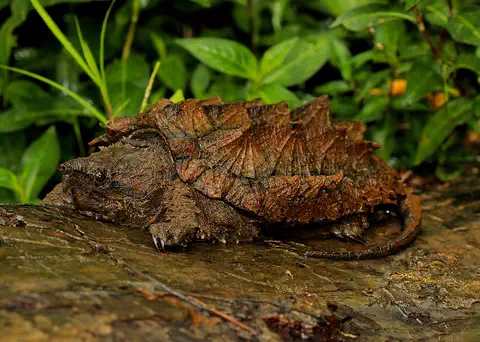
The alligator snapping turtle is the largest freshwater turtle in the United States. It lies still on the bottom of rivers and lakes with its mouth open, wiggling a worm-like lure on its tongue to trick fish into swimming close. Its numbers have fallen, and it is now endangered.
-
 Watch
3D
Animal
American alligator
The American alligator is a large, armored reptile of the swamps, marshes and lakes of the southeastern United States. Alligator mothers guard their nests and carry their babies to the water, and the holes alligators dig help many other animals survive dry seasons.
For parents & teachers
What children will learn
- Describe the corn snake's appearance, including its checkered belly and blotched pattern.
- Explain how a constrictor catches its food and why corn snakes are useful to people.
- Describe the corn snake life cycle from egg to adult.
- Understand the difference between a wild animal's range and a pet population, and why pets must never be released.
Recommended ages: 3 to 17 · About 15 minutes
Talk about it
- Why might a snake that hunts in burrows be hard for scientists to study?
- Why do you think some people mistake corn snakes for copperheads? How could that be prevented?
- What should a family think about before getting a pet that can live more than 20 years?
Try at home or in class
- Draw a corn snake's checkered belly on a strip of paper with a black marker, then compare it with a cob of colorful Indian corn or a picture of one.
- Measure 1.2 meters of string and lay it out to see how long a typical adult corn snake is.
Key vocabulary: constrictor, non-venomous, burrow, hibernate, clutch, introduced
Where these facts come from
- The IUCN Red List of Threatened Species , International Union for Conservation of Nature (IUCN terms of use (no redistribution of Red List data or range maps))
- GBIF Backbone Taxonomy and GBIF Occurrence Search , Global Biodiversity Information Facility (CC0 1.0 (backbone); occurrence counts are facts derived from records under CC0, CC BY and CC BY-NC)
- Wikimedia Commons , Wikimedia Foundation (Per file: Public domain, CC0, CC BY or CC BY-SA only (credited on each page))
- Pantherophis guttatus (Red Cornsnake), IUCN Red List assessment 2016 , IUCN
- Eastern corn snake , Smithsonian's National Zoo and Conservation Biology Institute
- Pantherophis guttatus (Red Cornsnake) , Animal Diversity Web, University of Michigan Museum of Zoology
- Wikidata , Wikimedia Foundation (CC0 1.0)
Checked, not yet human-reviewed. Last updated October 27, 2026. Spotted a mistake? Tell us.