
Animal
Common garter snake
The common garter snake is a small striped snake. It lives in gardens, fields and near ponds across North America. Mother garter snakes have live babies.
The common garter snake is one of the most familiar snakes in North America. It has light stripes along a dark body, it lives almost everywhere from Canada to Florida, and it copes with cold better than most snakes. In spring, huge numbers come out of their winter dens together.
Thamnophis sirtalis is a widespread, cold-tolerant colubrid that ranges from southeastern Alaska and the Northwest Territories to Florida. It is live-bearing, eats mainly amphibians and earthworms, gathers in communal winter dens and is listed as Least Concern, although one subspecies, the San Francisco garter snake, is endangered.
Photo: Holger Krisp, CC BY 3.0, via Wikimedia Commons
Meet the common garter snake
The common garter snake is a slim snake with stripes.
It has light stripes on a dark body. It lives in gardens, fields and near water.
The common garter snake may be the most familiar snake in North America. Most have three light stripes running along a dark body: a thin one down the middle of the back and one along each side. The stripes are usually yellow, but they can be blue, green or brown.
Its name comes from those stripes, which reminded people of the old-fashioned garters once used to hold up socks. Adults are usually about 46 to 66 centimeters long, and some grow to more than a meter.
Thamnophis sirtalis is a colubrid snake. The Connecticut Department of Energy and Environmental Protection calls it perhaps the most common, widely distributed and familiar of all North American snakes. The typical pattern is three light stripes on a dark body, with two rows of alternating black spots between the central and lateral stripes, and the scales are keeled, each with a raised ridge.
Adults are usually 18 to 26 inches (46 to 66 centimeters), occasionally up to 42 inches; Animal Diversity Web gives a total length of 46 to 137 centimeters. Many dozens of regional populations with distinct color patterns are recognized, and in some areas many snakes are entirely black.
Quick facts
- Group
- Reptile
- Length
- 0.46 to 0.66 m
- Lifespan in the wild
- up to 10 years
Where it lives
Garter snakes live across much of North America.
They live in woods, fields, marshes, lawns and by ponds and streams. They like to sun themselves on rocks and walls.
Common garter snakes live across much of North America, from southeastern Alaska and northern Canada south to California, Texas and southern Florida. There is even a tiny group in northern Mexico.
They live in many habitats: forests, forest edges, fields, swamps, bogs, the edges of streams and ponds, hedgerows and overgrown lawns. You might spot one sunning itself on a woodpile, a stone wall or a rock.
The IUCN range covers much of North America: from southeastern Alaska, British Columbia, the southern Northwest Territories, northern Saskatchewan, central Manitoba, Ontario, central Quebec and the Maritime Provinces south to southern California, central Utah, northeastern Colorado, New Mexico, Texas, the Gulf Coast and southern Florida, with a very small disjunct population in northwestern Chihuahua, Mexico.
It uses a very wide range of aquatic, wetland and upland habitats, with pronounced regional differences in preference between east and west. When inactive it stays underground, in or under surface cover or in other sheltered sites.
Continent
Its habitats


Where can you find this animal?
- Lives here naturally · Countries and seas named by a scientific source
- Sightings recorded · Records of wild sightings (GBIF)
Lives here naturally · Countries and seas named by a scientific source
Forests, fields, wetlands, stream and pond edges, lawns and gardens across much of North America, from southeastern Alaska and the southern Northwest Territories to southern California, Texas and southern Florida. In Mexico there is only a very small population in northwestern Chihuahua, and the snakes are absent from the far north of Canada.
Places: Canada, United States and Mexico.
Source: iucn-red-list · checked October 2026
Sightings recorded · Records of wild sightings (GBIF)
Counts of GBIF records of wild observations (human and machine) and preserved specimens. Records include introduced populations, vagrants, escaped or released animals and misidentifications, so a country with records is not necessarily part of the native range.
Wild sightings have been recorded in United States, Canada, Mexico, Denmark, Belgium, Ecuador, France, Sweden and 7 more places.
Source: gbif · checked October 2026
Range maps show where scientists say an animal lives, often country by country. An animal may live in only part of a country shown, and sightings records can include animals that wandered far from home.
What it eats
Garter snakes eat frogs, toads and worms.
They also eat small fish, slugs and insects. They swallow their food whole.
Garter snakes eat lots of different small animals. Their main food is frogs, toads and salamanders, followed by earthworms. They also eat mice, small fish, slugs, snails, leeches, insects and spiders.
Garter snakes grab their prey and swallow it whole. They usually hunt in the daytime, but in hot weather, and when frogs are breeding, they also hunt in the evening and at night.
The Connecticut DEEP describes the garter snake's success as resting on opportunism in both habitat and diet. Amphibians (frogs, toads, salamanders) are the main prey, followed by earthworms, then mice, small fish, nestling birds, small snakes, leeches, slugs, snails, sowbugs, crayfish, millipedes, insects and spiders. Prey is swallowed alive and whole.
The saliva appears to be toxic to amphibians and other small animals, and a bite may cause swelling or a rash in some people. Feeding is mostly diurnal, but the snakes also forage at dawn and dusk and at night in the hottest months and during amphibian breeding.
Did you know?
Some garter snakes are all black.
Garter snakes vary so much that in some places many of them are completely black.
Many dozens of regional color forms are recognized, and some populations have a high proportion of entirely black (melanistic) snakes (ADW).
Stripes, scales and a red tongue
A garter snake's scales have little ridges.
Its stripes help it hide in grass. Some garter snakes have red marks on their sides.
Look closely at a garter snake's scales and you will see a raised ridge down the middle of each one. Scientists call these keeled scales.
Garter snakes come in many colors. Some are greenish, some brownish, and some have red patches along their sides, like the red-sided garter snakes of Manitoba. In a few places, many garter snakes are completely black.
Keeled dorsal scales, three light stripes and rows of dark spots define the typical pattern, but variation is enormous: many regional populations have distinct coloration, some with red lateral markings (as in the red-sided garter snakes of Manitoba) and some largely melanistic.
The photo shows a captive snake's head close up: the large eye, the nostril near the tip of the snout, pale lip scales and, along the body, the keeled scales, red between the scales and a light lateral stripe.
Live babies
In spring, garter snakes come out of their winter dens and find mates.
In summer, the mother has live babies, often 10 to 40 at a time. The babies go off on their own straight away.
Garter snakes mate in spring, as soon as they come out of their winter dens. Often many males crowd around one female in a wriggling "mating ball."
Garter snakes do not lay eggs. The babies grow inside their mother for about three months and are born alive between July and October, usually 10 to 40 at a time. Each newborn is about 12 to 23 centimeters long and looks like a tiny adult. The babies get no care and slither off right away. They can have their own young at about two years old.
Mating follows emergence from the winter den in March or April, often in breeding balls of several males around a female. The species is viviparous: young develop within the female in thin, yolk-filled membranes for 90 to 100 days and are born between July and October, typically 10 to 40 per litter depending on the female's age, size and condition (Connecticut DEEP). Newborns are 12.5 to 23 centimeters long (ADW) and disperse at once without parental care.
The Connecticut DEEP notes that live birth protects the young from egg predators and speeds development, because a pregnant female can bask to keep her body warm, an adaptation it suggests probably helps the species live so far north. Males mature at about 1.5 years and females at two.
Tough in the cold
Garter snakes can handle the cold better than most snakes.
In winter, lots of them rest together underground. In Manitoba, tens of thousands come out together in spring!
Garter snakes are very cold-hardy. They come out earlier in spring and stay active later in fall than other snakes. In winter they rest underground, often in groups, in burrows, rock walls and under stumps.
In Manitoba, Canada, the Narcisse Snake Dens fill with tens of thousands of red-sided garter snakes every spring. For one to three weeks in late April or early May, the males come out first and wait for the females. The garter snakes there are harmless, and visitors watch from platforms.
The common garter snake is extremely cold-resistant and active over a wider range of temperatures than most snakes. As temperatures fall, snakes aggregate to brumate, inactive but not deeply asleep, in muskrat and crayfish burrows, mud banks, rock walls, under stumps and in soft earth (Connecticut DEEP).
The Province of Manitoba describes the Narcisse Snake Dens, where tens of thousands of red-sided garter snakes emerge each spring from underground winter dens for a mating period of one to three weeks in late April or early May; males surface first, and a female may be surrounded by up to one hundred males in a mating ball. Garter snakes, especially young ones, are eaten by many predators, including owls, hawks, herons, crows, raccoons, skunks and mink.
Did you know?
In spring, up to 100 boy garter snakes can crowd around one girl.
At the Narcisse Snake Dens in Manitoba, a female can be surrounded by up to 100 males in a wriggling mating ball.
The Province of Manitoba reports mating balls of up to one hundred males around a single female during the spring emergence at Narcisse.
Common, with one rare relative
There are lots of common garter snakes.
They are not in danger. But one kind that lives near San Francisco is very rare and protected.
Common garter snakes are listed as least concern. There are probably more than a million adults, and their numbers seem stable.
But one special group, the San Francisco garter snake, is endangered and has been protected by law since 1967. The tiny population in Mexico depends on its wetlands staying wet. Manitoba's wildlife officials call garter snakes harmless, but like any wild animal they are best watched, not handled.
The IUCN lists Thamnophis sirtalis as Least Concern (assessed 2007, published 2015, flagged as needing an update): it has a very large number of subpopulations, an adult population probably exceeding one million and a stable or slowly declining trend. No major threats are identified, although the small Mexican population is vulnerable to changes in hydrology.
Subspecies tell a different story: Animal Diversity Web notes that the San Francisco garter snake (T. s. tetrataenia) was placed on the U.S. and California endangered species lists in 1967, and other subspecies may be protected by state laws.
IUCN Red List
How is the common garter snake doing in the wild?
- Least Concern (this animal)
- Near Threatened
- Vulnerable
- Endangered
- Critically Endangered
- Extinct in the Wild
- Extinct
Least Concern
Not at risk of disappearing from the wild right now.
See the IUCN Red List assessment · The IUCN Red List of Threatened Species 2022.2
Amazing facts
-
The garter snake is named after old-fashioned sock holders.
Garter snakes got their name because their stripes looked like the garters people once wore to hold up their socks.
The common name comes from the resemblance of the stripes to old-fashioned sock garters (Connecticut DEEP).
-
In spring, up to 100 boy garter snakes can crowd around one girl.
At the Narcisse Snake Dens in Manitoba, a female can be surrounded by up to 100 males in a wriggling mating ball.
The Province of Manitoba reports mating balls of up to one hundred males around a single female during the spring emergence at Narcisse.
-
Garter snakes come out in spring before most other snakes.
Garter snakes are active earlier in spring and later in fall than other snakes, because they cope well with cold.
The species is extremely cold-resistant and is active over a wider range of temperatures than most snakes, extending its active season at both ends.
-
Some garter snakes are all black.
Garter snakes vary so much that in some places many of them are completely black.
Many dozens of regional color forms are recognized, and some populations have a high proportion of entirely black (melanistic) snakes (ADW).
Words to know
- keeled scale
- a scale with a raised ridge down the middle
- live-bearing
- giving birth to live babies instead of laying eggs
- den
- a sheltered place underground where animals rest or spend the winter
- brumation
- a resting state in which reptiles stay inactive through the cold months
- subspecies
- a group within a species that lives in one area and looks a bit different
- captive
- living in a zoo, exhibit or home instead of in the wild
Discovery challenge
-
What is a garter snake's favorite food?
What is the main food of common garter snakes?
Which group of animals makes up most of the common garter snake's diet?
- Frogs, toads and salamanders
- Grass and leaves
- Big deer
Show the answer
Frogs, toads and salamanders
Garter snakes love to eat frogs and toads. They eat worms too.
Frogs, toads and salamanders are their main food, followed by earthworms.
Amphibians are the main prey, followed by earthworms and a wide range of small animals.
-
How are baby garter snakes born?
How do garter snakes have babies?
What is the garter snake's mode of reproduction?
- They hatch from eggs
- They are born alive
- They grow from tadpoles
Show the answer
They are born alive
Garter snake babies are born alive, often 10 to 40 at a time.
The babies grow inside the mother for about three months and are born alive.
It is viviparous; young develop in yolk-filled membranes inside the female for 90 to 100 days.
-
Where did the garter snake get its name?
Why is it called a garter snake?
What is the origin of the name garter snake?
- It lives in gardens
- Its stripes look like old sock garters
- It was found by a man named Garter
Show the answer
Its stripes look like old sock garters
Its stripes looked like old-fashioned bands for holding up socks.
The stripes reminded people of the garters once worn to hold up socks.
The name refers to the stripes' resemblance to old-fashioned sock garters.
-
What happens at the Narcisse Snake Dens in spring?
What can you see at the Narcisse Snake Dens in Manitoba each spring?
What happens at the Narcisse Snake Dens each spring?
- Tens of thousands of garter snakes come out of their dens
- Snakes lay eggs in the snow
- Snakes fly south for the summer
Show the answer
Tens of thousands of garter snakes come out of their dens
Tens of thousands of garter snakes wake up and come out together.
Tens of thousands of red-sided garter snakes come up from underground dens to mate.
Tens of thousands of red-sided garter snakes emerge from communal winter dens for a one- to three-week mating period.
Places where you might see it
-
 Watch
 Country
Canada
Canada is the second-largest country in the world, stretching across the north of North America from the Atlantic to the Pacific and up into the Arctic. It has the Rocky Mountains, thousands of islands and about 42 million people, who speak English, French and many other languages.
-
 Watch
 Country
United States
The United States is a large country in North America made of 50 states, from icy Alaska to the warm islands of Hawaii. It has the Grand Canyon, the Mississippi River and Yellowstone, and about 342 million people live there.
Explore next
-
 Watch
Animal
Corn snake
The corn snake is a slender, colorful snake of the pine woods, fields and old barns of the southeastern United States. It has red blotches outlined in black and a black-and-white checkered belly. It has no venom: it catches mice and rats by squeezing them, and it spends much of its time hidden in burrows.
-
Watch
Country
Canada
Canada is the second-largest country in the world, stretching across the north of North America from the Atlantic to the Pacific and up into the Arctic. It has the Rocky Mountains, thousands of islands and about 42 million people, who speak English, French and many other languages.
-
Watch
Country
United States
The United States is a large country in North America made of 50 states, from icy Alaska to the warm islands of Hawaii. It has the Grand Canyon, the Mississippi River and Yellowstone, and about 342 million people live there.
-
 Watch
Animal
American toad
The American toad is a common, warty toad of eastern North America, found in forests, prairies, farms and backyards. It has big poison glands behind its eyes, hunts insects and worms at night, and in spring the males sing a long, musical trill from shallow ponds, where females lay thousands of eggs in long strings.
-
 Watch
Animal
Wood frog
The wood frog is a brown forest frog with a dark "robber's mask" across its eyes. It lives farther north than any other North American amphibian, reaching Alaska and northern Canada. To survive winter it lets much of its body freeze, protected by sugar in its cells, and in early spring it is one of the first frogs to call, with a sound like quacking ducks.
-
 Watch
Animal
Aldabra giant tortoise
The Aldabra giant tortoise is one of the largest land tortoises on Earth. Wild ones live on Aldabra Atoll, a ring of coral islands in the Indian Ocean, where more than 100,000 of them graze, browse and shape the land like elephants do in Africa. They can live for more than 100 years.
-
 Watch
Animal
Alligator snapping turtle
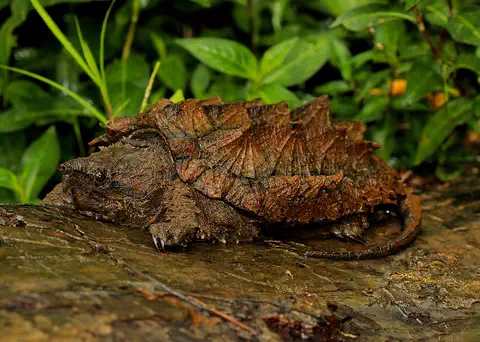
The alligator snapping turtle is the largest freshwater turtle in the United States. It lies still on the bottom of rivers and lakes with its mouth open, wiggling a worm-like lure on its tongue to trick fish into swimming close. Its numbers have fallen, and it is now endangered.
-
 Watch
3D
Animal
American alligator
The American alligator is a large, armored reptile of the swamps, marshes and lakes of the southeastern United States. Alligator mothers guard their nests and carry their babies to the water, and the holes alligators dig help many other animals survive dry seasons.
For parents & teachers
What children will learn
- Identify a common garter snake by its stripes and keeled scales, and explain where its name comes from.
- Describe what garter snakes eat and how they catch it.
- Explain live birth and why it may help snakes live in cold places.
- Describe communal winter dens and the spring emergence at Narcisse.
Recommended ages: 3 to 17 · About 15 minutes
Talk about it
- Why might giving birth to live young help a snake that lives where summers are short?
- Why do you think so many garter snakes share the same winter dens?
- How could a garden or schoolyard be made friendlier for garter snakes and the frogs they eat?
Try at home or in class
- Measure 60 centimeters with a ruler or string to see how long a typical adult garter snake is, and 15 centimeters for a newborn.
- Draw a garter snake with three stripes, then make a second one in a different color form, such as red-sided or all black.
Key vocabulary: keeled scale, live-bearing, den, brumation, subspecies, captive
Where these facts come from
- The IUCN Red List of Threatened Species , International Union for Conservation of Nature (IUCN terms of use (no redistribution of Red List data or range maps))
- GBIF Backbone Taxonomy and GBIF Occurrence Search , Global Biodiversity Information Facility (CC0 1.0 (backbone); occurrence counts are facts derived from records under CC0, CC BY and CC BY-NC)
- Wikimedia Commons , Wikimedia Foundation (Per file: Public domain, CC0, CC BY or CC BY-SA only (credited on each page))
- Thamnophis sirtalis (Common Gartersnake), IUCN Red List assessment 2015 , IUCN
- Common Gartersnake , Connecticut Department of Energy and Environmental Protection
- Snakes of Narcisse , Province of Manitoba
- Thamnophis sirtalis (Common Garter Snake) , Animal Diversity Web, University of Michigan Museum of Zoology
- Wikidata , Wikimedia Foundation (CC0 1.0)
Checked, not yet human-reviewed. Last updated October 27, 2026. Spotted a mistake? Tell us.