
Animal
Domestic sheep
Sheep are farm animals with thick, curly coats called wool. A mother is a ewe, a father is a ram, and a baby is a lamb. Sheep love to stay together.
Domestic sheep are farm animals that people tamed in western Asia thousands of years ago. They graze on grass, digest it with a four-part stomach and stick together in flocks. People keep sheep for wool, meat, milk and leather.
Ovis aries was domesticated roughly 9,000 to 11,000 years ago in the Middle East and Central Asia and now lives with people almost everywhere. Selective breeding has produced more than 200 breeds, and the woolly fleece of many of them was developed from the fine undercoat of wild sheep.
Photo: Lucyin, CC BY-SA 4.0, via Wikimedia Commons
Meet the sheep
Sheep are gentle farm animals.
Many sheep have thick, soft wool. Some have curly horns. A mother is a ewe, a father is a ram and a baby is a lamb.
Domestic sheep are hoofed farm animals related to goats and cattle. Many have a thick, woolly coat called a fleece, and some males, called rams, grow big curled horns. Females are ewes, and the babies are lambs.
Sheep come in more than 200 breeds. Some are white and fluffy, some are brown or black, some have hair instead of wool, and some have no horns at all. A mature sheep can weigh from about 35 to 180 kilograms, depending on its breed.
Ovis aries is a domesticated bovid in the genus Ovis, which also includes wild sheep such as the bighorn of western North America. Breeds vary enormously: Animal Diversity Web gives a head-and-body length of 1.2 to 1.8 meters and a shoulder height of 0.65 to 1.27 meters, and females are about two-thirds to three-quarters the size of males.
Selection for useful traits has produced sheep with or without wool, horns and even external ears, in colors from milky white to dark brown and black. Compared with goats, sheep are typically stockier, with more widely spreading horns and short tails. A vertical cleft divides the upper lip.
Quick facts
- Group
- Mammal
- Length
- 1.2 to 1.8 m
- Height
- 0.65 to 1.27 m
- Weight
- 35 to 180 kg
Where sheep live
Sheep live on farms all over the world.
They live on green hills, on high mountains and in dry, rocky places. A farmer or a shepherd looks after them.
Sheep are domesticated, so they live with people rather than in the wild. Farmers keep them on every continent except Antarctica, from green hills and mountain pastures to dry, rocky land at the edge of deserts.
The first tame sheep lived in the Middle East and Central Asia. Farmers then carried them almost everywhere. Sheep are so adaptable that they live in places as different as cool mountain forests and hot, dry deserts.
Domestic sheep live worldwide in association with people, in habitats from temperate mountain forests to deserts. Animal Diversity Web places the first domestic sheep mainly in the Middle East and Central Asia, from where they were introduced across the world.
On some Mediterranean islands the story looped back to the wild. Britannica describes the mouflon of Corsica, Sardinia and Cyprus as a feral sheep, most likely descended from domestic sheep of Asia Minor that people brought to the islands thousands of years ago. Because sheep are domestic, the map shows continents where they are farmed, not a wild range.
Continents
Its habitats


Where can you find this animal?
- Kept by people · Countries and seas named by a scientific source
- Sightings recorded · Records of wild sightings (GBIF)
Kept by people · Countries and seas named by a scientific source
Sheep are domesticated: farmers keep them on every continent except Antarctica. This is not a wild range. The first domestic sheep lived in the Middle East and Central Asia.
Places: Africa, Asia, Europe, North America, South America and Australia and Oceania.
Source: https://animaldiversity.org/accounts/Ovis_aries/ · checked October 2026
Sightings recorded · Records of wild sightings (GBIF)
Counts of GBIF records of wild observations (human and machine) and preserved specimens. Records include introduced populations, vagrants, escaped or released animals and misidentifications, so a country with records is not necessarily part of the native range.
Wild sightings have been recorded in Netherlands, France, Chile, Spain, Switzerland, Germany, Sweden, Belgium and 104 more places.
Source: gbif · checked October 2026
Range maps show where scientists say an animal lives, often country by country. An animal may live in only part of a country shown, and sightings records can include animals that wandered far from home.
What sheep eat
Sheep eat grass.
They nibble it short, very close to the ground. Then they lie down and chew it again. In winter farmers give them hay.
Sheep are herbivores. In pastures they eat mostly grass, and farmers also feed them hay and oats. Sheep bite grass very close to the ground, closer than cattle do.
Like cows, sheep are ruminants with a stomach of four parts. A sheep eats a lot of grass quickly, then rests and brings the food back up to chew it again. Its day switches back and forth between grazing and chewing its cud.
Sheep are grazers that crop pasture closer to the roots than cattle, and in managed systems they are fed hays and grains such as oats. Their four-compartment ruminant stomach digests highly fibrous food that many animals cannot use.
Animal Diversity Web notes how modest their needs are: sheep can survive on cellulose, starch or sugars for energy plus a nitrogen source that need not be protein. Feeding follows a rhythm of eating a large amount quickly, then resting to ruminate, which is part of what makes sheep so economical to keep.
Did you know?
Sheep bite grass very short.
Sheep graze closer to the ground than cattle do, so farmers must take care that a flock does not overgraze its pasture.
Sheep crop plants closer to the root than cattle, which is why Britannica warns that care is needed to stop them overgrazing a range.
Wool, hooves and a cleft lip
Wool keeps sheep warm.
Farmers cut the wool off once it grows long. Then it is spun into yarn for sweaters. Sheep walk on hard, split hooves.
A sheep's woolly fleece grew out of the soft, fine undercoat that wild sheep have beneath their outer hair. People bred sheep with more and more of this soft wool. Farmers shear, or cut off, the fleece, and it is spun into yarn for clothes and blankets.
Sheep walk on two toes on each foot, called cloven hooves. They have a split in their top lip and nibble grass very short, and special glands, including some between their toes, give sheep their typical smell.
The fleece of domestic sheep was developed by selective breeding from the fine undercoat of their wild ancestors. Not all breeds are woolly: selection has also produced sheep without wool.
The narrow snout has a vertical cleft and is covered in short hair except around the nostrils and lips. The genus Ovis has scent glands in a shallow pit in front of the eye, in the groin and between the two main toes, which produce the characteristic sheep smell. In some breeds the tail is long and stores fat. Domestic sheep also have a smaller eye socket and brain case than wild sheep.
Growing up
Most lambs are born in spring.
A ewe usually has one or two lambs. A few minutes after it is born, a lamb stands up and drinks milk.
Sheep breed at a set time of year. As days get shorter in autumn, ewes become ready to mate. About five months later, usually in spring, each ewe gives birth to one or two lambs.
Lambs are strong from the start. Within a few minutes of birth they can stand up and drink their mother's milk. Both male and female lambs can be old enough to breed within about a year.
Ewes breed seasonally: shortening day length brings them into breeding condition from early autumn through midwinter, with estrus cycles of about 14 to 20 days. Rams are fertile year round, and breeders commonly run one ram with 25 to 35 ewes.
Gestation averages about 146 to 148 days, so most lambs arrive in mid-spring. Ewes usually have one or two lambs, which stand and suckle within minutes of birth. Lambs can reach sexual maturity within their first year, and the longest-lived sheep on record in captivity reached about 23 years.

Life in the flock
Sheep like to stay together in a big group called a flock.
Where one sheep goes, the others follow. A sheep feels scared when it is alone. It calls out to find its friends.
Sheep have a very strong flocking instinct. A flock moves together as one group, and sheep become very upset if they are separated, calling out and pawing at the ground until they are back with the others.
Surprisingly, a flock has no single leader that starts grazing or running. The whole group moves together, which is why a single shepherd can look after a large flock. Flocks can number a thousand or more.
Ovis aries has a highly developed flocking instinct. Groups of up to a thousand or more move over an area together rather than as individuals, and Animal Diversity Web reports no fixed leaders initiating grazing or flight; the behavior spreads through the group.
This cohesion is the basis of shepherding: a single person can manage a large flock. Isolation is stressful, causing calling and pawing. Flocks still have dominance hierarchies, and sheep sense their world strongly through touch and smell.
Did you know?
Some wild-looking sheep came from farm sheep.
The mouflon of Corsica, Sardinia and Cyprus looks wild, but it probably comes from farm sheep that people brought to those islands long ago.
Britannica describes mouflon as feral sheep, most likely derived from domestic sheep of Asia Minor introduced to Mediterranean islands thousands of years ago.
Sheep and people
Sheep give us wool for warm clothes.
Some people drink sheep's milk or make cheese from it. Sheep have helped people for a very long time.
Sheep are not endangered, because people keep enormous numbers of them. Since they were first tamed between about 9,000 and 11,000 years ago, sheep have given people meat, milk, wool and hides in nearly every country. Some famous cheeses are made from sheep's milk.
Because they need little food and can live in tough places, sheep can be raised cheaply in many different places, including rough grazing land. Farmers have to make sure flocks do not overgraze the land, so that the grass can grow back.
Domestic sheep are among the most economically significant animals on Earth. Since domestication roughly 9,000 to 11,000 years ago they have supplied meat, milk, wool and hides almost worldwide, and their modest nutritional needs let them turn rough grazing into food and fiber.
As a domestic species they are not assessed by the IUCN. Their flocking instinct and hardiness are the traits that made them so useful: a single shepherd can move and protect a large flock across rough grazing land.
Did you know?
There are more than 200 kinds of sheep.
People have bred more than 200 different breeds of sheep, with and without wool, horns or even outer ears.
Over 200 breeds exist; selection has produced sheep with or without wool, horns and external ears.
Amazing facts
-
A lamb can stand up a few minutes after it is born.
Newborn lambs stand and drink their mother's milk within a few minutes of birth.
Lambs are able to stand and suckle within minutes of birth, an important advantage in grazing animals that must follow the flock.
-
Sheep bite grass very short.
Sheep graze closer to the ground than cattle do, so farmers must take care that a flock does not overgraze its pasture.
Sheep crop plants closer to the root than cattle, which is why Britannica warns that care is needed to stop them overgrazing a range.
-
Some wild-looking sheep came from farm sheep.
The mouflon of Corsica, Sardinia and Cyprus looks wild, but it probably comes from farm sheep that people brought to those islands long ago.
Britannica describes mouflon as feral sheep, most likely derived from domestic sheep of Asia Minor introduced to Mediterranean islands thousands of years ago.
-
There are more than 200 kinds of sheep.
People have bred more than 200 different breeds of sheep, with and without wool, horns or even outer ears.
Over 200 breeds exist; selection has produced sheep with or without wool, horns and external ears.
Words to know
- ewe
- a female sheep
- ram
- a male sheep
- lamb
- a young sheep
- fleece
- the woolly coat of a sheep
- flock
- a group of sheep that live and move together
- shear
- to cut the wool off a sheep
Discovery challenge
-
What is a baby sheep called?
What is a baby sheep called?
What are male, female and young sheep called?
- A lamb
- A calf
- A kid
Show the answer
A lamb
A baby sheep is a lamb.
A baby sheep is a lamb; its mother is a ewe and its father is a ram.
Rams are males, ewes are females and young are lambs; a kid is a young goat.
-
What is a sheep's woolly coat called?
Where did the sheep's wool come from?
From which part of the wild sheep coat was the domestic fleece bred?
- Feathers
- A fleece bred from soft undercoat
- Scales
Show the answer
A fleece bred from soft undercoat
A sheep's woolly coat is called a fleece.
People bred sheep with more and more of the soft underfur that wild sheep have, and it became wool.
The fleece was developed by selective breeding from the fine undercoat of wild sheep.
-
Do sheep like to be alone?
How does a flock of sheep move?
What did Animal Diversity Web report about leadership in sheep flocks?
- Together as one group
- Each sheep on its own
- Always behind one leader sheep
Show the answer
Together as one group
No! Sheep like to stay together in a flock.
The flock moves together; a sheep alone gets upset and calls out.
There are no fixed leaders; the flock moves as a unit, which makes shepherding possible.
-
When are most lambs born?
In which season are most lambs born?
What controls when ewes come into breeding condition?
- Spring
- Any day, all year
- Only at night in winter
Show the answer
Spring
Most lambs are born in spring.
Ewes mate in autumn and lambs are born about five months later, in spring.
Shortening day length in autumn triggers breeding, so after a 146-to-148-day gestation lambs arrive in spring.
Explore next
-
 Watch
3D
Animal
Domestic goat
Domestic goats are lively farm animals that came from a wild goat of Asia. They reach up to nibble leaves, twigs and weeds that other farm animals leave behind, and people keep them for milk, cheese, meat, wool and leather.
-
 Watch
3D
Animal
Cattle
Cattle are large farm animals that people tamed from wild oxen long ago. They eat grass and digest it with a stomach that has four parts. Farmers around the world keep cattle for milk, meat and leather, and in some places oxen still pull plows and carts.
-
 Watch
Animal
Alpaca
Alpacas are small, woolly members of the camel family from the high Andes Mountains of South America. People bred them from wild vicuñas thousands of years ago, mainly for their soft, warm fleece. Every alpaca lives with people.
-
 Watch
3D
Animal
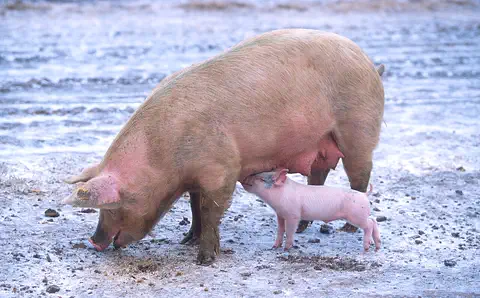
Domestic pig
Domestic pigs live with people on every continent except Antarctica. Their ancestor is the wild boar, which people began taming about 9,000 years ago. Pigs are among the smartest farm animals, with a super-sensitive snout for digging up food.
-
 Watch
3D
Animal
Llama
Llamas are South American cousins of camels, without the hump. People in the Andes Mountains bred them from wild guanacos thousands of years ago, and they still carry loads, give wool and even guard sheep. Llamas do not live in the wild: every llama lives with people.
-
 Watch
Animal
Aardvark
The aardvark is a shy night digger of African savannas. It sniffs out ant and termite nests, rips them open with its spade-like claws and laps up the insects with a sticky tongue about 30 centimeters long. Its name means 'earth pig' in Afrikaans.
-
 Watch
Animal
African buffalo
The African buffalo is a huge, cow-like grazer with heavy, curving horns. It lives in herds that can number in the thousands, and a herd will rush to protect a calf in danger. It lives across much of Africa south of the Sahara, from open savannas to rainforests.
-
 Watch
Animal
African forest elephant
The African forest elephant is a separate species from the bigger bush elephant. It lives in the rainforests of central and western Africa, eats lots of fruit and spreads the seeds of forest trees in its dung. It is Critically Endangered.
For parents & teachers
What children will learn
- Explain that sheep are domesticated and where they were first tamed.
- Describe how wool developed through selective breeding.
- Describe the sheep's ruminant diet and its flocking behavior.
- Describe the sheep life cycle and why lambs are born in spring.
Recommended ages: 3 to 17 · About 15 minutes
Talk about it
- Why might staying in a flock help a sheep stay safe?
- What things in your home might be made of wool?
- How could farmers make sure their sheep do not eat a hillside bare?
Try at home or in class
- Look at a piece of wool yarn under a magnifying glass, then gently untwist it to find the fibers it is made from.
- Play 'flock': one person gently guides a group of children who must stay together without a leader, and talk about how it feels.
Key vocabulary: ewe, ram, lamb, fleece, flock, shear
Where these facts come from
- GBIF Backbone Taxonomy and GBIF Occurrence Search , Global Biodiversity Information Facility (CC0 1.0 (backbone); occurrence counts are facts derived from records under CC0, CC BY and CC BY-NC)
- Wikidata , Wikimedia Foundation (CC0 1.0)
- Sheep , Encyclopaedia Britannica
- Mouflon , Encyclopaedia Britannica
- Ovis aries (domestic sheep) , Animal Diversity Web, University of Michigan Museum of Zoology
- Wikimedia Commons , Wikimedia Foundation (Per file: Public domain, CC0, CC BY or CC BY-SA only (credited on each page))
Checked, not yet human-reviewed. Last updated October 28, 2026. Spotted a mistake? Tell us.