
Natural wonder Africa
Virunga National Park
Virunga is a big wild park in Africa. It has smoking volcanoes, snowy mountains, lakes and forests. Mountain gorillas live in its misty forests.
Virunga National Park, in the east of the Democratic Republic of the Congo, was founded in 1925; the park describes itself as Africa's first national park. It stretches from active volcanoes in the south to the snowy Rwenzori Mountains in the north. About one third of the world's mountain gorillas live in its forests, along with elephants, hippos, chimpanzees and hundreds of kinds of birds.
Virunga National Park covers about 7,800-7,900 km² of the Albertine Rift in the eastern Democratic Republic of the Congo, from 680 m to 5,109 m, including Nyiragongo and Nyamulagira, Africa's two most active volcanoes, and part of the Rwenzori Mountains. Established in 1925 as Albert National Park and listed by UNESCO in 1979, it holds about a third of the world's mountain gorillas. UNESCO has listed it as World Heritage in Danger since 1994.
Photo: Ad Meskens, CC BY-SA 3.0, via Wikimedia Commons
Discover Virunga
Virunga is a national park in Africa.
It is very big and very wild. It has volcanoes, lakes, grassy plains and forests. Up north there are snowy mountains. Many animals live here, like gorillas, elephants and hippos.
Virunga National Park lies in the east of the Democratic Republic of the Congo, along the borders with Uganda and Rwanda. It was founded in 1925 as Albert National Park, and the park says it was the first national park in Africa. In 1969 it was renamed Virunga, and in 1979 UNESCO made it a World Heritage Site.
UNESCO says few parks anywhere have so many different landscapes: grassy plains and savannas, marshes, lowland and mountain forests, chains of volcanoes and, on the Rwenzori Mountains, glaciers and snow. The land rises from 680 meters to 5,109 meters, so the climate, plants and animals change a lot from one part of the park to another.
UNESCO describes Virunga as a mosaic of habitats over 790,000 ha, from steppes, savannas and marshes to low-altitude and Afromontane forest, Afro-alpine vegetation and permanent snow and glaciers on the Rwenzori; the park itself gives about 3,000 square miles (7,800 km²) in four sectors, northern, central, southern and lake. It was created in 1925 as Albert National Park, first around three volcanoes in the south, and later extended north to the Rwindi plains, Lake Edward and the Rwenzori; it took the name Virunga in 1969.
The park is managed by the Congolese Institute for Nature Conservation (ICCN), since 2011 in a long-term partnership with the Virunga Foundation. UNESCO inscribed it in 1979 under criteria for landscape, geology and biodiversity, and it has been on the List of World Heritage in Danger since 1994. Lake Edward and the neighboring Queen Elizabeth National Park in Uganda act as ecological corridors linking the park's sectors.
- Country
- Democratic Republic of the Congo
- Founded
- 1925 (as Albert National Park)
- Area
- about 7,800 km² (park); 790,000 ha (UNESCO)
- Height range
- 680 m to 5,109 m
- World Heritage Site
- since 1979
A rift full of volcanoes
Deep under Virunga, the ground is slowly pulling apart.
Hot melted rock pushes up through the cracks. That is how the volcanoes were made. One volcano has a lake of glowing lava in its top!
Virunga sits in the Albertine Rift, the western branch of Africa's Great Rift Valley. Here the Earth's crust is slowly stretching apart, and molten rock can rise to the surface. UNESCO says this stretching built the Virunga Mountains, a chain of eight volcanoes, seven of them partly or fully inside the park.
Two of them, Nyiragongo and Nyamulagira, are the most active volcanoes in Africa. Their lava is very runny. Nyiragongo's crater holds a lake of lava, which the park describes as about 700 feet (210 meters) across. In the north, the Rwenzori Mountains rise to 5,109 meters, high enough for glaciers.
UNESCO places the park in the center of the Albertine Rift, part of the Great Rift Valley, where extension of the crust has raised the Virunga massif of eight volcanoes, seven wholly or partly within the park. Nyamulagira and Nyiragongo, the continent's two most active, account between them for about two-fifths of Africa's historic eruptions and are known for the extreme fluidity of their alkaline lava. Nyiragongo is of world importance for its almost permanent lava lake, which drains periodically with serious consequences for nearby communities; the park gives the lake as about 700 ft across and the volcano as 3,470 m.
The Rwenzori are not volcanoes: UNESCO calls them the only true alpine mountain chain in Africa and its largest glacial region. The park's northern sector holds about 20% of the massif and shares Margherita Peak (Pic Marguerite, 5,109 m), the third-highest summit in Africa, with Uganda's Rwenzori Mountains National Park. UNESCO also highlights the eroded valleys of the Sinda and Ishango areas.
Mountain gorillas
Mountain gorillas live in the misty forests on the volcanoes.
They live in families. Babies ride on their mothers and play in the trees. A big male with a silver back looks after the group.
Mountain gorillas live in only two places on Earth: the forests of the Virunga volcanoes, shared by the Democratic Republic of the Congo, Rwanda and Uganda, and Bwindi Impenetrable National Park in Uganda. About one third of all mountain gorillas live inside Virunga National Park, the park says.
They were once in serious danger. Now, thanks to rangers and conservation work, their numbers have grown. WWF reports that the gorillas of the Virunga volcanoes rose from 480 in 2010 to 604, and the IUCN has changed their status from critically endangered to endangered. Rangers check on the park's ten groups of gorillas that are used to people.
The mountain gorilla (Gorilla beringei beringei), a subspecies of the eastern gorilla, survives in two populations: the Virunga Massif, shared by the DRC, Rwanda and Uganda, and Bwindi Impenetrable National Park in Uganda. WWF reports that the Virunga Massif population grew from 480 in 2010 to 604, bringing the wild total above 1,000, and the park records that the IUCN downgraded the subspecies from Critically Endangered to Endangered after the recovery. Virunga National Park holds about a third of the world population in its southern gorilla sector.
UNESCO notes that Virunga is a refuge for 22 primate species, including three great apes: the mountain gorilla, Grauer's or eastern lowland gorilla (G. b. graueri) and the eastern chimpanzee. Threats named by WWF include clearance of habitat for farming, firewood, charcoal and livestock, and the park warns that gorillas can catch human illnesses; the park runs the Senkwekwe Centre, established in 2009 for orphaned mountain gorillas.

From lakes to snowy peaks
Hippos splash in the rivers and lakes.
Elephants and buffalo walk across the grassy plains. Okapis hide in the forest. Hundreds of kinds of birds fly here too.
Because the park climbs from warm plains to icy peaks, it holds an amazing mix of life. UNESCO counts 218 kinds of mammals, 706 kinds of birds, 109 kinds of reptiles and 78 kinds of amphibians, plus more than 2,000 kinds of plants.
On the grassy Rwindi plains and around Lake Edward live elephants, buffalo, warthogs and hippos. Both savanna elephants and forest elephants live in the park. Shoebills, tall birds with huge beaks, hunt in the swamps near Lake Edward. In the forests lives the okapi, a shy relative of the giraffe found only in the Democratic Republic of the Congo.
UNESCO credits the altitude range of 680-5,109 m, rainfall and soils with making Virunga Africa's most biologically diverse national park: over 2,000 plant species (10% endemic to the Albertine Rift), 218 mammals, 706 birds, 109 reptiles and 78 amphibians, with savanna wildlife biomass of about 27.6 tonnes per km², one of the highest on Earth. Rarities include the okapi, endemic to the DRC, and the Rwenzori red duiker; the park also matters for wintering Palearctic birds.
Its hippo population shows both loss and recovery. UNESCO's description cites large hippo numbers along Lake Edward and the Rwindi, Rutshuru and Semliki rivers, but the park reports a collapse of about 98% from the 1960s-1970s, after heavy poaching, before its 2017 count exceeded 2,000 for the first time in over 20 years. In 2020, a herd of more than 500 elephants, the largest seen since the 1980s, was recorded in the Ishasha corridor.
Rangers and neighbors
Park rangers look after Virunga.
They watch over the gorillas every day. They walk through the forest to keep the animals safe. Lots of people live near the park too.
More than 800 rangers protect Virunga, the park says. They are local men and women who go through hard training, and they check on the gorillas every day. In 2015 the rangers received National Geographic's Explorer of the Year award for their work.
About four million people live within a day's walk of the park. The park is working with them on projects such as small power stations that use rivers to make electricity, farming, fishing and tourism, to create jobs and reduce the pressure on the park's forests and wildlife.
Virunga's history includes long periods of conflict. The park describes attacks on patrol posts from 1990, the arrival in 1994 of nearly 2 million people fleeing the genocide in neighboring Rwanda, most settling within walking distance of the park, and war in the DRC from 1996, with armed groups, poaching, charcoal production and land clearance continuing in parts of the park since. UNESCO notes that the ICCN has lost many staff killed on duty, and WWF records that parts of the gorilla habitat have at times been occupied by armed groups, making conservation work dangerous or impossible. Proposals to explore for oil around Lake Edward in 2013 met local and international opposition; the company involved did not renew its claim.
The park's response combines protection with development. More than 800 rangers protect it, and the Virunga Alliance invests in hydropower, sustainable agriculture, fisheries and tourism for the roughly four million people living within a day's walk, aiming to give young people alternatives to joining armed groups.
Visiting safely
Gorilla walks are only for older children and grown-ups.
Visitors walk quietly with rangers. They wear a mask so the gorillas don't catch a cold. Never feed or touch wild animals.
Gorilla treks are led by Virunga's rangers and trackers, and visitors must be at least 15 years old. The walk to a gorilla family takes about 1 to 2.5 hours each way through the forest, so good boots, long sleeves and long socks help against thorns, stinging plants and ants.
Gorillas can catch human illnesses, so every visitor wears a mask near them, and anyone who feels sick should cancel or change the date. The park closes attractions if there is any sign of a security problem, and families should always follow their own government's travel advice before going.
Virunga's tourism service sets an age limit of 15 years for gorilla visits; treks are led by rangers and local trackers (pisteurs) who monitor the park's ten habituated groups, and take about 1 to 2.5 hours each way. Because mountain gorillas are susceptible to human disease, visitors wear surgical masks in the gorillas' presence and are asked to cancel or rebook if unwell.
Security matters too. The park states that it assesses conditions continuously, may temporarily close attractions if there are signs of a security issue, and that visitors must assess their trip on the advice of their own consular services. Respect for distance, quiet and hygiene protects both visitors and the animals.
Amazing facts
-
Virunga has three kinds of great apes.
Virunga is home to three kinds of great apes: mountain gorillas, eastern lowland gorillas and eastern chimpanzees.
Virunga shelters three great ape taxa, Gorilla beringei beringei, G. b. graueri and Pan troglodytes schweinfurthii, among 22 primate species.
-
One volcano here has a lake of hot lava inside.
Nyiragongo's crater holds a lake of lava, which the park describes as about 700 feet (210 meters) across.
UNESCO calls Nyiragongo of world importance as a witness to lava-lake volcanism; its almost permanent lake drains periodically.
-
Two kinds of elephants live in Virunga.
Both savanna elephants and forest elephants live in Virunga, one of the few places in the world where the two species share a home.
Virunga is one of few places where African savanna and forest elephants coexist; in 2020 a herd of over 500 was seen in the Ishasha corridor.
-
Virunga has more kinds of birds than the whole United States.
The park says Virunga has more kinds of birds than the whole of the United States, and more than three times as many as the United Kingdom.
The park reports that its bird list exceeds the US total and is over three times the UK's; UNESCO counts 706 species.
Words to know
- national park
- a large area of land protected by law for nature and visitors
- rift valley
- a long valley where the Earth's crust is pulling apart
- lava lake
- a pool of melted rock inside a volcano's crater
- ranger
- a person whose job is to protect a park and its wildlife
- habituated
- used to people being nearby, so the animals stay calm
- endangered
- at high risk of dying out in the wild
Discovery challenge
-
Which great ape lives in Virunga's misty mountain forests?
Which famous great ape lives in the forests on Virunga's volcanoes?
About a third of the world population of which great ape lives in Virunga?
- Mountain gorilla
- Orangutan
- Bonobo
Show the answer
Mountain gorilla
Mountain gorillas! They live in families.
Mountain gorillas; about one third of them live in Virunga.
The mountain gorilla, Gorilla beringei beringei.
-
What does Nyiragongo volcano have inside its top?
What is special about the crater of Nyiragongo?
Why does UNESCO call Nyiragongo of world importance?
- A lake of lava
- A lake of ice
- A forest of trees
Show the answer
A lake of lava
A lake of hot, glowing lava!
A lava lake, which the park describes as about 210 meters across.
Its almost permanent lava lake, a world example of lava-lake volcanism.
-
When did Virunga become a park?
In which year was Virunga founded, as Albert National Park?
In which year was Albert National Park, today Virunga, established?
- 1925
- 1979
- 2009
Show the answer
1925
In 1925, about 100 years ago.
1925; it became a World Heritage Site in 1979.
1925; renamed Virunga in 1969 and inscribed in 1979.
-
Why do gorilla visitors wear masks?
Why must visitors wear masks near Virunga's gorillas?
What risk do masks reduce during gorilla visits?
- So gorillas don't catch human illnesses
- To keep out the smell
- To hide from the gorillas
Show the answer
So gorillas don't catch human illnesses
Gorillas can catch our colds. Masks help keep them healthy.
Gorillas can catch human illnesses, so masks help protect them.
Transmission of human disease, to which mountain gorillas are susceptible.
-
Who looks after Virunga's animals every day?
Who protects Virunga's wildlife and leads the gorilla treks?
Which local team, honored by National Geographic in 2015, protects the park?
- Park rangers
- Astronauts
- Firefighters
Show the answer
Park rangers
Park rangers! They check on the gorillas every day.
More than 800 rangers, local men and women.
Virunga's rangers, named National Geographic Explorers of the Year in 2015.
Nearby places
-
 Watch
Natural wonder
Mount Nyiragongo
Mount Nyiragongo is a steep volcano in the Virunga Mountains of the Democratic Republic of the Congo, near the border with Rwanda and just north of Lake Kivu. It is 3,470 meters high, and its deep summit crater often holds a lake of bubbling lava. Its lava is very runny, and eruptions in 1977, 2002 and 2021 sent lava flowing down its sides toward the city of Goma.
-
 Watch
Natural wonder
Lake Victoria
Lake Victoria is the largest lake in Africa, and Britannica says only Lake Superior, in North America, is a bigger freshwater lake. It is shared by Kenya, Tanzania and Uganda. The lake is wide but shallow, its only outlet is the Nile, and it is home to hundreds of kinds of colorful fish called cichlids.
-
 Watch
Natural wonder
Serengeti National Park
Serengeti National Park in northern Tanzania protects 14,763 square kilometers of grassy plains and woodlands. Each year more than a million wildebeest, with zebras and gazelles, travel a great loop across the Serengeti and into Kenya in search of grass and water, followed by lions and other predators.
-
 Watch
Natural wonder
Lake Tanganyika
Lake Tanganyika lies in a deep crack in Africa called a rift valley. Britannica calls it the longest freshwater lake in the world, and only Lake Baikal, in Russia, is deeper. Four countries share it: Tanzania, the Democratic Republic of the Congo, Burundi and Zambia. Its water is home to about 250 kinds of cichlid fish found nowhere else.
-
 Watch
Natural wonder
Ngorongoro Conservation Area
The Ngorongoro Conservation Area in northern Tanzania holds the Ngorongoro Crater, a giant bowl about 16 to 20 kilometers across, left when an ancient volcano collapsed about 2.5 million years ago. Around 25,000 large animals live in and around the crater. The area also protects Olduvai Gorge and Laetoli, where scientists have found important evidence of how humans evolved.
-
 Watch
Natural wonder
Great Rift Valley
The Great Rift Valley is a huge valley that runs through East Africa, where the continent is slowly being stretched and pulled apart. Long, steep cliffs line its sides, its floor holds lakes full of flamingos, and giant volcanoes such as Kilimanjaro and Mount Kenya rose beside it. Scientists think a new ocean may one day open here.
-
 Watch
City
Nairobi
Nairobi, the capital of Kenya, sits high in the highlands of East Africa. It began in the late 1890s as a railway camp beside a Maasai water hole called Enkare Nairobi, "Cold Water." Today it is one of the biggest cities in tropical Africa, with Nairobi National Park, full of wild animals, at its edge.
-
 Watch
Natural wonder
Mount Kenya
Mount Kenya is the second highest mountain in Africa, 5,199 meters tall, standing just south of the Equator in central Kenya. It is an old volcano that stopped erupting millions of years ago and has been carved by glaciers into sharp rocky peaks. Its slopes climb through farms, forests, bamboo and strange giant plants up to small, shrinking glaciers.
Explore next
-
Watch
 Country
Democratic Republic of the Congo
The Democratic Republic of the Congo, or DR Congo, is the second-largest country in Africa. The mighty Congo River curves through its rainforests, volcanoes rise in the east, and its capital, Kinshasa, is a center of music, fashion and popular culture.
-
Watch
Animal
Eastern gorilla
The eastern gorilla is the gorilla of the misty mountains and forests of east-central Africa. It has two kinds: the shaggy mountain gorilla, whose numbers are slowly growing, and the big Grauer's gorilla, which has become much rarer.
-
 Watch
Animal
Okapi
The okapi has a velvety reddish-brown coat and zebra-like stripes on its legs, but its closest living relative is the giraffe. It lives only in the rainforests of the Democratic Republic of the Congo, where it browses leaves with a long, dark tongue. It is endangered.
-
 Watch
Animal
Common hippopotamus
The common hippopotamus is one of the biggest animals on land, yet it spends most of the day resting in rivers and lakes to keep cool. At night it walks out to graze, and its special skin makes its own sunscreen.
-
Watch
Natural wonder
Great Rift Valley
The Great Rift Valley is a huge valley that runs through East Africa, where the continent is slowly being stretched and pulled apart. Long, steep cliffs line its sides, its floor holds lakes full of flamingos, and giant volcanoes such as Kilimanjaro and Mount Kenya rose beside it. Scientists think a new ocean may one day open here.
-
Watch
Natural wonder
Mount Nyiragongo
Mount Nyiragongo is a steep volcano in the Virunga Mountains of the Democratic Republic of the Congo, near the border with Rwanda and just north of Lake Kivu. It is 3,470 meters high, and its deep summit crater often holds a lake of bubbling lava. Its lava is very runny, and eruptions in 1977, 2002 and 2021 sent lava flowing down its sides toward the city of Goma.
- Watch Geography Types of volcanoes Volcanoes come in different shapes. Runny lava builds wide, gentle shield volcanoes like Mauna Loa. Sticky lava and ash build tall, steep stratovolcanoes like Mount Fuji. Small cinder cones grow from bits of lava thrown into the air. Whether lava is runny or sticky, and how much gas it holds, decides the shape and how explosive the eruptions are.
-
 Watch
Natural wonder
Victoria Falls
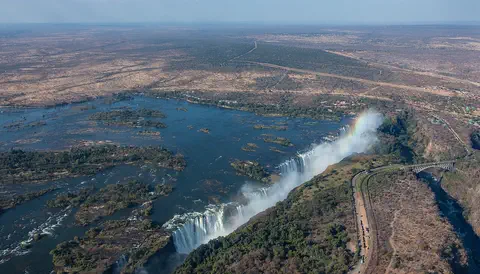
Victoria Falls, on the Zambezi River between Zambia and Zimbabwe, is about 1,708 meters wide and up to 108 meters deep. UNESCO calls it the largest curtain of falling water in the world, and its spray can be seen from tens of kilometers away.
For parents & teachers
What children will learn
- Locate Virunga National Park in the eastern Democratic Republic of the Congo.
- Explain how the Albertine Rift produced the park's volcanoes.
- Describe the mountain gorilla's recovery and the rules that protect it.
- Explain how rangers and local communities work to protect the park.
Recommended ages: 3 to 17 · About 15 minutes
Talk about it
- Why might a park with volcanoes, lakes and glaciers have so many kinds of animals?
- How could a park help the people who live next to it?
- Why is it important not to visit wild animals when you are sick?
Try at home or in class
- Draw the park from south to north: volcanoes, Lake Edward, grassy plains and the snowy Rwenzori. Add the animals that live in each part.
- Hold a sheet of paper by two edges and gently pull it apart until it tears, to see how a rift opens in the middle.
Key vocabulary: national park, rift valley, lava lake, ranger, habituated, endangered
Where these facts come from
- Wikidata , Wikimedia Foundation (CC0 1.0)
- UNESCO World Heritage List , UNESCO World Heritage Centre (Linked as a reference; site facts come from Wikidata)
- Virunga National Park , UNESCO World Heritage Centre
- About Virunga , Virunga National Park
- History of Virunga , Virunga National Park
- Trekking with Mountain Gorillas , Visit Virunga National Park
- Frequently asked questions , Visit Virunga National Park
- Mountain gorilla , WWF
- Wikimedia Commons , Wikimedia Foundation (Per file (public domain, CC0, CC BY or CC BY-SA); see each media record)
Checked, not yet human-reviewed. Last updated October 27, 2026. Spotted a mistake? Tell us.