
Animal
Flatback sea turtle
The flatback sea turtle has a flat shell. It lives in the warm, shallow sea around northern Australia and only lays its eggs on Australian beaches.
The flatback sea turtle is named for its flat, smooth shell. It stays in shallow coastal seas around northern Australia, eats soft sea animals such as sea cucumbers and jellyfish, and nests only on Australian beaches, where its big hatchlings dash for the waves at night.
Natator depressus is a sea turtle of the continental shelf of northern Australia, southern New Guinea and the Indonesian archipelago that breeds only in Australia. It lays fewer but larger eggs than other sea turtles, its young stay in shallow coastal water rather than drifting out into the open ocean, and the IUCN still lists it as Data Deficient on a 1996 assessment.
Photo: Purpleturtle57, CC BY-SA 3.0, via Wikimedia Commons
Meet the flatback sea turtle
The flatback is a sea turtle with a flat shell.
Its shell is gray-green on top and creamy yellow underneath. It swims with big flippers. Baby flatbacks hatch from eggs on sandy beaches in Australia.
The flatback sea turtle gets its name from its shell, which is flatter than the rounded shells of other sea turtles, with edges that turn up a little. Adults are gray, pale gray-green or olive on top and creamy yellow underneath.
A grown-up flatback has a shell up to about 1 meter long and can weigh about 90 kilograms, as much as a large adult person. Flatbacks are reptiles, so they breathe air and lay eggs on land, even though they spend almost their whole lives in the sea.
Natator depressus is a reptile (class Reptilia, order Testudines) and one of the seven living sea turtles. The Australian Government describes a low-domed, olive-gray carapace with upturned edges and four or more pairs of large costal scales along each side; the Queensland Government gives an adult shell length of up to 1 meter and a total length of up to 1.2 meters from head to tail. SEE Turtles, a conservation nonprofit, gives a typical adult weight of about 200 pounds (90 kilograms).
The IUCN assessment calls the flatback one of the most poorly understood marine turtles, and SEE Turtles suggests the remoteness of much of its habitat is part of the reason. The Australian Government notes that all known breeding sites are in Australia.
Quick facts
- Group
- Reptile
- Length
- up to 1 m
- Weight
- 90 kg
- Lifespan in the wild
- 50 years
A turtle of Australia's shallow seas
Flatbacks live in warm, shallow sea near northern Australia.
They swim close to the coast. They only lay their eggs on beaches in Australia.
Flatbacks live in the warm, shallow seas along the coast of northern Australia, as far south as the Tropic of Capricorn. Some swim to feeding areas near Indonesia and Papua New Guinea, but every known nesting beach is in Australia.
They like soft, sandy or muddy sea floors rather than coral reefs. Some other sea turtles travel thousands of kilometers, but flatbacks stay over the shallow continental shelf and travel hundreds.
The Australian Government lists the flatback's feeding range along northern Australia to about the Tropic of Capricorn, extending to the Indonesian archipelago and the Papua New Guinea coast, mostly over shallow, soft-bottomed sea floors away from reefs. All known breeding sites are in Australia, from Mon Repos in southern Queensland to Exmouth in Western Australia, with the largest nesting concentration in the northeastern Gulf of Carpentaria and western Torres Strait.
Western Australia's Department of Biodiversity, Conservation and Attractions (DBCA) recognizes seven genetically distinct breeding stocks, five of them in Western Australia, while the Australian Government's species page groups nesting into four major areas. Flatbacks travel hundreds of kilometers between nesting and feeding areas, far less than many other sea turtles; SEE Turtles adds that they have no open-ocean phase and are usually found in water less than about 60 meters (200 feet) deep.
Continent
Did you know?
Scientists can count rings in a turtle's bones, like rings in a tree.
By counting growth rings in flatback bones, a bit like tree rings, scientists worked out that flatbacks start breeding at about 16 and live to about 50.
Skeletochronology, counting growth layers in bone, gives an age at first breeding of about 16 years and a lifespan of about 50 years (DBCA).
Where can you find this animal?
- Lives here naturally · Countries and seas named by a scientific source
- Sightings recorded · Records of wild sightings (GBIF)
Lives here naturally · Countries and seas named by a scientific source
Shallow continental-shelf waters of northern Australia, south to about the Tropic of Capricorn, with feeding grounds reaching the Indonesian archipelago and the Papua New Guinea coast. Every known nesting beach is in Australia. Shading is by country, so it covers far more land than the coastal seas the turtles use.
Places: Australia, Indonesia and Papua New Guinea.
Source: https://www.dcceew.gov.au/environment/marine/marine-species/marine-turtles/flatb · checked October 2026
Sightings recorded · Records of wild sightings (GBIF)
Counts of GBIF records of wild observations (human and machine) and preserved specimens. Records include introduced populations, vagrants, escaped or released animals and misidentifications, so a country with records is not necessarily part of the native range.
Wild sightings have been recorded in Australia, Indonesia, Papua New Guinea, Timor-Leste, Japan, New Caledonia, New Zealand, Pacific Ocean and 4 more places.
Source: gbif · checked October 2026
Range maps show where scientists say an animal lives, often country by country. An animal may live in only part of a country shown, and sightings records can include animals that wandered far from home.
What it eats
Flatbacks eat soft sea animals.
They eat sea cucumbers, soft corals and jellyfish. They find their food on the sandy sea floor.
Flatbacks are carnivores, which means they eat other animals. They like soft-bodied sea creatures: sea cucumbers, soft corals and jellyfish.
They find most of their food in shallow water over soft, sandy or muddy sea floors. Because flatbacks eat jellyfish, a floating plastic bag can look like food to them, and swallowing plastic can make a turtle very sick.
The Australian and Queensland governments describe the flatback as carnivorous, feeding mostly on soft-bodied prey such as sea cucumbers, soft corals and jellyfish in subtidal, soft-bottomed habitats. SEE Turtles gives a broader list that also includes shrimp, crabs, molluscs, fish and seaweed.
The Queensland Government warns that turtles can mistake plastic bags for jellyfish, and that swallowed plastic can block the stomach and intestines. For a predator of soft drifting animals, floating rubbish is a particular hazard.
Did you know?
Baby flatbacks walk toward the brightest part of the sky over the sea.
Hatchlings find the sea by heading toward the lighter horizon over the water, so beach lights can lead them the wrong way.
Hatchlings orient to the brighter seaward horizon; artificial lighting can draw them inland, where predators catch them (Queensland Government).
A flat shell and strong flippers
A flatback has a smooth, flat shell.
It has four flippers. The front flippers are long and push it through the water. Babies have dark lines around the plates on their shells.
The flatback's shell is low and flat, with upturned edges. It is covered with big plates called scutes, with four or more pairs along each side.
It has four flippers. Hatchlings use the long front ones to scramble to the sea, and mothers dig their nests with the back ones. Hatchlings look different from adults: they are olive-green, and each plate on the shell is outlined in black, like the baby in this photo.
Key identification features given by the Australian Government are a low-domed carapace with upturned margins, four or more pairs of costal scutes, and olive-gray coloring; the underside is creamy yellow. Hatchlings are olive-green with the dorsal scutes broadly outlined in black (Queensland Government), as the hatchling in this photo shows.
As in all sea turtles, the limbs are flippers; DBCA describes nesting females digging the egg chamber with their back flippers. Flatback eggs and hatchlings are proportionally larger than those of other sea turtles, which SEE Turtles suggests may help hatchlings avoid predators.
From beach to sea
A mother flatback crawls up a beach at night.
She digs a hole and lays about 50 eggs. The babies hatch and dig out of the sand together. Then they run to the sea.
A female flatback comes back to nest near the beach where she hatched. She crawls up the sand, digs a hole with her back flippers, lays about 50 to 70 eggs and covers them over before returning to the sea.
When the babies hatch, they break out of their leathery eggs at night and dig up through the sand together. On the surface they head for the brighter horizon over the sea and race into the waves. Flatbacks start to breed when they are about 16 years old and can live to about 50.
Females return to breed near the region where they hatched. DBCA describes a female digging the nest with her back flippers and laying 50 to 70 eggs; the Queensland Government says flatbacks lay the fewest eggs of any marine turtle, about 50 per nest. Females nest every two to three years, which DBCA estimates could add up to around 2,000 eggs in a lifetime. On the east coast nesting peaks in late November and early December and hatchlings emerge from late December to about late March, mostly in February (Australian Government); in the Gulf of Carpentaria flatbacks nest all year round.
Hatchlings break out of the leathery eggs at night, dig up together and orient toward the lighter sea horizon. Using growth rings in bones, scientists estimate that flatbacks begin breeding at about 16 years and live about 50 years (DBCA).
A stay-at-home sea turtle
Flatbacks do not swim across big oceans.
They stay close to the coast of Australia. Mother turtles swim back to the same beaches to lay eggs.
Many sea turtles swim across whole oceans, but flatbacks stay closer to home. They travel hundreds of kilometers between the beaches where they nest and the shallow waters where they feed and mate, which is short for a sea turtle.
The tiny hatchlings face a dangerous start: many are eaten by sharks, crocodiles and birds, and only a few grow up. Mothers come back again and again to nest in the same part of the coast where they were born.
Flatbacks are not ocean wanderers: SEE Turtles notes they have no open-ocean phase and make no long ocean-crossing migrations, and DBCA describes movements of hundreds rather than thousands of kilometers between nesting, mating and foraging areas. The IUCN still records the species as a full migrant because adults move between those areas.
Survival is low for the young: the Queensland Government notes that many hatchlings are eaten by sharks and crocodiles, and SEE Turtles lists sand monitors, birds such as night herons and pelicans, and feral pigs as nest and hatchling predators. Saltwater crocodiles have also been seen attacking nesting females.
Did you know?
Flatbacks lay fewer eggs than other sea turtles, but bigger ones.
A flatback lays about 50 to 70 eggs in a nest, fewer than other sea turtles, but its eggs and babies are bigger.
Flatbacks lay the smallest clutches of any marine turtle (about 50 eggs, per the Queensland Government), but their eggs and hatchlings are proportionally large.
Protecting flatbacks
Flatbacks need safe, dark beaches to lay their eggs.
People protect the nests and keep lights off near the beach at night. Picking up plastic helps turtles too.
Scientists still do not know enough about flatbacks to say how many there are, so the IUCN lists them as Data Deficient. Australia protects them by law.
They face real problems: wild pigs dig up nests, bright lights near beaches confuse hatchlings so they crawl the wrong way, cars on beaches crush nests, and turtles drown in fishing nets. Rangers and volunteers now guard nests and control pigs.
The IUCN Red List lists the flatback as Data Deficient. That status rests on a 1996 ruling by the IUCN's Standards and Petitions Subcommittee after a petition against its 1996 Vulnerable listing, and the assessment is flagged as needing an update. Under Australia's national environment law, the EPBC Act, it is listed as Vulnerable (Australian Government).
The Queensland Government names threats including nest predation by feral pigs (up to 90 percent of nests in west Cape York in the past), vehicles and coastal development on nesting beaches, light pollution that disorients hatchlings, water pollution, and drowning in fishing gear and discarded ghost nets. A national Recovery Plan for Marine Turtles in Australia (2017) sets out actions, Queensland's Nest to Ocean program has protected nests from predators since 2014, and Avoid Island, a major eastern rookery, is now a nature refuge.
IUCN Red List
How is the flatback sea turtle doing in the wild?
- Least Concern
- Near Threatened
- Vulnerable
- Endangered
- Critically Endangered
- Extinct in the Wild
- Extinct
Data Deficient
Scientists do not know enough about it yet to say how it is doing.
See the IUCN Red List assessment · The IUCN Red List of Threatened Species 2022.2
Amazing facts
-
Flatbacks lay fewer eggs than other sea turtles, but bigger ones.
A flatback lays about 50 to 70 eggs in a nest, fewer than other sea turtles, but its eggs and babies are bigger.
Flatbacks lay the smallest clutches of any marine turtle (about 50 eggs, per the Queensland Government), but their eggs and hatchlings are proportionally large.
-
Every flatback nest ever found is in Australia.
Flatbacks may feed near Indonesia and Papua New Guinea, but every known nesting beach is in Australia.
All known breeding sites are in Australia; DBCA recognizes seven genetically distinct breeding stocks, five of them in Western Australia.
-
Scientists can count rings in a turtle's bones, like rings in a tree.
By counting growth rings in flatback bones, a bit like tree rings, scientists worked out that flatbacks start breeding at about 16 and live to about 50.
Skeletochronology, counting growth layers in bone, gives an age at first breeding of about 16 years and a lifespan of about 50 years (DBCA).
-
Baby flatbacks walk toward the brightest part of the sky over the sea.
Hatchlings find the sea by heading toward the lighter horizon over the water, so beach lights can lead them the wrong way.
Hatchlings orient to the brighter seaward horizon; artificial lighting can draw them inland, where predators catch them (Queensland Government).
Words to know
- carapace
- the top part of a turtle's shell
- scute
- one of the hard plates that cover a turtle's shell
- hatchling
- a baby animal that has just come out of its egg
- rookery
- a beach where many sea turtles come to lay their eggs
- continental shelf
- the shallow sea floor around a continent, before the deep ocean begins
- endemic
- found naturally in only one place in the world
Discovery challenge
-
Where do flatbacks lay their eggs?
In which country are all known flatback nesting beaches?
Where are all known flatback breeding sites?
- Australia
- Brazil
- Canada
Show the answer
Australia
Flatbacks lay their eggs on beaches in Australia.
Every known flatback nesting beach is in Australia, from Queensland to Western Australia.
All known breeding sites are in Australia, from Mon Repos in Queensland to Exmouth in Western Australia.
-
Which of these do flatbacks eat?
Which soft sea animal is a favorite flatback food?
Which prey is typical of the flatback's carnivorous diet?
- Grass
- Sea cucumbers
- Bird seed
Show the answer
Sea cucumbers
Flatbacks eat soft sea animals like sea cucumbers.
They eat soft-bodied sea animals such as sea cucumbers, soft corals and jellyfish.
Mostly soft-bodied invertebrates such as sea cucumbers, soft corals and jellyfish, taken over soft sea floors.
-
How do baby flatbacks find the sea?
How do flatback hatchlings find their way to the sea?
Which cue do hatchlings follow to reach the sea?
- They follow the brighter sky over the sea
- Their mother carries them
- They wait for the tide to reach the nest
Show the answer
They follow the brighter sky over the sea
They walk toward the brighter sky over the sea.
They head toward the lighter horizon over the water, which is why beach lights can confuse them.
They orient toward the brighter seaward horizon; artificial light behind the beach can lead them inland.
-
Why is it called a flatback?
How did the flatback get its name?
Which feature gives Natator depressus its common name?
- It sleeps on its back
- Its shell is flat
- It has a flat tail
Show the answer
Its shell is flat
Its shell is flat.
Its shell is low and flat, with edges that turn up.
Its low-domed carapace with upturned margins, flatter than other sea turtles' shells.
Places where you might see it
-
 Watch
 Country
Australia
Australia is a country and the smallest continent, surrounded by ocean in the Southern Hemisphere. Much of its middle is dry and flat, most people live near the coast, and its animals include kangaroos, koalas and the platypus, a mammal that lays eggs.
-
 Watch
Natural wonder
Kakadu National Park
Kakadu, in Australia's Northern Territory, is the country's largest national park. It stretches from a high sandstone cliff called the escarpment down to floodplains, mangroves and the sea. Aboriginal people have lived here for tens of thousands of years, and their rock paintings, some up to 20,000 years old, record their way of life.
Explore next
-
 Watch
Animal
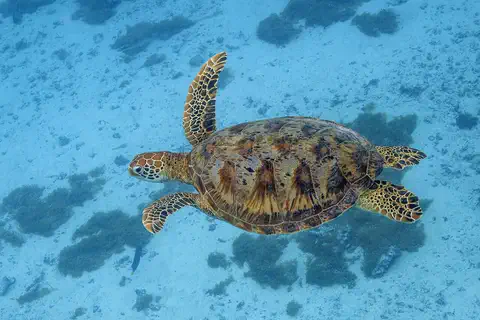
Green sea turtle
The green sea turtle is the largest sea turtle with a hard shell. It lives in warm seas around the world and, unlike other sea turtles, grown-ups eat mostly seagrass and algae. Females swim hundreds or even thousands of kilometers to lay their eggs on the beaches where they hatched long ago.
-
 Watch
3D
Animal
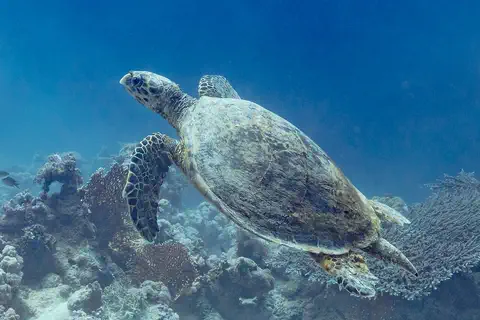
Hawksbill sea turtle
The hawksbill sea turtle lives in warm seas around the world, mostly near coral reefs. Its pointed, hawk-like beak reaches into cracks in the reef to find sponges, its favorite food. Its beautiful patterned shell once made it a target for hunters, and today it is critically endangered.
-
 Watch
Animal
Loggerhead sea turtle
The loggerhead sea turtle is named for its huge head and powerful jaws, which crush crabs, conchs and other hard-shelled animals. Babies hatch on sandy beaches, ride the open ocean for years and may cross an entire ocean before coming home to nest.
-
 Watch
Animal
Leatherback sea turtle
The leatherback sea turtle is the largest turtle on Earth. Instead of a hard shell it has tough, rubbery skin over a layer of tiny bones. It eats jellyfish, dives deeper than any other turtle and swims thousands of kilometers between feeding waters and the beaches where it lays its eggs.
-
Watch
Country
Australia
Australia is a country and the smallest continent, surrounded by ocean in the Southern Hemisphere. Much of its middle is dry and flat, most people live near the coast, and its animals include kangaroos, koalas and the platypus, a mammal that lays eggs.
-
 Watch
Animal
Saltwater crocodile
The saltwater crocodile is the largest reptile alive today. It lives in rivers, swamps and estuaries from India to northern Australia, can cope with fresh water and seawater, and sometimes swims far out across the open ocean to reach distant islands.
-
 Watch
Animal
Dugong
The dugong is a large, slow marine mammal that grazes on seagrass meadows in warm, shallow coastal seas from East Africa to the western Pacific. It is a relative of the manatee and, surprisingly, more closely related to elephants than to cows. It has a whale-like tail, a big bristly snout and very good hearing.
-
Watch
Natural wonder
Kakadu National Park
Kakadu, in Australia's Northern Territory, is the country's largest national park. It stretches from a high sandstone cliff called the escarpment down to floodplains, mangroves and the sea. Aboriginal people have lived here for tens of thousands of years, and their rock paintings, some up to 20,000 years old, record their way of life.
For parents & teachers
What children will learn
- Describe how the flatback sea turtle differs from other sea turtles (flat shell, small range, no open-ocean stage, fewer but larger eggs).
- Retell the flatback life cycle from nest to adult.
- Explain how lights, pigs, vehicles and fishing gear affect sea turtles, and what people do to help.
Recommended ages: 3 to 17 · About 12 minutes
Talk about it
- Why might laying fewer but bigger eggs help baby flatbacks survive?
- Why do you think hatchlings head for the brighter horizon, and what happens if there are lights behind the beach?
- What could families do on a beach holiday to help nesting turtles?
Try at home or in class
- Measure 1 meter on the floor with a tape measure and lie down next to it to compare yourself with an adult flatback's shell.
- In a dim room, stand at one end and walk toward a lit window, then switch on a lamp behind you and notice how a second light can pull you off course.
Key vocabulary: carapace, scute, hatchling, rookery, continental shelf, endemic
Where these facts come from
- The IUCN Red List of Threatened Species , International Union for Conservation of Nature (IUCN terms of use (no redistribution of Red List data or range maps))
- GBIF Backbone Taxonomy and GBIF Occurrence Search , Global Biodiversity Information Facility (CC0 1.0 (backbone); occurrence counts are facts derived from records under CC0, CC BY and CC BY-NC)
- Natator depressus (Flatback Turtle), 1996 assessment (errata version 2022) , IUCN Red List of Threatened Species
- Flatback turtle , Australian Government Department of Climate Change, Energy, the Environment and Water
- Flatback turtle , Queensland Government
- Understanding a unique Australian turtle , Department of Biodiversity, Conservation and Attractions, Western Australia
- Flatback sea turtles , SEE Turtles
- Wikidata , Wikimedia Foundation (CC0 1.0)
- Wikimedia Commons , Wikimedia Foundation (Per file: Public domain, CC0, CC BY or CC BY-SA only (credited on each page))
Checked, not yet human-reviewed. Last updated October 27, 2026. Spotted a mistake? Tell us.