
Animal
Galah
The galah is a pink and gray cockatoo from Australia. It lives in big, noisy flocks. It eats seeds from the ground and nests in holes in trees.
The galah is a cockatoo with a rose-pink face, neck and chest, a pale pink cap and gray wings and back. It lives across most of Australia, from open woodlands and grasslands to farms, parks and towns. Galahs feed on seeds on the ground in big, noisy flocks, and a pair stays together for life, raising chicks in a tree hollow lined with leaves.
Eolophus roseicapilla is a medium-sized cockatoo (family Cacatuidae), the only member of its genus, found across most of Australia. BirdLife International assessed it as Least Concern for the IUCN Red List (assessed 7 August 2018, published 2018): its population has not been counted but it is described as common, and the trend appears to be increasing. Clearing land for cereal crops and water points for livestock helped it spread inland after European settlement.
Photo: Charles J. Sharp, CC BY-SA 4.0, via Wikimedia Commons
Meet the galah
The galah is a pink and gray cockatoo.
Its face and chest are pink. Its wings are gray.
The galah is a cockatoo, a kind of parrot with a crest on its head. Its face, neck and chest are rose-pink, its cap is pale pink, and its back, wings and tail are gray. Around each eye is a ring of bare, wrinkled skin.
A galah is about 35 centimeters long and weighs about 270 to 350 grams. Its wings stretch about 75 centimeters from tip to tip. The name galah is of Aboriginal origin, and it is now used more than the older name, rose-breasted cockatoo.
Eolophus roseicapilla is a medium-sized cockatoo (family Cacatuidae, per the IUCN and the Australian Museum), the only species in its genus; the IUCN notes it was formerly placed in Cacatua. San Diego Zoo Wildlife Alliance gives a length of 35 to 36 centimeters, a wingspan of 75 centimeters and average weights of 345 grams for males and 311 grams for females; New Zealand Birds Online gives 270 to 350 grams.
The Australian Museum describes a rose-pink head, neck and underparts, a paler pink crown and a gray back, wings and undertail, with western birds paler. Three subspecies are named, though not every authority accepts the northern kuhli. San Diego Zoo Wildlife Alliance notes that 'galah', of Aboriginal origin, is now preferred to the European name rose-breasted cockatoo.
Quick facts
- Group
- Bird
- Length
- 0.35 to 0.36 m
- Wingspan
- 0.75 m
- Weight
- 0.27 to 0.35 kg
All over Australia
Galahs live almost everywhere in Australia.
They like open land with trees, and places near water.
Galahs live across most of Australia, including Tasmania and some islands off the coast. They like open country with trees: woodlands, grasslands and savannas, usually near water.
Galahs do well around people, too. You can see them on farms and in parks, gardens, sports fields and golf courses. The Australian Museum says they are becoming more common around towns, mostly because people provide more food and water.
The IUCN lists Australia as the galah's only native country. San Diego Zoo Wildlife Alliance describes most of Australia, including Tasmania and other offshore islands, in open habitats with trees, such as eucalyptus woodland and forest, grassland and savanna, and less often shrubland, beaches and mangroves; birds adapt well to farmland, pasture and suburban parks and sports fields.
The Alliance says the species spread inland after European settlement as native vegetation was cleared for cereal crops and water was provided for livestock, and that escapes from aviaries added to the spread. The Australian Museum and BirdLife Australia say it is becoming more abundant around human settlements, largely because of more available food and water, and call it one of the most abundant and familiar Australian parrots.
Continent
Its habitat

Where can you find this animal?
- Lives here naturally · Countries and seas named by a scientific source
- Sightings recorded · Records of wild sightings (GBIF)
Lives here naturally · Countries and seas named by a scientific source
Most of Australia, including Tasmania and some offshore islands, in open country with trees, farmland and towns.
Places: Australia.
Source: iucn-red-list · checked October 2026
Sightings recorded · Records of wild sightings (GBIF)
Counts of GBIF records of wild observations (human and machine) and preserved specimens. Records include introduced populations, vagrants, escaped or released animals and misidentifications, so a country with records is not necessarily part of the native range.
Wild sightings have been recorded in Australia, New Zealand, Belgium, Netherlands, United States, Germany, UK, Ireland and 9 more places.
Source: gbif · checked October 2026
Range maps show where scientists say an animal lives, often country by country. An animal may live in only part of a country shown, and sightings records can include animals that wandered far from home.
Seeds from the ground
Galahs eat seeds from grasses and plants.
They look for food on the ground in big groups.
Galahs mostly eat seeds, which they find on the ground: seeds of grasses and wild plants, and grains such as wheat. They also eat some fruit, nuts, roots, young shoots, flowers and insects.
Because they eat crops, farmers in some areas see them as pests. Galahs can travel long distances to find good feeding places. When food is easy to find, they feed in the morning and evening and rest in trees in between.
San Diego Zoo Wildlife Alliance lists mainly seeds of grasses, cereal grains, cultivated crops and herbaceous plants, plus fruits, berries, nuts, roots, young shoots and leaves, flowers, and insects and their larvae. Birds typically feed on the ground in flocks of 10 to 1,000, and also in foliage. In summer, when food is plentiful, they feed in the morning and evening; in winter they may forage most of the day, resting in trees between bouts of 30 minutes to 5 hours.
The Australian Museum says the seed and crop diet makes galahs agricultural pests in some areas, and that birds may travel long distances to good feeding grounds. The Alliance adds that they have been seen undoing the stitches on farmers' grain bags.
Did you know?
Galahs are clever at finding food.
Galahs have been seen undoing the stitches on farmers' bags of grain.
Resourceful foragers that undo stitches on grain bags (San Diego Zoo Wildlife Alliance, after Rowley and Boesman 2019).
Pink, gray and a bare eye ring
A galah has a short crest on its head.
Its beak is pale gray and strong.
A galah has a short crest that usually lies flat, so it looks like a pale cap. It can raise it, for example when defending its nest. Its hooked beak is pale gray.
Male and female galahs look almost the same, but their eyes are different: a male has dark brown eyes, and a female has pink to red eyes. Young galahs are duller, with gray mixed into their pink feathers. Galahs are strong, fast fliers, able to fly at least 70 kilometers per hour.
New Zealand Birds Online describes a small cockatoo with a slim frame and narrow wings suited to fast, agile flight, a short crest normally laid back as a pale cap, a pale gray bill, and juveniles with pink areas suffused with gray. San Diego Zoo Wildlife Alliance adds a raised, featherless ring of wrinkled pinkish skin around the eye, said to help tell the subspecies apart.
The sexes are similar except for iris colour: dark brown in males and pink to red in females (San Diego Zoo Wildlife Alliance; New Zealand Birds Online). The Alliance gives a flight speed of at least 70 kilometers per hour, says galahs glide only when landing, and describes a slow, rolling walk.
A nest in a tree hollow
Galah parents nest in a hole in a tree.
They line it with leaves. Mom and dad both look after the eggs.
A galah pair stays together for life. They nest in a hollow in a tree and line the bottom with fresh eucalyptus leaves, and they often use the same hollow year after year. The female usually lays about 4 eggs, and both parents take turns keeping them warm for about 22 to 26 days.
The chicks stay in the hollow for about 7 weeks. Then the parents lead them to nearby trees, where they join other young galahs and learn to fly in a flock.
San Diego Zoo Wildlife Alliance describes a long-term pair bond and a bowl-shaped nest lined with freshly collected eucalyptus leaves, usually in a tree hollow and often reused. Clutches are typically 4 eggs (from 2 to usually 6, rarely 7 or 8), laid 2 to 3 days apart; incubation takes 22 to 26 days (Rowley 1990), and male and female share nest building, incubation and care of the young.
Nestlings fledge at about 49 days (45 to 59) and are taken one at a time to a crèche in nearby trees; they feed on their own about 4 weeks after fledging and separate from their parents by about 14 weeks. Females first breed at about 3 years and males at 2 or 3. The Australian Museum gives the breeding season as February to July in the north and July to December in the south.
Noisy, playful flocks
Galahs live in big, noisy flocks.
They like to play. They even hang upside down!
Galahs are very social. They live in pairs and flocks, sometimes of a thousand birds or more, and at night huge, noisy flocks sleep together in big trees. On hot days they spend much of their time resting in the shade of leaves.
Galahs are playful: they swing upside down, slide down wires and roll down slopes. In light rain they may hang upside down from a branch to bathe. When an eagle or falcon comes, hundreds of galahs can swirl together like a tornado.
San Diego Zoo Wildlife Alliance describes a fission-fusion society of breeding pairs, juvenile flocks and local nomadic flocks that feed together, in groups from pairs to about 1,000 birds and, infrequently, over 2,000; large males dominate at food. Some birds are nomadic while others stay in home ranges. The Australian Museum notes a bouncing, acrobatic flight, sheltering from the heat in foliage for much of the day and huge, noisy roosts at night.
The Alliance records play (swinging upside down, sliding down wires, rolling down slopes), bathing upside down in light rain, mobbing of ground predators, and a 'swirling tornado flock' of hundreds of birds that appears to confuse raptors. Most breeding pairs strip a patch of bark near their nest hollow.
Did you know?
Galahs line their nests with leaves.
Galahs line their tree-hollow nests with fresh eucalyptus leaves.
The nest is a bowl lined with freshly collected eucalyptus leaves, usually in a tree hollow (San Diego Zoo Wildlife Alliance).
Listen to a galah
Listen to the sound at the start of this page.
It is a real galah calling in Perth, in Australia.
At the start of this page you can play a real recording of a galah calling near the Swan River in Perth, Western Australia, made in January 2025.
The Australian Museum describes the galah's voice as a high-pitched screech, 'chi-chi'. Galahs call loudly as they fly to their roost in the evening, and each galah can recognize others by their calls.
The recording on this page was uploaded to Wikimedia Commons by Ronnievonjohnson, who describes it as a galah call near the Swan River in Perth, Western Australia, recorded on 5 January 2025.
The Australian Museum describes the voice as a distinctive high-pitched screech, 'chi-chi'. San Diego Zoo Wildlife Alliance gives a two-note flight call written as chet-chet, chee-chuh or chill-chill, a short, harsh alarm screech and other calls given while perched; individuals recognize one another by their contact calls, and the calls and calling behaviour of males and females differ (Scarl and Bradbury 2009).
Did you know?
You can tell boy and girl galahs apart by their eyes.
Male galahs have dark brown eyes, and females have pink to red eyes.
Iris dark brown in males and pink to red in females; otherwise the sexes are similar (San Diego Zoo Wildlife Alliance; New Zealand Birds Online).
Least concern and common
There are lots of galahs in Australia.
They are protected by law there.
The galah is listed as least concern. Nobody has counted all the galahs, but they are common across Australia and their numbers seem to be growing.
They still face some problems. Some galahs are hit by cars when they feed beside roads, some are taken for illegal trade, and very hot weather can make them ill. Galahs are protected as a native species in Australia, and international trade in them is controlled.
BirdLife International assessed Eolophus roseicapilla as Least Concern for the IUCN Red List (assessed 7 August 2018, published 2018): an extremely large range, an apparently increasing trend and an unquantified population described as common (del Hoyo et al. 1997). The IUCN lists it as not a migrant, with a generation length of 12.1 years.
San Diego Zoo Wildlife Alliance lists illegal trade, heat stress linked to climate change, and collisions with vehicles while feeding beside roads as threats, and notes that the galah is protected as a native species under Australia's Environment Protection and Biodiversity Conservation Act 1999 and listed on CITES Appendix II. It also notes that cereal and oilseed farmers regard it as a pest.
IUCN Red List
How is the galah doing in the wild?
- Least Concern (this animal)
- Near Threatened
- Vulnerable
- Endangered
- Critically Endangered
- Extinct in the Wild
- Extinct
Least Concern
Not at risk of disappearing from the wild right now.
Amazing facts
-
Galahs can hang upside down to take a bath in the rain.
In light rain, galahs may hang upside down from a branch to bathe.
Galahs bathe by hanging upside down from a branch in light rain (San Diego Zoo Wildlife Alliance, after Rowley 1990).
-
You can tell boy and girl galahs apart by their eyes.
Male galahs have dark brown eyes, and females have pink to red eyes.
Iris dark brown in males and pink to red in females; otherwise the sexes are similar (San Diego Zoo Wildlife Alliance; New Zealand Birds Online).
-
Galahs line their nests with leaves.
Galahs line their tree-hollow nests with fresh eucalyptus leaves.
The nest is a bowl lined with freshly collected eucalyptus leaves, usually in a tree hollow (San Diego Zoo Wildlife Alliance).
-
Galahs are clever at finding food.
Galahs have been seen undoing the stitches on farmers' bags of grain.
Resourceful foragers that undo stitches on grain bags (San Diego Zoo Wildlife Alliance, after Rowley and Boesman 2019).
Words to know
- cockatoo
- a kind of parrot with a crest of feathers on its head
- crest
- a tuft of feathers on top of a bird's head
- tree hollow
- a hole inside a tree trunk or branch where animals can shelter or nest
- flock
- a group of birds that feed, fly or rest together
- roost
- to rest or sleep somewhere, often together in a tree
- crèche
- a group of young animals gathered together while adults look after them
Discovery challenge
-
What colors is a galah?
What are a galah's main colors?
Which colors describe the galah's plumage?
- Pink and gray
- Blue and yellow
- Black and white
Show the answer
Pink and gray
Pink and gray!
A rose-pink face, neck and chest, and gray wings, back and tail.
Rose-pink head, neck and underparts; gray back, wings and undertail (Australian Museum).
-
Where do galahs make their nests?
Where does a galah pair usually nest?
Where is the galah's nest typically placed?
- In a tree hollow
- On the beach sand
- Floating on a pond
Show the answer
In a tree hollow
In a hole in a tree!
In a tree hollow lined with fresh leaves.
Usually in a tree hollow, lined with fresh eucalyptus leaves (San Diego Zoo Wildlife Alliance).
-
What do galahs mostly eat?
What makes up most of a galah's food?
What is the galah's main food?
- Seeds
- Fish
- Nectar from flowers
Show the answer
Seeds
Seeds!
Mostly seeds of grasses, plants and crops, found on the ground.
Mainly seeds of grasses, cereal grains, crops and herbaceous plants (San Diego Zoo Wildlife Alliance).
-
In which country do galahs live?
Which is the only country where galahs are native?
To which country is the galah native?
- Australia
- Brazil
- Kenya
Show the answer
Australia
Australia!
Galahs are native only to Australia, where they live almost everywhere.
Australia is its only native country (IUCN).
Places where you might see it
Explore next
-
 Watch
Animal
Sulphur-crested cockatoo
The sulphur-crested cockatoo is a large white parrot with a bright yellow crest. It lives in forests and towns in northern and eastern Australia and New Guinea. Cockatoos live in noisy flocks, take turns keeping watch while others feed, and in Sydney some have learned to open garbage bins by watching each other.
-
 Watch
3D
Animal
Cockatiel
The cockatiel is a small, slim parrot with a tall crest that lives wild in the dry inland of Australia. Flocks fly fast across open country, looking for grass seeds and water, and pairs nest in hollow trees after the rain.
-
 Watch
Animal
Rainbow lorikeet
The rainbow lorikeet is a colorful parrot of northern and eastern Australia. It feeds mostly on nectar and pollen, which it collects with a brush-tipped tongue. Noisy, fast-flying flocks are a common sight in forests, parks and gardens.
-
 Watch
Animal
Budgerigar
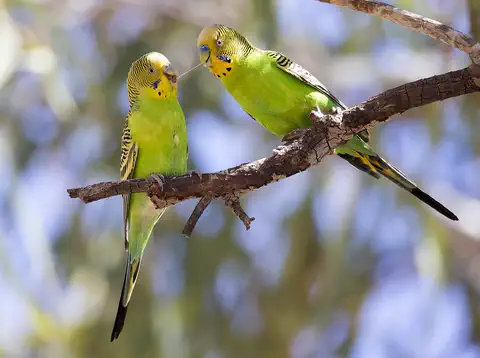
The budgerigar, or budgie, is a little parrot from the dry heart of Australia. Wild budgies are green and yellow with wavy black stripes. They are nomads that travel in flocks, they must find water every day, and they breed after good rain. Budgies are also popular pets all over the world.
-
 Watch
Animal
Laughing kookaburra
The laughing kookaburra is one of the larger members of the kingfisher family. It lives in the woodlands of eastern Australia, pounces on insects, worms and small animals, and lives in family groups. Its famous 'laugh' is really a territorial call that warns other birds to stay away.
-
 Watch
 Country
Australia
Australia is a country and the smallest continent, surrounded by ocean in the Southern Hemisphere. Much of its middle is dry and flat, most people live near the coast, and its animals include kangaroos, koalas and the platypus, a mammal that lays eggs.
-
 Watch
Animal
Tawny frogmouth
The tawny frogmouth is a big-headed, wide-mouthed bird of Australia's woodlands, parks and gardens. It looks like an owl, but its closest relatives are nightjars. By day it sits still on a branch, its streaky gray feathers matching the bark; at dusk and at night it watches for insects, frogs and other small animals and swoops down to catch them.
-
 Watch
Animal
Adélie penguin
The Adélie penguin is a medium-sized penguin, about 70 centimeters tall, with a black back, a white front and a bright white ring around each eye. It breeds in summer on rocky, ice-free ground all around Antarctica, building nests of pebbles, and spends the winter far out at sea among the pack ice.
For parents & teachers
What children will learn
- Locate Australia and describe the open country, farms and towns where galahs live.
- Describe the galah's colors, crest and how males and females differ.
- Describe how galah parents raise their chicks in a tree hollow.
- Explain how farmland and water points helped galahs spread.
Recommended ages: 3 to 17 · About 15 minutes
Talk about it
- Why might a bird that eats seeds do well where people grow crops?
- Why do you think birds might feel safer in a big flock?
- How can a tree hollow be a good place for a nest?
Try at home or in class
- Galah colors: draw or paint a galah using only pink, gray and white, and label its crest, eye ring and beak.
- Seed sort: with a grown-up, mix a few kinds of dry seeds or grains on a tray and sort them by size, as a galah might pick through seeds on the ground.
Key vocabulary: cockatoo, crest, tree hollow, flock, roost, crèche
Where these facts come from
- GBIF Backbone Taxonomy and GBIF Occurrence Search , Global Biodiversity Information Facility (CC0 1.0 (backbone); occurrence counts are facts derived from records under CC0, CC BY and CC BY-NC)
- Wikidata , Wikimedia Foundation (CC0 1.0)
- The IUCN Red List of Threatened Species , International Union for Conservation of Nature (IUCN terms of use (no redistribution of Red List data or range maps))
- Eolophus roseicapilla (BirdLife International, assessed 7 August 2018, published 2018) , IUCN Red List of Threatened Species
- Eolophus roseicapilla: justification, taxonomy and population text , IUCN Red List of Threatened Species
- Eolophus roseicapilla: IUCN Red List global assessment record (BirdLife International 2018), IUCN checklist on GBIF , GBIF
- Galah (Eolophus roseicapilla) Fact Sheet (c2019) , San Diego Zoo Wildlife Alliance Library
- Galah , The Australian Museum
- Galah , BirdLife Australia
- Galah (Styche 2013) , New Zealand Birds Online
- File:Galah (Eolophus roseicapilla albiceps) male Adelaide.jpg (29 November 2023, Charles J. Sharp) , Wikimedia Commons
- File:Eolophus roseicapilla - Pink and grey cockatoo (galah) call, near the Swan River in Perth, Western Australia.ogg (5 January 2025, Ronnievonjohnson) , Wikimedia Commons
- Wikimedia Commons , Wikimedia Foundation (Per file: Public domain, CC0, CC BY or CC BY-SA only (credited on each page))
Checked, not yet human-reviewed. Last updated November 1, 2026. Spotted a mistake? Tell us.