Animal
Budgerigar
The budgerigar is a small green and yellow parrot from Australia. Wild budgies fly in flocks and have no fixed home.
The budgerigar, or budgie, is a little parrot from the dry heart of Australia. Wild budgies are green and yellow with wavy black stripes. They are nomads that travel in flocks, they must find water every day, and they breed after good rain. Budgies are also popular pets all over the world.
Melopsittacus undulatus is a small, nomadic parrot of inland Australia. It eats the seeds of native grasses and herbs, drinks every day, forms huge flocks after seasons of good rain and can breed at any time of year when rain brings plenty of seed. Captive breeding has produced many color forms, but wild birds are green and yellow.
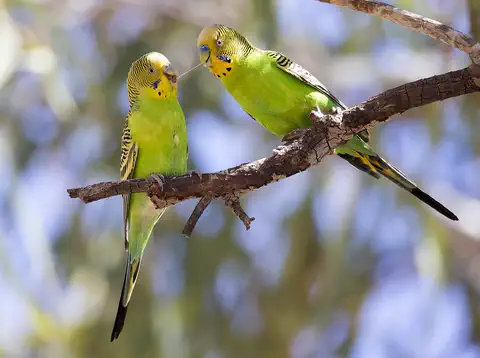
Photo: Jim Bendon from Karratha, Australia, CC BY-SA 2.0, via Wikimedia Commons
Meet the budgerigar
The budgie is a small parrot.
Wild budgies are bright green with a yellow face. They have wavy black stripes on their heads and wings. Their tails are long and pointed.
The budgerigar is a small parrot about 18 to 20 centimeters long, and much of that is its long, pointed tail. It weighs about 30 grams, as much as six sheets of paper.
Wild budgies are green and yellow, with wavy black bars on the head, back and wings, a small blue patch on each cheek and a row of black spots on the throat. Pet budgies come in many colors, like blue, white and yellow, because people have bred them that way.
Melopsittacus undulatus is a small parrot of 18 to 20 centimeters with pointed wings and tail. Average mass is about 28 to 30 grams. Wild-type plumage is green below, with a yellow face and forehead, black-and-yellow barring on the head, back and wings, violet-blue cheek patches and black throat spots.
Since the species was taken into captivity it has been bred into white, blue, yellow, mauve, olive and gray forms, and the Australian Museum describes it as the best-known Australian bird because of its worldwide popularity as a cage bird.
Quick facts
- Group
- Bird
- Length
- 0.18 to 0.2 m
- Weight
- 0.03 to 0.03 kg
Where it lives
Wild budgies live in Australia.
They live in dry, open country with grass and a few trees. They stay near water.
Wild budgerigars live across most of mainland Australia, especially the dry inland. They are missing from Tasmania, the far southwest, the far north of the Northern Territory and most of the east coast.
They live in open country: grasslands, scrub, open woodland and semi-desert, but seldom far from water. Budgies are nomads, which means they have no fixed home. They wander in flocks, and after a season of good rain and plenty of food, very large flocks gather.
The species is native only to Australia (IUCN), occurring through much of the mainland interior but absent from Tasmania, the far southwest, the north of the Northern Territory and most of the eastern seaboard (Australian Museum). It uses most open, semi-arid and sub-humid habitats, including grassland, shrubland, open woodland and desert edges, but stays within reach of water.
The species is nomadic. Animal Diversity Web adds that birds move north in winter, following a continuing food supply. Animal Diversity Web reports that people have introduced budgerigars in many countries, but by its account they became established only in southwest Florida.
Continent
Its habitats


Where can you find this animal?
- Brought here by people · Countries and seas named by a scientific source
- Lives here naturally · Countries and seas named by a scientific source
- Sightings recorded · Records of wild sightings (GBIF)
Brought here by people · Countries and seas named by a scientific source
Introduced birds in southwest Florida.
Places: United States.
Source: iucn-red-list · checked October 2026
Lives here naturally · Countries and seas named by a scientific source
Open grassland, scrub, woodland and semi-desert across much of inland mainland Australia, seldom far from water. Absent from Tasmania, the far southwest, the far north of the Northern Territory and most of the east coast.
Places: Australia.
Source: iucn-red-list · checked October 2026
Sightings recorded · Records of wild sightings (GBIF)
Counts of GBIF records of wild observations (human and machine) and preserved specimens. Records include introduced populations, vagrants, escaped or released animals and misidentifications, so a country with records is not necessarily part of the native range.
Wild sightings have been recorded in Australia, United States, Belgium, Taiwan, France, Denmark, Netherlands, Spain and 91 more places.
Source: gbif · checked October 2026
Range maps show where scientists say an animal lives, often country by country. An animal may live in only part of a country shown, and sightings records can include animals that wandered far from home.
Seeds and a daily drink
Budgies eat tiny grass seeds.
They find the seeds on the ground. Seeds are dry, so budgies need a drink of water every day.
Wild budgies eat almost nothing but seeds, especially from native grasses and herbs such as spinifex and saltbush. They pick most of them up from the ground, and they do most of their feeding and drinking in the morning.
Seeds hold almost no water, so budgies must drink every day. Flocks meet at waterholes and farm tanks alongside pigeons, finches and other parrots. Some budgies hover over the water to sip, and a few even land on the surface. Early explorers followed budgie flocks because they knew the birds would lead them to water.
The diet is almost entirely the seeds of native grasses and herbs, such as porcupine grass (spinifex) and saltbush, taken mostly from the ground. Feeding and drinking peak in the morning; in the heat of midday birds shelter motionless in shade.
Because dry seeds supply virtually no moisture, budgerigars must drink daily, gathering at waterholes and stock tanks with other seed-eaters. BirdLife Australia notes that some hover to drink or settle briefly on the water, and that their predictable flights to water were used by explorers to find it.

A small, speedy parrot
A budgie has a small hooked beak.
Boy budgies have a blue patch above the beak. Girl budgies have a brown or pale blue patch. Their wings and tails are pointed.
A budgie has a small, pointed beak whose top half hooks over the bottom half. Above the beak is a patch of bare skin around the nostrils called the cere. In males it is dark blue. In females it is light blue, turning brownish when they are ready to breed.
Budgies have pointed wings and long, pointed tails. A flock flies in a bouncing, up-and-down pattern, and at dusk flocks zoom around the trees at high speed. Young budgies have dark eyes and barred foreheads; adults have pale eyes and plain yellow foreheads.
The bill is pointed, with the tip of the upper mandible extending over the lower. The cere, the fleshy skin around the nostrils, shows slight sexual dimorphism: dark blue in adult males, light blue in non-breeding females and brownish when females are breeding.
The wings and tail are pointed; flocks fly with a characteristic undulating motion and, before roosting, at high speed around the trees. Juveniles have barred foreheads and dark brown eyes, while adults have a plain yellow forehead and white or yellow irises.
Growing up
Budgies lay eggs in a hole in a tree.
They lay lots of round white eggs. The mother keeps them warm. The father brings food.
Budgies breed when rain makes grass seeds plentiful, so they can nest at any time of year. The female picks a hollow in a tree branch, trunk, log or fence post and lays six to eight round white eggs.
She keeps them warm for about 18 days while the male brings her food. The chicks hatch naked and helpless. They leave the nest after about 35 days. If the rain keeps coming, the parents may raise several families in a row.
Breeding is triggered by rainfall and the seed flush that follows, so it can happen in any month; Animal Diversity Web notes that good rain can set off breeding even during molt. Pairs are monogamous and breed in colonies, with several nests in the same branch only a few meters apart.
The female chooses a cavity in a eucalypt, log or fence post and lays a clutch of six to eight white eggs (BirdLife Australia), incubating for about 18 days while the male feeds her. Hatchlings are altricial, naked and helpless; the nestling period is about 35 days, and successive broods are common when conditions stay good. Females can mature by about six months of age.
Flocks that follow the rain
Budgies love company.
They fly together in flocks and call to each other. After lots of rain, a flock can have thousands of birds!
Budgies are very social. Most flocks have somewhere between three and a hundred birds, but after a season of good rain and plenty of food, flocks of tens of thousands can fill the sky.
Their day starts before sunrise with preening and singing. They fly off to feed, rest in the shade through the hottest part of the day, then gather again at dusk, calling loudly and zooming around the trees before settling to roost. Their contact call is a warbling 'chirrup'.
Budgerigars are strongly gregarious. Flocks typically number from a few birds to 100 or more, swelling occasionally to tens of thousands after abundant rain. Flocking improves foraging success and gives protection from predators; Animal Diversity Web finds little sign of a dominance hierarchy, although females tend to be more aggressive than males.
The daily cycle runs from pre-dawn preening and song, through morning feeding and drinking, to inactivity in midday heat and a noisy, high-speed gathering before roosting just after sunset. The contact call is a warbling 'chirrup', and 'zit' is an alarm call.
Did you know?
A budgie flock flies up and down, like a wave.
A flock of budgies flies in a bouncy, up-and-down pattern that is easy to recognize.
The Australian Museum describes the characteristic undulating flight of budgerigar flocks.
Is it in danger?
There are lots of wild budgies.
They are not in danger. Millions of budgies also live with people as pets.
Wild budgerigars are not in danger. The IUCN Red List rates them Least Concern, and they live across a huge part of Australia.
Flock sizes change with the rain: good seasons bring huge flocks. Pet budgies all over the world have been bred by people into many colors.
The global assessment (IUCN, 2018) lists the budgerigar as Least Concern. It ranges across much of inland Australia. Its numbers in any one place change a great deal: good seasons of rain and seed trigger breeding and very large flocks, while flocks are usually much smaller.
Captive breeding has produced white, blue, yellow, mauve, olive and gray forms, and the species is now kept as a pet all over the world.
IUCN Red List
How is the budgerigar doing in the wild?
- Least Concern (this animal)
- Near Threatened
- Vulnerable
- Endangered
- Critically Endangered
- Extinct in the Wild
- Extinct
Least Concern
Not at risk of disappearing from the wild right now.
See the IUCN Red List assessment · The IUCN Red List of Threatened Species 2021.3
Amazing facts
-
Explorers followed budgies to find water.
Budgies fly to water so regularly that early explorers in Australia followed them to find a drink.
BirdLife Australia notes that explorers followed budgerigar flocks because their daily flights reliably led to water.
-
Some budgies sip water while hovering.
Some budgies hover above a waterhole to drink, and a few even land on the water.
Drinking budgerigars sometimes hover or settle briefly on the water surface.
-
Wild budgies are green and yellow.
Blue, white and yellow budgies come from pet breeding. Every wild budgie is green and yellow.
Captive breeding has produced white, blue, yellow, mauve, olive and gray forms; wild birds keep the green-and-yellow plumage.
-
A budgie flock flies up and down, like a wave.
A flock of budgies flies in a bouncy, up-and-down pattern that is easy to recognize.
The Australian Museum describes the characteristic undulating flight of budgerigar flocks.
Words to know
- nomad
- an animal or person that moves from place to place with no fixed home
- cere
- the patch of bare skin above a bird's beak around the nostrils
- outback
- the dry, far-away inland parts of Australia
- flock
- a group of birds that live or travel together
- clutch
- a group of eggs laid at one time
- drought
- a long time with little or no rain
Discovery challenge
-
What color are wild budgies?
What color are all wild budgerigars?
What colors is a wild budgerigar's plumage?
- Green and yellow
- Pink and purple
- All white
Show the answer
Green and yellow
Wild budgies are green and yellow.
Wild budgies are green and yellow with black bars; other colors come from pet breeding.
Green and yellow with black barring; white, blue and other forms come from breeding in captivity.
-
Why do budgies drink every day?
Why must budgies find water every day?
Why are budgerigars tied to water sources?
- Their seed food is very dry
- They like to swim
- They eat fish
Show the answer
Their seed food is very dry
Seeds are dry, so budgies get thirsty.
Seeds hold almost no water, so budgies must drink daily.
A diet of dry seed supplies almost no moisture, so daily drinking is essential.
-
What makes budgies start laying eggs?
What sets off breeding in wild budgies?
What usually triggers budgerigar breeding?
- Snow
- Rain
- Full moons
Show the answer
Rain
Rain makes seeds grow, and then budgies lay eggs.
Rain makes grasses seed, so budgies breed when food will be plentiful.
Rainfall and the resulting seed flush trigger breeding in any season.
-
Where do wild budgies live?
In which country do wild budgerigars live?
In which country is the budgerigar native?
- Australia
- Canada
- Brazil
Show the answer
Australia
Wild budgies live in Australia.
They live only in Australia, mostly in the dry inland.
Australia, mostly the arid and semi-arid interior, not Tasmania or most of the east coast.
Places where you might see it
Explore next
-
 Watch
3D
Animal
Cockatiel
The cockatiel is a small, slim parrot with a tall crest that lives wild in the dry inland of Australia. Flocks fly fast across open country, looking for grass seeds and water, and pairs nest in hollow trees after the rain.
-
 Watch
Animal
Rainbow lorikeet
The rainbow lorikeet is a colorful parrot of northern and eastern Australia. It feeds mostly on nectar and pollen, which it collects with a brush-tipped tongue. Noisy, fast-flying flocks are a common sight in forests, parks and gardens.
-
 Watch
Animal
Red kangaroo
The red kangaroo is the largest marsupial in the world, an animal whose babies grow up in a pouch. It lives on the dry plains of inland Australia, hops on powerful back legs that work like springs, and can get most of the water it needs from the plants it eats.
-
 Watch
 Country
Australia
Australia is a country and the smallest continent, surrounded by ocean in the Southern Hemisphere. Much of its middle is dry and flat, most people live near the coast, and its animals include kangaroos, koalas and the platypus, a mammal that lays eggs.
-
 Watch
Animal
Sulphur-crested cockatoo
The sulphur-crested cockatoo is a large white parrot with a bright yellow crest. It lives in forests and towns in northern and eastern Australia and New Guinea. Cockatoos live in noisy flocks, take turns keeping watch while others feed, and in Sydney some have learned to open garbage bins by watching each other.
-
 Watch
Animal
Laughing kookaburra
The laughing kookaburra is one of the larger members of the kingfisher family. It lives in the woodlands of eastern Australia, pounces on insects, worms and small animals, and lives in family groups. Its famous 'laugh' is really a territorial call that warns other birds to stay away.
-
 Watch
Animal
Adélie penguin
The Adélie penguin is a medium-sized penguin, about 70 centimeters tall, with a black back, a white front and a bright white ring around each eye. It breeds in summer on rocky, ice-free ground all around Antarctica, building nests of pebbles, and spends the winter far out at sea among the pack ice.
-
 Watch
Animal
African fish eagle
The African fish eagle is a big eagle of Africa's lakes, rivers and coasts, with a white head, chest and tail and a chestnut-brown body. It snatches fish from the surface of the water, and its loud, ringing call is one of the best-known sounds of Africa.
For parents & teachers
What children will learn
- Describe the wild budgerigar's appearance and how pet color forms differ.
- Explain why budgerigars are nomadic and must drink every day.
- Describe how rainfall triggers budgerigar breeding.
- Locate the budgerigar's native range in inland Australia.
Recommended ages: 3 to 17 · About 15 minutes
Talk about it
- Why might it be useful for a bird to have no fixed home in a dry land?
- How could a flock of birds help a thirsty traveler?
- Why do you think pet budgies come in colors that wild ones don't?
Try at home or in class
- Put a few dry seeds and a slice of fruit on a plate overnight and compare which dries out: talk about why seed-eaters need to drink.
- Weigh 30 grams of rice to feel how light a budgie is.
Key vocabulary: nomad, cere, outback, flock, clutch, drought
Where these facts come from
- The IUCN Red List of Threatened Species , International Union for Conservation of Nature (IUCN terms of use (no redistribution of Red List data or range maps))
- GBIF Backbone Taxonomy and GBIF Occurrence Search , Global Biodiversity Information Facility (CC0 1.0 (backbone); occurrence counts are facts derived from records under CC0, CC BY and CC BY-NC)
- Wikidata , Wikimedia Foundation (CC0 1.0)
- Melopsittacus undulatus (Budgerigar), Red List assessment 2018 , IUCN Red List of Threatened Species
- Budgerigar , Australian Museum
- Budgerigar , BirdLife Australia
- Melopsittacus undulatus (budgerigar) , Animal Diversity Web, University of Michigan Museum of Zoology
- Wikimedia Commons , Wikimedia Foundation (Per file: Public domain, CC0, CC BY or CC BY-SA only (credited on each page))
Checked, not yet human-reviewed. Last updated October 28, 2026. Spotted a mistake? Tell us.