
Animal
Sulphur-crested cockatoo
The sulphur-crested cockatoo is a big white parrot from Australia. It has a yellow crest on its head that it can lift up like a fan. It is very loud!
The sulphur-crested cockatoo is a large white parrot with a bright yellow crest. It lives in forests and towns in northern and eastern Australia and New Guinea. Cockatoos live in noisy flocks, take turns keeping watch while others feed, and in Sydney some have learned to open garbage bins by watching each other.
Cacatua galerita is a large, long-lived white cockatoo of timbered habitats in Australia, New Guinea and nearby islands, now also common in cities. It is gregarious, posts sentinels while feeding and shows social learning: researchers found that bin-opening spread between groups in Sydney. The IUCN rates it Least Concern (2018).
Photo: Charles J. Sharp, CC BY-SA 4.0, via Wikimedia Commons
Meet the sulphur-crested cockatoo
The sulphur-crested cockatoo is a big white parrot.
It has a long yellow crest on its head. It can lift the crest up high. Its strong beak is dark gray.
The sulphur-crested cockatoo is a large white parrot, about 45 to 50 centimeters long. On its head is a crest of long, sulphur-yellow feathers that it can fold flat or raise like a fan. The undersides of its wings and tail are washed with pale yellow, and its strong, curved bill is dark gray-black.
Males and females look almost the same. Up close, though, you can tell them apart by their eyes: a female's eyes are red-brown, while a male's are darker brown.
Cacatua galerita is a large cockatoo, about 45 to 50 centimeters long; Animal Diversity Web gives an average weight of 800 grams (700 to 950) and an average wingspan of 103 centimeters. The plumage is white apart from the erectile sulphur-yellow crest and a pale yellow wash under the wings and tail; the bill is dark gray-black.
The sexes are alike except for eye color, red-brown in females and darker brown in males, and young birds resemble adults. ADW recognizes four subspecies: C. g. fitzroyi of northern Australia has a pale blue rather than white eye ring and longer crest feathers, while eleonora and triton average smaller than the nominate galerita.
Quick facts
- Group
- Bird
- Length
- 0.45 to 0.5 m
- Wingspan
- 1.03 m
- Weight
- 0.7 to 0.95 kg
Forests, farms and cities
Sulphur-crested cockatoos live in Australia and New Guinea.
They live in forests with big trees. Many live in towns and cities too, in parks and gardens.
Sulphur-crested cockatoos live across northern and eastern Australia and in Tasmania, as well as in New Guinea and on nearby islands. They need places with trees, from rainforests to the open savanna woodlands of northern Australia.
They are also common around towns and cities, especially in parks and gardens. Cockatoos stay in the same area all year round. People also brought cockatoos to places such as Perth and New Zealand, where they now live wild.
The IUCN's 2018 assessment lists the species as native to Australia, Indonesia and Papua New Guinea, up to about 1,400 meters, and introduced in New Zealand, Palau and Puerto Rico. The Australian Museum describes the range as the northern and eastern mainland and Tasmania, with an established population around Perth, plus New Guinea and the Aru Islands.
Habitats are timbered: ADW lists tropical and subtropical rainforest, northern savannas and suburban parks and gardens. Birds are sedentary, staying in one area all year, though they may fly long distances daily to forage and almost always return to the same roost. The Australian Museum notes that the bird's popularity as a cage bird has spread it, as birds escape or are released.
Continents
Its habitat

Where can you find this animal?
- Brought here by people · Countries and seas named by a scientific source
- Lives here naturally · Countries and seas named by a scientific source
- Sightings recorded · Records of wild sightings (GBIF)
Brought here by people · Countries and seas named by a scientific source
New Zealand, where cockatoos that people brought now breed in the wild.
Places: New Zealand.
Source: iucn-red-list · checked October 2026
Lives here naturally · Countries and seas named by a scientific source
Forests, woodlands, farmland and towns with trees across northern and eastern Australia and Tasmania, and in New Guinea and nearby islands. A population around Perth in Western Australia was introduced.
Places: Australia, Indonesia and Papua New Guinea.
Source: iucn-red-list · checked October 2026
Sightings recorded · Records of wild sightings (GBIF)
Counts of GBIF records of wild observations (human and machine) and preserved specimens. Records include introduced populations, vagrants, escaped or released animals and misidentifications, so a country with records is not necessarily part of the native range.
Wild sightings have been recorded in Australia, Papua New Guinea, New Zealand, Taiwan, Indonesia, Bahamas, United States, Netherlands and 24 more places.
Source: gbif · checked October 2026
Range maps show where scientists say an animal lives, often country by country. An animal may live in only part of a country shown, and sightings records can include animals that wandered far from home.
Seeds, roots and a lookout
Cockatoos eat seeds, nuts, berries and roots.
They often eat on the ground in a big group. A few cockatoos sit in a tree and watch for danger.
Sulphur-crested cockatoos eat mainly seeds, nuts, berries, fruit, blossoms and roots, plus some insects and their larvae. They often feed on the ground in groups.
While the flock feeds, one or more cockatoos sit in a nearby tree as lookouts. If they spot danger, they give a loud warning screech and the whole flock flies up. Cockatoos also bite off small twigs and leaves without eating them. This may help keep their bills trimmed.
ADW describes the species as primarily granivorous, eating seeds, nuts, fruit, blossoms, insects and larvae on the ground and in trees, and taking newly planted and ripening grain crops; the Australian Museum adds berries, roots and handouts from people.
Feeding groups post sentinels: one or more birds watch from a nearby perch and raise a deafening alarm call when a predator is seen. Birds stay sheltered in the middle of the day and resume feeding in the late afternoon and evening before drinking and returning to roost (ADW). Biting off small branches and leaves that are not eaten may help keep the bill trimmed (Australian Museum).

A crest that shows feelings
The cockatoo's crest can go up and down.
When the cockatoo is excited, it lifts its crest up high. Its strong beak can bite through wood!
A cockatoo's yellow crest is like a flag it can raise and lower. When a cockatoo is excited, for example when it spots danger or when it is courting, it lifts and spreads the crest.
Its curved bill is very powerful. Cockatoos chew and rip at wood, and in towns some damage wooden decks and the panels on houses. The same bill handles the seeds, nuts and roots it eats.
ADW notes that the crest is used to communicate emotion: birds raise and spread it when excited, as when danger is detected or during courtship. In courtship, a bird raises its crest, bobs its head and moves it from side to side in a figure-of-eight while giving soft chattering notes.
The powerful bill handles seeds, nuts and roots and is strong enough to damage timber; both the Australian Museum and BirdLife Australia note that in urban areas the birds destroy timber decking and paneling on houses. ADW notes that their large size protects adults from all but the largest birds of prey, and names the powerful owl as a known predator.
Families that stay together
Cockatoos nest in a hole high in a tree.
Mom and dad both keep the eggs warm and feed the chicks. The young stay with their family all year.
A pair of cockatoos prepares a hollow high in a tree, often near water. The female lays one to three eggs, and both parents take turns keeping them warm for about 27 to 30 days.
Both parents feed the chicks, which stay in the nest for about 65 to 70 days. While they have eggs and young chicks, the parents keep very quiet so that predators do not find the nest. Young cockatoos stay with their parents, and families can stay together for a long time. They are ready to breed at three to four years.
Breeding runs from August to January in the south and May to September in the north. Pairs are monogamous and prepare a tree hollow together, usually high up and often near water. Clutches are one to three eggs (Australian Museum; ADW gives two to three), incubated by both parents for about 27 to 30 days.
Chicks are altricial and are fed by both parents. They stay in the nest for about 65 days (Australian Museum) to 70 days (ADW). ADW notes that during incubation and for 6 to 10 weeks afterward the parents stay deliberately quiet so as not to attract predators. Young remain with the parents all year, family groups stay together indefinitely, and maturity comes at three to four years. The Australian Museum reports captive birds living up to 80 years.
Clever, noisy flocks
Cockatoos live in big, noisy flocks.
They screech very loudly. In the city of Sydney, some cockatoos learned to open garbage bins by watching other cockatoos!
Sulphur-crested cockatoos are very social. Flocks can hold a dozen to several hundred birds, and their loud screech can be deafening.
They are also clever. In Sydney, scientists found that some cockatoos had learned to open the lids of garbage bins with their beaks to get food scraps. In 2018 people had seen it in 3 suburbs; by the end of 2019 it had spread to 44. The birds learned by watching each other, and each area's cockatoos had their own way of doing it.
Flocks of a dozen to several hundred birds split into small foraging groups and reunite at evening roosts (ADW). The common call is a loud screech ending with a slight upward inflection, and ADW notes the species can mimic sounds.
Researchers led by Barbara Klump of the Max Planck Institute of Animal Behavior showed in a 2021 study in Science that bin-opening in Sydney is socially learned: birds pry up the lid with the bill and shuffle along the rim to flip it. National Geographic reports that surveys found the behavior in three suburbs in 2018 and 44 by the end of 2019, spreading outward. Klump describes it as a cultural trait, with local groups using their own techniques.
Did you know?
Cockatoos keep watch while their friends eat.
While a flock feeds on the ground, a few cockatoos sit in trees as lookouts and screech if danger comes.
Sentinel birds watch from perches during feeding and give a loud alarm call when a predator is sighted.
Common, protected and sometimes a nuisance
There are lots of sulphur-crested cockatoos.
In Australia the law protects them. People in cities have found clever ways to keep them out of garbage bins.
The IUCN Red List rates the sulphur-crested cockatoo Least Concern. It is common in many places, although the IUCN notes that its numbers are going down overall.
In cities, cockatoos and people sometimes clash. The birds chew wooden decks and raid garbage bins, and people have invented ways to keep them out, from bricks on lids to special bin locks. The cockatoos then work out new tricks. Barbara Klump, a scientist who studies them, hopes people will come to understand and accept the animals we share our lives with.
The IUCN assessed Cacatua galerita as Least Concern in 2018, with a decreasing population trend. ADW describes it as generally common and abundant, estimates more than 500,000 individuals, and notes that it is protected under Australian law, so a government permit is needed before birds that damage crops can be controlled. The species is listed on CITES Appendix II (ADW).
In Sydney, a 2022 follow-up study by Klump's team described an innovation 'arms race': residents weigh down lids with bricks, stones or water bottles, block hinges with sticks or buy cockatoo locks, and the birds keep finding ways around them. Klump has said she hopes for better understanding and more tolerance for the animals we share our lives with.
IUCN Red List
How is the sulphur-crested cockatoo doing in the wild?
- Least Concern (this animal)
- Near Threatened
- Vulnerable
- Endangered
- Critically Endangered
- Extinct in the Wild
- Extinct
Least Concern
Not at risk of disappearing from the wild right now.
See the IUCN Red List assessment · The IUCN Red List of Threatened Species 2021.3
Amazing facts
-
Some city cockatoos can open garbage bins.
Sydney cockatoos learned to open garbage bins by watching each other, and the trick spread to 44 suburbs by 2019.
Klump and colleagues showed that bin-opening spread by social learning, with local differences in technique (Science, 2021).
-
Cockatoos keep watch while their friends eat.
While a flock feeds on the ground, a few cockatoos sit in trees as lookouts and screech if danger comes.
Sentinel birds watch from perches during feeding and give a loud alarm call when a predator is sighted.
-
Cockatoo parents are very quiet when they have babies.
Cockatoo parents keep very quiet while they have eggs and small chicks, so predators do not find their nest.
ADW notes that parents stay deliberately quiet during incubation and for 6 to 10 weeks after hatching.
-
You can tell a girl cockatoo by her eyes.
Up close, a female has red-brown eyes and a male has darker brown eyes.
The sexes are alike except that females have a red-brown iris and males a darker brown one.
Words to know
- crest
- a tuft of feathers on a bird's head
- cockatoo
- a kind of parrot with a crest it can raise
- flock
- a group of birds that live or travel together
- sentinel
- an animal that keeps watch for danger while others feed
- social learning
- learning by watching and copying others
- tree hollow
- a hole inside a tree trunk or branch where animals can nest
Discovery challenge
-
What color is a sulphur-crested cockatoo's crest?
What color is the sulphur-crested cockatoo's crest?
Which color gives the sulphur-crested cockatoo its name?
- Yellow
- Red
- Blue
Show the answer
Yellow
Its crest is bright yellow.
The crest is sulphur-yellow, and the rest of the bird is mostly white.
The erectile crest is sulphur-yellow; the plumage is otherwise white, with a pale yellow wash under the wings and tail.
-
What do some cockatoos do while the others eat?
What job do a few cockatoos do while the flock feeds?
What do sentinel cockatoos do while the flock forages?
- Keep watch for danger
- Build a nest
- Go to sleep
Show the answer
Keep watch for danger
They sit in trees and watch for danger.
A few sit in nearby trees as lookouts and screech a warning if danger comes.
Sentinels perch nearby and raise a loud alarm call when a predator is sighted.
-
What did cockatoos in Sydney learn to open?
What did some Sydney cockatoos learn to open?
Which behavior did researchers show spreading by social learning among Sydney cockatoos?
- Garbage bins
- Car doors
- Bird cages
Show the answer
Garbage bins
They learned to open garbage bins by watching other cockatoos.
They learned to lift and flip garbage bin lids, and the trick spread from suburb to suburb.
Opening garbage bin lids, which spread outward from 3 suburbs in 2018 to 44 by the end of 2019 (Science, 2021).
-
Where do cockatoos make their nests?
Where do sulphur-crested cockatoos nest?
Where do sulphur-crested cockatoos usually lay their eggs?
- In a hole high in a tree
- In a burrow in sand
- On floating plants
Show the answer
In a hole high in a tree
They nest in a hole in a tall tree.
A pair prepares a hollow high in a tree, often near water.
In a tree hollow prepared by both sexes, usually high up and often near water.
Places where you might see it
Explore next
-
 Watch
Animal
Rainbow lorikeet
The rainbow lorikeet is a colorful parrot of northern and eastern Australia. It feeds mostly on nectar and pollen, which it collects with a brush-tipped tongue. Noisy, fast-flying flocks are a common sight in forests, parks and gardens.
-
 Watch
Animal
Budgerigar
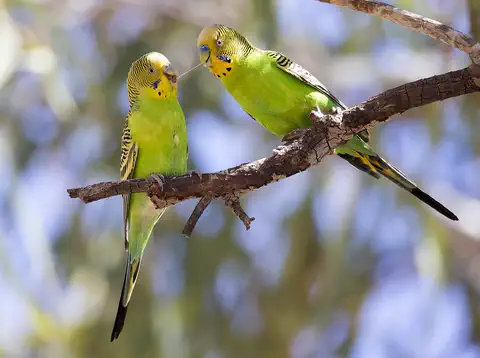
The budgerigar, or budgie, is a little parrot from the dry heart of Australia. Wild budgies are green and yellow with wavy black stripes. They are nomads that travel in flocks, they must find water every day, and they breed after good rain. Budgies are also popular pets all over the world.
-
 Watch
Animal
Laughing kookaburra
The laughing kookaburra is one of the larger members of the kingfisher family. It lives in the woodlands of eastern Australia, pounces on insects, worms and small animals, and lives in family groups. Its famous 'laugh' is really a territorial call that warns other birds to stay away.
-
 Watch
 Country
Australia
Australia is a country and the smallest continent, surrounded by ocean in the Southern Hemisphere. Much of its middle is dry and flat, most people live near the coast, and its animals include kangaroos, koalas and the platypus, a mammal that lays eggs.
-
 Watch
3D
Animal
Cockatiel
The cockatiel is a small, slim parrot with a tall crest that lives wild in the dry inland of Australia. Flocks fly fast across open country, looking for grass seeds and water, and pairs nest in hollow trees after the rain.
-
 Watch
Animal
Frilled lizard
The frilled lizard is a dragon lizard of the warm woodlands of northern Australia and southern New Guinea. It spends most of its life in trees, and when it is cornered it pops open a huge frill around its neck, opens its bright mouth and hisses, a bluff that makes it look much bigger than it is.
-
 Watch
Animal
Adélie penguin
The Adélie penguin is a medium-sized penguin, about 70 centimeters tall, with a black back, a white front and a bright white ring around each eye. It breeds in summer on rocky, ice-free ground all around Antarctica, building nests of pebbles, and spends the winter far out at sea among the pack ice.
-
 Watch
Animal
African fish eagle
The African fish eagle is a big eagle of Africa's lakes, rivers and coasts, with a white head, chest and tail and a chestnut-brown body. It snatches fish from the surface of the water, and its loud, ringing call is one of the best-known sounds of Africa.
For parents & teachers
What children will learn
- Describe the sulphur-crested cockatoo's crest, bill and feet and what each is used for.
- Explain how sentinels help a feeding flock.
- Describe the cockatoo's family life and slow growing-up.
- Explain what social learning is, using the Sydney bin-opening study.
Recommended ages: 3 to 17 · About 15 minutes
Talk about it
- Why might a feeding flock be safer with a few birds on lookout?
- What is the difference between working something out yourself and learning it by watching others?
- How can people and wild animals share a city without harming each other?
Try at home or in class
- Play 'copy the trick': one person invents a simple way to open a box, and others learn it only by watching, like the Sydney cockatoos.
- Measure 48 centimeters with a tape measure to see how long a sulphur-crested cockatoo is.
Key vocabulary: crest, cockatoo, flock, sentinel, social learning, tree hollow
Where these facts come from
- The IUCN Red List of Threatened Species , International Union for Conservation of Nature (IUCN terms of use (no redistribution of Red List data or range maps))
- GBIF Backbone Taxonomy and GBIF Occurrence Search , Global Biodiversity Information Facility (CC0 1.0 (backbone); occurrence counts are facts derived from records under CC0, CC BY and CC BY-NC)
- Wikidata , Wikimedia Foundation (CC0 1.0)
- Cacatua galerita (Sulphur-crested Cockatoo), Red List assessment 2018 , IUCN Red List of Threatened Species
- Sulphur-crested Cockatoo , Australian Museum
- Sulphur-crested Cockatoo , BirdLife Australia
- Cacatua galerita (sulphur-crested cockatoo) , Animal Diversity Web, University of Michigan Museum of Zoology
- Cockatoos learn to open bins by copying others , National Geographic
- In Australia, cockatoos and humans are in an arms race over garbage access , Max Planck Society
- Wikimedia Commons , Wikimedia Foundation (Per file: Public domain, CC0, CC BY or CC BY-SA only (credited on each page))
Checked, not yet human-reviewed. Last updated October 27, 2026. Spotted a mistake? Tell us.