
Animal
Cockatiel
The cockatiel is a small gray parrot from Australia. It has a pointy crest, a yellow face and round orange cheeks.
The cockatiel is a small, slim parrot with a tall crest that lives wild in the dry inland of Australia. Flocks fly fast across open country, looking for grass seeds and water, and pairs nest in hollow trees after the rain.
Nymphicus hollandicus is the smallest member of the cockatoo family (Cacatuidae), according to Animal Diversity Web. Wild cockatiels are nomadic seed-eaters of arid and semi-arid inland Australia whose breeding is triggered by rain; the IUCN lists them as Least Concern with a stable population.
Photo: Jim Bendon from Karratha, Australia, CC BY-SA 2.0, via Wikimedia Commons
Meet the cockatiel
The cockatiel is a small parrot.
It is mostly gray with a white patch on each wing. It has a yellow face, round orange cheeks and a crest of feathers that sticks up on its head. Wild cockatiels live in Australia.
The cockatiel is a slim parrot about as long as a school ruler, and half of that length is its pointed tail. Wild cockatiels are mostly brownish gray, with a bright white patch on each wing, a yellow face, an orange patch over each ear and a tall, wispy crest.
Many people know cockatiels as pets, but they come from the dry middle of Australia, where big flocks roam far and wide. Scientists count them as the smallest members of the cockatoo family.
Nymphicus hollandicus is a small, slender parrot (class Aves, order Psittaciformes) 25 to 35 centimeters long and weighing about 80 to 90 grams, according to Animal Diversity Web; its tapering tail makes up roughly half that length. The IUCN Red List places it in the cockatoo family, Cacatuidae, and Animal Diversity Web calls it the smallest of the cockatoos.
Wild birds are brownish gray with white wing patches, a yellow face, an orange ear patch and a long gray-and-yellow crest. Males are brighter than females, and young birds look like females (BirdLife Australia). Cockatiels are among the world's most popular pet birds, but this page is about the wild birds of inland Australia.
Quick facts
- Group
- Bird
- Length
- 0.25 to 0.35 m
- Weight
- 0.08 to 0.09 kg
- Lifespan in the wild
- 10 to 14 years
Where it lives
Wild cockatiels live in Australia.
They like dry, open land with grass and a few trees. They stay close to water so they can drink.
Wild cockatiels live only in Australia, mostly in the dry inland. They are found in every state and territory on the mainland, but not on the island of Tasmania.
They like open country: grassland with a few trees, open woodland, and gum trees growing along rivers. They also visit farmland. Cockatiels are nomads, which means they do not stay in one home all year. Flocks move around to find places where rain has brought seeds and water.
The species is native only to Australia, where BirdLife Australia describes it as found throughout the arid inland of the mainland, in all mainland states and territories but absent from Tasmania. It favors lightly wooded grassland, open woodland and eucalypts along watercourses, such as River Red Gum forest and Black Box or Coolibah woodland, as well as partly cleared farmland.
The IUCN assessment lists the cockatiel as nomadic, with an extent of occurrence of about 7.85 million square kilometers, and records an introduced population in Puerto Rico. Animal Diversity Web notes that birds in the wetter north are more nomadic, while those in the south, where the weather is more predictable, move more regularly with the seasons.
Continent
Its habitats


Where can you find this animal?
- Brought here by people · Countries and seas named by a scientific source
- Lives here naturally · Countries and seas named by a scientific source
- Sightings recorded · Records of wild sightings (GBIF)
Brought here by people · Countries and seas named by a scientific source
The IUCN assessment lists an introduced population in Puerto Rico. Pet birds escape in many other countries, but those are not listed as established.
Places: Puerto Rico.
Source: iucn-red-list · checked October 2026
Lives here naturally · Countries and seas named by a scientific source
The dry inland of mainland Australia, in every mainland state and territory; not in Tasmania. Wild flocks wander widely, following rain, seeds and water.
Places: Australia.
Source: iucn-red-list · checked October 2026
Sightings recorded · Records of wild sightings (GBIF)
Counts of GBIF records of wild observations (human and machine) and preserved specimens. Records include introduced populations, vagrants, escaped or released animals and misidentifications, so a country with records is not necessarily part of the native range.
Wild sightings have been recorded in Australia, United States, Belgium, France, Spain, Netherlands, Portugal, Germany and 71 more places.
Source: gbif · checked October 2026
Range maps show where scientists say an animal lives, often country by country. An animal may live in only part of a country shown, and sightings records can include animals that wandered far from home.
What it eats
Cockatiels eat seeds.
They walk on the ground and pick up seeds from grass. Their curved beak cracks open each seed.
Cockatiels eat mostly seeds from grasses, shrubs and trees, and they especially like grain crops. They feed mostly on the ground, walking about in small groups and picking up dry seeds.
A cockatiel can shell a seed in just a few seconds: its tongue turns the seed while the sharp upper beak peels off the husk. At a water hole, cockatiels drink quickly, often just a sip or two, then lift their heads to look around for danger.
Seeds of grasses, shrubs and trees form most of the diet, and cereal crops are favored (BirdLife Australia). Cockatiels forage almost entirely on the ground, in pairs, small groups or flocks of hundreds; Animal Diversity Web describes how the tongue rotates each seed while the upper beak removes the husk, taking only seconds. They also eat some fruit and berries and have been seen taking small ground insects.
Because feeding birds on the ground are exposed to birds of prey from above, they drink rapidly at water holes, usually one or two sips before raising the neck to swallow and scan. Large flocks can raid crops such as sorghum, millet, wheat and sunflowers, so farmers in parts of Australia regard them as pests.
Did you know?
Cockatiels can fly very fast.
When danger comes, cockatiels fly away fast, at more than 64 kilometers an hour.
Lacking other defenses, cockatiels escape raptors by flight, reaching speeds above 64 km/h (40 mph), according to Animal Diversity Web.
Crest, cheeks and a pointed tail
A cockatiel can lift its crest up or lay it flat.
Its orange cheeks look like little round spots. Its long tail is pointy at the end. Gray feathers help it hide on the ground.
The crest is a bunch of about five-centimeter-long feathers on top of the head. Cockatiels raise and lower it to show how they feel: straight up when alert or startled, half raised when calm, and flat when upset or flying.
The long, pointed tail spreads like a fan in flight. The curved beak is built for husking seeds. Gray feathers help a feeding cockatiel blend in with the ground, so hawks flying overhead find it harder to spot.
Animal Diversity Web describes a crest of about 5 centimeters, made of several dozen feathers, whose angle signals mood: held upright when the bird is alert or startled, at roughly 45 degrees when content, flat against the head when agitated, and flat in flight to reduce drag. The tapering tail, about 15 centimeters long, fans out in flight.
The dull gray plumage is thought to camouflage feeding birds from raptors above. Like all parrots, cockatiels have a curved, pointed upper beak and zygodactyl feet, with two toes forward and two back, which grip perches and also spread wide for walking. Males have bright orange cheek patches bordered with white; females have duller cheeks.
Growing up in a hollow tree
Cockatiels lay eggs inside a hole in a tree.
Mom and dad take turns sitting on the eggs. Both parents feed the chicks. The chicks leave the nest after about a month.
Wild cockatiels pair up and stay together all year. When heavy rain comes, the grass grows and makes seeds, and that tells the birds it is time to nest. They choose a hollow in a tree, usually a gum tree near water.
The female usually lays three to five white eggs. Both parents keep them warm, and the chicks hatch after about two and a half to three weeks. Mom and dad feed the chicks together, and the young leave the hollow after about a month.
Pairs are monogamous and stay together throughout the year, so they can begin breeding quickly when conditions allow. Animal Diversity Web links breeding to rainfall, which brings a flush of seed. Nests are in tree hollows, usually in eucalypts and often in dead trees near fresh water; several pairs may nest in the same tree (BirdLife Australia).
Clutches are usually three to five white eggs, though up to eight are recorded. Incubation lasts 17 to 23 days and is shared: males sit by day, females through the night. Both parents feed the chicks, which stay in the hollow for about a month and fledge at three to five weeks. Animal Diversity Web gives sexual maturity at about 13 months for males and 18 months for females, and a wild lifespan of 10 to 14 years.
Life in a flock
Cockatiels live in groups called flocks.
They fly together and sleep together. They call to each other with a loud 'queel, queel' as they fly.
Cockatiels are social all year round. Most flocks have up to about 30 birds, but where food is plentiful hundreds or even thousands can gather. Small flocks fly in tight, neat formations, and at night the birds roost together.
Their main call is a rolling 'queel, queel', often given in flight. Cockatiels have no special weapons against danger, so they rely on lots of watching eyes, loud alarm calls and fast flight to escape.
BirdLife Australia describes cockatiels as gregarious even when breeding: most flocks hold up to about 30 birds, but hundreds or thousands may gather, and flocks roost communally at night. The main contact call is a rolling 'queel, queel', usually given in flight.
Their main predators are birds of prey. Animal Diversity Web reports that cockatiels respond to threats by flying off, at speeds that can exceed 64 kilometers (40 miles) an hour, and that large flocks, alarm calls and camouflage all add to their safety. The same source notes that pet cockatiels do not copy human speech well but can learn to whistle tunes.
Did you know?
Cockatiel moms and dads take turns sitting on their eggs.
Cockatiel parents share the job of keeping eggs warm: dad usually sits in the daytime and mom sits at night.
Incubation is shared, with males sitting from early morning to late afternoon and females through the night, a division Animal Diversity Web describes for the species.
Doing well in the wild
There are lots of wild cockatiels.
They are not in danger. Many people keep cockatiels as pets, and pet cockatiels need kind care for many years.
Wild cockatiels are not endangered. The IUCN lists them as Least Concern, because they live across a huge area of Australia and their numbers seem steady.
Nobody has counted all the wild cockatiels, but scientists describe them as abundant. Cockatiels are also one of the most popular pet birds in the world. Pet birds have been bred in many colors, while wild birds are all gray with yellow faces.
BirdLife International's 2018 assessment for the IUCN Red List classes the cockatiel as Least Concern: its range is extremely large, the global population has not been counted but the species is described as abundant, and the trend is suspected to be stable in the absence of evidence of declines. The species occurs in at least one protected area.
As pets, cockatiels are second in popularity only to budgerigars (Animal Diversity Web), and breeding has produced dozens of color forms, such as the pale yellow lutino, that are not seen in wild flocks. The IUCN also records an introduced population in Puerto Rico.
IUCN Red List
How is the cockatiel doing in the wild?
- Least Concern (this animal)
- Near Threatened
- Vulnerable
- Endangered
- Critically Endangered
- Extinct in the Wild
- Extinct
Least Concern
Not at risk of disappearing from the wild right now.
See the IUCN Red List assessment · The IUCN Red List of Threatened Species 2021.3
Amazing facts
-
A cockatiel's tail is half as long as the whole bird.
A cockatiel's long, pointed tail makes up about half of its total length.
The tapering tail, about 15 cm long, accounts for roughly half of the cockatiel's 25 to 35 cm length, according to Animal Diversity Web.
-
Cockatiel moms and dads take turns sitting on their eggs.
Cockatiel parents share the job of keeping eggs warm: dad usually sits in the daytime and mom sits at night.
Incubation is shared, with males sitting from early morning to late afternoon and females through the night, a division Animal Diversity Web describes for the species.
-
Cockatiels can fly very fast.
When danger comes, cockatiels fly away fast, at more than 64 kilometers an hour.
Lacking other defenses, cockatiels escape raptors by flight, reaching speeds above 64 km/h (40 mph), according to Animal Diversity Web.
-
Sometimes thousands of cockatiels fly together.
Most cockatiel flocks have up to 30 birds, but sometimes hundreds or even thousands gather in one place.
BirdLife Australia notes flocks of hundreds or even thousands, though most hold up to about 30 birds; small flocks fly in tight formation and large ones break into groups.
Words to know
- crest
- a group of feathers on top of a bird's head that it can raise or lower
- nomadic
- moving from place to place instead of living in one home
- flock
- a group of birds that live, feed and fly together
- tree hollow
- a hole inside a tree trunk or branch, used by animals as a nest
- incubate
- to keep eggs warm so the chicks inside can grow
- camouflage
- colors or patterns that help an animal blend into its surroundings
Discovery challenge
-
Where do wild cockatiels live?
On which continent do cockatiels live in the wild?
Which country is the cockatiel's only native home?
- Australia
- Antarctica
- Europe
Show the answer
Australia
Wild cockatiels live in Australia.
Wild cockatiels live only in Australia, mostly in the dry inland.
The species is native only to mainland Australia; the IUCN records an introduced population in Puerto Rico.
-
What do cockatiels mostly eat?
What makes up most of a wild cockatiel's food?
Which food forms most of the wild cockatiel's diet?
- Fish
- Seeds
- Leaves from tall trees
Show the answer
Seeds
Cockatiels eat seeds that they find on the ground.
They eat mostly seeds from grasses, shrubs and trees, picked up from the ground.
Seeds of grasses, shrubs and trees, with cereals favored; fruit, berries and small insects are also eaten.
-
What does a cockatiel's crest do?
What can a cockatiel show by moving its crest?
According to Animal Diversity Web, what does the angle of the crest signal?
- How it feels
- How old it is
- Which way is north
Show the answer
How it feels
The crest goes up or down to show how the cockatiel feels.
The crest stands up when a cockatiel is alert, tilts back when it is calm and lies flat when it is upset.
Upright when alert or startled, about 45 degrees when content and flat when agitated; it is also flattened in flight.
-
Where do cockatiels lay their eggs?
Where do wild cockatiels build their nests?
What kind of nest site do wild cockatiels use?
- On the beach
- In a hole in a tree
- Under the water
Show the answer
In a hole in a tree
Cockatiels lay their eggs in a hole in a tree.
They nest in tree hollows, usually in gum trees near water.
They are cavity nesters, using hollows usually in eucalypts, often in dead trees near water; several pairs may share a tree.
Places where you might see it
Explore next
-
 Watch
Animal
Budgerigar
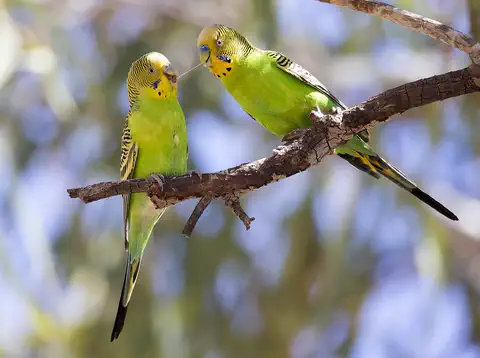
The budgerigar, or budgie, is a little parrot from the dry heart of Australia. Wild budgies are green and yellow with wavy black stripes. They are nomads that travel in flocks, they must find water every day, and they breed after good rain. Budgies are also popular pets all over the world.
-
 Watch
Animal
Sulphur-crested cockatoo
The sulphur-crested cockatoo is a large white parrot with a bright yellow crest. It lives in forests and towns in northern and eastern Australia and New Guinea. Cockatoos live in noisy flocks, take turns keeping watch while others feed, and in Sydney some have learned to open garbage bins by watching each other.
-
 Watch
 Country
Australia
Australia is a country and the smallest continent, surrounded by ocean in the Southern Hemisphere. Much of its middle is dry and flat, most people live near the coast, and its animals include kangaroos, koalas and the platypus, a mammal that lays eggs.
-
 Watch
Animal
Emu
The emu is Australia's tallest native bird and the second-largest bird in the world, after the ostrich. It cannot fly, but it can sprint at about 48 kilometers an hour. Emus are famous fathers: the male sits on the eggs for about eight weeks without eating, then looks after the striped chicks.
-
 Watch
Animal
Rainbow lorikeet
The rainbow lorikeet is a colorful parrot of northern and eastern Australia. It feeds mostly on nectar and pollen, which it collects with a brush-tipped tongue. Noisy, fast-flying flocks are a common sight in forests, parks and gardens.
-
 Watch
Animal
Adélie penguin
The Adélie penguin is a medium-sized penguin, about 70 centimeters tall, with a black back, a white front and a bright white ring around each eye. It breeds in summer on rocky, ice-free ground all around Antarctica, building nests of pebbles, and spends the winter far out at sea among the pack ice.
-
 Watch
Animal
African fish eagle
The African fish eagle is a big eagle of Africa's lakes, rivers and coasts, with a white head, chest and tail and a chestnut-brown body. It snatches fish from the surface of the water, and its loud, ringing call is one of the best-known sounds of Africa.
-
 Watch
Animal
African penguin
The African penguin is a penguin of warm, sunny coasts. It lives only in South Africa and Namibia, nests in burrows and under bushes, and hunts sardines and anchovies in the cold sea. Its numbers have fallen so far that it is now Critically Endangered, and people are working hard to protect it.
For parents & teachers
What children will learn
- Identify the wild cockatiel's main features (crest, orange ear patch, white wing patch, long tail) and what each does.
- Explain how rain controls where wild cockatiels travel and when they breed.
- Describe how a flock helps small birds stay safe from predators.
- Tell the difference between wild cockatiels in Australia and pet cockatiels.
Recommended ages: 3 to 17 · About 12 minutes
Talk about it
- Why might a bird that eats grass seeds need to move around after the rain?
- How is a cockatiel raising its crest like a person making a face to show a feeling?
- Wild cockatiels are all gray with yellow faces, but pet cockatiels come in many colors. Why might gray feathers be useful in the wild?
Try at home or in class
- Measure 30 centimeters with a ruler and mark the halfway point: that is about where a cockatiel's tail begins.
- Look closely at a handful of birdseed or grass seeds with a magnifying glass and sort them by size, as a cockatiel might.
Key vocabulary: crest, nomadic, flock, tree hollow, incubate, camouflage
Where these facts come from
- The IUCN Red List of Threatened Species , International Union for Conservation of Nature (IUCN terms of use (no redistribution of Red List data or range maps))
- GBIF Backbone Taxonomy and GBIF Occurrence Search , Global Biodiversity Information Facility (CC0 1.0 (backbone); occurrence counts are facts derived from records under CC0, CC BY and CC BY-NC)
- Nymphicus hollandicus (Cockatiel), 2018 global assessment , IUCN Red List of Threatened Species (BirdLife International)
- Cockatiel bird profile , BirdLife Australia
- Nymphicus hollandicus (cockatiel) , Animal Diversity Web, University of Michigan Museum of Zoology
- Wikidata , Wikimedia Foundation (CC0 1.0)
- Wikimedia Commons , Wikimedia Foundation (Per file: Public domain, CC0, CC BY or CC BY-SA only (credited on each page))
Checked, not yet human-reviewed. Last updated October 28, 2026. Spotted a mistake? Tell us.