
Animal
Rainbow lorikeet
The rainbow lorikeet is a small, bright parrot from Australia. It has a blue head, a red beak, an orange chest and green wings. It drinks sweet nectar from flowers.
The rainbow lorikeet is a colorful parrot of northern and eastern Australia. It feeds mostly on nectar and pollen, which it collects with a brush-tipped tongue. Noisy, fast-flying flocks are a common sight in forests, parks and gardens.
Trichoglossus moluccanus is a nectar- and pollen-feeding lorikeet of coastal northern and eastern Australia, common in treed suburbs as well as forest and woodland. Its brush-tipped tongue suits a diet of flowers, and it carries pollen between plants. The IUCN rates it Least Concern (2024); outside its natural range, introduced birds around Perth compete with native species for nest hollows.
Photo: Andrew Mercer (www.baldwhiteguy.co.nz), CC BY-SA 4.0, via Wikimedia Commons
Meet the rainbow lorikeet
The rainbow lorikeet is a bright little parrot.
Its head is blue, and its beak is red. Its chest is orange and yellow. Its wings and long tail are green.
The rainbow lorikeet is a parrot about 28 to 32 centimeters long, close to the length of a 30-centimeter school ruler. Its name fits: you can find most colors of the rainbow in its feathers.
It has a blue (or mauve) head and belly, a bright red beak, an orange and yellow chest, and green wings, back and long, pointed tail. Males and females look alike. Lorikeets are often seen in loud, fast-moving flocks.
Trichoglossus moluccanus is a lorikeet, one of the brush-tongued parrots specialized for nectar and pollen. The Australian Museum gives a length of 28 to 32 centimeters; the plumage is blue to mauve on the head and belly, orange-yellow on the breast and green on the wings, back and tail, with a bright red bill. The sexes look alike.
The IUCN's 2024 assessment of Trichoglossus moluccanus lists Australia as its only native country. Flocks are loud and fast-moving, and birds gather in communal roosts at dusk (Australian Museum).
Quick facts
- Group
- Bird
- Length
- 0.28 to 0.32 m
- Lifespan in the wild
- from 20 years
Treetops, coasts and backyards
Rainbow lorikeets live in Australia.
They live in forests and woods near the coast. Many live in towns too, where there are lots of trees with flowers.
Rainbow lorikeets live in coastal areas across northern and eastern Australia. They are found wherever there are plenty of trees: rainforests, woodlands, mangroves, coastal heath and well-treed parks and suburbs.
Most lorikeets stay in the same area all year, but some move around to follow trees that are flowering or fruiting. They have done well in cities, where gardens and street trees can give them food all year round.
The IUCN's 2024 assessment lists the species as resident in Australia only, up to about 700 meters, in forest, shrubland, wetland and artificial habitats. The Australian Museum describes its range as coastal northern and eastern Australia, in rainforest, woodland and well-treed urban areas.
It is largely sedentary, with some nomadic movements that follow seasonal flowering and fruiting (the IUCN also lists it as nomadic). The Australian Museum notes that it has acclimatized well to urbanization and appears to have benefited from artificial feeding and from prolifically flowering and fruiting garden plants. A population around Perth, far outside the natural range, began from aviary releases.
Continent
Its habitat

Where can you find this animal?
- Lives here naturally · Countries and seas named by a scientific source
- Sightings recorded · Records of wild sightings (GBIF)
Lives here naturally · Countries and seas named by a scientific source
Coastal forests, woodlands and leafy suburbs across northern and eastern Australia. The population around Perth in Western Australia began from released aviary birds.
Places: Australia.
Source: iucn-red-list · checked October 2026
Sightings recorded · Records of wild sightings (GBIF)
Counts of GBIF records of wild observations (human and machine) and preserved specimens. Records include introduced populations, vagrants, escaped or released animals and misidentifications, so a country with records is not necessarily part of the native range.
Wild sightings have been recorded in Australia, New Zealand, Papua New Guinea, United States, Belgium, Netherlands, Vanuatu, Indonesia and 16 more places.
Source: gbif · checked October 2026
Range maps show where scientists say an animal lives, often country by country. An animal may live in only part of a country shown, and sightings records can include animals that wandered far from home.
Nectar and pollen
Rainbow lorikeets drink nectar, the sweet juice inside flowers.
They also eat pollen, fruit and seeds. When they feed, they carry pollen from flower to flower.
Rainbow lorikeets feed mainly on flowers. They visit the blossoms of trees and shrubs, such as eucalypts, banksias and bottlebrushes, to collect nectar and pollen. They also eat fruit, seeds and some insects.
While a lorikeet feeds, pollen sticks to its feathers, and it carries the pollen to the next flower. That makes rainbow lorikeets important pollinators of many Australian plants.
The Australian Museum describes foraging mostly on the flowers of shrubs and trees for nectar and pollen, with fruit, seeds and some insects. Field of Mars Environmental Education Centre, a NSW public school site, names eucalypt, banksia and bottlebrush flowers in Sydney and describes the birds as important pollinators, because pollen sticks to their feathers and is carried between flowers.
Flocks gather where food is plentiful and often compete noisily with other birds for flowering trees. A NSW Government page warns that sugar, honey or jam put out by people can harm lorikeets, and that scientists link poor artificial diets and dirty feeding trays to disease.

A tongue like a paintbrush
A lorikeet's tongue has a tiny brush on the end.
The brush helps it lick up nectar and pollen from flowers. Its strong feet hold on to branches while it feeds.
The rainbow lorikeet's secret tool is its tongue. Its brush-like tip collects nectar and pollen from deep inside flowers.
Its curved red beak helps it reach into blossoms, and its strong feet, with two toes pointing forward and two back, grip branches so it can climb while it feeds. Lorikeets fly fast and nimbly from tree to tree.
Auckland Zoo and the Field of Mars centre describe a long, brush-tipped tongue adapted for collecting nectar and pollen. The curved bill gives access to blossoms.
The feet are zygodactyl, with two toes facing forward and two backward, which Field of Mars notes helps the birds grip branches and climb through the canopy. Their flight is fast and agile, letting flocks move quickly between feeding areas, and the Australian Museum describes them as often seen in loud, fast-moving flocks.
Two eggs in a tree hollow
Lorikeets nest in a hole in a tree.
The mother lays two eggs on soft, chewed wood. Mom and dad both feed the chicks.
Rainbow lorikeets breed between June and January. A pair chooses a hollow branch, usually in a eucalyptus tree, and together they prepare the inside. The female lays her eggs, usually two, on a layer of chewed, decayed wood.
Only the female keeps the eggs warm, for about 23 days. The chicks hatch with very few feathers and need their parents for warmth and food. Both parents feed them, and the young leave the nest after about 45 days.
The breeding season runs from June to January. Both sexes prepare the nest, usually a hollow limb of a eucalypt, where the eggs are laid on chewed, decayed wood. The Australian Museum gives a clutch of two, incubation of 23 days by the female alone, and 45 days in the nest.
Nestlings hatch with little feather cover and depend completely on their parents for warmth and food; both parents feed them. Field of Mars notes that after leaving the nest young birds may keep learning feeding and survival behaviors from adults, and that rainbow lorikeets can live for more than 20 years in the wild.
Screeching flocks and evening roosts
Rainbow lorikeets are very noisy.
They screech and chatter all the time. At sunset, lots of lorikeets gather in one big tree to sleep.
Rainbow lorikeets are very social and very loud. They screech, chatter and squawk as they feed and fly, and their calls help the flock stay together.
At dusk, lorikeets gather in big communal roosts, where hundreds of birds may call loudly before settling down for the night. They also defend good feeding areas from other birds.
The species is highly social, with frequent screeching and chattering (Australian Museum). Field of Mars notes that calls help flocks stay together and that birds spend much of their time feeding, calling and defending feeding areas from other birds.
Communal roosts form at dusk; Field of Mars describes roosts where hundreds of birds call before settling. BirdLife Australia reports that around nest hollows the introduced Perth population is aggressive: lorikeets there have been recorded pulling the nestlings of Australian ringnecks out of hollows and taking the hollows over.
Did you know?
Lorikeets help flowers by carrying pollen.
Pollen sticks to lorikeets' feathers as they feed, so they carry it from flower to flower.
By moving pollen between flowers on their feathers, rainbow lorikeets pollinate many Australian plants.
Doing well, sometimes too well
There are lots of rainbow lorikeets in Australia.
They like towns with flowering trees. Sugary food from people is not good for lorikeets. Flowers give them the food they need.
The IUCN Red List rates the rainbow lorikeet Least Concern, though it notes that their numbers are going down. In many cities lorikeets are common and seem to be helped by gardens full of flowers and fruit.
But outside their natural range, they can cause trouble. Around Perth in Western Australia, released lorikeets compete with native birds for nesting holes. In New Zealand, they compete with birds like the tui for food and homes, so they are treated as a pest there.
The IUCN assessed Trichoglossus moluccanus as Least Concern in 2024, with a decreasing population trend. In its native range it has adapted well to suburbs and benefits from flowering gardens and artificial feeding (Australian Museum).
Outside that range it can harm other wildlife. BirdLife Australia reports that the feral Perth population was established by the late 1960s, expanded in the 1980s and prevents native birds from nesting by aggressively taking over hollows. Auckland Zoo notes that the New Zealand Department of Conservation classes rainbow lorikeets as a pest because they compete with native birds such as tui and bellbirds for food and habitat.
IUCN Red List
How is the rainbow lorikeet doing in the wild?
- Least Concern (this animal)
- Near Threatened
- Vulnerable
- Endangered
- Critically Endangered
- Extinct in the Wild
- Extinct
Least Concern
Not at risk of disappearing from the wild right now.
See the IUCN Red List assessment · The IUCN Red List of Threatened Species 2021.3
Amazing facts
-
A rainbow lorikeet's tongue has a brush on the end.
A rainbow lorikeet's tongue has a brush-like tip that collects nectar and pollen.
Lorikeets have long, brush-tipped tongues adapted to collect nectar and pollen (Auckland Zoo).
-
Lorikeets help flowers by carrying pollen.
Pollen sticks to lorikeets' feathers as they feed, so they carry it from flower to flower.
By moving pollen between flowers on their feathers, rainbow lorikeets pollinate many Australian plants.
-
Hundreds of lorikeets can sleep in the same tree.
At dusk, hundreds of lorikeets may gather noisily in one communal roost.
Communal dusk roosts can hold hundreds of birds that call loudly before settling.
-
Lorikeet eggs are laid on chewed-up wood.
Rainbow lorikeets lay their eggs on a bed of chewed, decayed wood inside a hollow branch.
Eggs are laid on chewed, decayed wood, usually in a hollow eucalypt limb (Australian Museum).
Words to know
- nectar
- the sweet liquid inside flowers
- pollen
- a fine powder that flowers need to make seeds
- pollinator
- an animal that carries pollen from flower to flower
- lorikeet
- a small parrot with a brush-tipped tongue that feeds on flowers
- roost
- a place where birds rest or sleep
- eucalyptus
- an Australian tree, also called a gum tree
Discovery challenge
-
What does a rainbow lorikeet mostly eat?
What do rainbow lorikeets mainly feed on?
Which foods make up most of the rainbow lorikeet's diet?
- Nectar and pollen
- Fish and frogs
- Hard nuts
Show the answer
Nectar and pollen
They drink sweet nectar and eat pollen from flowers.
They feed mainly on nectar and pollen from flowering trees and shrubs, plus fruit, seeds and some insects.
Mostly nectar and pollen from the flowers of shrubs and trees, with fruit, seeds and some insects.
-
What is on the tip of a lorikeet's tongue?
What is special about a rainbow lorikeet's tongue?
What feature of the tongue suits lorikeets to their diet?
- A tiny brush
- A sharp hook
- A sticky ball
Show the answer
A tiny brush
Its tongue has a tiny brush for licking up nectar.
The tip is brush-like, mopping up nectar and pollen from inside flowers.
A long, brush-tipped tongue adapted for collecting nectar and pollen.
-
How do lorikeets help flowers?
How do rainbow lorikeets help plants?
What ecological role do rainbow lorikeets play for many Australian plants?
- They carry pollen between flowers
- They water the flowers
- They dig holes for seeds
Show the answer
They carry pollen between flowers
Pollen sticks to them, and they carry it to the next flower.
Pollen sticks to their feathers as they feed, and they carry it to other flowers.
They are pollinators: pollen carried on their feathers moves between flowers.
-
Where do lorikeets lay their eggs?
Where do rainbow lorikeets lay their eggs?
Where are rainbow lorikeet eggs usually laid?
- In a hollow tree branch
- On the beach
- In a floating nest
Show the answer
In a hollow tree branch
They lay eggs inside a hollow branch.
In a hollow branch, usually of a eucalyptus, on a layer of chewed wood.
On chewed, decayed wood in a hollow limb, usually of a eucalypt.
Places where you might see it
Explore next
-
 Watch
Animal
Sulphur-crested cockatoo
The sulphur-crested cockatoo is a large white parrot with a bright yellow crest. It lives in forests and towns in northern and eastern Australia and New Guinea. Cockatoos live in noisy flocks, take turns keeping watch while others feed, and in Sydney some have learned to open garbage bins by watching each other.
-
 Watch
Animal
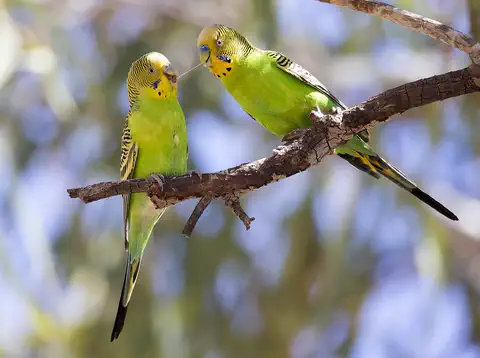
Budgerigar
The budgerigar, or budgie, is a little parrot from the dry heart of Australia. Wild budgies are green and yellow with wavy black stripes. They are nomads that travel in flocks, they must find water every day, and they breed after good rain. Budgies are also popular pets all over the world.
-
 Watch
Animal
Laughing kookaburra
The laughing kookaburra is one of the larger members of the kingfisher family. It lives in the woodlands of eastern Australia, pounces on insects, worms and small animals, and lives in family groups. Its famous 'laugh' is really a territorial call that warns other birds to stay away.
-
 Watch
 Country
Australia
Australia is a country and the smallest continent, surrounded by ocean in the Southern Hemisphere. Much of its middle is dry and flat, most people live near the coast, and its animals include kangaroos, koalas and the platypus, a mammal that lays eggs.
-
 Watch
3D
Animal
Cockatiel
The cockatiel is a small, slim parrot with a tall crest that lives wild in the dry inland of Australia. Flocks fly fast across open country, looking for grass seeds and water, and pairs nest in hollow trees after the rain.
-
 Watch
Animal
Superb fairywren
The superb fairywren is a tiny Australian songbird that lives in family groups. In the breeding season the male is bright sky blue and black; the female is brown with an orange-red face. Older family members help feed the chicks, and mothers even call to their eggs before the chicks hatch.
-
 Watch
Animal
Adélie penguin
The Adélie penguin is a medium-sized penguin, about 70 centimeters tall, with a black back, a white front and a bright white ring around each eye. It breeds in summer on rocky, ice-free ground all around Antarctica, building nests of pebbles, and spends the winter far out at sea among the pack ice.
-
 Watch
Animal
African fish eagle
The African fish eagle is a big eagle of Africa's lakes, rivers and coasts, with a white head, chest and tail and a chestnut-brown body. It snatches fish from the surface of the water, and its loud, ringing call is one of the best-known sounds of Africa.
For parents & teachers
What children will learn
- Describe how the rainbow lorikeet's tongue and beak suit a diet of nectar and pollen.
- Explain what a pollinator is and how lorikeets help plants.
- Describe the lorikeet's nesting and growing up.
- Explain why an animal can be common at home but cause problems where people release it.
Recommended ages: 3 to 17 · About 15 minutes
Talk about it
- How is a lorikeet's way of eating different from a cockatoo's or a macaw's?
- Why might gardens full of flowers help lorikeets in cities?
- Why could released birds cause trouble for the animals that already live in a place?
Try at home or in class
- Dip a dry paintbrush and a pencil into a little water: see which picks up more, like a lorikeet's brush-tipped tongue.
- Dab a cotton ball in a little flour 'pollen' and touch it to paper flowers to see how pollen travels.
Key vocabulary: nectar, pollen, pollinator, lorikeet, roost, eucalyptus
Where these facts come from
- The IUCN Red List of Threatened Species , International Union for Conservation of Nature (IUCN terms of use (no redistribution of Red List data or range maps))
- GBIF Backbone Taxonomy and GBIF Occurrence Search , Global Biodiversity Information Facility (CC0 1.0 (backbone); occurrence counts are facts derived from records under CC0, CC BY and CC BY-NC)
- Wikidata , Wikimedia Foundation (CC0 1.0)
- Trichoglossus moluccanus (Rainbow Lorikeet), Red List assessment 2024 , IUCN Red List of Threatened Species
- Rainbow Lorikeet , Australian Museum
- Rainbow Lorikeet , BirdLife Australia
- Rainbow lorikeet fact sheet , Field of Mars Environmental Education Centre, NSW Department of Education
- Rainbow lorikeet , Auckland Zoo
- The danger of feeding lorikeets , NSW Department of Climate Change, Energy, the Environment and Water
- Wikimedia Commons , Wikimedia Foundation (Per file: Public domain, CC0, CC BY or CC BY-SA only (credited on each page))
Checked, not yet human-reviewed. Last updated October 24, 2026. Spotted a mistake? Tell us.