
Animal
Gila monster
The Gila monster is a big, slow lizard with beady pink-and-black skin. It lives in the deserts of the United States and Mexico.
The Gila monster (say HEE-luh) is the largest lizard native to the United States. Its bumpy black skin is patterned with pink or orange, it spends most of its life hidden underground, and it is one of the very few lizards with venom.
Heloderma suspectum is a heavy-bodied, venomous lizard of the deserts and desert grasslands of the southwestern United States and northwestern Mexico. It spends most of the year in burrows, may get by on a few large meals a year, and its venom led to a diabetes medicine. The IUCN lists it as Near Threatened.
Photo: Josh Olander, CC BY 4.0, via Wikimedia Commons
Meet the Gila monster
The Gila monster is a big lizard.
Its skin is black with pink or orange patches, and it is bumpy like little beads. It walks slowly on short legs and has a fat tail.
The Gila monster (say HEE-luh) is the largest lizard that lives wild in the United States, up to about 56 centimeters long. Its skin is covered in tiny, bead-like bumps, black with pink, orange or salmon patterns, and its snout is solid black.
It is named after the Gila River, where these lizards are common. Gila monsters are slow, shy and rarely seen, because they spend most of their lives underground. They are also one of only a few lizards in the world that have venom.
Heloderma suspectum is the largest lizard native to the United States: the Smithsonian's National Zoo gives up to about 56 centimeters in total length, and the Arizona-Sonora Desert Museum 18 to 22.5 inches (46 to 57 centimeters) and 3 to 5 pounds. It is one of only two venomous lizards in North America, along with its close relative the beaded lizard, and the only one in the United States (National Park Service).
The bead-like scales reflect tiny nodules of bone in the skin, and each animal's pattern is unique, which lets Saguaro National Park identify individuals from visitors' photos. The northern subspecies, the banded Gila monster, has light bands across the back; in the southern reticulated Gila monster the light markings are broken into a network.
Quick facts
- Group
- Reptile
- Length
- 0.46 to 0.57 m
- Top speed
- up to 2.4 km/h
Where it lives
Gila monsters live in hot, dry deserts.
They live in the United States and Mexico. They like rocky places with bushes and cactus, and they hide in burrows.
Gila monsters live in the southwestern United States and northwestern Mexico. Most live in Arizona and the Mexican state of Sonora, and a few live in the corners of Nevada, Utah, California and New Mexico.
They like rocky foothills, canyons, dry streambeds called washes, and desert scrub with palo verde trees and saguaro cactuses. They mostly stay away from open flats and farms. Underground burrows are their most important shelter.
The IUCN describes a range from extreme southwestern Utah, southern Nevada and adjacent southeastern California south through southern Arizona, southwestern New Mexico and much of Sonora to extreme northern Sinaloa, with the core in Arizona and Sonora. It occurs from near sea level in Sonora to at least 1,545 meters in southeastern Arizona, and Saguaro National Park has found them as high as 2,134 meters.
Habitats include desert grassland, Mojave and Sonoran desert scrub, thorn scrub and, less often, oak woodland. In southern Arizona it is more abundant in wetter, rockier palo verde-saguaro desert than in drier, sandier creosote-bursage desert. Burrows, rock crevices and woodrat nests serve as refuges, and some winter shelters are reused year after year, sometimes by several lizards at once.
Continent
Its habitat

Where can you find this animal?
- Lives here naturally · Countries and seas named by a scientific source
- Sightings recorded · Records of wild sightings (GBIF)
Lives here naturally · Countries and seas named by a scientific source
Deserts and desert grasslands of the southwestern United States (mainly Arizona, with edges of Utah, Nevada, California and New Mexico) and northwestern Mexico (Sonora to northern Sinaloa). Gila monsters live only in this small corner of each country shown.
Places: United States and Mexico.
Source: iucn-red-list · checked October 2026
Sightings recorded · Records of wild sightings (GBIF)
Counts of GBIF records of wild observations (human and machine) and preserved specimens. Records include introduced populations, vagrants, escaped or released animals and misidentifications, so a country with records is not necessarily part of the native range.
Wild sightings have been recorded in United States, Mexico, Japan, Spain, Canada and Switzerland.
Source: gbif · checked October 2026
Range maps show where scientists say an animal lives, often country by country. An animal may live in only part of a country shown, and sightings records can include animals that wandered far from home.
What it eats
Gila monsters eat eggs and baby animals they find in nests.
They smell their food with their tongues. One big meal can last them a long time.
Gila monsters are carnivores. They mostly raid nests, eating eggs, baby birds and baby rabbits or rodents, and they also eat lizards, frogs, insects and dead animals they find.
They flick out their tongues to pick up faint smells, which lead them to food. A Gila monster can eat a huge meal, up to about a third of its own weight, and store the energy as fat in its thick tail. That is why it does not need to eat very often.
The diet centers on nest contents: young rabbits, packrats and other rodents still in the nest, eggs (including those of desert tortoises) and nestling birds, plus lizards and occasionally small snakes (National Park Service). The tongue picks up faint scents, and the Arizona-Sonora Desert Museum notes they hunt mainly by taste and smell.
They can eat up to about a third of their body weight at once, and the National Park Service gives up to 35 percent for adults and over 50 percent for young ones. Fat is stored in the tail and lower abdomen. With a low metabolic rate, the Smithsonian notes it has been suggested that a Gila monster could get a year's calories from three or four large meals.
Did you know?
A Gila monster can eat a giant meal.
A young Gila monster can eat more than half its own weight in a single meal.
The National Park Service gives meals of up to 35 percent of body weight for adults and over 50 percent for young Gila monsters.
A beaded body
The Gila monster's skin is bumpy, like beads.
Its bright colors tell other animals to stay away. Its fat tail stores food for later. Its sharp claws dig.
Look at the photo: the skin is covered in round, bead-like scales, black with orange and pink. In the dappled shade of a desert bush, those patterns help the lizard blend in. The bright colors also warn bigger animals that the Gila monster is dangerous.
Its thick tail is a pantry full of stored fat. Short, strong legs end in long, sharp claws for digging and climbing. Gila monsters are slow: their top speed is only about 2.4 kilometers an hour, slower than a grown-up usually walks.
The dorsal scales are bead-like, underlain by small nodules of bone, and the pattern of black with pink, orange or salmon both camouflages the animal in dappled shade and, according to the National Park Service, warns predators that it is dangerous. Fat reserves in the tail and abdomen carry it through food shortages, hibernation and pregnancy (Arizona-Sonora Desert Museum).
Venom is made in glands in the lower jaw. Instead of hollow fangs, the Gila monster has enlarged, grooved teeth in the lower jaw, and venom mixed with saliva moves along the grooves into a wound by capillary action as it chews (Smithsonian's National Zoo). Its top speed is about 2.4 kilometers per hour.
Growing up
A mother Gila monster lays her eggs underground.
The babies stay safe below the ground all winter. In spring they come out. They look like tiny grown-ups.
Gila monsters court in spring, from late April to early June, when food is easiest to find. In mid to late June, just before the summer rains, the female lays eggs, usually four or five, in an underground burrow.
The babies bite their way out of their soft eggs in early winter, but they stay underground, living off the leftover egg yolk, until the next spring. When they finally come out, they are about 16 centimeters long, look like tiny copies of their parents and take care of themselves from the start.
Mating takes place in spring, when food is most abundant; courtship and male-to-male combat run from late April to early June (Smithsonian's National Zoo). The zoo gives clutches of 2 to 12 leathery eggs; the National Park Service says usually 4 or 5, laid in underground burrows in mid to late June, just before the summer monsoon.
Hatchlings bite out of their soft-shelled eggs in early winter but remain underground, nourished by yolk, until the following spring. They average about 16.5 centimeters (6.5 inches) and 34 grams (1.2 ounces), resemble the adults and are independent at once. In human care Gila monsters normally live 20 years or more, with a record of 36 years (Smithsonian's National Zoo); Saguaro National Park's photo project hopes to learn more about how long wild ones live.
Life underground
Gila monsters spend most of their time hiding underground.
They come out to look for food, mostly in spring. Gila monsters have venom, so if you ever see one, stay back and leave it alone.
Gila monsters spend most of the year hidden in burrows or under rocks, out of the desert heat. In Arizona they are under cover about 98 days out of every 100. In spring and fall they come out in the morning and evening, and in summer mostly at night.
They live alone, but in spring they gather to mate. Gila monsters are venomous, but they cannot strike like a snake, and they try hard to stay hidden. If you see one in the wild, enjoy it from a distance and never touch it.
The IUCN cites estimates that Gila monsters spend about 98 percent of the year under cover in Arizona, and over 95 percent of the active season underground in Utah. Surface activity peaks in spring; they are active in mornings and evenings in spring and fall and at night in summer (National Park Service), and home ranges are about 1.6 square kilometers (Smithsonian's National Zoo).
The National Park Service states plainly that a Gila monster bite is a serious, painful medical emergency, but that the lizards have no fangs, cannot strike and try to stay hidden, so bites happen only when someone puts a hand or foot near one's mouth. Its advice is to watch where you put your hands and feet, take photos from a distance and never touch or bother a Gila monster.
Did you know?
Every Gila monster has its own pattern.
No two Gila monsters have the same pattern, so park rangers can tell them apart from photos.
Because each animal's beaded pattern is unique, Saguaro National Park asks hikers to send photos so staff can follow individual lizards over time.
Protecting Gila monsters
People are building homes and roads in the desert, and Gila monsters lose their homes.
The law protects them. Nobody is allowed to catch or hurt them.
The Gila monster is listed as near threatened. Its biggest problem is losing its desert home to new houses, farms and roads. Cars on busy roads hit Gila monsters, and some people have caught them illegally to keep or sell.
Gila monsters were the first venomous reptile in the United States to be protected by law, and Arizona was the first state to protect them. Today it is illegal to catch, keep or harm them anywhere they live, and large areas of their desert are protected in national parks and monuments.
The IUCN assessed the Gila monster as Near Threatened in 2007 and flags the assessment as needing an update. It judged the species probably in significant decline, though likely by less than 30 percent over three generations, mainly from habitat loss to development, along with illegal collecting, road deaths and barriers such as concrete-lined canals. In 1985 one study estimated the Utah population at 450 to 800, down from an estimated 2,000 to 5,000 before the 1930s.
Arizona was the first state to protect it, and it was the first venomous reptile protected in the United States (National Park Service). Collection is banned throughout its range in the United States and Mexico, and it is listed on CITES Appendix II. Saguaro National Park collects visitors' photos to follow individual lizards over time.
IUCN Red List
How is the gila monster doing in the wild?
- Least Concern
- Near Threatened (this animal)
- Vulnerable
- Endangered
- Critically Endangered
- Extinct in the Wild
- Extinct
Near Threatened
Not at risk yet, but it could be soon.
See the IUCN Red List assessment · The IUCN Red List of Threatened Species 2022.2
Amazing facts
-
Gila monsters spend almost all year hiding underground.
In Arizona, Gila monsters spend about 98 days out of every 100 hidden under cover.
Studies cited by the IUCN found Gila monsters under cover about 98 percent of the year in Arizona and underground for over 95 percent of the active season in Utah.
-
Something in Gila monster venom helped make a medicine.
Scientists found a substance in Gila monster venom that became part of a medicine for people with type 2 diabetes.
Exendin-4, a component of Gila monster venom, is the basis of the drug Byetta, approved by the US Food and Drug Administration to treat type 2 diabetes (Arizona-Sonora Desert Museum).
-
Every Gila monster has its own pattern.
No two Gila monsters have the same pattern, so park rangers can tell them apart from photos.
Because each animal's beaded pattern is unique, Saguaro National Park asks hikers to send photos so staff can follow individual lizards over time.
-
A Gila monster can eat a giant meal.
A young Gila monster can eat more than half its own weight in a single meal.
The National Park Service gives meals of up to 35 percent of body weight for adults and over 50 percent for young Gila monsters.
Words to know
- venomous
- able to make venom, a harmful substance passed on by a bite or sting
- burrow
- a hole or tunnel in the ground where an animal lives or shelters
- carnivore
- an animal that eats other animals
- wash
- a dry streambed in the desert that fills with water after rain
- monsoon
- a season of heavy rain; in the Sonoran Desert, summer storms
- near threatened
- close to being at risk of disappearing from the wild
Discovery challenge
-
Where does a Gila monster spend most of its time?
Where does a Gila monster spend most of the year?
Where do Gila monsters spend about 98 percent of the year in Arizona?
- Up in tall trees
- Hidden underground or under cover
- Swimming in rivers
Show the answer
Hidden underground or under cover
Gila monsters hide underground most of the time.
They spend most of the year in burrows and under rocks, out of the desert heat.
Under cover in burrows, crevices and other shelters; surface activity peaks in spring.
-
What does the Gila monster keep in its fat tail?
What does a Gila monster store in its thick tail?
What is stored in a Gila monster's tail?
- Water
- Fat
- Eggs
Show the answer
Fat
Its tail stores fat, like food saved for later.
It stores fat, so it can go a long time between meals.
Fat reserves in the tail and abdomen sustain it through food shortages, hibernation and pregnancy.
-
What should you do if you see a Gila monster?
What should you do if you see a Gila monster in the wild?
What does the National Park Service advise if you meet a Gila monster?
- Pick it up
- Look from far away and leave it alone
- Take it home as a pet
Show the answer
Look from far away and leave it alone
Look from far away and let it be.
Gila monsters are venomous and protected by law, so enjoy watching from a distance and never touch one.
Enjoy the sighting and take photos, but do not touch or disturb it; it is illegal to possess, harass or harm a Gila monster.
-
When do baby Gila monsters come out of the ground?
When do young Gila monsters first come out above ground?
When do Gila monster hatchlings emerge?
- In spring
- The day they hatch, in summer
- They never come out
Show the answer
In spring
They come out in spring.
They hatch in early winter but stay underground, living on egg yolk, until spring.
Hatching occurs in early winter; hatchlings remain underground on yolk reserves and emerge the following spring.
Places where you might see it
-
 Watch
 Country
United States
The United States is a large country in North America made of 50 states, from icy Alaska to the warm islands of Hawaii. It has the Grand Canyon, the Mississippi River and Yellowstone, and about 342 million people live there.
-
 Watch
 Country
Mexico
Mexico is a large country in southern North America, between the Pacific Ocean and the Gulf of Mexico. It has smoking volcanoes, ancient cities built by the Maya and other peoples, and about 132 million people, many of them in and around Mexico City.
Explore next
-
 Watch
Animal
Desert tortoise
The desert tortoise, also called the Mojave desert tortoise, lives in the deserts of the south-western United States. It spends most of its life in underground burrows, stores water in its body, and can live for 50 years or more. Sadly, it is now critically endangered.
-
 Watch
Animal
Greater roadrunner
The greater roadrunner is a long-legged member of the cuckoo family that lives in deserts and scrubby country in the southwestern United States and Mexico. It flies only a little but runs fast, chasing lizards, insects and even snakes, and it has clever ways of coping with desert heat.
-
 Watch
3D
Animal
Komodo dragon
The Komodo dragon is the largest lizard alive today. It lives only on a handful of Indonesian islands, where it tracks food with its flicking yellow tongue, rests in burrows in the heat and spends its first years safely up in the trees.
-
 Watch
Animal
Western diamondback rattlesnake
The western diamondback rattlesnake is a heavy-bodied snake of the deserts and dry grasslands of the southwestern United States and Mexico. It has diamond patterns, a black-and-white striped tail and a rattle that buzzes as a warning. It is venomous, so it is a snake to admire from far away, but it would much rather hide or slip away than meet a person.
-
Watch
Country
United States
The United States is a large country in North America made of 50 states, from icy Alaska to the warm islands of Hawaii. It has the Grand Canyon, the Mississippi River and Yellowstone, and about 342 million people live there.
-
Watch
Country
Mexico
Mexico is a large country in southern North America, between the Pacific Ocean and the Gulf of Mexico. It has smoking volcanoes, ancient cities built by the Maya and other peoples, and about 132 million people, many of them in and around Mexico City.
-
 Watch
Animal
Aldabra giant tortoise
The Aldabra giant tortoise is one of the largest land tortoises on Earth. Wild ones live on Aldabra Atoll, a ring of coral islands in the Indian Ocean, where more than 100,000 of them graze, browse and shape the land like elephants do in Africa. They can live for more than 100 years.
-
 Watch
Animal
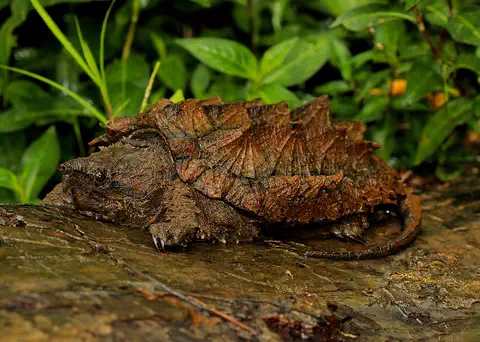
Alligator snapping turtle
The alligator snapping turtle is the largest freshwater turtle in the United States. It lies still on the bottom of rivers and lakes with its mouth open, wiggling a worm-like lure on its tongue to trick fish into swimming close. Its numbers have fallen, and it is now endangered.
For parents & teachers
What children will learn
- Describe how the Gila monster's body (beaded skin, fat tail, claws) suits desert life.
- Explain how eating large meals and storing fat lets an animal live mostly underground.
- Describe the Gila monster's life cycle across a year.
- Explain why it is protected by law and how to behave safely around wild animals.
Recommended ages: 3 to 17 · About 15 minutes
Talk about it
- Why might spending most of the year underground help an animal survive in a hot desert?
- How can bright colors help an animal both hide and warn?
- Why do you think scientists study venom to make medicines?
Try at home or in class
- Measure 56 centimeters with a ruler or tape and compare it with your arm, to see how long a big Gila monster is.
- Draw a Gila monster with your own bead pattern using dot stickers or a pencil eraser dipped in paint; remember that every real one is different.
Key vocabulary: venomous, burrow, carnivore, wash, monsoon, near threatened
Where these facts come from
- The IUCN Red List of Threatened Species , International Union for Conservation of Nature (IUCN terms of use (no redistribution of Red List data or range maps))
- GBIF Backbone Taxonomy and GBIF Occurrence Search , Global Biodiversity Information Facility (CC0 1.0 (backbone); occurrence counts are facts derived from records under CC0, CC BY and CC BY-NC)
- Heloderma suspectum (Gila Monster), global Red List assessment 2007 , IUCN Red List of Threatened Species
- Gila monster , Smithsonian's National Zoo and Conservation Biology Institute
- Gila Monster , Saguaro National Park, U.S. National Park Service
- Animal Fact Sheet: Gila Monster , Arizona-Sonora Desert Museum
- Wikidata , Wikimedia Foundation (CC0 1.0)
- Wikimedia Commons , Wikimedia Foundation (Per file: Public domain, CC0, CC BY or CC BY-SA only (credited on each page))
Checked, not yet human-reviewed. Last updated October 27, 2026. Spotted a mistake? Tell us.