
Animal
Komodo dragon
The Komodo dragon is the biggest lizard in the world. It lives on a few islands in Indonesia and smells with its long, forked tongue.
The Komodo dragon is the largest lizard alive today. It lives only on a handful of Indonesian islands, where it tracks food with its flicking yellow tongue, rests in burrows in the heat and spends its first years safely up in the trees.
Varanus komodoensis, the largest living lizard, is a monitor confined to a few islands in Indonesia's Lesser Sunda group. A top predator and scavenger with a venomous bite, it has a tiny total range, and the IUCN now lists it as Endangered (assessed 2019) because its population is small, about 1,400 mature adults, and expected to decline.
Photo: Dezidor, CC BY 3.0, via Wikimedia Commons
Meet the Komodo dragon
The Komodo dragon is the biggest lizard in the world.
It has rough, scaly skin, strong legs, long claws and a long tail. Its tongue is yellow and split at the tip. It is not a real dragon, just a very big lizard!
The Komodo dragon is the largest lizard alive today. Adults are usually 1.8 to 3 meters long and weigh 70 to 136 kilograms, with males bigger than females.
It is a type of monitor lizard. Its rough skin is strengthened with tiny bony plates, it has a long, muscular tail and powerful claws, and it flicks out a long, yellow, forked tongue. A scientist first described the species in 1912.
Varanus komodoensis is the largest living lizard. The San Diego Zoo gives adult lengths of 1.8 to 3 meters and weights of 70 to 136 kilograms; the longest verified animal measured 3.13 meters and the heaviest 166 kilograms. Males are larger and bulkier, yet the sexes look so alike that researchers struggle to tell them apart.
It belongs to the monitor lizards (family Varanidae). The species was formally described in 1912 by Peter Ouwens, director of the zoological museum at Bogor on Java, from a photograph, a skin and two specimens sent by a collector. Its skin is reinforced with osteoderms, small bony plates that protect against scratches and bites.
Quick facts
- Group
- Reptile
- Length
- 1.8 to 3 m
- Weight
- 70 to 136 kg
- Top speed
- up to 20 km/h
- Lifespan in the wild
- 30 years
Where it lives
Komodo dragons live on a few islands in Indonesia.
The islands are hot and hilly, with grassy land and forests. Dragons dig burrows to rest in when it is very hot.
Komodo dragons live only on a few islands in Indonesia: Komodo, Rinca, Flores and a few small islands nearby. That is the smallest home of any big predator on Earth, less than 900 square kilometers in all.
The islands were made by volcanoes. They are rugged and hilly, covered with tropical forest and grassy savanna, and daytime temperatures in the dry season often reach 35 °C. Dragons roam from the beaches to the ridge tops and dig burrows to stay cool by day and warm at night.
The species is confined to the Lesser Sunda Islands of Indonesia. In 2021 the San Diego Zoo Wildlife Alliance reported eight subpopulations on six islands (Flores, Gili Motang, Komodo, Nusa Kode, Padar and Rinca), almost 70 percent of them on Komodo and Rinca, in a range of under 900 square kilometers, the smallest of any large predator. Most of these subpopulations are small: the zoo's fact sheet, citing the 2021 IUCN assessors, puts Gili Motang and Nusa Kode at under 100 each and Padar at fewer than 10. Older sources, such as the National Zoo, say no dragons were seen on Padar after the 1970s, when poachers had killed off the deer they ate.
The islands are volcanic, rugged and hilly, with tropical savanna forest and grassland; dry-season days often reach 35 °C at 70 percent humidity. Dragons range from beach to ridge top and dig or borrow shallow burrows, sometimes on the slopes of dry streambeds, as shelter from midday heat and night cold.
Continent

Where can you find this animal?
- Lives here naturally · Countries and seas named by a scientific source
- Sightings recorded · Records of wild sightings (GBIF)
Lives here naturally · Countries and seas named by a scientific source
Only a few islands in Indonesia's Lesser Sunda group: Komodo, Rinca, Flores and small nearby islands, less than 900 square kilometers in all. It does not live across the rest of Indonesia.
Places: Indonesia.
Source: iucn-red-list · checked October 2026
Sightings recorded · Records of wild sightings (GBIF)
Counts of GBIF records of wild observations (human and machine) and preserved specimens. Records include introduced populations, vagrants, escaped or released animals and misidentifications, so a country with records is not necessarily part of the native range.
Wild sightings have been recorded in Indonesia, United States, Germany, Burundi and Denmark.
Source: gbif · checked October 2026
Range maps show where scientists say an animal lives, often country by country. An animal may live in only part of a country shown, and sightings records can include animals that wandered far from home.
What it eats
Komodo dragons eat meat.
Baby dragons live in trees and eat insects, eggs and little lizards. Big dragons eat deer and wild pigs. They also eat animals that are already dead.
Komodo dragons are carnivores and eat almost any kind of meat. Young dragons live in trees and catch grasshoppers, beetles, geckos and eggs. Once they are about four years old and big enough to live on the ground, they move on to larger animals. Deer are their favorite food, and they also eat wild pigs, goats and even water buffalo.
Komodos are scavengers too: they find dead animals by smell, sometimes from several kilometers away, and many dragons may share one meal.
Komodo dragons are apex predators and scavengers. Juveniles take insects, small lizards, snakes, birds and eggs; from about age four or five they shift to larger prey such as rodents, monkeys, goats, wild boar, water buffalo and especially deer, the most important food.
Adults often wait for hours beside a game trail rather than chase. Saliva carrying bacteria and venom from a gland in the lower jaw weakens animals that are bitten, and the dragons later track them down by smell. Carcasses are often shared by many dragons, little is wasted, and an adult's stomach expands enough for a meal of up to 80 percent of its body weight.
Did you know?
Baby Komodo dragons live up in the trees.
Young Komodo dragons spend their first years in trees, eating insects, eggs and geckos, until they are about 1.2 meters long.
Arboreal juveniles reduce their risk from larger, cannibalistic dragons and move to the ground at about four years and 1.2 meters.
Tongue, teeth and claws
A Komodo dragon smells with its tongue.
It flicks its yellow tongue in and out to catch smells in the air. It has strong legs and long claws for digging.
A Komodo dragon's most important sense is smell, and it smells with its tongue. It flicks its long, forked, yellow tongue to collect scent from the air, then touches the tips to special sensing spots in the roof of its mouth called Jacobson's organs. If one tip picks up more scent than the other, the dragon knows which way to go.
Its teeth are curved and jagged, a little like a shark's. Its eyes are good at spotting movement up to 300 meters away, but it does not see well in dim light.
Smell is the primary food detector. The forked tongue samples airborne molecules and delivers them to the paired Jacobson's (vomeronasal) organs in the roof of the mouth; comparing the concentration on the left and right tips gives direction, helped by a side-to-side swinging walk. Carrion can be detected up to about 4 kilometers away.
The teeth are large, curved and serrated. Researchers have documented a venom gland in the lower jaw; the venom stops blood from clotting. The retina has only cones, so dragons may see color but see poorly in dim light, and they spot movement up to 300 meters away. Their hearing range is much narrower than ours.
From egg to dragon
A mother Komodo dragon lays her eggs in a nest in the ground.
The eggs are as big as a grapefruit. When the babies hatch, they climb up a tree right away to stay safe.
A female Komodo dragon lays about 20 to 30 eggs, each about the size of a grapefruit. She often uses an old mound nest built by a bird called the orange-footed scrubfowl, and she may dig fake nest holes to fool animals that might dig up her eggs. She guards the nest for the first few months.
The eggs take about nine months to hatch. Each hatchling is about 30 to 40 centimeters long. It climbs straight up the nearest tree and lives there until it is about four years old and 1.2 meters long.
Mating occurs from May to August, and nest digging in August and September. Females lay roughly 20 to 30 eggs in hillside nests, ground nests or mounds built by orange-footed scrubfowl, which they appear to prefer, and dig decoy chambers that may deter other dragons from disturbing the clutch. Females do not breed every year.
Incubation takes about nine months, and the female may guard the nest early on, but there is no evidence of care after hatching. Hatchlings weigh under 100 grams and measure about 30 centimeters (San Diego Zoo) to 40 centimeters (National Zoo); they live in trees until about four years old and 1.2 meters long. At five they weigh about 25 kilograms and are about 2 meters long, and they keep growing slowly all their lives.
A dragon's day
In the morning, a Komodo dragon comes out of its burrow to sit in the sun.
Then it looks for food. In the hottest part of the day it rests in the shade. At night it goes back to its burrow.
A Komodo dragon's day follows the sun. In the morning it crawls out of its burrow and finds a sunny spot to warm up. Then it goes looking for food, takes a long rest in the shade during the hottest hours, has another look for food in the late afternoon and returns to its burrow for the night.
Komodo dragons mostly live alone. They can run in short bursts of 16 to 20 kilometers an hour, but they usually rely on patience rather than speed.
Daily activity tracks temperature: dragons emerge from burrows to bask, forage, retreat to shade at midday, forage again in late afternoon and shelter overnight. Adults are solitary outside feeding gatherings, and they can sprint briefly at 16 to 20 kilometers an hour, though their hunting relies on stealth.
Because large dragons will eat smaller ones, juveniles stay in trees and use appeasement behavior at feeding sites. Courtship happens when groups gather around carrion, and males compete for females in ritual wrestling, rearing up on their hind legs and using their tails for support.
Did you know?
It is hard even for scientists to tell boy and girl dragons apart.
Male and female Komodo dragons look so alike that zoos developed blood tests and ultrasound scans to tell them apart.
With no obvious external differences between sexes, the San Diego Zoo developed blood-sample and ultrasound methods in the mid-1990s to sex dragons from age two.
Protecting the dragons
There are not many Komodo dragons left.
They live on only a few islands. A national park and strict laws help keep them safe. If you ever see one, stay well back and listen to the grown-ups in charge.
Komodo dragons are endangered. About 3,500 lived in the wild in 2021, fewer than in 1981, and all of them live on just six islands. People hunting the same deer the dragons need, wild dogs and the loss of habitat on Flores all cause problems. Scientists also predict that rising seas could cover part of the land where dragons live.
Komodo National Park, set up in 1980, and strict laws against poaching help protect them, and visitors who come to see the dragons bring money that gives local people a reason to protect them too.
The IUCN assessed the species as Endangered in 2019 (criterion C1: a small population, about 1,383 mature individuals in eight subpopulations, with continuing decline expected), and the San Diego Zoo Wildlife Alliance reports a fall from about 5,000 in 1981 to about 3,500 in 2021, roughly 30 percent. Komodo and Rinca hold stable numbers; the risk is greatest on Flores. Threats include poaching of deer, the main prey, competition with people and introduced feral dogs, illegal trafficking, and habitat loss on Flores, where no more than about 10 percent of that subpopulation lives in a protected area. The San Diego Zoo Wildlife Alliance also cites a prediction that rising sea levels could remove 30 to 70 percent of the native range by 2040.
Komodo National Park (1980) and anti-poaching laws protect the core populations, though illegal activity still happens, and tourism gives local communities an economic reason to support protection.
IUCN Red List
How is the komodo dragon doing in the wild?
- Least Concern
- Near Threatened
- Vulnerable
- Endangered (this animal)
- Critically Endangered
- Extinct in the Wild
- Extinct
Endangered
At very high risk of disappearing from the wild.
See the IUCN Red List assessment · The IUCN Red List of Threatened Species 2022.2
Amazing facts
-
A Komodo dragon egg is as big as a grapefruit.
Komodo dragons begin life in an egg about the size of a grapefruit, and the eggs take about nine months to hatch.
Grapefruit-sized eggs incubate for about nine months, and egg laying can be delayed, which may help a clutch avoid the hottest months of the dry season.
-
Baby Komodo dragons live up in the trees.
Young Komodo dragons spend their first years in trees, eating insects, eggs and geckos, until they are about 1.2 meters long.
Arboreal juveniles reduce their risk from larger, cannibalistic dragons and move to the ground at about four years and 1.2 meters.
-
A Komodo dragon can smell food far away with its tongue.
Komodo dragons can smell a dead animal up to about 4 kilometers away by flicking their forked tongues.
Comparing scent concentrations on the two tongue tips tells a dragon the direction of food; carrion can be detected at up to about 4 kilometers.
-
It is hard even for scientists to tell boy and girl dragons apart.
Male and female Komodo dragons look so alike that zoos developed blood tests and ultrasound scans to tell them apart.
With no obvious external differences between sexes, the San Diego Zoo developed blood-sample and ultrasound methods in the mid-1990s to sex dragons from age two.
Words to know
- monitor lizard
- a family of large lizards with long necks, strong claws and forked tongues
- scavenger
- an animal that eats animals that are already dead
- Jacobson's organ
- sensing spots in the roof of the mouth that pick up smells from the tongue
- venom
- a harmful substance some animals put into others with a bite or sting
- osteoderms
- tiny bony plates in the skin that protect it
- endangered
- at risk of disappearing from the wild
Discovery challenge
-
What does a Komodo dragon use its tongue for?
What is the main job of a Komodo dragon's forked tongue?
What does the forked tongue deliver to the Jacobson's organs?
- Smelling scents in the air
- Drinking water
- Keeping cool
Show the answer
Smelling scents in the air
It flicks its tongue to catch smells.
The tongue collects scent from the air and carries it to the Jacobson's organs, which helps the dragon find food.
Airborne scent molecules; comparing left and right tips gives the direction of food.
-
Where do baby Komodo dragons live?
Where do young Komodo dragons spend their first years?
Which habitat do juvenile Komodo dragons use until about four years old?
- In the sea
- Up in trees
- In deep caves
Show the answer
Up in trees
They live up in the trees, where they are safe.
Hatchlings climb the nearest tree and live there until they are about 1.2 meters long.
Juveniles are arboreal, which reduces predation, including by larger dragons.
-
Where do wild Komodo dragons live?
Where do wild Komodo dragons live?
Which best describes the Komodo dragon's wild range?
- All over Asia
- In African deserts
- On a few islands in Indonesia
Show the answer
On a few islands in Indonesia
They live on a few islands in Indonesia.
Only on Komodo, Rinca, Flores and a few small islands nearby, all in Indonesia.
Eight subpopulations on six islands of the Lesser Sundas, under 900 square kilometers in total.
-
How long do Komodo dragon eggs take to hatch?
About how long do Komodo dragon eggs take to hatch?
What is the typical incubation period of a Komodo dragon clutch?
- About one week
- About nine months
- About five years
Show the answer
About nine months
They take about nine months.
The eggs incubate for about nine months.
About nine months; the female may guard the nest early on, but there is no care after hatching.
Places where you might see it
-
 Watch
 Country
Indonesia
Indonesia is a country of about 17,500 islands in Southeast Asia, spread across the Equator between the Indian and Pacific oceans. It has more than 100 active volcanoes, rainforests full of wildlife, and about 286 million people (2025).
-
Watch
Natural wonder
Komodo National Park
Komodo National Park, in Indonesia, is a group of rugged, dry islands between Sumbawa and Flores. Its three main islands, Komodo, Rinca and Padar, were made by volcanoes. The park contains most of the places where wild Komodo dragons, the largest living lizards, still live, along with rich coral reefs visited by turtles, dolphins and whales.
Explore next
-
 Watch
3D
Animal
Green iguana
The green iguana is a large lizard from the forests of Central and South America. It climbs high into trees to bask in the sun, eats leaves, flowers and fruit, and dives into rivers to get away from danger. It can grow to about 2 meters long, tail included.
-
Watch
Country
Indonesia
Indonesia is a country of about 17,500 islands in Southeast Asia, spread across the Equator between the Indian and Pacific oceans. It has more than 100 active volcanoes, rainforests full of wildlife, and about 286 million people (2025).
-
 Watch
Animal
Tuatara
The tuatara looks like a spiny lizard, but it is not one. It is the last living member of a group of reptiles that lived alongside the dinosaurs. Today wild tuatara live only on small islands off New Zealand, where they come out at night, grow very slowly and can live for around 100 years.
-
Watch
Natural wonder
Komodo National Park
Komodo National Park, in Indonesia, is a group of rugged, dry islands between Sumbawa and Flores. Its three main islands, Komodo, Rinca and Padar, were made by volcanoes. The park contains most of the places where wild Komodo dragons, the largest living lizards, still live, along with rich coral reefs visited by turtles, dolphins and whales.
-
 Watch
Animal
Gila monster
The Gila monster (say HEE-luh) is the largest lizard native to the United States. Its bumpy black skin is patterned with pink or orange, it spends most of its life hidden underground, and it is one of the very few lizards with venom.
-
 Watch
Animal
Aldabra giant tortoise
The Aldabra giant tortoise is one of the largest land tortoises on Earth. Wild ones live on Aldabra Atoll, a ring of coral islands in the Indian Ocean, where more than 100,000 of them graze, browse and shape the land like elephants do in Africa. They can live for more than 100 years.
-
 Watch
Animal
Alligator snapping turtle
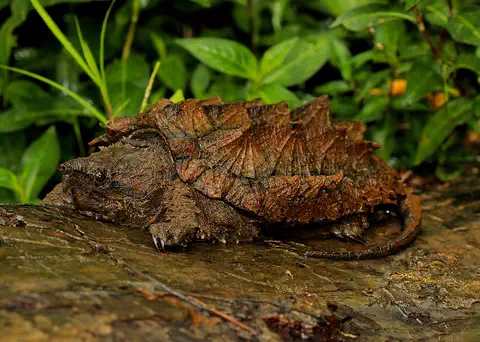
The alligator snapping turtle is the largest freshwater turtle in the United States. It lies still on the bottom of rivers and lakes with its mouth open, wiggling a worm-like lure on its tongue to trick fish into swimming close. Its numbers have fallen, and it is now endangered.
-
 Watch
3D
Animal
American alligator
The American alligator is a large, armored reptile of the swamps, marshes and lakes of the southeastern United States. Alligator mothers guard their nests and carry their babies to the water, and the holes alligators dig help many other animals survive dry seasons.
For parents & teachers
What children will learn
- Describe what makes the Komodo dragon the largest lizard and how its body and senses help it find food.
- Explain how the tongue and Jacobson's organs work together to detect smells.
- Describe the Komodo dragon life cycle, including why young dragons live in trees.
- Explain why a species with a very small range is endangered and how it is protected.
Recommended ages: 3 to 17 · About 15 minutes
Talk about it
- Why might an animal that lives on only a few islands be more at risk than one that lives on a whole continent?
- How could tourists visiting Komodo National Park help or harm the dragons?
- Why might young dragons be safer in trees than on the ground?
Try at home or in class
- Measure 3 meters with tape or string and lie down beside it to compare yourself with a big Komodo dragon.
- Play a smell-direction game: put a drop of vanilla on one side of a room and try to find it with your eyes closed, turning your head side to side as a dragon swings its head.
Key vocabulary: monitor lizard, scavenger, Jacobson's organ, venom, osteoderms, endangered
Where these facts come from
- The IUCN Red List of Threatened Species , International Union for Conservation of Nature (IUCN terms of use (no redistribution of Red List data or range maps))
- GBIF Backbone Taxonomy and GBIF Occurrence Search , Global Biodiversity Information Facility (CC0 1.0 (backbone); occurrence counts are facts derived from records under CC0, CC BY and CC BY-NC)
- Wikidata , Wikimedia Foundation (CC0 1.0)
- Varanus komodoensis (Komodo Dragon), Red List assessment 2019 , IUCN Red List of Threatened Species
- Komodo dragon , Smithsonian's National Zoo and Conservation Biology Institute
- Komodo dragon , San Diego Zoo Wildlife Alliance
- Komodo Dragon (Varanus komodoensis) Fact Sheet: Population & Conservation Status , San Diego Zoo Wildlife Alliance Library
- Wikimedia Commons , Wikimedia Foundation (Per file: Public domain, CC0, CC BY or CC BY-SA only (credited on each page))
Checked, not yet human-reviewed. Last updated October 27, 2026. Spotted a mistake? Tell us.