
Animal
Green anaconda
The green anaconda is one of the biggest snakes in the world. It lives in rivers and swamps in South America. It spends most of its time in the water.
The green anaconda is one of the largest snakes on Earth. This olive-green, spotted boa lives in the rivers, swamps and flooded grasslands of northern South America, where it lies hidden in shallow water with only its eyes and nose showing.
Eunectes murinus is a giant, nonvenomous boa of tropical South American wetlands and one of the largest living snakes, with females far bigger than males. It is a semi-aquatic apex predator that bears live young. In 2024 researchers proposed that northern populations are a separate species, the northern green anaconda (E. akayima), a split other taxonomists still dispute.
Photo: TimVickers, public domain, via Wikimedia Commons
Meet the green anaconda
The green anaconda is a giant snake.
It is olive green with big dark spots. Mother anacondas are much bigger than fathers. Anacondas love the water.
The green anaconda is one of the largest snakes in the world. The biggest can reach about 9 meters long and 250 kilograms, and females are much larger than males.
It is olive green, with dark oval spots along its back and spots with yellow centers along its sides. Two dark stripes run from each eye back toward the jaw. Anacondas belong to the boa family. They have no venom; instead they hold their prey and squeeze it with their powerful bodies.
Eunectes murinus is one of the largest living snakes. The Smithsonian's National Zoo reports that green anacondas can reach 9 meters, 30.5 centimeters in diameter and 250 kilograms; these are maximum figures, and females are considerably larger than males.
The body is olive green with dark oval dorsal spots, yellow-centered lateral spots, a yellow-and-black belly and two dark stripes angling from the eyes to the jaw. As a member of Boidae it is a nonvenomous constrictor. Stories about anacondas often exaggerate their size and ferocity; substantiated attacks on people are extremely rare.
Quick facts
- Group
- Reptile
- Length
- up to 9 m
- Weight
- up to 250 kg
- Lifespan in the wild
- 10 years
Where it lives
Green anacondas live in South America.
They live in slow rivers, swamps and flooded grassy plains. They spend most of their time in the water.
Green anacondas live in northern South America. They are most common in the Orinoco River basin in Colombia, the Amazon basin in Brazil and the flooded grasslands of Venezuela called the Llanos, and they also live in Ecuador, Peru, Bolivia, Guyana, Paraguay, French Guiana and Trinidad.
They like shallow, slow-moving water: streams, rivers, swamps and flooded grasslands in and around the rainforest. Where the land floods for only part of the year, an anaconda must find water in the dry season or bury itself in the mud.
The species is native to northern South America, most abundant in the Orinoco basin of Colombia, the Amazon basin of Brazil and Venezuela's seasonally flooded Llanos, and also present in Ecuador, Peru, Bolivia, Guyana, Paraguay, French Guiana and Trinidad; the IUCN's assessment (made in 2014, published in 2021) lists 11 countries and territories, adding Suriname.
It favors shallow, slow water in tropical forest and flooded grassland, spending most of its time in water but also using dense vegetation and trees. In seasonally flooded areas, anacondas survive the dry season by moving to remaining water or burrowing into mud. A 2024 proposal would treat the northern populations as a separate species (see Conservation).
Continent

Where can you find this animal?
- Lives here naturally · Countries and seas named by a scientific source
- Sightings recorded · Records of wild sightings (GBIF)
Lives here naturally · Countries and seas named by a scientific source
Rivers, swamps and flooded grasslands of tropical South America, especially the Amazon and Orinoco basins and Venezuela's Llanos. A disputed 2024 proposal treats the northern populations as a separate species, the northern green anaconda.
Places: Bolivia, Brazil, Colombia, Ecuador, Guyana, Paraguay, Peru, Suriname and 2 more places.
Source: iucn-red-list · checked October 2026
Sightings recorded · Records of wild sightings (GBIF)
Counts of GBIF records of wild observations (human and machine) and preserved specimens. Records include introduced populations, vagrants, escaped or released animals and misidentifications, so a country with records is not necessarily part of the native range.
Wild sightings have been recorded in Brazil, Colombia, Ecuador, Peru, Suriname, Venezuela, Guyana, Bolivia and 9 more places.
Source: gbif · checked October 2026
Range maps show where scientists say an animal lives, often country by country. An animal may live in only part of a country shown, and sightings records can include animals that wandered far from home.
What it eats
Anacondas eat other animals.
Young ones eat fish and birds. Big ones can eat large animals that come to the water. After a big meal, an anaconda does not need to eat again for weeks.
Green anacondas are carnivores and eat many kinds of animals. Young anacondas catch fish, birds and small mammals. Big adults can catch much larger animals at the water's edge, such as capybaras, deer, caimans and big birds.
An anaconda grabs its prey with its strong jaws, wraps its body around it and squeezes, then swallows it whole. Its jaws can stretch very wide. Because its body works slowly, it usually needs to eat only once every few weeks.
Green anacondas are opportunistic apex predators. Juveniles take fish, birds and small mammals; adults can take deer, capybaras, caimans and large birds. Prey is seized with the jaws and constricted until it suffocates, then swallowed whole; flexible jaw connections allow very large meals, although anacondas appear to weigh the risk of injury that big prey poses.
A slow metabolism means that, except for breeding females, an anaconda typically needs to feed only once every few weeks. Females fast through their roughly seven-month pregnancy.
Did you know?
Anaconda babies are born alive, not in eggs.
Anacondas give birth to live young in the water, usually 20 to 40 at a time. The record litter was 82!
Viviparous females produce litters of 20 to 40, scaled to body size; the largest recorded litter was 82.
Built for the water
An anaconda's eyes and nose are on top of its head.
It can hide in the water with only its eyes and nose showing. Its spots help it blend in with the water plants.
A green anaconda's eyes and nostrils sit on top of its head, so it can lie almost completely underwater and still see and breathe. Its olive color and dark spots help it blend in with wet, thick plants.
Anacondas have super senses. They flick their tongues to pick up scents in the air, feel vibrations, and have special pits on their upper lip that sense the warmth of nearby animals.
The eyes and nostrils are positioned on top of the head, an adaptation for seeing and breathing while almost fully submerged, and the cryptic olive-and-black pattern camouflages the snake in wet, dense vegetation.
Anacondas have advanced chemosensory abilities: tongue-flicking collects chemical signals from the air, which males also use to track female pheromones in the breeding season. They also detect vibrations, and heat-sensing pit organs on the upper lip let them pick up the heat signatures of nearby animals.
Live babies
Anaconda mothers do not lay eggs.
The babies grow inside their mother. She gives birth to lots of babies in the water.
Green anacondas mate in the dry season, from about March to May. Several males may gather around one female, each trying to be her mate. The female carries her young inside her body for about seven months.
Instead of laying eggs, she gives birth in the water to about 20 to 40 live babies. The record is 82! Young anacondas are grown up at about three to four years old. Females have babies only every other year.
Green anacondas mature at about 3 to 4 years. Mating usually takes place from March to May, in the dry season, when up to 13 males may cluster around a single female in a 'breeding ball' that can last up to a month.
They are viviparous: after a gestation of about seven months the female gives birth in water to 20 to 40 young, with litter size linked to her body size; the largest recorded litter was 82. They mate only every other year, probably because reproduction costs so much energy. Average lifespan in the wild is about 10 years, though some in human care have lived into their late 20s.
Hiding and waiting
Anacondas like to be alone.
They spend most of their time in the water. Big mother anacondas have few enemies. Smaller ones hide in the mud or swim away.
Green anacondas usually live alone and stay in their own hunting area, except in the breeding season. They spend most of their time in water, but they also climb into trees and move through thick plants.
Full-grown females are so big that few animals can harm them, but young anacondas and males need to stay safe. They escape by sliding into the water or burrowing into mud. If cornered, an anaconda coils into a ball to protect its head.
Green anacondas are typically solitary and remain within their own hunting areas except when breeding. They spend most of their time in water, though they also climb into trees and move through dense vegetation.
Adult females have few predators because of their size, while juveniles and males escape by retreating into water or burrowing into mud. When cornered, an anaconda coils into a ball, protecting its head while keeping the ability to strike.
Did you know?
An anaconda may eat only once every few weeks.
Green anacondas have such slow bodies that most need to eat only once every few weeks.
A slow metabolism lets most anacondas, apart from breeding females, go several weeks between meals.
Protecting anacondas
Anacondas need their rivers and forests.
Some forests are being cut down. Some people are scared of anacondas. If you ever see a big snake, stay well back and tell a grown-up.
The green anaconda is listed as Least Concern, but it still faces problems. Forests are being cut down, and some people kill anacondas because they are afraid of them or want to protect their farm animals. Anacondas are also hunted for products made from them and caught for the pet trade, which is controlled by international rules.
In 2024 a team of scientists said that anacondas in the north of South America are a separate species, the northern green anaconda. Other experts are not yet sure, so scientists are still studying the question. If there are two species, each will need its own check on how well it is doing.
The IUCN assessed Eunectes murinus as Least Concern in 2014 (published 2021, flagged as needing an update), with an unknown population trend. Threats include habitat loss and deforestation, including inside poorly regulated protected areas, killing out of fear or to protect livestock, and trade in anaconda products and live animals; trade is regulated under CITES Appendix II, but illegal trade persists.
In February 2024, Jesús Rivas, Sarah Corey-Rivas and colleagues named the northern green anaconda, Eunectes akayima, for populations from the Ecuadorian Amazon through Colombia and Venezuela to French Guiana, reporting mitochondrial DNA divergence equivalent to a split about 10 million years ago. Because the first paper did not meet the rules of zoological naming, they published a formal description in July 2024. The split is contested: other authors argued about which name applies, and the Reptile Database currently keeps E. akayima as a synonym of E. murinus because the two cannot yet be told apart by their bodies. If the split holds, each species will need its own conservation assessment.
IUCN Red List
How is the green anaconda doing in the wild?
- Least Concern (this animal)
- Near Threatened
- Vulnerable
- Endangered
- Critically Endangered
- Extinct in the Wild
- Extinct
Least Concern
Not at risk of disappearing from the wild right now.
See the IUCN Red List assessment · The IUCN Red List of Threatened Species 2022.2
Amazing facts
-
An anaconda may eat only once every few weeks.
Green anacondas have such slow bodies that most need to eat only once every few weeks.
A slow metabolism lets most anacondas, apart from breeding females, go several weeks between meals.
-
Anaconda babies are born alive, not in eggs.
Anacondas give birth to live young in the water, usually 20 to 40 at a time. The record litter was 82!
Viviparous females produce litters of 20 to 40, scaled to body size; the largest recorded litter was 82.
-
Anacondas can feel the warmth of other animals with their lips.
Pits on an anaconda's upper lip can sense the body heat of animals nearby.
Labial pit organs detect the heat signatures of nearby animals, complementing chemical and vibration senses.
-
Scientists think there may be two kinds of green anaconda.
In 2024 some scientists said that green anacondas in the north of South America are a separate species, the northern green anaconda. Others are still checking.
Eunectes akayima was named in 2024 after mitochondrial DNA showed deep divergence between northern and southern green anacondas; its status is still debated.
Words to know
- constrictor
- a snake that wraps around its prey and squeezes
- boa
- a family of snakes that squeeze their prey and usually give birth to live young
- camouflage
- colors or patterns that help an animal blend in
- carnivore
- an animal that eats other animals
- wetland
- land that is covered with shallow water for all or part of the year
- species
- one particular kind of living thing
Discovery challenge
-
Where does a green anaconda spend most of its time?
Where do green anacondas spend most of their time?
Which habitat do green anacondas use most?
- In the water
- In the desert
- On mountain tops
Show the answer
In the water
They love the water!
They spend most of their time in shallow, slow-moving water such as rivers, swamps and flooded grasslands.
Shallow, slow water in tropical forest and flooded grassland; they also use dense vegetation and trees.
-
How does an anaconda catch its food?
How does a green anaconda hold and stop its prey?
Which hunting method does Eunectes murinus use?
- With venom
- It squeezes it
- It spits at it
Show the answer
It squeezes it
It wraps around its food and squeezes.
It grabs prey with its jaws, then wraps its strong body around it and squeezes. It has no venom.
Nonvenomous constriction: prey is seized with the jaws and constricted until it suffocates.
-
How are anaconda babies born?
How do green anacondas have their young?
Which describes green anaconda reproduction?
- From eggs in a nest
- From eggs in a tree
- Born alive in the water
Show the answer
Born alive in the water
The babies are born alive, right in the water.
After about seven months, the mother gives birth in the water to 20 to 40 live babies.
Viviparous: live birth in water after about seven months of gestation.
-
Which anacondas are bigger, mothers or fathers?
Which green anacondas grow bigger?
How do male and female green anacondas differ in size?
- Males are much bigger
- Females are much bigger
- They are the same size
Show the answer
Females are much bigger
Mother anacondas are much bigger than fathers.
Females are considerably larger than males; the biggest females reach about 9 meters.
Females are considerably larger, reaching about 9 meters and 250 kilograms at most.
Places where you might see it
-
 Watch
 Country
Brazil
Brazil covers about half of South America and is the fifth-largest country in the world. It holds most of the Amazon River basin and much of the world's largest rainforest, and about 214 million people lived there in 2026, most of them near the Atlantic coast.
-
 Watch
 Country
Venezuela
Venezuela is a country on the north coast of South America. It has high Andes mountains, huge grassy plains called the Llanos, the great Orinoco River and flat-topped mountains called tepuis, where Angel Falls drops 979 meters.
Explore next
-
 Watch
Animal
Boa constrictor
The boa constrictor is a large, heavy snake of South America. Of all the boas, it lives in the greatest variety of places, from rainforests to dry scrub and farms. It catches food by squeezing, it has no venom, and mothers give birth to live babies.
-
 Watch
Animal
Reticulated python
The reticulated python lives in the forests, riversides and even towns of Southeast Asia. It can grow longer than any other kind of snake, it is covered in a net-like pattern, and it is such a good swimmer that it has reached many small islands across the sea.
-
 Watch
3D
Animal
Capybara
The capybara is the largest rodent alive, a giant cousin of the guinea pig. It lives in groups beside rivers, lakes and marshes in South America, grazes on grass and water plants, and dives into the water to stay cool and safe.
-
Watch
Country
Brazil
Brazil covers about half of South America and is the fifth-largest country in the world. It holds most of the Amazon River basin and much of the world's largest rainforest, and about 214 million people lived there in 2026, most of them near the Atlantic coast.
-
Watch
Country
Venezuela
Venezuela is a country on the north coast of South America. It has high Andes mountains, huge grassy plains called the Llanos, the great Orinoco River and flat-topped mountains called tepuis, where Angel Falls drops 979 meters.
-
 Watch
3D
Animal
Jaguar
The jaguar is the largest cat in North and South America. It lives near rivers and swamps, swims well, and has such a powerful bite that it can crack a turtle's shell. Most jaguars live in the Amazon rainforest.
-
 Watch
Animal
Aldabra giant tortoise
The Aldabra giant tortoise is one of the largest land tortoises on Earth. Wild ones live on Aldabra Atoll, a ring of coral islands in the Indian Ocean, where more than 100,000 of them graze, browse and shape the land like elephants do in Africa. They can live for more than 100 years.
-
 Watch
Animal
Alligator snapping turtle
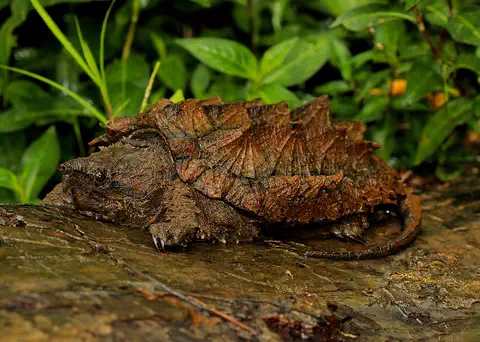
The alligator snapping turtle is the largest freshwater turtle in the United States. It lies still on the bottom of rivers and lakes with its mouth open, wiggling a worm-like lure on its tongue to trick fish into swimming close. Its numbers have fallen, and it is now endangered.
For parents & teachers
What children will learn
- Describe how the green anaconda's body and senses suit a life spent mostly in water.
- Explain how a constrictor catches prey without venom.
- Describe the anaconda life cycle, including live birth.
- Explain how scientists use DNA to propose new species, and why other scientists check and sometimes dispute them, using the 2024 northern green anaconda as an example.
Recommended ages: 3 to 17 · About 15 minutes
Talk about it
- Why might having eyes and nostrils on top of the head help an animal that lives in water?
- Why do you think stories about anacondas often make them sound bigger and fiercer than they are?
- How could people living near anacondas protect their animals without harming the snakes?
Try at home or in class
- Lay out 9 meters of string outdoors to see how long the very biggest anacondas can be, then compare it with the length of a car.
- Float a toy in a bowl of water with only its top showing, and notice how hard it is to spot from the side, like an anaconda with only its eyes and nose above water.
Key vocabulary: constrictor, boa, camouflage, carnivore, wetland, species
Where these facts come from
- The IUCN Red List of Threatened Species , International Union for Conservation of Nature (IUCN terms of use (no redistribution of Red List data or range maps))
- GBIF Backbone Taxonomy and GBIF Occurrence Search , Global Biodiversity Information Facility (CC0 1.0 (backbone); occurrence counts are facts derived from records under CC0, CC BY and CC BY-NC)
- Wikidata , Wikimedia Foundation (CC0 1.0)
- Eunectes murinus (Green Anaconda), Red List assessment 2014 , IUCN Red List of Threatened Species
- Green anaconda , Smithsonian's National Zoo and Conservation Biology Institute
- NMHU researchers discover new species of giant anaconda in South America , New Mexico Highlands University
- Description of the Northern Green Anaconda (Eunectes akayima sp. nov.): What Is in a Name? (Rivas et al., Diversity 16: 418, 2024) , Naturalis Biodiversity Center repository
- Eunectes murinus , The Reptile Database
- Wikimedia Commons , Wikimedia Foundation (Per file: Public domain, CC0, CC BY or CC BY-SA only (credited on each page))
Checked, not yet human-reviewed. Last updated October 27, 2026. Spotted a mistake? Tell us.