
Animal
Green iguana
The green iguana is a big lizard that lives high up in trees. It has spikes down its back and a floppy flap under its chin. It eats leaves and fruit.
The green iguana is a large lizard from the forests of Central and South America. It climbs high into trees to bask in the sun, eats leaves, flowers and fruit, and dives into rivers to get away from danger. It can grow to about 2 meters long, tail included.
Iguana iguana is a large, mostly herbivorous, tree-dwelling lizard native from Mexico to Paraguay and southeastern Brazil and many Caribbean islands. It is Least Concern on the IUCN Red List, yet it is also an invasive species in Florida, Puerto Rico and other places where people released it.
Photo: Rjcastillo, CC BY-SA 3.0, via Wikimedia Commons
Meet the green iguana
The green iguana is a big lizard.
It has spikes along its back, a long striped tail and a flap of skin under its chin. Young iguanas are bright green. Grown-ups can be gray, brown or orange.
The green iguana is a big lizard. From nose to tail tip, a large adult can be about 2 meters long, and most grown-ups weigh 4 to 6 kilograms, about as much as a big pet cat.
Despite the name, green iguanas are not always green. Young ones are usually bright green, but adults can be gray, brown or greenish, and males in the breeding season can turn orange. Their color can even change with temperature and mood.
Iguana iguana is a large iguanid lizard reaching about 2 meters in total length, of which the tail can make up as much as three quarters (UF/IFAS); most mature adults weigh 4 to 6 kilograms, and Animal Diversity Web notes some South American individuals reach 8 kilograms. It is the largest lizard known to occur within the borders of the United States, where it is introduced.
Color is variable. Juveniles are often bright green, or blotched or banded green and brown; adults become more uniform, and individuals shift shade with temperature, health, mood and social rank. For six to eight weeks before and during courtship, males may turn orange or gold, a change Animal Diversity Web links in part to sex hormones. The genus is still being studied: the Reptile Database lists Lesser Antilles island forms such as the Saint Lucia horned iguana as subspecies of I. iguana, while some researchers argue that genetically distinct island populations deserve species status.
Quick facts
- Group
- Reptile
- Length
- up to 2 m
- Weight
- 4 to 6 kg
- Lifespan in the wild
- 8 to 20 years
Where it lives
Green iguanas live in warm forests in Central and South America.
They climb high up in the trees. They like trees near rivers, so they can jump into the water.
Green iguanas are native to warm parts of the Americas, from Mexico south through Central America to Paraguay and southeastern Brazil, and on many Caribbean islands. They live mostly in forests, especially near rivers, lakes and the sea.
People have also carried them to other places, often as pets, and some were released. Now wild iguanas live in Florida, Hawaii, Puerto Rico and other islands, where they do not belong.
The native range runs from Sinaloa and Veracruz in Mexico south through Central America and tropical South America to the Tropic of Capricorn in Paraguay and southeastern Brazil, plus many Caribbean and eastern Pacific islands (Animal Diversity Web). The IUCN's 2018 assessment lists the countries; Ecuador, missing from that list, is added here because the Reptile Database and Reptiles of Ecuador both record the species there, in Ecuador's Pacific lowlands.
Iguanas are arboreal and prefer forest canopy beside water, but adapt to more open land. Introduced populations now live in Florida and Hawaii in the United States and on islands including Puerto Rico, Hispaniola (the Dominican Republic), Fiji and Taiwan. In Florida they were first reported in the 1960s near Miami (FWC). The map shows native and introduced areas as separate layers.
Continents
Its habitat

Where can you find this animal?
- Brought here by people · Countries and seas named by a scientific source
- Lives here naturally · Countries and seas named by a scientific source
- Sightings recorded · Records of wild sightings (GBIF)
Brought here by people · Countries and seas named by a scientific source
Wild populations started by released or escaped pets: southern Florida and Hawaii in the United States, Puerto Rico, the Dominican Republic and Fiji (IUCN) and Taiwan (Reptile Database), plus several small Caribbean islands not shown.
Places: United States, Puerto Rico, Dominican Rep., Fiji and Taiwan.
Source: iucn-red-list · checked October 2026
Lives here naturally · Countries and seas named by a scientific source
Tropical forests, river banks and coasts from Mexico through Central America to Paraguay and southeastern Brazil, and some Caribbean islands. Iguanas live in only the warm parts of countries such as Mexico, Brazil and Paraguay.
Places: Mexico, Belize, Guatemala, El Salvador, Honduras, Nicaragua, Costa Rica, Panama and 10 more places.
Source: iucn-red-list · checked October 2026
Sightings recorded · Records of wild sightings (GBIF)
Counts of GBIF records of wild observations (human and machine) and preserved specimens. Records include introduced populations, vagrants, escaped or released animals and misidentifications, so a country with records is not necessarily part of the native range.
Wild sightings have been recorded in Colombia, United States, Mexico, Costa Rica, Brazil, Puerto Rico, Panama, Ecuador and 41 more places.
Source: gbif · checked October 2026
Range maps show where scientists say an animal lives, often country by country. An animal may live in only part of a country shown, and sightings records can include animals that wandered far from home.
What it eats
Green iguanas eat plants.
They munch leaves, flowers and fruit. Baby iguanas sometimes eat a few insects too, to help them grow.
Green iguanas are herbivores. Grown-ups eat mostly leaves, flowers and ripe fruit high in the trees. Young iguanas need more protein for growing, so they sometimes eat insects too.
Iguanas hardly chew. They use their tongues to move food and bite off pieces small enough to swallow. Sitting in the sun warms their bodies, which helps them digest the tough leaves. Iguanas also help spread the seeds of the plants they eat.
Adults are primarily folivores and frugivores, eating leaves, flowers and fruit, with occasional invertebrates or carrion; juveniles, with higher protein needs, take more insects and eggs (Animal Diversity Web).
Food is bitten into swallowable pieces with little or no chewing. Most digestion happens in a chambered hindgut (the sacculated colon), where microbes break down cellulose; hatchlings eat adult droppings, which may be how they acquire these microbes. Temperature matters: cold suppresses appetite and digestive enzymes, and active feeding happens at about 25 to 35 °C, so basking and digestion are closely linked. Iguanas also disperse seeds. Where they are invasive, the same diet becomes a problem; Britannica notes that in Florida they eat fruits and vegetables from orchards and gardens, damage landscaping and threaten native tree snails.
Did you know?
If an iguana loses its tail, a new one grows back.
An iguana can let part of its tail break off to escape. A new tail grows back within about a year, though usually shorter.
Caudal autotomy lets the lizard escape a predator's grip; regeneration takes about a year and the new tail does not reach the original length.
An amazing body
An iguana has a row of spikes down its back.
A big round scale sits on each side of its head. The flap under its chin is called a dewlap. Its tail is very long and strong.
A row of spines, called a crest, runs from the iguana's neck down its back to the start of its tail. Under the chin hangs a flap of skin called a dewlap, which males spread out to show off or to warn rivals. Below each ear is a big, round scale.
On top of its head, iguanas even have a small third eye. It cannot see pictures, but it senses light and shadows, so it can notice a bird flying overhead.
Key features include a dorsal crest of dermal spines from mid-neck to the base of the tail, a pendulous dewlap stiffened by extensions of the hyoid bone, and a large rounded subtympanic plate below the eardrum (Animal Diversity Web). The dewlap is used in territorial and defensive displays and also helps absorb or shed heat.
Behind the eyes, on the top of the skull, is a parietal eye. It is not a true eye and forms no image, but it measures sunlight, plays a part in the maturing of the sex organs, thyroid and other endocrine glands, and can register the shadows of predators overhead (Animal Diversity Web). Like many lizards, iguanas can shed part of the tail when caught; a new tail regrows within about a year, though not to its old length.
Growing up
A mother iguana digs a deep hole in the ground.
She lays lots of eggs and fills the hole in. After about three or four months, the babies hatch. They look after themselves right away.
About two months after mating, a female digs a burrow, often deep in the ground, and lays 10 to 30 leathery eggs over a few days. She does not stay to guard them.
The eggs hatch after about 90 to 120 days. Each baby uses a tiny egg tooth to cut its way out. Hatchlings are only about 17 to 25 centimeters long and weigh about 12 grams, but within three years a young iguana can weigh a kilogram.
Females lay about 65 days after mating, depositing an average of 10 to 30 eggs over about three days in nests from 45 centimeters to more than a meter deep; nest sites are sometimes shared when space is limited. Incubation takes 90 to 120 days. Hatchlings slit the shell with a caruncle (egg tooth) that is soon lost, and live off absorbed yolk for their first week or two.
Young iguanas are independent from hatching and often stay in small groups, which may help them spot predators. They grow from about 12 grams to around 1 kilogram in three years and usually mature at three to four. Animal Diversity Web gives an average wild lifespan of about 8 years, and more than 20 in captivity.

Sunbathing and splashing
Iguanas love to lie in the sun.
The warm sun helps their bodies work. If danger comes near, they can jump from a branch into the water and swim away.
Like other reptiles, iguanas get their warmth from around them. In the morning their skin is darker, which soaks up sunlight; in the hot middle of the day they turn paler.
They like to rest on branches over water. If a hawk or another danger comes near, an iguana can drop into the river and swim swiftly away. Iguanas argue most over good sunny perches, and in the breeding season males guard their own patch. They talk with body language: bobbing their heads and spreading their dewlaps.
Iguanas are diurnal ectotherms, and color supports thermoregulation: darker skin early in the day absorbs heat, paler skin at midday reflects it. They bask on limbs overhanging water, and their main escape is to drop in and swim strongly or stay motionless and rely on camouflage.
Visual signals dominate communication: head bobbing, dewlap extension and color change. In the breeding season males defend territories and display to rivals; Animal Diversity Web notes that injuries are rare because rivals have room to retreat. Cold is a real limit. Britannica explains that when Florida temperatures drop below about 7 °C (45 °F), iguanas can become cold-stunned, lose their grip and fall from trees, sometimes needing days to recover.
Did you know?
Iguanas have a tiny third eye on top of their heads.
Green iguanas have a tiny third eye on top of the head. It cannot see pictures, but it senses light and the shadow of a bird flying over.
The parietal eye detects light and overhead shadows and plays a part in the maturing of the sex organs and endocrine glands.
Iguanas and people
Lots of green iguanas live in the wild.
In some places, people let pet iguanas go. There, the iguanas eat garden plants. If you see a wild iguana, watch it from a distance and do not touch.
Green iguanas are listed as Least Concern, which means the species is not thought to be at risk of dying out. In some places, though, hunting for food and catching for the pet trade have made them much rarer.
In places where pet iguanas were released or escaped, like Florida and Puerto Rico, the iguanas have become a problem. They dig burrows that can make sidewalks collapse, and they eat garden plants and native plants. If you see a wild iguana, enjoy it from a distance, don't touch it, and never let a pet reptile go outdoors.
The IUCN Red List assessed Iguana iguana as Least Concern in 2018, reflecting its very large range, though local populations have declined through hunting for meat and eggs and collection for the pet trade. Iguanas are also farmed for food and leather in some countries.
Outside the native range the picture flips. Released and escaped pets founded invasive populations; in Florida, Britannica and the state wildlife agency (FWC) report burrows that erode sidewalks, seawalls and canal banks, damage to landscaping and gardens, tree-snail remains found in iguana stomachs and the spread of Salmonella. Florida added the species to its prohibited list in 2021, encourages removal from private land and forbids releasing captured iguanas elsewhere. The species is a clear example of how the same animal can be secure at home and harmful elsewhere.
IUCN Red List
How is the green iguana doing in the wild?
- Least Concern (this animal)
- Near Threatened
- Vulnerable
- Endangered
- Critically Endangered
- Extinct in the Wild
- Extinct
Least Concern
Not at risk of disappearing from the wild right now.
See the IUCN Red List assessment · The IUCN Red List of Threatened Species 2022.2
Amazing facts
-
Iguanas have a tiny third eye on top of their heads.
Green iguanas have a tiny third eye on top of the head. It cannot see pictures, but it senses light and the shadow of a bird flying over.
The parietal eye detects light and overhead shadows and plays a part in the maturing of the sex organs and endocrine glands.
-
If an iguana loses its tail, a new one grows back.
An iguana can let part of its tail break off to escape. A new tail grows back within about a year, though usually shorter.
Caudal autotomy lets the lizard escape a predator's grip; regeneration takes about a year and the new tail does not reach the original length.
-
Iguanas are good swimmers.
Green iguanas are strong swimmers. They often rest on branches over water so they can drop in and swim away from danger.
Basking on limbs over water provides an escape route; iguanas drop in and use their powerful tails to swim away.
-
Iguanas change color when they warm up.
An iguana is often darker in the cool morning, which soaks up sunlight, and paler in the hot afternoon.
Color change supports thermoregulation: darker skin absorbs more heat when body temperature is low, paler skin reflects heat at midday.
Words to know
- dewlap
- a flap of skin that hangs under an animal's chin
- herbivore
- an animal that eats mainly plants
- arboreal
- living in trees
- basking
- lying in the sun to get warm
- invasive species
- a living thing taken to a new place, where it spreads and causes harm
- ectotherm
- an animal that gets its body heat from its surroundings, such as a reptile
Discovery challenge
-
What does a green iguana eat?
What do adult green iguanas mostly eat?
What makes up most of a green iguana's diet?
- Leaves, flowers and fruit
- Fish
- Rocks
Show the answer
Leaves, flowers and fruit
Iguanas eat plants: leaves, flowers and fruit.
Adults are herbivores that eat leaves, flowers and fruit in the trees.
A mainly plant diet of leaves, flowers and fruit; growing juveniles also add insects and eggs for protein.
-
How can an iguana in a tree by a river get away from danger?
How does a green iguana often escape danger?
How does a green iguana basking over water usually escape a predator?
- It drops into the water and swims away
- It flies away
- It digs a deep tunnel
Show the answer
It drops into the water and swims away
Splash! It jumps into the water and swims.
It drops off its branch into the water and swims away with its tail.
It drops into the water below its perch and swims away, an instant escape from predators such as hawks.
-
What is the flap under an iguana's chin called?
What is the flap of skin under an iguana's chin called?
Which structure is supported by extensions of the hyoid bone?
- A dewlap
- A fin
- A beak
Show the answer
A dewlap
It is called a dewlap.
It is a dewlap. Males spread it out to show off and warn rivals.
The dewlap, used in display and heat exchange, is stiffened by the hyoid apparatus.
-
If you see a wild iguana, what should you do?
What should you do if you see a wild iguana?
How should people behave around wild green iguanas, including invasive ones in Florida?
- Watch it from a distance
- Pick it up
- Chase it
Show the answer
Watch it from a distance
Watch it quietly from far away and do not touch it.
Watch it from a distance. In Florida they are not native: released pets spread and now eat gardens and native plants.
Watch from a distance and never release pets; most invasive populations began with released or escaped pets.
Places where you might see it
-
 Watch
 Country
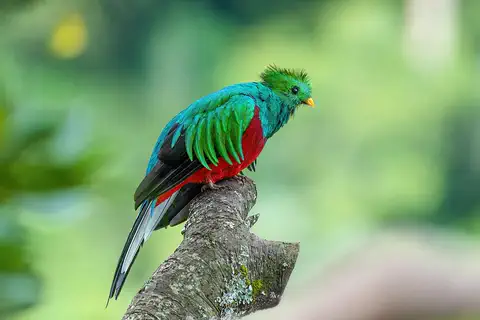
Costa Rica
Costa Rica is a small country in Central America between the Caribbean Sea and the Pacific Ocean. Volcanoes and mountains run down its middle, its forests are full of wildlife, and many national parks protect them. Since 1949 it has had no army. About 5.2 million people lived there in 2025.
-
 Watch
 Country
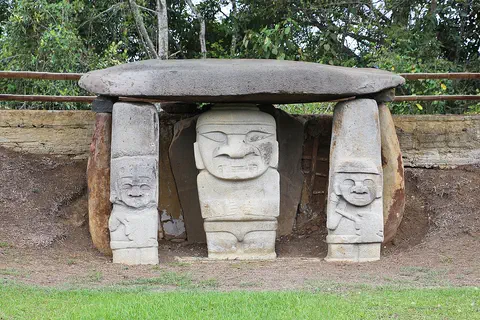
Colombia
Colombia is in the northwest of South America, with coasts on both the Caribbean Sea and the Pacific Ocean. Three ranges of the Andes run through it, and most people live in the cool mountains, where the capital, Bogotá, sits on a high plateau. About 53.4 million people lived there in 2026, according to DANE, the national statistics office.
Explore next
-
 Watch
Animal
Marine iguana
The marine iguana is the only lizard in the world that finds its food in the sea. It lives only on the rocky shores of the Galápagos Islands, where it grazes on seaweed, warms up on black lava rocks and sneezes out extra salt.
-
 Watch
Animal
Common basilisk
The common basilisk is a lizard of riversides and streams from Nicaragua to Venezuela. It climbs trees, swims well and, when it is startled, can sprint upright across the surface of the water on its big back feet before it sinks and swims.
-
Watch
Country
Costa Rica
Costa Rica is a small country in Central America between the Caribbean Sea and the Pacific Ocean. Volcanoes and mountains run down its middle, its forests are full of wildlife, and many national parks protect them. Since 1949 it has had no army. About 5.2 million people lived there in 2025.
-
Watch
Country
Colombia
Colombia is in the northwest of South America, with coasts on both the Caribbean Sea and the Pacific Ocean. Three ranges of the Andes run through it, and most people live in the cool mountains, where the capital, Bogotá, sits on a high plateau. About 53.4 million people lived there in 2026, according to DANE, the national statistics office.
-
 Watch
Animal
Ocelot
The ocelot is a medium-sized wild cat of the Americas, from southern Texas to northern Argentina. Its golden coat has chains of dark-edged spots, and no two ocelots look alike. It hunts mostly at night, catching mice, rats, lizards and birds, and it needs thick plants to hide in.
-
 Watch
Animal
Tuatara
The tuatara looks like a spiny lizard, but it is not one. It is the last living member of a group of reptiles that lived alongside the dinosaurs. Today wild tuatara live only on small islands off New Zealand, where they come out at night, grow very slowly and can live for around 100 years.
-
 Watch
3D
Animal
Veiled chameleon
The veiled chameleon lives in the dry mountains of Yemen and Saudi Arabia. It has a tall helmet-like casque on its head, eyes that can look two ways at once, feet that grip like hands and a super-fast sticky tongue. It changes color to show its mood, not to hide.
-
 Watch
Animal
Panther chameleon
The panther chameleon is a lizard famous for its brilliant colors. It lives on the island of Madagascar, grips branches with tong-shaped feet and a curling tail, looks two ways at once, and catches insects with a lightning-fast tongue. Males change their colors to send messages.
For parents & teachers
What children will learn
- Describe the green iguana's body features (crest, dewlap, subtympanic scale, parietal eye, tail) and what they do.
- Explain how reptiles depend on outside heat, including basking and color change.
- Describe the iguana life cycle from buried eggs to independent hatchlings.
- Explain the difference between a native and an invasive species, using the iguana in Florida.
Recommended ages: 3 to 17 · About 15 minutes
Talk about it
- Why might a lizard that eats leaves need to sunbathe?
- How can the same animal be safe in one place and a problem in another?
- Why should people never release pets into the wild?
Try at home or in class
- Put a dark and a light piece of paper in the sun for 10 minutes and feel which is warmer: link it to an iguana's morning color.
- Measure 2 meters of string and tie a knot half a meter from one end: the short part is the head and body, the long part shows how long an iguana's tail can be (up to three quarters of its length).
Key vocabulary: dewlap, herbivore, arboreal, basking, invasive species, ectotherm
Where these facts come from
- The IUCN Red List of Threatened Species , International Union for Conservation of Nature (IUCN terms of use (no redistribution of Red List data or range maps))
- GBIF Backbone Taxonomy and GBIF Occurrence Search , Global Biodiversity Information Facility (CC0 1.0 (backbone); occurrence counts are facts derived from records under CC0, CC BY and CC BY-NC)
- Wikidata , Wikimedia Foundation (CC0 1.0)
- Iguana iguana (Common Green Iguana), Red List assessment 2018 , IUCN Red List of Threatened Species
- Iguana iguana (common green iguana) , Animal Diversity Web, University of Michigan Museum of Zoology
- Iguana iguana , The Reptile Database
- Common iguana , Encyclopaedia Britannica
- Green Iguana (Iguana iguana) , Reptiles of Ecuador (Arteaga, Bustamante and Vieira, eds.)
- Florida's Introduced Reptiles: Green Iguana (Iguana iguana) , University of Florida IFAS Extension (EDIS)
- Green Iguana , Florida Fish and Wildlife Conservation Commission
- Green Iguana , SeaWorld Animal Info
- Why are iguanas falling from trees in Florida? , Encyclopaedia Britannica
- Wikimedia Commons , Wikimedia Foundation (Per file: Public domain, CC0, CC BY or CC BY-SA only (credited on each page))
Checked, not yet human-reviewed. Last updated October 27, 2026. Spotted a mistake? Tell us.