
Animal
Tuatara
The tuatara is a reptile from New Zealand. It looks like a lizard, but it is not a lizard. It can live to be very, very old.
The tuatara looks like a spiny lizard, but it is not one. It is the last living member of a group of reptiles that lived alongside the dinosaurs. Today wild tuatara live only on small islands off New Zealand, where they come out at night, grow very slowly and can live for around 100 years.
Sphenodon punctatus is the sole surviving species of the reptile order Rhynchocephalia (Sphenodontia), whose lineage split from that of lizards and snakes about 250 million years ago. Endemic to New Zealand and now naturally present on about 32 offshore islands, it is Least Concern on the IUCN Red List but entirely dependent on keeping its islands free of rats.
Photo: Stewart Nimmo, CC BY-SA 4.0, via Wikimedia Commons
Meet the tuatara
The tuatara looks a lot like a lizard, with a spiky crest on its back.
But it is not a lizard. It is the very last of a family of reptiles that lived long, long ago, at the time of the dinosaurs.
With its scaly body, clawed feet and spiny crest, the tuatara looks like a lizard. But scientists say it is not one. It is the only living member of a separate group of reptiles called the Sphenodontia. Long ago, at the time of the dinosaurs, there were many kinds; now only the tuatara is left.
The tuatara is New Zealand's largest reptile. Grown-up males are about half a meter long, and the male has a crest of spines along his neck and back that he can raise to impress females or face rivals. Its color can be olive-green, brown or orange-red.
Sphenodon punctatus is the only living rhynchocephalian. The order flourished with many species around 200 million years ago, and all but the tuatara died out about 60 million years ago (New Zealand Department of Conservation). A 2020 genome study in Nature placed the tuatara on the branch shared with lizards and snakes, but found it split off about 250 million years ago, so it is a close cousin of lizards rather than a lizard.
Its differences are real anatomy: teeth fused to the jaw bone (unlike all other living toothed reptiles), no external ear openings, a diapsid skull with two openings on each side, and a light-sensitive parietal "third eye" on top of the head, covered by a scale in adults (Animal Diversity Web). A second species, S. guntheri, recognized in 1989, was merged back into one species in 2009.
Quick facts
- Group
- Reptile
- Length
- 40 to 60 cm
- Weight
- up to 1.5 kg
- Lifespan in the wild
- 60 to 100 years
Where it lives
Tuatara live only in New Zealand.
Today wild tuatara live on small islands near the coast. They live in burrows, often next to seabirds.
Tuatara once lived all over mainland New Zealand. Today, wild ones live naturally on only about 32 small islands off the coast, from the Poor Knights Islands in the north to islands in Cook Strait. The biggest group, around 30,000 tuatara, lives on Stephens Island.
These islands are often home to colonies of seabirds, and tuatara often live in seabird burrows. The seabirds make the soil rich, which means more insects and lizards for tuatara to eat. People have also moved tuatara to other rat-free islands and into fenced, predator-proof sanctuaries on the mainland.
Subfossil remains show the tuatara was once widespread on the New Zealand mainland; it was lost there sometime in the 800 years after people arrived, and from 10 more offshore islands within the last century (IUCN). It is now naturally present on about 32 offshore islands from the Poor Knights Islands (35°28'S) to North Brother Island (41°07'S) in Cook Strait, from just above high tide to 722 meters.
Stephens Island (Takapourewa), only 150 hectares, holds the largest population, around 30,000, with densities in coastal forest of up to about 2,015 per hectare. Tuatara often use seabird burrows; DOC notes that seabirds enrich the soil and so the invertebrates and lizards tuatara eat. Translocations have added populations on seven Cook Strait islands and one Bay of Plenty island, and fenced mainland sanctuaries.
Continent
Its habitat

Where can you find this animal?
- Lives here naturally · Countries and seas named by a scientific source
- Sightings recorded · Records of wild sightings (GBIF)
Lives here naturally · Countries and seas named by a scientific source
About 32 small offshore islands from the Poor Knights Islands to Cook Strait, plus islands and fenced mainland sanctuaries where tuatara have been reintroduced. Wild tuatara no longer live freely on the main islands of New Zealand.
Places: New Zealand.
Source: iucn-red-list · checked October 2026
Sightings recorded · Records of wild sightings (GBIF)
Counts of GBIF records of wild observations (human and machine) and preserved specimens. Records include introduced populations, vagrants, escaped or released animals and misidentifications, so a country with records is not necessarily part of the native range.
Wild sightings have been recorded in New Zealand and Australia.
Source: gbif · checked October 2026
Range maps show where scientists say an animal lives, often country by country. An animal may live in only part of a country shown, and sightings records can include animals that wandered far from home.
What it eats
Tuatara eat beetles, worms and big insects called wētā.
Sometimes they eat seabird eggs and chicks, or small lizards.
Tuatara are hunters that mostly eat invertebrates: beetles, wētā (big New Zealand insects related to crickets), worms, millipedes and spiders. They also eat lizards, and seabird eggs and chicks.
Tuatara have a slow body, so they do not need to eat as often as most other reptiles. They are most active at night.
The diet is mainly invertebrates, including beetles, wētā, worms and millipedes, with the rest made up of lizards, seabird eggs and chicks, and occasionally young tuatara (Department of Conservation); Animal Diversity Web adds snails, frogs and small birds. Because its metabolic rate is very low, the tuatara feeds less often than most other reptiles.
Rats harm tuatara partly through competition: DOC notes that rats compete for the same invertebrate food, and that islands with rats have few nocturnal invertebrates or reptiles.
Did you know?
Tuatara have been protected for more than 125 years.
Tuatara were protected by law in 1895, one of the first native animals in New Zealand to be protected.
Legal protection in 1895 made the tuatara one of New Zealand's first protected native species; before that, hundreds were shipped overseas for museums and collectors (Department of Conservation).
A cool-weather reptile
Tuatara like cool weather. That is unusual for a reptile!
They have a spiky crest, big eyes and strong claws. They shed their skin once a year.
Most reptiles need warm weather to be active, but tuatara can be busy when it is cool, and they do not do well if it stays hotter than about 25 degrees Celsius. They still like to sit in the sun at the entrance to their burrows.
Look at the photo of Huruwhenua, a tuatara cared for at a wildlife center: you can see her big eye, the spiky crest on her neck and back, and her strong, clawed feet. Tuatara also have a "third eye" on top of the head. In adults it is hidden under a scale, so you cannot see it here.
Tuatara can remain active at low temperatures, which is unusual for reptiles, and in experiments they did not thrive at constant temperatures above 25 degrees Celsius (Department of Conservation), though they bask at burrow entrances. The metabolic rate is very low, and growth is among the slowest of any reptile: tuatara keep growing until about age 35.
The parietal eye on top of the skull has a retina-like structure, but a scale covers it in adults and its function is not clearly understood (Animal Diversity Web). Although tuatara are mainly nocturnal, the 2020 genome study found many genes for color vision, which the researchers suggest might help day-active juveniles avoid predators. Tuatara shed their skin about once a year.
A very slow life
A mother tuatara lays eggs.
The eggs take more than a year to hatch! Tuatara grow very slowly and can live to be about 100.
Tuatara do everything slowly. They mate in summer and early autumn, but the female does not lay her eggs until the next spring. The eggs then take 12 to 15 months to hatch, because the babies stop growing inside the egg during the cold winter.
The warmth of the nest decides whether the babies are boys or girls. Young tuatara take 10 to 20 years to grow up, and a female lays eggs only about once every four years. Tuatara keep growing until they are about 35 and can live to around 100.
Mating takes place from January to March, and eggs (5 to 18) are laid the following October to December; incubation lasts 12 to 15 months, with development pausing over winter, so a hatchling may have been conceived more than two years earlier (Animal Diversity Web). Sex is set by incubation temperature.
Maturity takes 10 to 20 years, and the IUCN gives an average of one clutch every four years for adult females, which Animal Diversity Web calls the longest reproductive cycle of any reptile. The average life span is about 60 years and some may reach 100 (Department of Conservation); the IUCN records a maximum of 91 years, but notes the true longevity is unknown because the longest-studied animals are still alive.
Night life in a burrow
Tuatara sleep in burrows in the daytime.
At night they come out to hunt. Boy tuatara raise their spiky crests to look big.
Tuatara are most active at night. Each tuatara usually lives alone in a burrow, which it sometimes defends. On sunny days, they may sit at the burrow entrance to soak up some warmth, and when it is cold they stay inside.
Male tuatara show off by puffing up their bodies, raising their crests and darkening the skin around their necks. They do this to challenge other males and to approach females.
Tuatara are nocturnal and solitary, living singly in burrows they sometimes defend, and basking at the entrance on sunny days (Animal Diversity Web). In cold weather they stay in their burrows.
In male contests and courtship, males inflate the body, raise the crest and darken the skin between the shoulders and the neck crest. Copulation is by cloacal contact, as males have no external sex organs.
Did you know?
Tuatara have a hidden third eye on top of their head.
Tuatara have a "third eye" on top of the head. In grown-ups it is covered by a scale.
The parietal eye has a retina-like structure and is sensitive to light, but in adults it is covered by a scale and its role is not clearly understood.
Islands without rats
Rats that people brought to New Zealand ate tuatara eggs and babies.
Now people keep the tuatara's islands free of rats. Tuatara are protected by law.
When people arrived in New Zealand, they brought rats. Rats eat tuatara eggs and babies and eat the insects tuatara need. Tuatara breed so slowly that they cannot keep up, so they disappeared from the mainland and from some islands.
Today rats have been removed from almost every island where tuatara live, and tuatara have been moved to more rat-free islands and fenced sanctuaries. Tuatara were protected by law in 1895. Visitors help by following the no-landing rule on tuatara islands and checking their gear for pests.
The IUCN lists the tuatara as Least Concern (assessed and published 2019), with more than 55,000 mature individuals, but stresses that it is entirely reliant on conservation management to keep invasive species off its islands. New Zealand's own threat classification lists it as At Risk, Relict (Department of Conservation). Introduced rats, including kiore, are thought to have caused much of the past decline by preying on eggs and hatchlings and competing for food, and rats have now been eradicated from all but one island with a known population.
Other concerns include habitat change (more than 80 percent of Stephens Island's forest was cleared for farms by the 1920s), low genetic diversity in small or once-reduced populations, and illegal collecting. The tuatara was legally protected in 1895, one of New Zealand's first protected native species, and is listed on CITES Appendix I.
IUCN Red List
How is the tuatara doing in the wild?
- Least Concern (this animal)
- Near Threatened
- Vulnerable
- Endangered
- Critically Endangered
- Extinct in the Wild
- Extinct
Least Concern
Not at risk of disappearing from the wild right now.
See the IUCN Red List assessment · The IUCN Red List of Threatened Species 2022.2
A living fossil?
Scientists study tuatara to learn about animals from long ago.
In 2020 scientists read the tuatara's genes, the instructions inside its body.
Some scientists call the tuatara a "living fossil". A news story from Northern Arizona University about a 2020 study used those words, because tuatara fossils about 150 million years old look very much like tuatara today.
Not every scientist likes the name. Animal Diversity Web points out that tuatara have their own new features, so they are not unchanged leftovers. In the 2020 study, scientists worked with the Māori tribe Ngātiwai to read the tuatara's genes for the first time.
The label "living fossil" is used, and disputed. Northern Arizona University's report on the 2020 Nature genome study described the tuatara that way, noting fossils about 150 million years old that look like living animals; Animal Diversity Web argues the term is misleading because the tuatara, though similar to its extinct relatives, has evolved features of its own.
The genome project, led by Neil Gemmell of the University of Otago in partnership with the Ngātiwai tribe, found a genome of about 5 billion bases, 67 percent larger than the human genome, a slow rate of molecular change, and more genes linked to protection against ageing than in any other vertebrate examined so far.
Did you know?
Tuatara eggs take more than a year to hatch.
Tuatara eggs take 12 to 15 months to hatch, so a baby tuatara may have started more than two years before it hatches.
With mating in late summer, laying the next spring and 12 to 15 months of incubation, a hatchling may have been conceived more than two years earlier (Animal Diversity Web).
Amazing facts
-
Tuatara eggs take more than a year to hatch.
Tuatara eggs take 12 to 15 months to hatch, so a baby tuatara may have started more than two years before it hatches.
With mating in late summer, laying the next spring and 12 to 15 months of incubation, a hatchling may have been conceived more than two years earlier (Animal Diversity Web).
-
Tuatara have a hidden third eye on top of their head.
Tuatara have a "third eye" on top of the head. In grown-ups it is covered by a scale.
The parietal eye has a retina-like structure and is sensitive to light, but in adults it is covered by a scale and its role is not clearly understood.
-
Tuatara keep growing until they are about 35 years old.
Tuatara grow so slowly that they keep growing until they are about 35.
Tuatara have one of the slowest growth rates of any reptile and continue growing until about age 35 (Department of Conservation).
-
Tuatara have been protected for more than 125 years.
Tuatara were protected by law in 1895, one of the first native animals in New Zealand to be protected.
Legal protection in 1895 made the tuatara one of New Zealand's first protected native species; before that, hundreds were shipped overseas for museums and collectors (Department of Conservation).
Words to know
- reptile
- a cold-blooded animal with scales, such as a lizard, snake, turtle or tuatara
- endemic
- found naturally in only one place in the world
- nocturnal
- active at night
- sanctuary
- a protected place where animals are kept safe
- genome
- all the genetic instructions inside a living thing
- wētā
- a large New Zealand insect related to crickets
Discovery challenge
-
Is a tuatara a lizard?
Which statement about the tuatara is true?
How is the tuatara classified?
- It is a kind of lizard
- It is not a lizard; it is the last of a separate group of reptiles
- It is a kind of frog
Show the answer
It is not a lizard; it is the last of a separate group of reptiles
No! It looks like a lizard, but it is not one.
It is the last living member of a separate reptile group, the Sphenodontia.
The sole living rhynchocephalian, whose lineage diverged from lizards and snakes about 250 million years ago.
-
Where do tuatara live?
Where do wild tuatara live today?
Where do natural tuatara populations survive?
- On small islands off New Zealand
- In the deserts of Africa
- In the Amazon rainforest
Show the answer
On small islands off New Zealand
They live in New Zealand, on small islands.
On about 32 small islands off New Zealand, plus a few rat-free sanctuaries.
About 32 offshore islands from the Poor Knights to Cook Strait, plus reintroduced sites.
-
What animals did people bring that harmed tuatara?
Which animals brought by people caused tuatara to disappear from many places?
Which introduced animals were the main cause of the tuatara's decline?
- Rats
- Penguins
- Butterflies
Show the answer
Rats
Rats ate tuatara eggs and babies.
Rats ate eggs and young tuatara and the insects tuatara need.
Introduced rats, especially kiore, preyed on eggs and hatchlings and competed for invertebrate food.
-
How long do tuatara eggs take to hatch?
How long do tuatara eggs take to hatch?
What is the incubation period of tuatara eggs?
- One week
- One month
- More than a year
Show the answer
More than a year
More than a year! They are very slow.
12 to 15 months, because development pauses during the cold winter.
12 to 15 months, including a winter pause in embryonic development.
Places where you might see it
Explore next
-
 Watch
 Country
New Zealand
New Zealand, also called Aotearoa, is an island country in the South Pacific. Its two main islands have snowy mountains, glaciers, volcanoes and deep fiords, and about 5.36 million people lived there in 2026.
-
 Watch
Animal
Kākāpō
The kākāpō is a large, moss-green parrot from New Zealand with an owl-like face. It cannot fly, it is active at night, and it eats only plants. It nearly died out, but careful work by New Zealand's Department of Conservation has grown the population to 325 birds (September 2026).
-
 Watch
Animal
North Island brown kiwi
The North Island brown kiwi is a flightless bird that lives only in New Zealand's North Island. It has shaggy brown feathers, no tail, and a long bill with nostrils near the tip, so it can sniff out worms and grubs in the dark. The father keeps the huge egg warm for 75 to 90 days.
-
 Watch
3D
Animal
Komodo dragon
The Komodo dragon is the largest lizard alive today. It lives only on a handful of Indonesian islands, where it tracks food with its flicking yellow tongue, rests in burrows in the heat and spends its first years safely up in the trees.
-
 Watch
3D
Animal
Green iguana
The green iguana is a large lizard from the forests of Central and South America. It climbs high into trees to bask in the sun, eats leaves, flowers and fruit, and dives into rivers to get away from danger. It can grow to about 2 meters long, tail included.
-
 Watch
Animal
Aldabra giant tortoise
The Aldabra giant tortoise is one of the largest land tortoises on Earth. Wild ones live on Aldabra Atoll, a ring of coral islands in the Indian Ocean, where more than 100,000 of them graze, browse and shape the land like elephants do in Africa. They can live for more than 100 years.
-
 Watch
Animal
Alligator snapping turtle
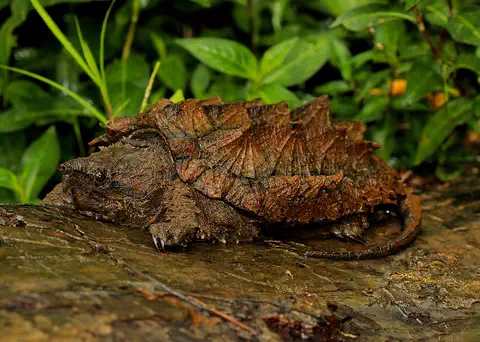
The alligator snapping turtle is the largest freshwater turtle in the United States. It lies still on the bottom of rivers and lakes with its mouth open, wiggling a worm-like lure on its tongue to trick fish into swimming close. Its numbers have fallen, and it is now endangered.
-
 Watch
3D
Animal
American alligator
The American alligator is a large, armored reptile of the swamps, marshes and lakes of the southeastern United States. Alligator mothers guard their nests and carry their babies to the water, and the holes alligators dig help many other animals survive dry seasons.
For parents & teachers
What children will learn
- Explain why the tuatara is not a lizard and what makes it special.
- Describe how the tuatara's slow growth and breeding make it vulnerable to introduced predators.
- Describe how removing rats and protecting islands helped tuatara.
- Discuss the phrase "living fossil" and why some scientists question it.
Recommended ages: 3 to 17 · About 15 minutes
Talk about it
- Why might an animal that breeds only every four years be hurt badly by rats?
- Is "living fossil" a good name for the tuatara? Why or why not?
- Why do you think keeping some islands free of visitors helps wildlife?
Try at home or in class
- Make a timeline on a long strip of paper: mark one year for the egg, 15 years to grow up and 100 years of life, to see how slow a tuatara's life is.
- Measure 60 centimeters with a tape measure to see how long a big male tuatara is.
Key vocabulary: reptile, endemic, nocturnal, sanctuary, genome, wētā
Where these facts come from
- The IUCN Red List of Threatened Species , International Union for Conservation of Nature (IUCN terms of use (no redistribution of Red List data or range maps))
- GBIF Backbone Taxonomy and GBIF Occurrence Search , Global Biodiversity Information Facility (CC0 1.0 (backbone); occurrence counts are facts derived from records under CC0, CC BY and CC BY-NC)
- Sphenodon punctatus (Tuatara), global Red List assessment 2019 , IUCN Red List of Threatened Species
- Tuatara , Department of Conservation
- Sphenodon punctatus (Tuatara) , Animal Diversity Web, University of Michigan Museum of Zoology
- The curious genome of the tuatara, an ancient reptile in peril , EMBL (European Molecular Biology Laboratory)
- NAU biologist part of international team to sequence genome of rare reptilian 'living fossil' , The NAU Review, Northern Arizona University
- Wikidata , Wikimedia Foundation (CC0 1.0)
- Wikimedia Commons , Wikimedia Foundation (Per file: Public domain, CC0, CC BY or CC BY-SA only (credited on each page))
Checked, not yet human-reviewed. Last updated October 27, 2026. Spotted a mistake? Tell us.