
Animal
Common basilisk
The common basilisk is a lizard with a very long tail. It can run across the top of the water on its back legs!
The common basilisk is a lizard of riversides and streams from Nicaragua to Venezuela. It climbs trees, swims well and, when it is startled, can sprint upright across the surface of the water on its big back feet before it sinks and swims.
Basiliscus basiliscus is a semiaquatic, semiarboreal lizard of Central America and northwestern South America, famous for bipedal running on water, which physicists explain with a slap, stroke and recovery cycle of its feet. It is common, and the IUCN lists it as Least Concern.
Photo: Charles J. Sharp, CC BY-SA 4.0, via Wikimedia Commons
Meet the common basilisk
The common basilisk is a lizard that lives by rivers.
It has a very long tail and long back legs. When it is scared, it can run on top of the water!
The common basilisk is a large lizard that is mostly tail: about three quarters of its length is its long, thin tail, which helps it balance. Adults are 43 to 80 centimeters long from nose to tail tip.
Most common basilisks are brown or olive, but some are bright green or bronze, with dark bands and pale stripes along the lips and sides. Males are bigger than females and have tall, sail-like crests on the head, back and tail. Their most famous trick is running across water.
Basiliscus basiliscus reaches a snout-vent length of up to about 203 millimeters and a total length of 430 to 800 millimeters, with the tail making up 70 to 75 percent (Animal Diversity Web). Color ranges from brown or olive to bright green and bronze, with darker crossbands and cream to yellow lip and lateral stripes; juveniles are more vivid.
Males are larger and carry sail-like head, dorsal and caudal crests supported by elongated neural spines, a clear case of sexual dimorphism that suggests visual signals matter in this species. Long, sharp-clawed digits help with climbing.
Quick facts
- Group
- Reptile
- Length
- 43 to 80 cm
- Weight
- 200 to 500 g
Where it lives
Common basilisks live in warm forests in Central and South America.
They always stay close to rivers and streams. At night they climb up high to sleep.
Common basilisks live in Nicaragua, Costa Rica, Panama, Colombia and Venezuela. On the Pacific side they live from southwestern Nicaragua to northwestern Colombia, and on the Caribbean side from central Panama to Venezuela, including all around Lake Maracaibo.
They are almost always found along rivers and streams, in dry, moist and wet forests and even along streams running through farmland. They live from near sea level up to about 1,200 meters in Central America.
The IUCN (assessed 2013, published 2016) describes the range as the lowlands and adjacent slopes of the Pacific versant from southwestern Nicaragua to northwestern Colombia and the inter-Andean valleys of central Colombia, and the Atlantic versant from central Panama to northwestern Venezuela, including the whole Lake Maracaibo basin. It reaches about 1,200 meters in Central America and about 1,600 meters in Andean valleys in Venezuela.
It is diurnal, semiaquatic and semiarboreal, typically along watercourses in lowland dry, moist and wet forests and premontane forests, including gallery forest and secondary growth along streams in heavily disturbed agricultural land. An introduction to Guyana is reported, but a breeding population there is not confirmed.
Continents
Its habitat

Where can you find this animal?
- Lives here naturally · Countries and seas named by a scientific source
- Sightings recorded · Records of wild sightings (GBIF)
Lives here naturally · Countries and seas named by a scientific source
Rivers and streams in lowland and foothill forests from southwestern Nicaragua through Costa Rica and Panama to Colombia and northwestern Venezuela. Basilisks live along watercourses, not across whole countries.
Places: Nicaragua, Costa Rica, Panama, Colombia and Venezuela.
Source: iucn-red-list · checked October 2026
Sightings recorded · Records of wild sightings (GBIF)
Counts of GBIF records of wild observations (human and machine) and preserved specimens. Records include introduced populations, vagrants, escaped or released animals and misidentifications, so a country with records is not necessarily part of the native range.
Wild sightings have been recorded in Colombia, Costa Rica, Panama, Venezuela, Nicaragua, Mexico, Belize, Guatemala and 5 more places.
Source: gbif · checked October 2026
Range maps show where scientists say an animal lives, often country by country. An animal may live in only part of a country shown, and sightings records can include animals that wandered far from home.
What it eats
Common basilisks eat bugs, small animals, fruit and flowers.
They even catch little fish and shrimps in the water.
Common basilisks are omnivores, which means they eat both animals and plants. Most of their food is animals: insects and other small creatures, small lizards and snakes, birds, mice, fish, freshwater shrimps and sometimes frogs. They also eat flowers and fruit.
Young basilisks eat mostly insects. As they grow older, they eat more plants.
The species is omnivorous but mainly predatory: a study of basilisks in Panama found about 78 percent animal and 22 percent plant material (Animal Diversity Web). Prey includes arthropods, small lizards, snakes, birds, mammals, fishes, freshwater shrimps and occasionally frogs, and plant foods include flowers and fruits.
Juveniles are more insectivorous than adults, and the share of plant food increases with age.
Did you know?
A basilisk wobbles with every step on water.
Running on water is wobbly. A scientist who studied basilisks said they are almost tripping on every step and catching themselves.
Tonia Hsieh, who filmed basilisks running across water tanks at Harvard, described them as basically tripping every single step and catching themselves (Physics World, 2024).
Running on water
The basilisk has big back feet with wide toes.
It runs on its back legs, very fast. Its feet slap the water so hard that it does not sink, for a little while!
A basilisk is much too heavy to be held up by the water's surface. So how does it run on water? Scientists filmed basilisks and found that each step has three parts. First the foot slaps down hard. Then it pushes down through the water so fast that a little pocket of air opens above it. Then the lizard pulls its foot out before the water closes in.
Big hind feet with flattened toes and flaps of scales along them give it extra push. Smaller basilisks can run 20 meters or more across water. Bigger ones sink after a few meters and swim instead.
Basilisks are far too heavy for surface tension to support them. Harvard researchers Jim Glasheen and Tom McMahon, analyzing videos, divided each water step into slap, stroke and recovery (Nature, 1996): each slap produces an upward force; during the stroke the foot moves so fast that an air-filled cavity forms above it, and the foot gains lift in proportion to the water it moves; in recovery the foot must leave before the cavity closes. Later work by Tonia Hsieh explained their wobbly sideways motion: as she put it, they are "basically tripping every single step" and catching themselves (Physics World, 2024).
Large hind feet with flattened toes and a fringe of scales that unrolls as the lizard starts across help. Animal Diversity Web notes that small individuals may run 20 meters or more, while large ones sink after a few meters and swim or dive.
Growing up
A mother basilisk digs a hole and lays her eggs.
She covers them with soil and leaves. The babies hatch a few months later and take care of themselves.
Common basilisks start breeding in March. Over the next ten months a female lays several clutches of 2 to 18 eggs. She digs a hole, lays the eggs, then fills it with soil using her front legs and pats it down with her snout. After that, she leaves.
The eggs hatch after about two to three months, and the babies take care of themselves. Females can breed at about 20 months old. Males can too in their second year, but bigger males often keep younger ones from breeding until they are three or four.
Breeding begins in March, and females lay several clutches of 2 to 18 eggs over the following ten months, fewer in January to March; larger females lay more eggs (Animal Diversity Web). The female digs a hole, lays, inspects the nest and backfills it, packing the soil with her snout; there is no further parental care. Incubation lasts 60 to 90 days.
Females mature at around 20 months, males in their second year, but size-based dominance means many males do not breed until three or four. Survival is low: first-year survival can be under 60 percent, most males live 4 to 6 years, and a captive basilisk lived more than 9 years.
Life by the river
Basilisks are busy in the daytime.
They bask in the sun and look for food by the water. At night they sleep high up on a branch.
Common basilisks are active by day. They spend their time hunting, basking in the sun and resting along rivers and streams, mostly on the ground. At night they sleep on perches as high as 20 meters up.
If something startles them, they drop into the water and run across it, or swim and dive. Male basilisks guard territories and bob their heads to warn other males away and to court females.
The species is diurnal, foraging, basking and resting along waterways and sleeping at night on perches up to 20 meters high (Animal Diversity Web). Disturbance or prey pursuit can trigger the bipedal water run.
Males are territorial and use head bobbing as a threat display and in courtship, and larger males dominate smaller ones. Natural predators include raptors, which take hatchlings, giant ameivas and other animals that eat eggs, and opossums and snakes that may catch sleeping adults.
Did you know?
Small basilisks can run farther on water than big ones.
Small basilisks can run 20 meters or more across water, but big ones sink after a few meters and start swimming.
Smaller individuals are better water runners and may cover 20 meters or more; larger ones sink and swim or dive after a few meters (Animal Diversity Web).
Doing well
There are lots of common basilisks.
They live in many places, even near farms. Some live in parks where they are protected.
Common basilisks are listed as least concern. They are common, they live across a big area, and they can even live along streams in farmland. Their numbers seem to be steady.
They are not hunted or traded, and no big threats to them are known. Some live in protected areas.
The IUCN lists the common basilisk as Least Concern (assessed 2013, published 2016, flagged as needing an update), citing its large range, high abundance, many collection sites, presence in protected areas and lack of major threats; the population trend is stable. It is very common around Lake Maracaibo in Venezuela.
The assessment notes that the species is not used or traded and needs no significant additional protection, management or research.
IUCN Red List
How is the common basilisk doing in the wild?
- Least Concern (this animal)
- Near Threatened
- Vulnerable
- Endangered
- Critically Endangered
- Extinct in the Wild
- Extinct
Least Concern
Not at risk of disappearing from the wild right now.
See the IUCN Red List assessment · The IUCN Red List of Threatened Species 2022.2
Amazing facts
-
Small basilisks can run farther on water than big ones.
Small basilisks can run 20 meters or more across water, but big ones sink after a few meters and start swimming.
Smaller individuals are better water runners and may cover 20 meters or more; larger ones sink and swim or dive after a few meters (Animal Diversity Web).
-
A basilisk's tail is longer than the rest of its body.
About three quarters of a common basilisk's length is its tail.
The tail makes up 70 to 75 percent of total length and aids balance.
-
Basilisks sleep high up in the trees.
At night, common basilisks sleep on perches as high as 20 meters up.
Night perches can be up to 20 meters high, though sleeping adults may still be caught by opossums and snakes (Animal Diversity Web).
-
A basilisk wobbles with every step on water.
Running on water is wobbly. A scientist who studied basilisks said they are almost tripping on every step and catching themselves.
Tonia Hsieh, who filmed basilisks running across water tanks at Harvard, described them as basically tripping every single step and catching themselves (Physics World, 2024).
Words to know
- bipedal
- moving on two legs
- crest
- a raised ridge of skin or scales on an animal's head or back
- surface tension
- the pull that holds the top of water together like a thin skin
- omnivore
- an animal that eats both plants and animals
- semiaquatic
- living partly in water and partly on land
- clutch
- a group of eggs laid at one time
Discovery challenge
-
What can a basilisk run across?
What surface can a startled basilisk run across?
Which locomotor feat is the common basilisk famous for?
- Water
- Snow
- Clouds
Show the answer
Water
It runs across the water on its back legs.
It sprints upright across water, then swims when it slows down.
Bipedal running on the water surface, driven by the slap, stroke and recovery of its hind feet.
-
What does a basilisk do with its feet to stay on top of the water?
How does a basilisk stay on top of the water?
What keeps a running basilisk from sinking?
- It slaps and pushes the water very fast
- It floats on a leaf
- It holds its breath
Show the answer
It slaps and pushes the water very fast
It slaps the water hard and fast with its big feet.
Each fast step slaps the water, pushes down to make an air pocket, and lifts out before the water closes.
Slap and stroke forces, with the foot withdrawn before the air cavity collapses; surface tension is far too weak.
-
Where do common basilisks like to live?
Where do common basilisks usually live?
Which habitat is the common basilisk most closely tied to?
- By rivers and streams
- On snowy mountain tops
- In the open ocean
Show the answer
By rivers and streams
They live by rivers and streams in warm forests.
They live along rivers and streams in tropical forests, and even by streams in farmland.
Watercourses in lowland and premontane forests, including gallery forest and disturbed farmland.
-
How much of a basilisk is tail?
How much of a common basilisk's length is its tail?
What share of total length does the tail make up?
- About a tenth
- About half
- About three quarters
Show the answer
About three quarters
Its tail is very long: most of the basilisk is tail!
About three quarters, so most of the basilisk is tail.
About 70 to 75 percent of total length.
Places where you might see it
-
 Watch
 Country
Costa Rica
Costa Rica is a small country in Central America between the Caribbean Sea and the Pacific Ocean. Volcanoes and mountains run down its middle, its forests are full of wildlife, and many national parks protect them. Since 1949 it has had no army. About 5.2 million people lived there in 2025.
-
 Watch
 Country
Panama
Panama is a narrow country in Central America that joins North and South America. Since 1914 the Panama Canal has let ships cross from the Atlantic Ocean to the Pacific without sailing around South America. Panama has rainforests, more than 1,600 islands and about 4.6 million people (2025).
-
 Watch
 Country
Colombia
Colombia is in the northwest of South America, with coasts on both the Caribbean Sea and the Pacific Ocean. Three ranges of the Andes run through it, and most people live in the cool mountains, where the capital, Bogotá, sits on a high plateau. About 53.4 million people lived there in 2026, according to DANE, the national statistics office.
Explore next
-
 Watch
3D
Animal
Green iguana
The green iguana is a large lizard from the forests of Central and South America. It climbs high into trees to bask in the sun, eats leaves, flowers and fruit, and dives into rivers to get away from danger. It can grow to about 2 meters long, tail included.
-
Watch
Country
Costa Rica
Costa Rica is a small country in Central America between the Caribbean Sea and the Pacific Ocean. Volcanoes and mountains run down its middle, its forests are full of wildlife, and many national parks protect them. Since 1949 it has had no army. About 5.2 million people lived there in 2025.
-
Watch
Country
Panama
Panama is a narrow country in Central America that joins North and South America. Since 1914 the Panama Canal has let ships cross from the Atlantic Ocean to the Pacific without sailing around South America. Panama has rainforests, more than 1,600 islands and about 4.6 million people (2025).
-
Watch
Country
Colombia
Colombia is in the northwest of South America, with coasts on both the Caribbean Sea and the Pacific Ocean. Three ranges of the Andes run through it, and most people live in the cool mountains, where the capital, Bogotá, sits on a high plateau. About 53.4 million people lived there in 2026, according to DANE, the national statistics office.
-
 Watch
Animal
Red-eyed tree frog
The red-eyed tree frog lives in the rainforests of Central America. By day it sleeps folded up on a leaf, looking plain green. When something disturbs it, it flashes huge red eyes, orange feet and blue-and-yellow sides.
-
 Watch
3D
Animal
Keel-billed toucan
The keel-billed toucan lives in the forests of southern Mexico, Central America and northern South America. Its huge, colorful bill can be a third of its whole length, yet it is light, and the bird uses it to pick fruit from thin branches.
-
 Watch
Animal
Aldabra giant tortoise
The Aldabra giant tortoise is one of the largest land tortoises on Earth. Wild ones live on Aldabra Atoll, a ring of coral islands in the Indian Ocean, where more than 100,000 of them graze, browse and shape the land like elephants do in Africa. They can live for more than 100 years.
-
 Watch
Animal
Alligator snapping turtle
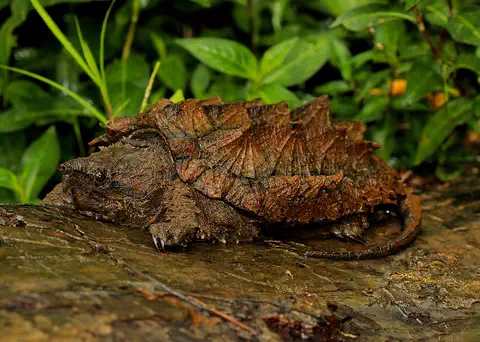
The alligator snapping turtle is the largest freshwater turtle in the United States. It lies still on the bottom of rivers and lakes with its mouth open, wiggling a worm-like lure on its tongue to trick fish into swimming close. Its numbers have fallen, and it is now endangered.
For parents & teachers
What children will learn
- Explain, in simple terms, how a basilisk can run on water (slap, stroke, recovery).
- Describe the common basilisk's body: long hind legs, big feet, crests and long tail.
- Describe its omnivorous diet and life cycle.
- Understand why a species that tolerates disturbed habitat can stay common.
Recommended ages: 3 to 17 · About 15 minutes
Talk about it
- Why do you think small basilisks can run farther on water than big ones?
- Could a person run on water like a basilisk? What would we need?
- Why might living close to water help a lizard escape danger?
Try at home or in class
- In a bathtub or basin, slap the water gently with a flat hand and then with one finger; feel which pushes back more. Always have a grown-up nearby around water.
- Measure 52 centimeters with a tape measure, then mark where the tail would start (about 13 centimeters from the nose) to see how much of a basilisk is tail.
Key vocabulary: bipedal, crest, surface tension, omnivore, semiaquatic, clutch
Where these facts come from
- The IUCN Red List of Threatened Species , International Union for Conservation of Nature (IUCN terms of use (no redistribution of Red List data or range maps))
- GBIF Backbone Taxonomy and GBIF Occurrence Search , Global Biodiversity Information Facility (CC0 1.0 (backbone); occurrence counts are facts derived from records under CC0, CC BY and CC BY-NC)
- Basiliscus basiliscus (Common Basilisk), global Red List assessment 2016 , IUCN Red List of Threatened Species
- Basiliscus basiliscus (Common Basilisk) , Animal Diversity Web, University of Michigan Museum of Zoology
- Could athletes mimic basilisk lizards and turn water-running into an Olympic sport? , Physics World (IOP Publishing)
- Wikidata , Wikimedia Foundation (CC0 1.0)
- Wikimedia Commons , Wikimedia Foundation (Per file: Public domain, CC0, CC BY or CC BY-SA only (credited on each page))
Checked, not yet human-reviewed. Last updated October 27, 2026. Spotted a mistake? Tell us.