
Animal
Green tree python
The green tree python is a bright green snake. It lives in rainforest trees. Its babies are yellow or red!
The green tree python is a bright green snake of the rainforests of New Guinea, nearby islands and the far northeast of Australia. It spends most of its life in the trees, waiting very still for animals to come close. Its young hatch yellow or brick-red and turn green as they grow.
Morelia viridis (family Pythonidae) is a non-venomous, mainly arboreal python of closed forest in New Guinea, its offshore islands and northeastern Cape York Peninsula, Australia, from sea level to 2,000 m. Tallowin and colleagues listed it as Least Concern for the IUCN Red List (assessed 12 June 2017, published 2018), with a stable trend; the assessment still includes the northern New Guinea populations that some scientists now call a separate species, Morelia azurea.
Photo: JJ Harrison, CC BY-SA 3.0, via Wikimedia Commons
Meet the green tree python
The green tree python is a long, bright green snake.
It lives up in the trees.
It has no venom.
The green tree python is a bright green snake that lives in rainforest trees. Grown-up green tree pythons are about 1.5 meters long on average, and the longest one ever recorded was 2.2 meters.
It has no venom. It catches its food and squeezes it in its coils. Most have a line of white or yellow scales along the middle of the back.
Morelia viridis is a python (family Pythonidae): a non-venomous constrictor (Oregon Zoo; Moonlit Sanctuary). Animal Diversity Web gives an average length of 1.5 m and a largest recorded specimen of 2.2 m, notes that adult males and females do not appear to differ, and calls it the most arboreal python species. Adults are bright green, usually with a ridge of white to yellow scales along the spine that forms a broken or continuous line, and yellow belly scales (ADW). The species was described by Schlegel in 1872 as Python viridis.
Quick facts
- Group
- Reptile
- Length
- 1.5 m
- Lifespan in the wild
- 15 years
Rainforests of New Guinea and Cape York
Green tree pythons live in warm, wet rainforests.
They live on a big island called New Guinea, and in a small part of Australia.
Green tree pythons live mainly in rainforest with a closed canopy, the leafy roof of the forest. They are found across most of the big island of New Guinea and on islands near it, and in one small corner of Australia: the northeast of the Cape York Peninsula in Queensland.
They live from the seashore up to about 2,000 meters high. In New Guinea they are also found in forest that is growing back, and even in gardens in the countryside.
The IUCN describes a wide range through New Guinea, absent only from the Trans-Fly in the south, where eucalyptus woodland does not suit it; records from offshore islands include Biak, Supiori, Yapen, Numfor and Num (Papua Province), Batanta, Kofiau, Misool, Salawati and Waigeo (West Papua) and the Aru Islands (Maluku). In Australia it is restricted to the Iron and McIlwraith Ranges of northeastern Cape York Peninsula and nearby areas, where it appears to form three isolated populations (Natusch and Natusch 2011). It lives mainly in closed forest, also using habitat next to it, and in New Guinea has been recorded in regrowth and rural gardens; elevation 0 to 2,000 m (IUCN).
Continent
Did you know?
A green tree python can wiggle its tail to trick small animals.
Young green tree pythons have been seen wiggling the tip of their tail to attract small animals, a trick called tail luring.
Caudal luring observed, especially in juveniles (ADW; Moonlit Sanctuary).
Where can you find this animal?
- Lives here naturally · Countries and seas named by a scientific source
- Sightings recorded · Records of wild sightings (GBIF)
Lives here naturally · Countries and seas named by a scientific source
New Guinea (Papua New Guinea and the Indonesian provinces on the island) and nearby islands, including the Aru Islands, and northeastern Cape York Peninsula in Queensland, Australia (IUCN). In Australia it lives only in the Iron and McIlwraith Ranges and nearby areas; it is absent from the Trans-Fly in southern New Guinea. This map follows the IUCN assessment, which still includes the northern New
Places: Papua New Guinea, Indonesia and Australia.
Source: iucn-red-list · checked November 2026
Sightings recorded · Records of wild sightings (GBIF)
Counts of GBIF records of wild observations (human and machine) and preserved specimens. Records include introduced populations, vagrants, escaped or released animals and misidentifications, so a country with records is not necessarily part of the native range.
Wild sightings have been recorded in Papua New Guinea, Australia, Indonesia, Iran, United States, Germany, Namibia, Nigeria and 1 more places.
Source: gbif · checked October 2026
Range maps show where scientists say an animal lives, often country by country. An animal may live in only part of a country shown, and sightings records can include animals that wandered far from home.
Waiting for dinner
Young green tree pythons eat small lizards.
Grown-ups eat mice, rats and birds.
A green tree python is an ambush hunter: it waits very still until an animal comes close, then strikes. Young pythons eat mostly lizards, especially skinks. As they grow bigger, they switch to small mammals such as rats and mice, and birds.
A green tree python may stay at the same hunting spot for up to 14 days. It squeezes its prey in its coils and swallows it headfirst. Its jaws open wide enough to swallow prey up to three times bigger than its own head.
A nocturnal 'sit and wait' predator: juveniles feed mainly on lizards, especially skinks, and adults mainly on small mammals (IUCN, after Natusch and Lyons 2014). ADW adds birds in the adult diet, ambush sites used for up to 14 days, and, as the main prey at Iron Range on Cape York, the rodents Rattus leucopus and Melomys capensis. It is a constrictor that swallows prey headfirst and can take prey up to three times larger than its head (Oregon Zoo). Caudal luring, wiggling the tail tip to attract small animals, has been observed, especially in juveniles (ADW; Moonlit Sanctuary).
Did you know?
A green tree python has lots of teeth, but no venom.
Green tree pythons have no venom, but they can have up to 100 teeth.
Non-venomous; up to 100 teeth (Oregon Zoo).
Yellow, red, then green
Baby green tree pythons are bright yellow or red.
As they grow, they turn green.
Green tree pythons change color as they grow up. They hatch bright yellow or brick-red, with white spots along the back. Somewhere between six months and a year old, they turn green. The change can happen overnight, or take several months.
Each color seems to help the snake hide where it lives at that age: yellow or red at the edges of the forest, where sunlight reaches the ground, and green high up in the leafy treetops. Red babies are found only in parts of New Guinea.
ADW describes the ontogenetic color change: hatchlings are bright yellow or brick-red with black- or brown-edged white dorsal blotches; they turn green between about six months and a year, at 53 to 59 cm, overnight or over several months, not tied to sexual maturity and usually not to a skin shed. Juveniles live in canopy gaps and forest edges, adults in closed canopy, and each color seems to give camouflage for its habitat. The red juvenile morph is found only in parts of New Guinea (ADW). Under the 2019 split (Natusch et al.), M. viridis in the narrow sense has a single (yellow) juvenile morph and a row of white vertebral scales, while M. azurea juveniles can be yellow or red (Reptile Database).
Seeing warmth
A green tree python has little holes on its lip.
They feel the warmth of animals nearby.
Along its upper lip, a green tree python has small heat-sensing pits. They let it sense the warmth of animals nearby, which helps a lot when it hunts in the dark. It also uses its eyes to find food.
Scientists think the pits may also help a python find good spots to wait for prey or to warm up, and notice predators coming.
ADW: the labial heat-sensing pits lie only within the scales of the upper lip; they allow infrared imaging, which matters for a predator that hunts mostly at night as an adult, and may also help it find ambush and warm resting sites and avoid predators. Prey is found by these pits and by sight (ADW; Moonlit Sanctuary).
Did you know?
A green tree python can wait in one spot for many days.
A hunting green tree python may stay at the same ambush spot for up to 14 days, waiting for prey to come by.
Ambush sites may be used for up to 14 days (ADW).
A mother coils around her eggs
The mother lays eggs.
She curls around them to keep them warm.
The babies look after themselves.
A female green tree python lays between 6 and 32 eggs. She coils around them, and in captivity mothers have been seen shivering their muscles, which seems to keep the eggs warm. The eggs hatch after about 50 days. The babies are about 30 centimeters long and get no care from their parents.
In the wild, green tree pythons breed in the dry season. They may not breed every year.
Oviparous, with clutches of 6 to 32 eggs and incubation of around 52 days; captive pythons may breed at any time of year, but the wild cycle falls in the dry season, July to November (IUCN). ADW: females brood the clutch for about 50 days (39 to 60); captive females coil around the eggs and shiver, apparently to produce heat; there is no care after hatching; hatchlings are about 30.5 cm; few young are found in any one year, suggesting they do not breed every year; maturity is reportedly reached at 2.4 years (males) and 3.6 years (females). IUCN gives maturity at about 91 cm (males) and 112 cm (females) snout-vent length.
Coiled on a branch
It rests curled up on a branch.
Grown-ups hunt at night.
Grown-up green tree pythons are active at night. When resting, they coil up over a branch or a vine, often in a tree hollow or among plants growing on the trees. To hunt, a python holds on to its branch with the back of its body and folds the front part like an accordion, ready to strike.
Green tree pythons live in the trees, but they sometimes come down to the ground at night to hunt. They live alone.
ADW: adults are nocturnal while juveniles, before the color change, are active by day; the resting posture is coiled over a horizontal branch or vine, often sheltered in a tree hollow or in epiphytes; the hunting posture extends the front of the body in accordion folds while the rear grips the perch; females, but not males or juveniles, keep home ranges (average 6.21 ha); males search widely for mates. The IUCN notes that this arboreal snake descends to the ground to hunt at night (Wilson et al. 2006). Predators include rufous owls, black butcherbirds, daytime raptors, mangrove monitors, dingoes and New Guinea quolls (ADW).
Did you know?
Baby green tree pythons are yellow or red, not green!
Green tree pythons hatch bright yellow or brick-red, and turn green between six months and a year old. The change can happen overnight.
Ontogenetic color change at 6 to 12 months, overnight or over several months (ADW).
Pets, palm oil and protected forest
There are many green tree pythons.
People must not take them from the wild.
They need their forests.
The green tree python is listed as least concern: it lives across a wide area and is common in most of it. But people catch many wild ones to sell as pets, even though it is against the law, and this may harm some small island populations. Many pet green tree pythons are now bred in captivity.
The biggest danger is the loss of forest, such as forest cleared for oil palm plantations in the Indonesian part of New Guinea. Green tree pythons are protected by law in Australia, Papua New Guinea and Indonesia.
Least Concern (Tallowin, Parker, O'Shea, Hoskin, Couper and Amey; Global; assessed 12 June 2017, published 2018; trend stable): widespread, abundant through most of its range and present in many protected areas. Illegal capture for the pet trade continues; it may threaten some local and island subpopulations, the Biak Island subpopulation being of highest concern, and some 'captive-bred' exports from Indonesian farms are wild-caught. Extensive captive breeding may have reduced pressure. People in New Guinea also hunt it for food. The IUCN calls the expansion of oil palm plantations in West Papua and Papua, and development there, the most significant threat. Trade is controlled under CITES Appendix II, and it has protected status in Australia, Papua New Guinea and Indonesia (IUCN).
IUCN Red List
How is the green tree python doing in the wild?
- Least Concern (this animal)
- Near Threatened
- Vulnerable
- Endangered
- Critically Endangered
- Extinct in the Wild
- Extinct
Least Concern
Not at risk of disappearing from the wild right now.
Amazing facts
-
Baby green tree pythons are yellow or red, not green!
Green tree pythons hatch bright yellow or brick-red, and turn green between six months and a year old. The change can happen overnight.
Ontogenetic color change at 6 to 12 months, overnight or over several months (ADW).
-
A green tree python can wiggle its tail to trick small animals.
Young green tree pythons have been seen wiggling the tip of their tail to attract small animals, a trick called tail luring.
Caudal luring observed, especially in juveniles (ADW; Moonlit Sanctuary).
-
A green tree python can wait in one spot for many days.
A hunting green tree python may stay at the same ambush spot for up to 14 days, waiting for prey to come by.
Ambush sites may be used for up to 14 days (ADW).
-
A green tree python has lots of teeth, but no venom.
Green tree pythons have no venom, but they can have up to 100 teeth.
Non-venomous; up to 100 teeth (Oregon Zoo).
Words to know
- constrictor
- a snake that holds its prey tight in its coils
- ambush
- to wait hidden and then attack by surprise
- arboreal
- living in trees
- nocturnal
- active at night
- heat-sensing pit
- a small hollow on a snake's face that can feel warmth from animals
- least concern
- not currently at serious risk of dying out in the wild
Discovery challenge
-
What color is a baby green tree python?
What color are green tree pythons when they hatch?
What color are Morelia viridis hatchlings?
- Yellow or red
- Green
- Black
Show the answer
Yellow or red
Yellow or red! They turn green later.
They hatch bright yellow or brick-red and turn green between six months and a year old.
Yellow or brick-red hatchlings; green at 6 to 12 months (ADW).
-
How does a green tree python catch its food?
How does a green tree python hunt?
What is the hunting strategy of Morelia viridis?
- It waits very still, then strikes
- It chases animals for a long way
- It digs them out of the ground
Show the answer
It waits very still, then strikes
It waits very still, then strikes!
It is an ambush hunter: it waits on a branch until an animal comes close.
A nocturnal sit-and-wait (ambush) predator (IUCN; ADW).
-
Where do green tree pythons live?
In which place do green tree pythons live?
Which region holds the range of Morelia viridis?
- New Guinea and northeastern Australia
- Africa
- South America
Show the answer
New Guinea and northeastern Australia
New Guinea and a corner of Australia!
Across most of New Guinea, on nearby islands and in northeastern Cape York, Australia.
New Guinea, offshore islands and northeastern Cape York Peninsula (IUCN).
-
What does a mother green tree python do with her eggs?
What does a female green tree python do after laying her eggs?
Which form of parental care does Morelia viridis show?
- Coils around them
- Buries them and leaves
- Carries them in her mouth
Show the answer
Coils around them
She curls around them!
She coils around the eggs for about 50 days until they hatch.
Females brood the clutch; no care after hatching (ADW).
Places where you might see it
-
 Watch
 Country
Papua New Guinea
Papua New Guinea covers the eastern half of New Guinea, the world's second largest island, plus many smaller islands. Its tall mountains, rainforests and coral reefs are home to about 40 kinds of birds-of-paradise. More than 800 languages are spoken there, and the 2024 census counted 10,185,363 people.
-
 Watch
 Country
Indonesia
Indonesia is a country of about 17,500 islands in Southeast Asia, spread across the Equator between the Indian and Pacific oceans. It has more than 100 active volcanoes, rainforests full of wildlife, and about 286 million people (2025).
-
 Watch
 Country
Australia
Australia is a country and the smallest continent, surrounded by ocean in the Southern Hemisphere. Much of its middle is dry and flat, most people live near the coast, and its animals include kangaroos, koalas and the platypus, a mammal that lays eggs.
Explore next
-
 Watch
Animal
Burmese python
The Burmese python is one of the largest snakes in the world. In its home in South and Southeast Asia it has become rare because so many are caught, but in southern Florida, where people let pet pythons go, it has spread through the Everglades and eats many of the animals that live there.
-
 Watch
Animal
Reticulated python
The reticulated python lives in the forests, riversides and even towns of Southeast Asia. It can grow longer than any other kind of snake, it is covered in a net-like pattern, and it is such a good swimmer that it has reached many small islands across the sea.
-
 Watch
Animal
Boa constrictor
The boa constrictor is a large, heavy snake of South America. Of all the boas, it lives in the greatest variety of places, from rainforests to dry scrub and farms. It catches food by squeezing, it has no venom, and mothers give birth to live babies.
-
Watch
Country
Papua New Guinea
Papua New Guinea covers the eastern half of New Guinea, the world's second largest island, plus many smaller islands. Its tall mountains, rainforests and coral reefs are home to about 40 kinds of birds-of-paradise. More than 800 languages are spoken there, and the 2024 census counted 10,185,363 people.
-
Watch
Country
Indonesia
Indonesia is a country of about 17,500 islands in Southeast Asia, spread across the Equator between the Indian and Pacific oceans. It has more than 100 active volcanoes, rainforests full of wildlife, and about 286 million people (2025).
-
Watch
Country
Australia
Australia is a country and the smallest continent, surrounded by ocean in the Southern Hemisphere. Much of its middle is dry and flat, most people live near the coast, and its animals include kangaroos, koalas and the platypus, a mammal that lays eggs.
-
 Watch
Animal
Aldabra giant tortoise
The Aldabra giant tortoise is one of the largest land tortoises on Earth. Wild ones live on Aldabra Atoll, a ring of coral islands in the Indian Ocean, where about 180,000 of them graze, browse and shape the land like elephants do in Africa. They can live for more than 100 years.
-
 Watch
Animal
Alligator snapping turtle
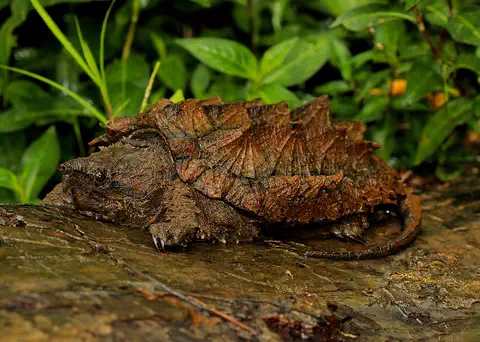
The alligator snapping turtle is the largest freshwater turtle in the United States. It lies still on the bottom of rivers and lakes with its mouth open, wiggling a worm-like lure on its tongue to trick fish into swimming close. Its numbers have fallen, and it is now endangered.
For parents & teachers
What children will learn
- Describe how a green tree python hunts by ambush.
- Explain how a young green tree python's color changes as it grows.
- Describe how heat-sensing pits help a snake hunt at night.
- Explain why taking wild animals for the pet trade and clearing forest can harm a species.
Recommended ages: 3 to 17 · About 15 minutes
Talk about it
- Why might a yellow or red color help a young python hide at a sunny forest edge, and green help an adult in the treetops?
- What are the good and bad sides of waiting for food instead of chasing it?
- Why is it better to buy a captive-bred pet than one taken from the wild?
Try at home or in class
- Hide and seek colors: cut snake shapes from yellow, red and green paper and hide them on a green plant and on a pile of brown leaves. Which ones are hardest to spot?
- Warm or cold: with eyes closed, hold your hand near a mug of warm water and near a cold one. Can you tell which is warm without touching?
Key vocabulary: constrictor, ambush, arboreal, nocturnal, heat-sensing pit, least concern
Where these facts come from
- GBIF Backbone Taxonomy and GBIF Occurrence Search , Global Biodiversity Information Facility (CC0 1.0 (backbone); occurrence counts are facts derived from records under CC0, CC BY and CC BY-NC)
- Wikidata , Wikimedia Foundation (CC0 1.0)
- The IUCN Red List of Threatened Species , International Union for Conservation of Nature (IUCN terms of use (no redistribution of Red List data or range maps))
- Morelia viridis (Tallowin, Parker, O'Shea, Hoskin, Couper and Amey, assessed 12 June 2017, published 2018) , IUCN Red List of Threatened Species
- Morelia viridis: taxonomy, justification, range, population, habitat, threats, trade and conservation text , IUCN Red List of Threatened Species
- Morelia viridis: IUCN Red List global assessment record (Tallowin et al. 2018), IUCN checklist on GBIF , GBIF
- Morelia viridis (Hillman, Michigan State University) , Animal Diversity Web
- Morelia viridis , The Reptile Database
- Morelia azurea , The Reptile Database
- Green tree python , Oregon Zoo
- Green Tree Python , Moonlit Sanctuary
- File:Green Tree Python 0A2A0428.jpg (JJ Harrison, 5 January 2022) , Wikimedia Commons
- Wikimedia Commons , Wikimedia Foundation (Per file: Public domain, CC0, CC BY or CC BY-SA only (credited on each page))
Checked, not yet human-reviewed. Last updated November 1, 2026. Spotted a mistake? Tell us.