
Animal
Eurasian hoopoe
The hoopoe is a pinkish-brown bird with black and white wings. It has a long, curved beak and a crest on its head. It pokes the ground to find insects.
The Eurasian hoopoe is a striking bird with a pinkish-brown body, bold black-and-white wings, a long, thin, down-curved beak and a crest it can raise. It lives in open country with bare ground across Europe, Asia and Africa, probing the soil for large insects and their young. It nests in holes, from old trees to walls and nest boxes.
Upupa epops is an insect-eating bird of open country from Portugal to China and south through Africa; northern populations migrate, others are partial migrants or resident. BirdLife International assessed it as Least Concern for the IUCN Red List (assessed 14 August 2020, published 2020), with about 5 to 10 million individuals (Krištín and Kirwan 2015) and a decreasing trend.
Photo: © Giles Laurent, gileslaurent.com, License CC BY-SA, CC BY-SA 4.0, via Wikimedia Commons
Meet the hoopoe
The hoopoe is a pinkish-brown bird.
Its wings have black and white stripes. It has a long, curved beak and a crest on its head.
The Eurasian hoopoe is hard to mistake. It has a pinkish-brown body, wings boldly striped in black and white, a long, thin, black beak that curves downward, and a pinkish-brown crest on its head. The RSPB says it is about the size of a mistle thrush.
A hoopoe is about 26 to 28 centimeters long and weighs about 47 to 87 grams. When it is excited, it raises its crest.
Upupa epops belongs to the family Upupidae, which the British Trust for Ornithology (BTO) places in the order Bucerotiformes. The RSPB gives a length of 26 to 28 centimeters, a wingspan of 42 to 46 centimeters and a weight of 47 to 87 grams; the BTO lists an average weight of 67.3 grams.
The BTO describes a down-curved bill, black, white and sandy brown plumage and a crest. The RSPB adds a pinkish-brown body and crest, striking black and white wings and a black bill, and notes that the crest is raised when the bird is excited.
Quick facts
- Group
- Bird
- Length
- 0.26 to 0.28 m
- Wingspan
- 0.42 to 0.46 m
- Weight
- 0.05 to 0.09 kg
Open country with bare ground
Hoopoes like open, sunny places.
They live in fields, orchards, parks and dry grassland.
Hoopoes live in open country: pastures, parks, orchards, olive groves and vineyards in Europe, dry steppe in Asia, and savanna with scattered trees in Africa. They are often found around villages and in places farmed in traditional ways.
A hoopoe needs perches, shade, holes to nest in and ground where it can reach its food. Patches of bare earth or sparse plants are important, because they make its food easier to find and reach.
The IUCN assessment describes open country such as pastures, parkland, orchards, sand-heathland, olive groves and vineyards, steppe and broken ground in Asia and dry wooded savanna in Africa, with perches, shade, nest sites and accessible food, frequently around villages and traditionally farmed areas (Krištín and Kirwan 2015). It lists the species up to 3,650 meters. The BTO describes a breeding range from Portugal to China, as far north as Estonia.
The Pfyn-Finges Nature Park in Switzerland stresses bare ground and sparse vegetation for finding food, and says the Central Valais holds most of Switzerland's hoopoes.
Continents
Its habitats


Where can you find this animal?
- Lives here naturally · Countries and seas named by a scientific source
- Sightings recorded · Records of wild sightings (GBIF)
- Visits for part of the year · Countries and seas named by a scientific source
Lives here naturally · Countries and seas named by a scientific source
Open country where hoopoes live all year or come to breed: most of Europe, North Africa and Africa south of the Sahara, the Middle East and Central, South, East and Southeast Asia. Hoopoes live in only parts of many countries shown. Andorra, Gibraltar, Liechtenstein and Hong Kong are also in the range but have no separate map shape. Birds pass through Kuwait, Qatar and Bahrain on migration.
Places: Algeria, Angola, Bangladesh, Botswana, Cambodia, Côte d'Ivoire, Djibouti, Egypt and 102 more places.
Source: iucn-red-list · checked October 2026
Sightings recorded · Records of wild sightings (GBIF)
Counts of GBIF records of wild observations (human and machine) and preserved specimens. Records include introduced populations, vagrants, escaped or released animals and misidentifications, so a country with records is not necessarily part of the native range.
Wild sightings have been recorded in Spain, France, India, Portugal, South Africa, UAE, China, Türkiye and 128 more places.
Source: gbif · checked October 2026
Visits for part of the year · Countries and seas named by a scientific source
Burundi, Gabon, Rwanda and Uganda, where the IUCN lists hoopoes only outside the breeding season.
Places: Burundi, Gabon, Rwanda and Uganda.
Source: iucn-red-list · checked October 2026
Range maps show where scientists say an animal lives, often country by country. An animal may live in only part of a country shown, and sightings records can include animals that wandered far from home.
Probing the ground
A hoopoe pokes its long beak into the ground.
It pulls out insects and grubs to eat.
A hoopoe walks over the ground and pushes its long beak into the soil to find food. It eats almost only small animals, mostly large insects and their young, such as grubs.
Crickets and grasshoppers are favorite prey. Sometimes a hoopoe also catches worms or small lizards. A Swiss nature park says fertilizers and pesticides on farmland harm the wildlife there.
The IUCN assessment says the hoopoe feeds almost entirely on animal matter, primarily large insects and their larvae and pupae (Snow and Perrins 1998), and that food quality and accessibility affect breeding success (Martin-Vivaldi et al. 1999; Fournier and Arlettaz 2001). The BTO names grasshoppers, crickets and small lizards as favored prey in the core range.
The Pfyn-Finges Nature Park lists larvae and large insects such as crickets, sometimes worms and small lizards, caught by searching the ground with the long bill, and says fertilizers and pesticides in the cultivated land it uses directly harm biodiversity.
Did you know?
Tiny helpers live in a hoopoe's gland.
Scientists found helpful bacteria in the hoopoe's tail gland that make substances that fight germs.
Uropygial-gland bacteria produce antibiotic substances that protect feathers and embryos (Martínez-García et al., Atlas of Science).
A crest and a smelly secret
The hoopoe can lift up its crest.
Mother hoopoes and their chicks can make a strong smell in the nest.
A hoopoe's crest usually lies flat along the back of its head, but the bird can raise it when it is excited. It uses its long, thin beak to search the ground for food.
Near its tail, a hoopoe has a gland. In the nest during the breeding season, the female and her chicks make a bad-smelling liquid from this gland. A Swiss nature park says it seems to work against tiny pests and to keep predators away.
The RSPB notes the crest is raised when the bird is excited. The Pfyn-Finges Nature Park reports that only in the nest and during the breeding season do the female and young secrete a foul-smelling substance from the rump (uropygial) gland, which seems to act against parasites and to deter predators.
Researchers (Martínez-García, Soler and colleagues, writing in Atlas of Science) describe a complex bacterial community in this gland that produces antibiotic substances, protects feathers from microbial damage and helps protect embryos from infection through the eggshell. Their swaps of nestlings between nests suggest chicks get some bacteria from their mothers and some from the nest around them.
A nest in a hole
Hoopoes nest in holes.
They use holes in trees, walls and nest boxes. The chicks leave after about four weeks.
Hoopoes nest in holes of many kinds: old woodpecker holes, hollow trees, cracks in walls and old buildings, gaps between rocks, and nest boxes. They have even nested in drainpipes, wells and old cars.
The female usually lays 7 or 8 eggs and keeps them warm for 15 to 16 days. The chicks hatch helpless, with some down, and are fed in the nest. They leave the nest at about 26 to 29 days old. A pair usually raises one family a year, occasionally two.
The IUCN assessment describes a monogamous, solitary, territorial breeder that nests in natural holes in stumps, trees, walls, old buildings, cliffs and boulders, and in abandoned vehicles, drainpipes, wells, roof spaces and nest boxes, sometimes reusing a site for several seasons; nests are normally fairly close to the ground but occasionally over 40 meters up (Krištín and Kirwan 2015). It notes extra-pair paternity found in southeast Spain.
The BTO gives a typical clutch of 7 to 8 eggs (4 to 12 observed), incubation by the female for 15 to 16 days, altricial, downy chicks fledging at 26 to 29 days, and one brood, exceptionally two. In Switzerland, the Pfyn-Finges Nature Park gives smaller clutches of 5 to 6 eggs and 1 to 2 broods a year.
Travelers and visitors
Many hoopoes fly to Africa for the winter.
Some get lost and land in England in spring.
Hoopoes from the north of their range migrate. In one Swiss nature park, for example, hoopoes are seen from March to September and usually spend the winter in Africa. In other places, some or all of the hoopoes stay all year.
Each spring, as many as 100 hoopoes can turn up in the United Kingdom. They are birds flying north from Africa that overshoot and land on the south coast of England. A pair has nested in Britain only now and then.
The IUCN describes northern populations as fully migratory and others as partially migratory or sedentary. The Pfyn-Finges Nature Park says its birds usually winter in Africa and are present in the park's region from March to September, and reports more winter sightings around the Mediterranean, which it links to climate change.
The RSPB says up to 100 birds reach the UK in spring, mostly alone, as northbound migrants overshoot onto the south coast of England. The BTO calls the hoopoe an occasional breeder in the UK: four pairs bred in southern England in 1977 and the last confirmed breeding was a pair in Wales in 1996. Its first documented British record is from Greater London in 1666.
Did you know?
Hoopoes have nested in drainpipes and old cars.
Hoopoes nest in all kinds of holes, including drainpipes, wells, roof spaces and abandoned vehicles.
Recorded nest sites include abandoned vehicles, drainpipes, wells and roof spaces (IUCN, after Krištín and Kirwan 2015).
Listen to a hoopoe
Listen to the sound at the start of this page.
It is a real hoopoe calling in Russia.
At the start of this page you can play a real recording of a hoopoe's call. Vladimir Arkhipov recorded it on 28 April 2004 in the delta of the Volga River, in the Astrakhan region of Russia, where the IUCN lists hoopoes as breeding birds.
Listen to the call, then talk about what it sounds like to you.
The recording on this page (Wikimedia Commons file "Upupa epops.ogg") was made by Vladimir Yu. Arkhipov on 28 April 2004 in the Volga delta, Astrakhan Oblast, Russia, and is described simply as the call of a hoopoe. Russia is among the breeding countries in the IUCN assessment, which lists the species in European, Central Asian and Eastern Asian Russia.
The file is shared under a CC BY-SA 3.0 license.
Did you know?
Some hoopoes fly too far and land in England.
As many as 100 hoopoes reach the United Kingdom each spring after overshooting on their way north from Africa.
Up to 100 birds can turn up in spring, mostly migrants overshooting onto England's south coast (RSPB); the first documented British record is from Greater London in 1666 (BTO).
Least concern, but fewer than before
There are millions of hoopoes.
They need big insects and holes to nest in. Nest boxes can help them.
The hoopoe is listed as least concern, with about 5 to 10 million birds, but its numbers are going down. People hunt hoopoes in some places, and modern farming can leave too few big insects and nesting holes.
Nest boxes have helped. In Switzerland, hoopoes almost disappeared in the second half of the 20th century, but nest boxes later helped their numbers grow again.
BirdLife International assessed Upupa epops as Least Concern for the IUCN Red List (assessed 14 August 2020, published 2020): an extremely large range and population, about 5 to 10 million individuals (Krištín and Kirwan 2015), and a decreasing trend not rapid enough to approach the Vulnerable thresholds. The generation length is 2.8 years. The IUCN lists hunting in the Mediterranean region, Kuwait and parts of Southeast Asia, possible declines from hunting and disturbance in the northern Malay Peninsula, and food and nest-cavity losses after agricultural intensification; it calls for controls on hunting.
In Switzerland, the Pfyn-Finges Nature Park writes that the species nearly vanished in the second half of the 20th century, that nest boxes helped numbers recover, and, on its page for a 2022 Bird of the Park project, gives an estimate of 180 to 260 pairs, still Vulnerable on the national red list.
IUCN Red List
How is the eurasian hoopoe doing in the wild?
- Least Concern (this animal)
- Near Threatened
- Vulnerable
- Endangered
- Critically Endangered
- Extinct in the Wild
- Extinct
Least Concern
Not at risk of disappearing from the wild right now.
Amazing facts
-
Hoopoes have nested in drainpipes and old cars.
Hoopoes nest in all kinds of holes, including drainpipes, wells, roof spaces and abandoned vehicles.
Recorded nest sites include abandoned vehicles, drainpipes, wells and roof spaces (IUCN, after Krištín and Kirwan 2015).
-
Mother hoopoes can make a stinky smell.
In the nest, a female hoopoe and her chicks can make a bad-smelling liquid from a gland near the tail.
Females and nestlings secrete a foul-smelling substance from the uropygial gland only during nesting (Pfyn-Finges).
-
Some hoopoes fly too far and land in England.
As many as 100 hoopoes reach the United Kingdom each spring after overshooting on their way north from Africa.
Up to 100 birds can turn up in spring, mostly migrants overshooting onto England's south coast (RSPB); the first documented British record is from Greater London in 1666 (BTO).
-
Tiny helpers live in a hoopoe's gland.
Scientists found helpful bacteria in the hoopoe's tail gland that make substances that fight germs.
Uropygial-gland bacteria produce antibiotic substances that protect feathers and embryos (Martínez-García et al., Atlas of Science).
Words to know
- crest
- a tuft of feathers on top of a bird's head
- probe
- to push something long and thin into a place to search it
- larva
- the young stage of an insect, such as a grub or caterpillar
- gland
- a part of the body that makes a liquid the animal uses
- migrate
- to move from one place to another as the seasons change
- clutch
- a group of eggs laid at one time
Discovery challenge
-
How does a hoopoe find its food?
How does a hoopoe find most of its food?
How does the hoopoe mainly forage?
- It pokes the ground with its long beak
- It dives into water
- It catches fish with its feet
Show the answer
It pokes the ground with its long beak
It pokes the ground!
It searches the soil with its long, curved beak for big insects and their young.
By searching the ground with its long bill for large insects, larvae and pupae (Pfyn-Finges; IUCN).
-
What can a hoopoe do with its crest?
What does a hoopoe do with its crest when it is excited?
When does the hoopoe raise its crest, according to the RSPB?
- Raise it up
- Use it to dig
- Change its color
Show the answer
Raise it up
It lifts it up!
It raises its crest when it is excited.
The crest is raised when the bird is excited (RSPB).
-
Where do hoopoes make their nests?
Where does a hoopoe build its nest?
What kind of nest site does the hoopoe use?
- In a hole
- On floating reeds
- On open sand by the sea
Show the answer
In a hole
In a hole!
In holes in trees, walls, old buildings, rocks or nest boxes.
Natural and artificial cavities, from stumps and walls to nest boxes (IUCN).
-
Which hoopoes can make a stinky smell?
Which hoopoes make a bad-smelling liquid in the nest?
Which birds secrete the foul-smelling uropygial substance?
- The mother and her chicks
- Only the father
- Only birds in winter
Show the answer
The mother and her chicks
The mother and her chicks!
The female and her chicks make it from a gland near the tail, in the nest during the breeding season.
Females and young, only in the nest during the breeding season (Pfyn-Finges).
Places where you might see it
-
 Watch
 Country
Spain
Spain covers most of the Iberian Peninsula in southwestern Europe. Its middle is a high, flat plateau, the Pyrenees mountains stand between it and France, and almost 50 million people live there, with Madrid as the capital.
-
 Watch
 Country
India
India is a huge country in South Asia, shaped like a big triangle pointing into the Indian Ocean. The Himalayas rise along its north, heavy monsoon rains arrive every summer, and about 1.46 billion people (2025) live there, speaking hundreds of languages.
-
 Watch
 Country
Switzerland
Switzerland is a small, landlocked country in central Europe. The Alps cover its south and east, great rivers such as the Rhine and Rhône begin there, and its 9.1 million people share four national languages: German, French, Italian and Romansh.
-
 Watch
 Country
South Africa
South Africa is the southernmost country in Africa, with the Atlantic Ocean on one side and the Indian Ocean on the other. A high plateau covers most of it, about 63.5 million people (2026) live there, and it has 12 official languages and three capital cities.
Explore next
-
 Watch
3D
Animal
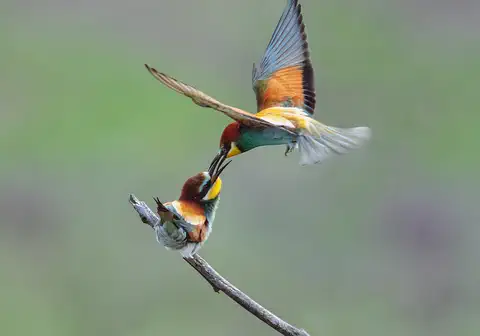
European bee-eater
The European bee-eater is one of the most colorful birds in Europe. It catches bees, dragonflies and other flying insects in midair, knocks out the stings on a branch, and digs a long tunnel in a sandy bank for its nest. Every autumn it flies to Africa for the winter.
-
 Watch
Animal
Southern ground hornbill
The southern ground hornbill is a huge black bird with bright red bare skin on its face and throat and a long, curved black beak. It lives in woodland and savanna in eastern and southern Africa, where family groups walk the ground hunting insects, frogs, snakes and other small animals. It is listed as vulnerable because of poisoning, loss of nest trees and other dangers from people.
-
 Watch
Animal
Lilac-breasted roller
The lilac-breasted roller is a dazzling bird of the open woodlands and savannas of eastern and southern Africa. It sits on high perches watching for insects, swoops down to catch them, and gets its name from the rolling, tumbling flights it makes in the breeding season.
-
Watch
Country
Spain
Spain covers most of the Iberian Peninsula in southwestern Europe. Its middle is a high, flat plateau, the Pyrenees mountains stand between it and France, and almost 50 million people live there, with Madrid as the capital.
-
Watch
Country
India
India is a huge country in South Asia, shaped like a big triangle pointing into the Indian Ocean. The Himalayas rise along its north, heavy monsoon rains arrive every summer, and about 1.46 billion people (2025) live there, speaking hundreds of languages.
-
Watch
Country
Switzerland
Switzerland is a small, landlocked country in central Europe. The Alps cover its south and east, great rivers such as the Rhine and Rhône begin there, and its 9.1 million people share four national languages: German, French, Italian and Romansh.
-
Watch
Country
South Africa
South Africa is the southernmost country in Africa, with the Atlantic Ocean on one side and the Indian Ocean on the other. A high plateau covers most of it, about 63.5 million people (2026) live there, and it has 12 official languages and three capital cities.
-
 Watch
Animal
Common cuckoo
The common cuckoo is a sleek, gray bird with a barred belly, a long tail and pointed wings. Each spring it flies from Africa or southern Asia to breed across Europe and Asia, where the males call their famous cuck-oo. Cuckoos never build nests: a female lays each egg in the nest of another bird, such as a meadow pipit or a warbler, and the foster parents raise the young cuckoo.
For parents & teachers
What children will learn
- Describe how a hoopoe looks and how it uses its long beak to find food.
- Locate the hoopoe's range across Europe, Asia and Africa.
- Explain why hoopoes need large insects, bare ground and nest holes.
- Describe how nest boxes have helped hoopoes in Switzerland.
Recommended ages: 3 to 17 · About 15 minutes
Talk about it
- Why might bare ground make it easier for a hoopoe to find insects?
- Why could a hole be a good place to raise chicks?
- How might a nest box help a bird that nests in holes?
Try at home or in class
- Bug hunt: with a grown-up, lift a stone or log in a garden or park, look for insects and their young, then put everything back gently.
- Crest card: draw a hoopoe on card, cut out a separate crest, and pin it with a paper fastener so it can be raised and lowered.
Key vocabulary: crest, probe, larva, gland, migrate, clutch
Where these facts come from
- GBIF Backbone Taxonomy and GBIF Occurrence Search , Global Biodiversity Information Facility (CC0 1.0 (backbone); occurrence counts are facts derived from records under CC0, CC BY and CC BY-NC)
- Wikidata , Wikimedia Foundation (CC0 1.0)
- The IUCN Red List of Threatened Species , International Union for Conservation of Nature (IUCN terms of use (no redistribution of Red List data or range maps))
- Upupa epops (BirdLife International, assessed 14 August 2020, published 2020) , IUCN Red List of Threatened Species
- Upupa epops: justification, population, habitat and threats text , IUCN Red List of Threatened Species
- Upupa epops: IUCN Red List global assessment record (BirdLife International 2020), IUCN checklist on GBIF , GBIF
- Hoopoe (BirdFacts) , British Trust for Ornithology
- Hoopoe , RSPB
- Bird of the Park: hoopoe, species portrait , Pfyn-Finges Nature Park (with the Swiss Ornithological Institute)
- Hoopoes modulate their alliance with beneficial bacteria along the nesting phase (Martínez-García, Soler et al.) , Atlas of Science
- File:008 Eurasian hoopoe eating in Keoladeo National Park Photo by Giles Laurent.jpg (15 March 2023) , Wikimedia Commons
- File:Upupa epops.ogg (Volga delta, 28 April 2004, Vladimir Yu. Arkhipov) , Wikimedia Commons
- Wikimedia Commons , Wikimedia Foundation (Per file: Public domain, CC0, CC BY or CC BY-SA only (credited on each page))
Checked, not yet human-reviewed. Last updated November 1, 2026. Spotted a mistake? Tell us.