
Animal
Impala
The impala is a graceful, reddish-brown antelope. It can leap very high. Males have long, curvy horns.
The impala is a slender, reddish-brown antelope of the savannas of eastern and southern Africa. It can both graze on grass and browse on leaves, lives in herds, and when startled the whole herd bursts into spectacular leaps. Only males have the long, curving horns.
Aepyceros melampus is a medium-sized antelope of eastern and southern African woodland savanna, notable for its mixed grazing and browsing diet, flexible seasonal social system and explosive leaping escape display. With about two million mature individuals and a stable trend, it is listed by the IUCN as Least Concern.
Photo: Mutari, CC BY-SA 3.0, via Wikimedia Commons
Meet the impala
The impala is a slim, reddish-brown antelope.
Its tummy is white. It has long, thin legs. Only the males have horns, and their horns are long and curvy.
The impala is a graceful antelope with a shiny reddish-brown coat and white fur on its belly, chin and throat, inside its ears and over each eye. A black line runs down its lower back to the tail, and each back thigh has a black stripe.
Only male impalas have horns. They are long, ridged and curved like the frame of an old harp called a lyre, and can be 40 to 90 centimeters long. Adults stand about 75 to 95 centimeters at the shoulder and weigh about 40 to 60 kilograms.
Aepyceros melampus is a medium-sized antelope: shoulder height about 75 to 95 centimeters, head-and-body length 1.2 to 1.6 meters and weight about 40 to 60 kilograms, males being larger. Only males carry horns, which are slender, S-shaped or lyre-shaped and strongly ridged, about 45 to 92 centimeters long with widely separated tips.
The glossy coat is reddish-brown with paler sides, and white marks the underparts, chin, lips, inner ears and a line over each eye. Black stripes run down the tail and the backs of the thighs, and the ear tips are black. Above each hind hoof is a brush-like tuft of black hair covering a scent gland.
Quick facts
- Group
- Mammal
- Length
- 1.2 to 1.6 m
- Height
- 0.75 to 0.95 m
- Weight
- 40 to 60 kg
- Lifespan in the wild
- up to 15 years
Where impalas live
Impalas live in Africa.
They live in open woods with grass and a few bushes. They like to be near water.
Impalas live in eastern and southern Africa, from Kenya and Uganda down to South Africa and west to Angola and Namibia. They like light woodland with little undergrowth, mixed with short and medium grass.
Impalas like to have water nearby, but when there is plenty of grass they can manage without it close by. They have disappeared from Burundi, and people have taken some to Gabon, far from their natural home.
The IUCN's 2016 assessment lists the impala as resident in 13 countries from Kenya, Uganda and Rwanda south to South Africa and west to Angola and Namibia. It is extinct in Burundi, and there is an introduced population in Gabon. It occurs from sea level to about 1,700 meters, and the IUCN estimates about 2,000,000 mature individuals across this range.
Animal Diversity Web describes its habitat as woodland with little undergrowth and low to medium grassland, ideally close to water, though water is not essential when grass is abundant. Map shading is by country, not exact range.
Continent
Its habitat

Where can you find this animal?
- Used to live here · Countries and seas named by a scientific source
- Brought here by people · Countries and seas named by a scientific source
- Lives here naturally · Countries and seas named by a scientific source
- Sightings recorded · Records of wild sightings (GBIF)
Used to live here · Countries and seas named by a scientific source
Burundi, where the IUCN lists the impala as extinct.
Places: Burundi.
Source: iucn-red-list · checked October 2026
Brought here by people · Countries and seas named by a scientific source
Gabon, where the IUCN lists an introduced population.
Places: Gabon.
Source: iucn-red-list · checked October 2026
Lives here naturally · Countries and seas named by a scientific source
Woodland savannas and grasslands of eastern and southern Africa, from Kenya and Uganda to South Africa, Angola and Namibia. Impalas live in only part of each country shown.
Places: Angola, Botswana, Eswatini, Kenya, Malawi, Mozambique, Namibia, Rwanda and 5 more places.
Source: iucn-red-list · checked October 2026
Sightings recorded · Records of wild sightings (GBIF)
Counts of GBIF records of wild observations (human and machine) and preserved specimens. Records include introduced populations, vagrants, escaped or released animals and misidentifications, so a country with records is not necessarily part of the native range.
Wild sightings have been recorded in South Africa, Zambia, Kenya, Tanzania, Botswana, Namibia, Zimbabwe, Uganda and 19 more places.
Source: gbif · checked October 2026
Range maps show where scientists say an animal lives, often country by country. An animal may live in only part of a country shown, and sightings records can include animals that wandered far from home.
Grass in the wet, leaves in the dry
Impalas eat grass and leaves.
In the rainy season they eat young grass. In the dry season they eat leaves from bushes. They have more food than animals that eat only one kind.
Impalas can do two jobs at once: they graze on grass and browse on leaves. In the rainy season they eat fresh young grass shoots. In the dry season they switch to herbs, shrubs and leaves.
Being able to eat both gives impalas a bigger and more reliable food supply than animals that eat only grass or only leaves. Like cows, they are ruminants, which chew their cud.
Impalas are intermediate or mixed feeders: predominantly grazers when grass is lush after the rains, they switch to browse in the dry season. The African Wildlife Foundation notes that this flexibility gives them a greater and more reliable food supply than strict grazers or browsers.
As ruminants they chew the cud, typically ruminating and resting at night, and they lack upper incisors and canines; the cheek teeth are folded and sharply ridged. Peak feeding and movement occur shortly after dawn and before dusk, and Animal Diversity Web notes that impalas can adapt to almost any mix of grass and browse.
Did you know?
Only boy impalas have horns.
Female impalas have no horns; only males grow the long, ridged, curving horns.
Horns are restricted to males and can grow to about 90 centimeters.
Built for leaping
An impala has long, thin legs.
It can jump very high and far. A black tuft of hair on its back legs hides a special smell.
Impalas are famous jumpers. When a predator comes, they can leap about 3 meters into the air, bounding in all directions to confuse it. Sometimes they land on their front legs and kick their back legs high.
Above the heel on each back leg is a brush-like tuft of black hair. Under it is a scent gland. When an impala leaps, it may release a scent that helps the rest of the herd follow it.
The impala's main defense is flight. Animal Diversity Web reports leaps of about 3 meters in height (Ultimate Ungulate gives up to 2.5 meters high and over 9 meters long), made in any direction to confuse a predator, sometimes landing on the forelegs while kicking the hind legs up. The African Wildlife Foundation describes a startled herd leaping in an apparently chaotic way that in fact keeps it together.
The black fetlock tufts on the hind legs cover scent glands, and AWF suggests that high jumps release scent signals in midair that fleeing herd members can follow. Further glands on the forehead are used by territorial males to mark their land.
A fawn in a nursery group
A baby impala is called a fawn.
Its mom finds a quiet place to have it. Then they join the herd. Fawns play together in a group.
A mother impala carries her baby for about six and a half months. When it is time, she leaves the herd and finds a quiet, hidden spot to give birth to one fawn. If many other fawns are around, she takes hers back to the herd within a day or two.
The fawns join a nursery group, where they play, groom and move about together. It is harder for predators to pick out one fawn in a group. Fawns drink milk for four to six months and are grown up at a little over a year.
Gestation lasts about 194 to 200 days, and most mating takes place from March to May; births often peak with the rains. The female leaves the herd to give birth to a single fawn, usually at midday. If few other young are around she may stay hidden with it for a week or more; if there are many, she returns within a day or two.
Fawns gather in creches, or nursery groups, that play, groom and move together, which makes it harder for predators to single one out. They are suckled for about four to six months. Females can conceive at about 1.5 years, while males can breed at a year but often do not hold territories until about four.

Herds that change with the seasons
Impalas live in herds.
Moms and young live together. In the rainy season, males guard their own land. In the dry season, everyone mixes together.
Female impalas live in herds of about 15 to 100, with their young. Males without territories, young and adult, form bachelor herds. When food is plentiful in the rainy season, adult males guard territories and try to keep female herds on their land.
When the dry season comes, males give up their territories, and herds travel farther to find food and mix together. Animal Diversity Web says impalas are active by day, especially just after dawn and before dusk, and rest and chew the cud at night; Ultimate Ungulate says they alternate resting and grazing around the clock.
Impala society changes with the seasons. In the wet season there are three kinds of group: territorial males, bachelor herds and breeding herds of females and young. Female clans of about 15 to 100 occupy home ranges of 80 to 180 hectares. Territorial males defend small breeding territories with tail-raising, forehead marking, herding, chasing and roaring.
In the dry season territories are abandoned and clans overlap and mix, though Animal Diversity Web notes that eastern impalas remain more territorial than southern ones. This flexibility, the African Wildlife Foundation suggests, helps the species adapt to changing conditions.
Did you know?
Impalas eat both grass and leaves.
Because impalas eat both grass and leaves, they have more food to choose from than animals that eat only one.
Mixed feeding gives impalas a greater and more reliable food supply than strict grazers or browsers.
Space to move
There are lots of impalas.
But roads and towns are cutting up their land. People are making safe paths so impalas can travel between parks.
The impala is common: the IUCN estimates about two million adults, and lists it as Least Concern. But it still faces problems. Roads, settlements and too much livestock farming are taking over its land, and some impalas are poached, even inside parks.
Conservation groups help plan where roads and towns go, and they set aside wildlife corridors, strips of land that let impalas and other animals move safely from one park to another.
The IUCN's 2016 assessment lists the impala as Least Concern, with about 2,000,000 mature individuals and a stable trend. The African Wildlife Foundation identifies unsustainable livestock farming, human encroachment and the expansion of roads and settlements as major threats, since fragmented habitat makes it harder for animals to move between parks to feed, breed and give birth. Poaching around and within protected areas adds pressure, and impalas are widely hunted on safaris and for meat in South Africa.
AWF works with governments on planning that avoids fragmentation and with communities to designate wildlife corridors, in some cases buying land so that wildlife can move between protected areas.
IUCN Red List
How is the impala doing in the wild?
- Least Concern (this animal)
- Near Threatened
- Vulnerable
- Endangered
- Critically Endangered
- Extinct in the Wild
- Extinct
Least Concern
Not at risk of disappearing from the wild right now.
See the IUCN Red List assessment · The IUCN Red List of Threatened Species 2022.2
Amazing facts
-
An impala can jump higher than a grown-up is tall.
Impalas can leap about 3 meters into the air.
Leaps of about 3 meters, in any direction, help impalas confuse predators.
-
Only boy impalas have horns.
Female impalas have no horns; only males grow the long, ridged, curving horns.
Horns are restricted to males and can grow to about 90 centimeters.
-
Baby impalas play together in a group.
Impala fawns gather in nursery groups where they play, groom and move together.
Fawns form creches, which make it harder for predators to single out an individual.
-
Impalas eat both grass and leaves.
Because impalas eat both grass and leaves, they have more food to choose from than animals that eat only one.
Mixed feeding gives impalas a greater and more reliable food supply than strict grazers or browsers.
Words to know
- antelope
- a hoofed, horned, plant-eating animal such as an impala or a wildebeest
- browse
- to eat leaves and twigs from bushes and trees
- graze
- to eat grass
- fawn
- a baby impala or deer
- scent gland
- a part of the body that makes a smell animals use to send messages
- corridor
- a strip of land that lets wild animals travel safely between areas
Discovery challenge
-
Which impalas have horns?
Which impalas grow horns?
Which impalas carry horns?
- Only the males
- Only the females
- Only the babies
Show the answer
Only the males
Only boy impalas have horns.
Only males grow the long, ridged, lyre-shaped horns.
Horns occur only in males; females are hornless.
-
What does an impala do when a lion comes near?
How does an impala herd escape a predator?
Which behavior is the impala's main defense against predators?
- It hides in a shell
- It leaps high in all directions
- It climbs a tree
Show the answer
It leaps high in all directions
Impalas jump high this way and that way, and run away.
The herd bursts into high leaps in all directions, confusing the predator.
Flight with leaps of about 3 meters in unpredictable directions.
-
What do impalas eat in the dry season?
What do impalas switch to eating in the dry season?
Impalas are mixed feeders. What do they switch to in the dry season?
- Leaves from bushes and shrubs
- Fish
- Insects
Show the answer
Leaves from bushes and shrubs
Impalas eat grass, and leaves from bushes when the grass is dry.
In the dry season they switch from grass to herbs, shrubs and leaves.
They graze lush grass after the rains and browse leaves from shrubs and herbs in the dry season.
-
Where is the impala's black tuft of hair?
Where are an impala's black tufts of hair, which cover scent glands?
Where are the impala's tuft-covered scent glands?
- On its nose
- Above the heel of each back leg
- On its tail tip
Show the answer
Above the heel of each back leg
The black tufts are on its back legs, above the heels.
A brush of black hair above the heel on each hind leg covers a scent gland.
Above the heel of each hind leg; scent released there may help the herd stay together when fleeing.
Places where you might see it
Explore next
-
 Watch
Animal
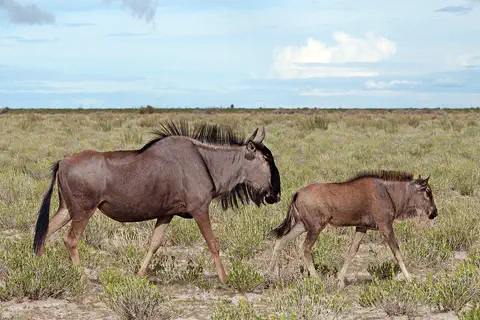
Blue wildebeest
The blue wildebeest, or gnu, is a big antelope with a box-like head, curved horns, a mane and a beard. It grazes the savannas of eastern and southern Africa, and in the Serengeti huge herds travel in a giant circle every year following the rains.
-
 Watch
Animal
Arabian oryx
The Arabian oryx is a white desert antelope with long, straight horns and a black-and-white face. Hunting wiped it out in the wild, but animals kept in zoos were bred and returned to the deserts of Arabia. Today it lives wild again in five countries.
-
 Watch
 Country
South Africa
South Africa is the southernmost country in Africa, with the Atlantic Ocean on one side and the Indian Ocean on the other. A high plateau covers most of it, about 63.5 million people (2026) live there, and it has 12 official languages and three capital cities.
-
 Watch
3D
Animal
Cheetah
The cheetah is the fastest land animal. It can go from standing still to 72 kilometers per hour in about two and a half seconds, and its top speed is around 100 kilometers per hour, as fast as a car on a highway. Cheetahs live mostly in Africa, with a very small group in Iran.
-
 Watch
3D
Animal
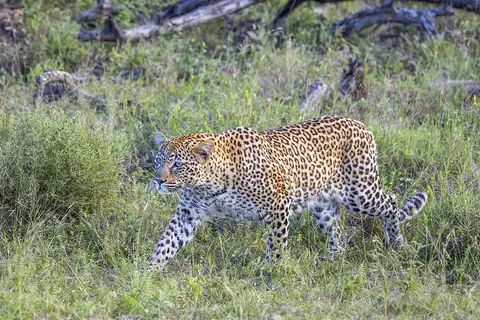
Leopard
The leopard is a strong, spotted big cat and the best climber of them all. It can carry its food high up into a tree, away from lions and hyenas. Leopards live in more kinds of places than any other big cat, from deserts to rainforests, across Africa and Asia.
-
 Watch
3D
Animal
African wild dog
The African wild dog, or painted dog, has a patchy coat unlike any other dog's, big round ears and only four toes on its front feet. It lives in close packs that hunt together, share food and care for the pups. It is endangered: the IUCN estimated in 2025 that only about 1,676 adults are left in the wild.
-
 Watch
Animal
Aardvark
The aardvark is a shy night digger of African savannas. It sniffs out ant and termite nests, rips them open with its spade-like claws and laps up the insects with a sticky tongue about 30 centimeters long. Its name means 'earth pig' in Afrikaans.
-
 Watch
Animal
African buffalo
The African buffalo is a huge, cow-like grazer with heavy, curving horns. It lives in herds that can number in the thousands, and a herd will rush to protect a calf in danger. It lives across much of Africa south of the Sahara, from open savannas to rainforests.
For parents & teachers
What children will learn
- Describe the impala's markings, horns and scent glands.
- Explain how eating both grass and leaves helps impalas through the dry season.
- Describe how impalas escape predators and how fawns stay safe in groups.
- Understand why corridors between parks matter for common animals too.
Recommended ages: 3 to 17 · About 15 minutes
Talk about it
- Why might it be useful to be able to eat both grass and leaves?
- How could jumping in many directions help a herd escape a lion?
- Why might fawns be safer together in a nursery group?
Try at home or in class
- Mark 3 meters up a wall or along the floor to see how high an impala can leap.
- Play a game where one person is a predator and a 'herd' scatters in different directions; talk about why it is hard to choose one.
Key vocabulary: antelope, browse, graze, fawn, scent gland, corridor
Where these facts come from
- The IUCN Red List of Threatened Species , International Union for Conservation of Nature (IUCN terms of use (no redistribution of Red List data or range maps))
- GBIF Backbone Taxonomy and GBIF Occurrence Search , Global Biodiversity Information Facility (CC0 1.0 (backbone); occurrence counts are facts derived from records under CC0, CC BY and CC BY-NC)
- Impala , African Wildlife Foundation
- Aepyceros melampus (impala) , Animal Diversity Web, University of Michigan
- Aepyceros melampus (Impala) , Ultimate Ungulate
- Aepyceros melampus (Impala), 2016 assessment , IUCN Red List
- Wikidata , Wikimedia Foundation (CC0 1.0)
- Wikimedia Commons , Wikimedia Foundation (Per file: Public domain, CC0, CC BY or CC BY-SA only (credited on each page))
Checked, not yet human-reviewed. Last updated October 24, 2026. Spotted a mistake? Tell us.