
Animal
Cheetah
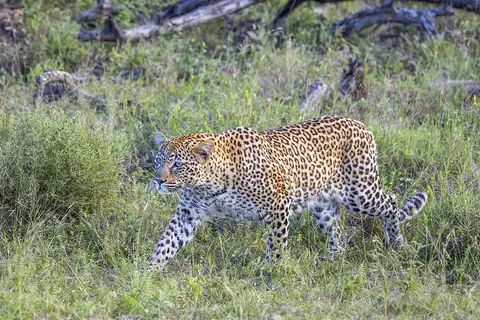
The cheetah is the fastest animal on land. It has a long, thin body and black spots. It has black lines on its face, like tears.
The cheetah is the fastest land animal. It can go from standing still to 72 kilometers per hour in about two and a half seconds, and its top speed is around 100 kilometers per hour, as fast as a car on a highway. Cheetahs live mostly in Africa, with a very small group in Iran.
Acinonyx jubatus is a lightly built cat specialized for acceleration: a flexible spine, long legs, grippy paw pads and semi-retractable claws carry it to roughly 96 to 112 kilometers per hour for a few hundred meters. Its range has collapsed to fragments of Africa and a critically small Asiatic population in Iran, and the IUCN lists it as Vulnerable.
Photo: Charles J. Sharp, CC BY-SA 4.0, via Wikimedia Commons
Meet the cheetah
The cheetah is a cat that runs very, very fast.
It has yellow fur with round black spots. It has long legs and a long tail. Two black lines run down its face, from its eyes to its mouth.
The cheetah is the fastest animal on land. It has a slim body, long legs, a small head and a long tail, more like a racing greyhound than a heavy lion.
Its short, coarse fur is yellow or tan with solid black spots. A black "tear mark" runs from the inside of each eye down to its mouth. People sometimes mix up cheetahs and leopards, but leopards are much heavier, have spots shaped like rosettes and have no tear marks.
Acinonyx jubatus is the only living member of its genus. Adults weigh 34 to 64 kilograms, stand about 77 centimeters at the shoulder and measure 112 to 142 centimeters in head and body, with a 66 to 84 centimeter tail (Smithsonian's National Zoo).
Almost every feature is a trade-off for speed. The skull is small and light, with large nasal passages for fast breathing; the National Zoo notes that this leaves little room for the long roots that anchor big canine teeth. The result is a superb sprinter that is too lightly built to defend itself or its food against lions and hyenas.
Quick facts
- Group
- Mammal
- Length
- 1.12 to 1.42 m
- Height
- 0.77 m
- Weight
- 34 to 64 kg
- Top speed
- 96 to 112 km/h
- Lifespan in the wild
- 8 to 10 years
Where it lives
Most cheetahs live in Africa.
They like wide, open grassy land where they can run. A very few cheetahs live in Iran, in Asia.
Cheetahs live in open country where they have room to sprint: grasslands, savannas, dry bushland and even mountains. Most wild cheetahs live in eastern and southern Africa, especially Kenya, Tanzania, Namibia and Botswana.
A very small number of Asiatic cheetahs survive in Iran, the last wild cheetahs in Asia. Many cheetahs in Namibia now live on farms, because people have turned so much of their wild land into ranches.
The IUCN Red List (2021 assessment) lists the cheetah as extant in 19 countries, 18 in Africa plus Iran, and as extinct in about thirty more, including India, Pakistan, Saudi Arabia and much of West Africa. Populations are small and scattered; strongholds are in eastern Africa (Kenya, Tanzania) and southern Africa (Namibia, Botswana), with smaller groups in the Sahel and Sahara.
The Smithsonian notes that over the past 50 years cheetahs have disappeared from at least 13 countries. Because much of their remaining range lies outside protected areas, many live on commercial farmland, which brings them into conflict with people raising livestock. The map shows the countries where cheetahs are best documented today.
Continents
Its habitats


Where can you find this animal?
- Lives here naturally · Countries and seas named by a scientific source
- Sightings recorded · Records of wild sightings (GBIF)
Lives here naturally · Countries and seas named by a scientific source
Small, scattered populations in open grassland, savanna, scrub and desert edges, mostly in eastern and southern Africa, with a few in the Sahel and Sahara and a tiny Asiatic population in central Iran. Cheetahs live in only part of each country shown.
Places: Algeria, Angola, Benin, Botswana, Chad, Ethiopia, Iran, Kenya and 8 more places.
Source: iucn-red-list · checked October 2026
Sightings recorded · Records of wild sightings (GBIF)
Counts of GBIF records of wild observations (human and machine) and preserved specimens. Records include introduced populations, vagrants, escaped or released animals and misidentifications, so a country with records is not necessarily part of the native range.
Wild sightings have been recorded in South Africa, Kenya, Tanzania, Namibia, Botswana, Benin, United States, Malawi and 34 more places.
Source: gbif · checked October 2026
Range maps show where scientists say an animal lives, often country by country. An animal may live in only part of a country shown, and sightings records can include animals that wandered far from home.
What it eats
Cheetahs eat meat.
They chase small antelopes, like gazelles and impalas. Cheetahs eat fast. Bigger animals like lions may take their food away.
Cheetahs are carnivores. They mostly catch small antelopes such as gazelles, impalas, springbok and duikers, plus the young of bigger animals like warthogs and kudu.
A cheetah sneaks to within about 90 meters of its prey, then bursts into a sprint that lasts about 20 seconds. After a catch, it eats quickly. Lions, hyenas and even groups of vultures can chase a cheetah off its meal, and the cheetah is too light to fight back.
Prey are mainly small and medium antelopes, including springbok, steenbok, duikers, impala and gazelles, and the young of larger ungulates such as warthog, kudu, hartebeest, oryx, roan and sable. Cheetahs stalk to within about 90 meters before the final acceleration; full sprints last about 20 seconds.
The sprint leaves the cat exhausted, and its large nostrils and lungs help it recover while it holds the prey by the throat. Kleptoparasitism, the stealing of kills, is a major cost: lions, hyenas and vulture flocks can drive cheetahs away, so they eat fast and leave bones and entrails behind. Because they are easily overpowered, cheetahs tend to flee rather than fight.
Did you know?
Cheetahs chirp like birds!
Cheetahs can't roar. Their most common call is a chirp that can be heard more than a kilometer away.
Cheetah chirps differ between individuals, suggesting they may identify one another by voice alone.
Built for speed
A cheetah's body is made for running.
Its back bends like a spring. Its claws grip the ground like running shoes. Its long tail helps it turn.
A cheetah can go from standing still to 72 kilometers per hour in just 2.5 seconds. At top speed, about 96 to 112 kilometers per hour, each stride covers 7 meters and it takes four strides every second. But it can keep that up for only about 270 meters.
Its bendy spine works like a spring, stretching each step. Special paw pads and claws that never fully pull back grip the ground. The black tear marks may cut down glare from the sun, helping it keep its eyes on its prey.
Speed comes from the whole skeleton. Small collarbones and vertical shoulder blades that are not attached to the collarbone, plus hips that swivel on an unusually flexible spine, lengthen the stride; the spine flexes and extends like a spring for the powerful hind legs. The Smithsonian gives 0 to 72 kilometers per hour in 2.5 seconds, strides of about 7 meters at four per second, and a top speed of about 96 to 112 kilometers per hour held for only about 274 meters.
Blunt, semi-retractable claws and special pads give traction like running spikes. The cost is exhaustion: such sprints are physiologically taxing, so a cheetah must judge each chase carefully.
Growing up
Baby cheetahs are called cubs.
They have long, fluffy gray fur on their backs. It helps them hide in the grass. Their mother teaches them how to hunt.
A cheetah mother is pregnant for about three months and usually has three to six cubs. Each newborn weighs only about 275 grams, less than a can of soup. The cubs have a long, smoky-gray coat of fur along their backs, called a mantle, which helps them hide in dry grass.
At six weeks the cubs follow their mother on hunts. At about six months she brings them live prey to practice on. When they are about 18 months old, she leaves them, and the brothers and sisters stay together for about six more months.
Gestation is about 92 days and the average litter is three to six cubs of about 275 grams each. Cubs carry a smoky-gray mantle of long hair along the back that may camouflage them among dead grass. They follow the mother from about six weeks, and from about six months she brings live prey so they can practice the kill.
At about 18 months the mother leaves; the littermates stay together for about another six months. Sexual maturity follows at 18 to 23 months. The Smithsonian's National Zoo gives an average wild lifespan of 8 to 10 years, and 12 to 15 years in human care.

Brothers together, mothers alone
Cheetah brothers often stay together all their lives.
Cheetahs do not roar. They chirp like a bird! A mother cheetah chirps to call her cubs.
Grown female cheetahs live alone, except when they have cubs, and they raise their cubs by themselves. Brothers are different: young males often stay together for life in a small group called a coalition, usually two or three littermates. A coalition shares a territory near water, where herds of gazelles come to drink.
Cheetahs cannot roar. Instead they purr, growl, hiss and chirp. A loud chirp sounds a bit like a bird or a puppy's yelp and can be heard over a kilometer away.
Cheetah social life differs by sex. Adult females are solitary and often occupy ranges overlapping their mother's, interacting with males only to breed. Males frequently live in lifelong coalitions, usually of two or three littermates, that hold a territory covering several female ranges, often near water that attracts prey herds.
Cheetahs do not roar; their calls include purrs, barks, growls, hisses, a pigeon-like stutter that mothers use to tell cubs to stay or follow, and the chirp, their most common call, which can carry about 1.6 kilometers. A 2001 study at the Smithsonian's National Zoo found that chirps differ between individuals, suggesting cheetahs may recognize each other by voice.
Did you know?
Baby cheetahs have a fluffy gray coat.
Cheetah cubs have a long, smoky-gray mantle of fur on their backs that helps them hide in dry grass.
The cubs' gray mantle may camouflage them among dead grasses during the weeks when predation risk is highest.
Helping cheetahs
There are not many wild cheetahs left.
People are working to help them. Some farmers find ways to keep their animals safe without hurting cheetahs.
Cheetahs are Vulnerable. The IUCN estimates there are only about 6,500 adult cheetahs left in the wild. They need huge areas of land, and as farms and towns spread, their homes are cut into small pieces. Some cheetahs are killed by farmers who are worried about their goats and cattle.
In Iran, the last Asiatic cheetahs are critically endangered. Wildlife parks give cheetahs room to roam, and groups such as the Cheetah Conservation Fund and Action for Cheetahs in Kenya help cheetahs and the people who raise livestock share the land.
The IUCN Red List assessed the cheetah as Vulnerable in 2021, with about 6,517 mature individuals, a decreasing trend and a severely fragmented population. Cheetahs live at low densities and range widely, so much of the remaining population lives outside protected areas, where habitat loss, the loss of wild prey and retaliatory killing over livestock are the main pressures.
The Asiatic population in Iran is critically endangered. The IUCN estimates that only about 31 to 40 percent of cheetahs live in protected areas, so their future depends on protected areas large enough for wide-ranging cats and on reducing conflict with ranchers outside them.
IUCN Red List
How is the cheetah doing in the wild?
- Least Concern
- Near Threatened
- Vulnerable (this animal)
- Endangered
- Critically Endangered
- Extinct in the Wild
- Extinct
Vulnerable
At high risk of disappearing from the wild.
See the IUCN Red List assessment · The IUCN Red List of Threatened Species 2022.2
Amazing facts
-
A cheetah is faster than a car in a town.
A cheetah can go from standing still to 72 kilometers per hour in about 2.5 seconds.
Cheetahs accelerate from 0 to 72 kilometers per hour in about 2.5 seconds and reach roughly 96 to 112 kilometers per hour.
-
Cheetahs chirp like birds!
Cheetahs can't roar. Their most common call is a chirp that can be heard more than a kilometer away.
Cheetah chirps differ between individuals, suggesting they may identify one another by voice alone.
-
Baby cheetahs have a fluffy gray coat.
Cheetah cubs have a long, smoky-gray mantle of fur on their backs that helps them hide in dry grass.
The cubs' gray mantle may camouflage them among dead grasses during the weeks when predation risk is highest.
-
One cheetah step is longer than a car.
At top speed, a single cheetah stride covers about 7 meters, and it takes four strides every second.
Sprint strides reach about 7 meters at around four per second, lengthened by the flexing spine and free-moving shoulder blades.
-
Cheetah brothers stay together.
Male cheetah brothers often stay together for life in a team called a coalition.
Coalitions of two or three littermate males hold territories together for life, often near water that attracts prey herds.
Words to know
- sprint
- to run as fast as possible for a short distance
- accelerate
- to speed up
- stride
- one long running step
- coalition
- a small group of male cheetahs, usually brothers, that live together
- mantle
- the long, fluffy gray fur on a cheetah cub's back
- carnivore
- an animal that eats meat
Discovery challenge
-
What is a cheetah best at?
What is the cheetah's special skill?
Which feature best describes the cheetah?
- Climbing very tall trees
- Running very fast
- Swimming in rivers
Show the answer
Running very fast
Cheetahs are the fastest runners on land!
The cheetah is the fastest land animal, reaching about 96 to 112 kilometers per hour.
It is specialized for acceleration and top speed, held only for a few hundred meters.
-
What sound does a cheetah make?
Which sound can a cheetah NOT make?
Which call is NOT part of a cheetah's repertoire?
- A chirp
- A purr
- A roar
Show the answer
A roar
Cheetahs chirp and purr, but they can't roar.
Cheetahs purr, growl, hiss and chirp, but they never roar.
Cheetahs do not roar; the chirp is their most common call.
-
Why does a cheetah eat its food fast?
Why does a cheetah eat quickly after a catch?
What is a major cost of the cheetah's light build?
- Lions and hyenas may take it
- It wants to go to sleep
- The food will melt
Show the answer
Lions and hyenas may take it
Bigger animals may take the cheetah's food, so it eats fast.
Lions, hyenas and vultures can chase a cheetah away from its meal.
Kills are often stolen by lions, hyenas and vulture flocks, because cheetahs are too light to defend them.
-
Which country in Asia still has wild cheetahs?
Where do the last wild Asiatic cheetahs live?
Which country holds the only wild cheetahs outside Africa?
- Iran
- Australia
- Canada
Show the answer
Iran
Most cheetahs live in Africa, and a few live in Iran.
A tiny group of critically endangered Asiatic cheetahs survives in Iran.
Iran holds the last wild Asiatic cheetahs; all other wild cheetahs are in Africa.
Places where you might see it
-
 Watch
Natural wonder
Serengeti National Park
Serengeti National Park in northern Tanzania protects 14,763 square kilometers of grassy plains and woodlands. Each year more than a million wildebeest, with zebras and gazelles, travel a great loop across the Serengeti and into Kenya in search of grass and water, followed by lions and other predators.
-
 Watch
 Country
Iran
Iran is a country in southwestern Asia. A high, dry plateau fills its middle, with mountain ranges all around it, and about 92 million people (2025) live there. Long ago it was called Persia, and its capital today is Tehran.
Explore next
-
 Watch
3D
Animal
Leopard
The leopard is a strong, spotted big cat and the best climber of them all. It can carry its food high up into a tree, away from lions and hyenas. Leopards live in more kinds of places than any other big cat, from deserts to rainforests, across Africa and Asia.
-
 Watch
3D
Animal
Lion
The lion is the only big cat that lives in a family group, called a pride. Lionesses hunt together, males guard the pride's land, and their roar can be heard about 8 kilometers away. Wild lions live in Africa, plus one small group in western India.
-
 Watch
3D
Animal
Puma
The puma, also called the cougar or mountain lion, is a big, slender cat with plain tan fur and a long tail. It lives in more of the Americas than any other wild cat, from Canada all the way to the southern tip of South America, in mountains, forests, deserts and swamps.
-
 Watch
Animal
Impala
The impala is a slender, reddish-brown antelope of the savannas of eastern and southern Africa. It can both graze on grass and browse on leaves, lives in herds, and when startled the whole herd bursts into spectacular leaps. Only males have the long, curving horns.
-
 Watch
Animal
Caracal
The caracal is a sleek, reddish-gold wild cat of Africa, the Middle East and Central Asia to India. Its name comes from a Turkish word meaning "black ears", for its black-backed ears with long tufts. It hunts on the ground, but it can leap two meters or more into the air to catch birds.
-
Watch
Natural wonder
Serengeti National Park
Serengeti National Park in northern Tanzania protects 14,763 square kilometers of grassy plains and woodlands. Each year more than a million wildebeest, with zebras and gazelles, travel a great loop across the Serengeti and into Kenya in search of grass and water, followed by lions and other predators.
-
 Watch
3D
Animal
Serval
The serval is a slender wild cat of African grasslands and wetlands. Its huge ears can hear mice moving in tall grass, and its long legs let it leap high into the air to pounce on them or snatch a bird.
-
Watch
Country
Iran
Iran is a country in southwestern Asia. A high, dry plateau fills its middle, with mountain ranges all around it, and about 92 million people (2025) live there. Long ago it was called Persia, and its capital today is Tehran.
For parents & teachers
What children will learn
- Explain how the cheetah's body is adapted for speed (spine, claws, legs, nose, tail).
- Understand the trade-off between speed and strength and how it affects cheetahs' meals.
- Describe how female and male cheetahs live differently.
- Locate where cheetahs live today and explain why they are Vulnerable.
Recommended ages: 3 to 17 · About 15 minutes
Talk about it
- Why can't a cheetah run at top speed for very long?
- If you were a cheetah, would you rather be fast or strong? What would you gain and lose?
- How could farmers and cheetahs share the same land?
Try at home or in class
- Mark out 7 meters outdoors and count how many of your steps fit into one cheetah stride.
- Time yourself running for 20 seconds, as long as a cheetah sprint, then talk about how your body feels.
Key vocabulary: sprint, accelerate, stride, coalition, mantle, carnivore
Where these facts come from
- The IUCN Red List of Threatened Species , International Union for Conservation of Nature (IUCN terms of use (no redistribution of Red List data or range maps))
- GBIF Backbone Taxonomy and GBIF Occurrence Search , Global Biodiversity Information Facility (CC0 1.0 (backbone); occurrence counts are facts derived from records under CC0, CC BY and CC BY-NC)
- Wikidata , Wikimedia Foundation (CC0 1.0)
- Acinonyx jubatus (Cheetah), 2021 assessment , IUCN Red List of Threatened Species
- Cheetah , Smithsonian's National Zoo and Conservation Biology Institute
- Cheetah , San Diego Zoo Wildlife Alliance
- Cheetah , Encyclopaedia Britannica
- Wikimedia Commons , Wikimedia Foundation (Per file: Public domain, CC0, CC BY or CC BY-SA only (credited on each page))
Checked, not yet human-reviewed. Last updated October 28, 2026. Spotted a mistake? Tell us.