
Animal
Indian peafowl
The Indian peafowl is a big bird from India. The boy, called a peacock, has a huge fan of shiny feathers covered in eye-shaped spots.
The Indian peafowl is a large bird of the pheasant family from South Asia. Males, called peacocks, have a bright blue neck and a long train of shimmering feathers decorated with eyespots, which they spread into a giant fan to impress females, called peahens. It is the national bird of India.
Pavo cristatus is a large pheasant native to India, Sri Lanka and neighboring South Asian countries. The peacock's train, made of elongated tail coverts with iridescent ocelli, apparently set Charles Darwin thinking about sexual selection, and peahens seem to prefer males with longer, more elaborate trains.
Photo: © Giles Laurent, gileslaurent.com, License CC BY-SA, CC BY-SA 4.0, via Wikimedia Commons
Meet the Indian peafowl
Peafowl are big, beautiful birds.
The boy is a peacock. He is bright blue and has a giant tail fan. The girl is a peahen. She is brown. Baby peafowl are called peachicks.
Peafowl belong to the pheasant family. Many people call them all 'peacocks', but only the males are peacocks. Females are peahens, and the babies are peachicks. There are two species, the Indian peafowl and the green peafowl.
The Indian peacock has a bright blue head and neck, iridescent feathers on his back and a long train. The peahen is mottled brown. Both have a crest on top of the head that looks like little dots on the ends of sticks.
Pavo cristatus is one of two peafowl species in the pheasant family Phasianidae; the other is the green peafowl of Southeast Asia. San Diego Zoo Wildlife Alliance gives lengths of 90 to 110 centimeters for females and 180 to 250 centimeters for males including the train, and weights of 2.8 to 6 kilograms.
The sexes look very different. Males have a bright blue head and neck and iridescent, scale-patterned feathers on the back and belly; females are a drab, mottled brown. Both have bare skin around the eyes and a fan-shaped crest of feathers on the head. Several color mutations, including all-white birds, are known.
Quick facts
- Group
- Bird
- Length
- 0.9 to 2.5 m
- Wingspan
- 0.8 to 1.6 m
- Weight
- 2.8 to 6 kg
Where it lives
Indian peafowl live in India and nearby countries.
They live in forests and walk on the ground to find food. At night they sleep up in tall trees.
Wild Indian peafowl live in South Asia: India, Sri Lanka, Pakistan, Nepal, Bhutan and Bangladesh. They are most common in open deciduous forests, where the trees lose their leaves for part of the year, and they need tall trees to sleep in, a small territory and enough food.
People have also taken peafowl to many other places, such as the United States, Australia, New Zealand, Japan and the Bahamas, where some now live in the wild. They do not migrate.
The IUCN's 2025 global assessment lists the species as resident in Bangladesh, Bhutan, India, Nepal, Pakistan and Sri Lanka, from sea level to about 2,250 meters, and as introduced in Japan, Australia, the Bahamas, New Zealand and Hawaii (USA).
Animal Diversity Web describes Indian peafowl as non-migratory and most common in open deciduous forest, needing a roost tree, a small territory and sufficient food; it also notes that peafowl adapt to colder climates than their native range, surviving winters in southern Britain with simple shelter. San Diego Zoo notes that birds brought to estates spread into surrounding areas, where loud dawn calls sometimes made them a nuisance.
Continent
Did you know?
Peacocks grow new fancy feathers every year.
Peacocks drop their eyespot feathers once a year, and new ones grow back over a few months.
The ornamental coverts are molted annually and regrown within a few months.
Where can you find this animal?
- Brought here by people · Countries and seas named by a scientific source
- Lives here naturally · Countries and seas named by a scientific source
- Sightings recorded · Records of wild sightings (GBIF)
Brought here by people · Countries and seas named by a scientific source
Peafowl brought by people now live wild in parts of Australia, the Bahamas, Japan, New Zealand and Hawaii (United States).
Places: Australia, Bahamas, Japan, New Zealand and United States.
Source: iucn-red-list · checked October 2026
Lives here naturally · Countries and seas named by a scientific source
Open forests, scrub and farmland edges of South Asia, from sea level to about 2,250 meters.
Places: Bangladesh, Bhutan, Sri Lanka, India, Nepal and Pakistan.
Source: iucn-red-list · checked October 2026
Sightings recorded · Records of wild sightings (GBIF)
Counts of GBIF records of wild observations (human and machine) and preserved specimens. Records include introduced populations, vagrants, escaped or released animals and misidentifications, so a country with records is not necessarily part of the native range.
Wild sightings have been recorded in India, United States, Sri Lanka, Australia, South Africa, Taiwan, New Zealand, Nepal and 110 more places.
Source: gbif · checked October 2026
Range maps show where scientists say an animal lives, often country by country. An animal may live in only part of a country shown, and sightings records can include animals that wandered far from home.
What it eats
Peafowl eat seeds, grain, berries, leaves and bugs.
They peck for food on the ground in small groups. Sometimes they catch a lizard or a mouse.
Indian peafowl are omnivores. Each day small groups walk along the ground looking for grain, seeds, berries, figs, leaves and flower parts, as well as insects, small reptiles and small mammals.
They have a daily routine. In the morning they leave their roost trees to feed. In the hot middle of the day they drink, clean their feathers and rest in the shade. When it cools down, they feed again, take one last drink and fly back up to roost.
San Diego Zoo describes a varied ground-foraging diet of grain, insects, small reptiles and mammals, berries, figs, leaves, seeds and flower parts; zoo birds receive pheasant pellets, chopped greens and fruit.
Foraging follows a daily cycle. Birds roost overnight in groups in tall, open trees, split into small groups in the morning to feed, drink, preen and rest in the shade at midday, then forage again in the cooler afternoon before a final drink and a return to the roost. In the nonbreeding season the groups are usually single-sex.
Did you know?
Some peafowl are all white.
There are white peafowl, whose feathers are white from head to train.
Color mutations include white birds that breed true and have brown eyes, so they are not albinos.
The peacock's amazing train
The peacock's long feathers are called a train.
They have shiny spots that look like eyes. He lifts them up into a giant fan, wider than most grown-ups are tall!
The peacock's famous 'tail' is not really his tail. It is a long train of feathers that grow from above the tail, called tail coverts. They are covered in round, shining spots called ocelli, or eyespots.
When a peacock shows off, he props up his train with his shorter, stiffer real tail feathers and spreads it into a fan 1.8 to 2.1 meters wide. Then he makes it shimmy and shimmer. Each year he drops his train feathers and grows new ones.
The train consists of elongated upper tail coverts, not tail feathers, patterned with iridescent ocelli. In display the male raises it on his stiffer true tail feathers into a fan about 1.8 to 2.1 meters across and vibrates it so the feathers shimmer.
A male grows his first train, without ocelli, in his second year; it becomes longer and more elaborate each year, reaching its fullest at about five or six years old. The train is shed once a year and regrown over a few months. Animal Diversity Web notes that both sexes have leg spurs about 2.5 centimeters long, which males use against rivals in the breeding season.
Peahens and peachicks
The peahen makes a nest on the ground and lays a few eggs.
She keeps them warm for about four weeks. The peachicks can walk and find food right away.
The peahen raises her chicks all by herself. She scrapes a hollow in the ground, lines it with sticks, and lays three to eight light green or tan eggs. She sits on them almost all the time for about four weeks.
Peachicks can walk and find food as soon as they hatch, but they are very easy for predators to catch. At two weeks old they can flap up into a tree, where they snuggle under their mother's wings. Young males get their bright colors in their second year.
Breeding begins with the monsoon rains. The female alone makes a stick-lined ground scrape, lays three to eight light green or tan eggs and incubates almost continuously for about four weeks. Chicks are precocial, walking and foraging from hatching, but vulnerable; at two weeks they can flutter up to roost beside the hen, under her wings.
Crests appear at four weeks, and at two months young of both sexes resemble the female at about half her size. Males gain adult coloring in their second year. San Diego Zoo notes that of every six chicks that hatch, usually only two survive to join the group.
Show-offs and loud calls
Peacocks dance with their big feather fans to impress peahens.
They are very loud too. Their call sounds like 'may-AWE, may-AWE!'
In the breeding season, a peacock holds a small territory and shows off in one part of it, called a lek. Peahens seem to choose males with the longest trains and the most eyespots. Charles Darwin used the peacock's train to think about how this kind of choice, which he called sexual selection, could shape animals.
Peafowl have 11 different calls. Peacocks give a loud 'may-AWE' call that carries a long way, mostly in the early morning and evening. With their sharp eyes, peafowl are often the first to spot a predator and call an alarm.
Males maintain small territories and display at leks. Female choice favors trains that are longer, carry more ocelli and are more symmetrical; Animal Diversity Web reports that experimentally removing eyespots reduced males' mating success, and that males with more eyespots and longer displays tended to be healthier. The train inspired Darwin's thinking about sexual selection.
The repertoire includes 11 calls, the loudest the male's far-carrying 'may-AWE', given at dawn and dusk and almost all day in the breeding season. Alarm calls from vigilant peafowl alert other animals nearby. Groups in the breeding season are harems of one male and several females, or bachelor groups.

Peafowl and people
There are many Indian peafowl.
The peacock is the national bird of India, and it is protected there. People all over the world love to see peafowl.
The Indian peafowl is listed as Least Concern, so it is not at risk. It is the national bird of India and is protected by law there.
Long ago, wealthy people brought peafowl to their estates to stroll around the grounds, and today they live in zoos and parks around the world. Their cousin, the green peafowl of Southeast Asia, is in much more trouble: it is endangered because of hunting and habitat loss.
The IUCN lists Pavo cristatus as Least Concern (global assessment, 2025). San Diego Zoo notes that it is India's national bird and protected there, and that it has long been kept on estates and in zoos, from which some populations have become established elsewhere.
The related green peafowl (Pavo muticus) is in a very different position: San Diego Zoo reports rapid declines from hunting for meat and feathers, collection for the pet trade, habitat loss and poisoning by farmers, and protection by law in China.
IUCN Red List
How is the indian peafowl doing in the wild?
- Least Concern (this animal)
- Near Threatened
- Vulnerable
- Endangered
- Critically Endangered
- Extinct in the Wild
- Extinct
Least Concern
Not at risk of disappearing from the wild right now.
See the IUCN Red List assessment · The IUCN Red List of Threatened Species 2021.3
Amazing facts
-
Only the boys are called peacocks.
Males are peacocks, females are peahens and babies are peachicks. Together they are peafowl.
'Peacock' properly means the male; the species as a whole is the peafowl.
-
A peacock's train is not really his tail.
The peacock's long train grows from above his tail. His real tail feathers are shorter and hold the train up.
The train is made of upper tail coverts; the stiffer rectrices prop it up during display.
-
Peacocks grow new fancy feathers every year.
Peacocks drop their eyespot feathers once a year, and new ones grow back over a few months.
The ornamental coverts are molted annually and regrown within a few months.
-
Some peafowl are all white.
There are white peafowl, whose feathers are white from head to train.
Color mutations include white birds that breed true and have brown eyes, so they are not albinos.
Words to know
- peacock
- a male peafowl
- peahen
- a female peafowl
- train
- the long feathers a peacock spreads into a fan
- eyespot
- a round spot on a feather that looks like an eye
- lek
- a place where males gather or display to attract females
- sexual selection
- when animals choose mates with certain features, so those features become more common
Discovery challenge
-
What is a girl peafowl called?
What is a female peafowl called?
What is the correct name for a female peafowl?
- A peahen
- A peacock
- A peachick
Show the answer
A peahen
A girl peafowl is a peahen.
Females are peahens; males are peacocks; babies are peachicks.
Peahen; 'peacock' refers only to the male.
-
What are the spots on a peacock's feathers called?
What are the round spots on a peacock's train called?
What are the iridescent markings on the train called?
- Eyespots
- Freckles
- Scales
Show the answer
Eyespots
They are called eyespots.
Eyespots, or ocelli. Peahens seem to prefer males with more of them.
Ocelli; their number and symmetry affect female choice.
-
Who looks after the peachicks?
Which parent raises the peachicks?
Which parent incubates the eggs and cares for the young?
- The peahen
- The peacock
- Both parents
Show the answer
The peahen
The mother peahen looks after them.
The peahen raises her chicks all by herself.
The female alone incubates and broods the chicks.
-
Where do wild Indian peafowl live?
In which part of the world do wild Indian peafowl live?
Which region is the native range of the Indian peafowl?
- South Asia
- Antarctica
- South America
Show the answer
South Asia
They live in India and nearby countries.
South Asia: India, Sri Lanka, Pakistan, Nepal, Bhutan and Bangladesh.
Six South Asian countries, per the IUCN 2025 assessment.
Places where you might see it
-
 Watch
 Country
India
India is a huge country in South Asia, shaped like a big triangle pointing into the Indian Ocean. The Himalayas rise along its north, heavy monsoon rains arrive every summer, and about 1.46 billion people (2025) live there, speaking hundreds of languages.
-
 Watch
 Country
Sri Lanka
Sri Lanka is an island country in the Indian Ocean, just south of India. Green highlands rise in the middle, surrounded by plains and sandy beaches. About 22 million people live there, and the island is famous for its tea, its ancient cities and its wild elephants.
Explore next
-
 Watch
3D
Animal
Chicken
The chicken is a domesticated bird: people raise it on farms and in backyards all over the world for eggs and meat. Its wild ancestor is the red junglefowl of the forests of southern and Southeast Asia, and scientists think chickens were first domesticated about 3,500 years ago near rice fields in Southeast Asia.
-
 Watch
Animal
Wild turkey
The wild turkey is a big, bronze-feathered bird of North American forests and clearings. It walks most of the time but can run, fly and even roost high in trees at night. By the early 1900s wild turkeys had become rare in many places, but people helped them come back, and now they live in every U.S. state except Alaska.
-
 Watch
3D
Animal
Tiger
The tiger is a huge cat with orange fur and dark stripes that help it hide in tall grass and forest shadows. It lives alone, hunts deer and wild pigs, and loves to swim. Wild tigers live only in Asia, and they are endangered.
-
Watch
Country
India
India is a huge country in South Asia, shaped like a big triangle pointing into the Indian Ocean. The Himalayas rise along its north, heavy monsoon rains arrive every summer, and about 1.46 billion people (2025) live there, speaking hundreds of languages.
-
Watch
Country
Sri Lanka
Sri Lanka is an island country in the Indian Ocean, just south of India. Green highlands rise in the middle, surrounded by plains and sandy beaches. About 22 million people live there, and the island is famous for its tea, its ancient cities and its wild elephants.
-
 Watch
Animal
Common pheasant
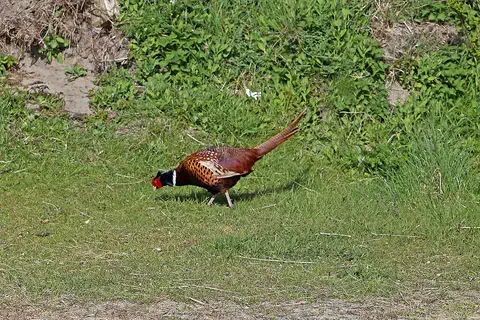
The common pheasant is a long-tailed ground bird. Its wild home is Asia, from the Caspian Sea to China and Korea, but people have taken it to Europe, North America, New Zealand and other places. Males are bright and coppery with a red face; females are mottled brown.
-
 Watch
Animal
Adélie penguin
The Adélie penguin is a medium-sized penguin, about 70 centimeters tall, with a black back, a white front and a bright white ring around each eye. It breeds in summer on rocky, ice-free ground all around Antarctica, building nests of pebbles, and spends the winter far out at sea among the pack ice.
-
 Watch
Animal
African fish eagle
The African fish eagle is a big eagle of Africa's lakes, rivers and coasts, with a white head, chest and tail and a chestnut-brown body. It snatches fish from the surface of the water, and its loud, ringing call is one of the best-known sounds of Africa.
For parents & teachers
What children will learn
- Use the correct names peacock, peahen and peachick, and describe how males and females look different.
- Explain what a peacock's train is and how peahens choose mates.
- Describe the peafowl's daily routine and how peahens raise their chicks.
- Compare the conservation status of the Indian and green peafowl.
Recommended ages: 3 to 17 · About 15 minutes
Talk about it
- Why might a peahen be brown while the peacock is so colorful?
- A long train makes a peacock easier for predators to catch. Why might peacocks still have them?
- Why might sleeping in tall trees help peafowl stay safe?
Try at home or in class
- Make a paper fan and draw eyespots on it, then count them. Try making it symmetrical, the way peahens seem to prefer.
- Measure 2 meters on the floor to see how wide a peacock's display fan is.
Key vocabulary: peacock, peahen, train, eyespot, lek, sexual selection
Where these facts come from
- The IUCN Red List of Threatened Species , International Union for Conservation of Nature (IUCN terms of use (no redistribution of Red List data or range maps))
- GBIF Backbone Taxonomy and GBIF Occurrence Search , Global Biodiversity Information Facility (CC0 1.0 (backbone); occurrence counts are facts derived from records under CC0, CC BY and CC BY-NC)
- Wikidata , Wikimedia Foundation (CC0 1.0)
- Pavo cristatus (Indian Peafowl), Red List global assessment 2025 , IUCN Red List of Threatened Species
- Peafowl , San Diego Zoo Wildlife Alliance
- Pavo cristatus (Indian peafowl) , Animal Diversity Web, University of Michigan Museum of Zoology
- Wikimedia Commons , Wikimedia Foundation (Per file: Public domain, CC0, CC BY or CC BY-SA only (credited on each page))
Checked, not yet human-reviewed. Last updated October 28, 2026. Spotted a mistake? Tell us.